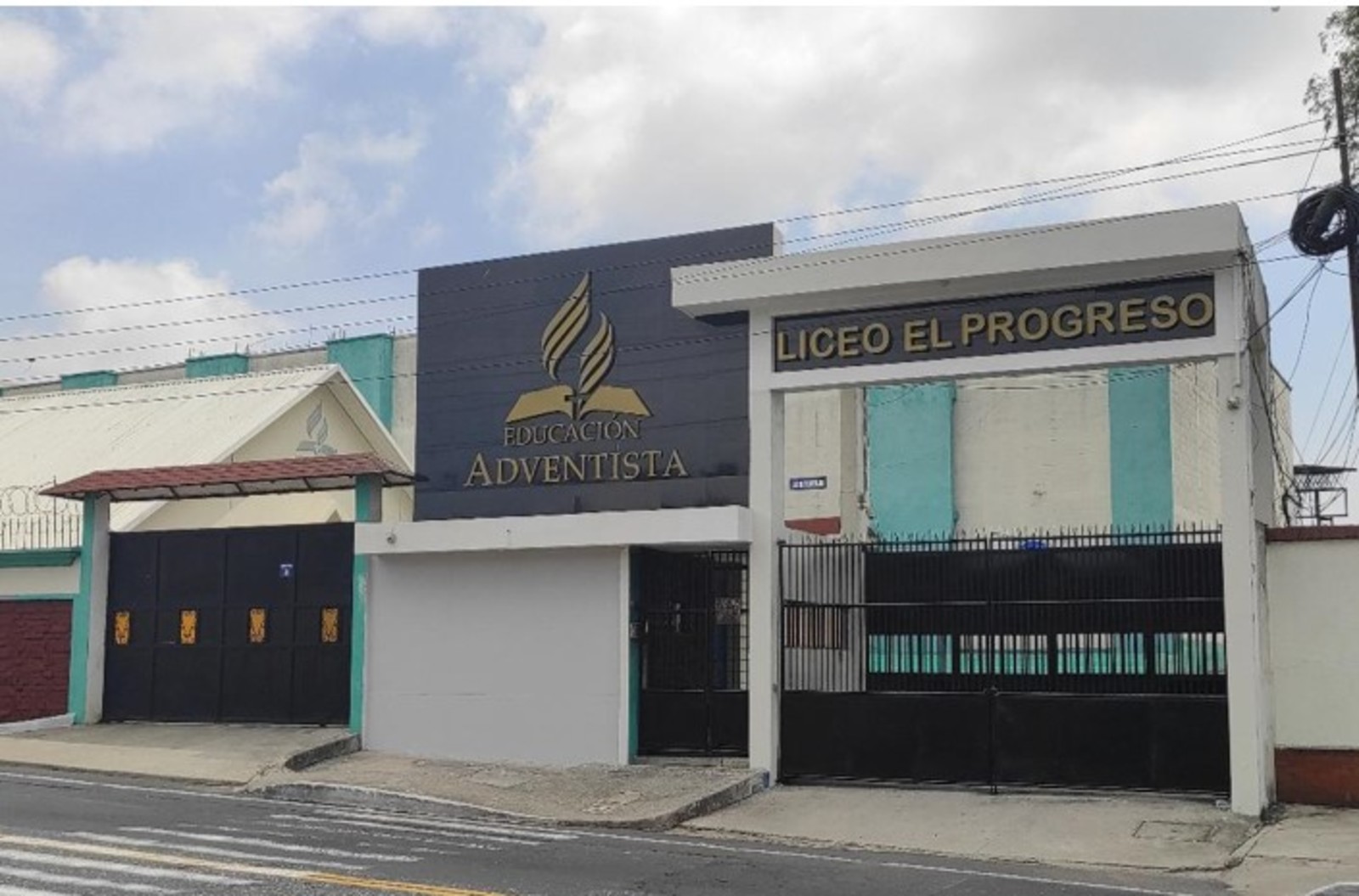
Liceo Adventista El Progreso
From the school's archives.
Liceo Adventista El Progreso
By Miriam Elizabeth Mayén
Miriam Elizabeth Mayen completed a teaching certificate from the Universidad Adventista de Centroamérica and served as an elementary and secondary teacher in the Adventist educational system in Guatemala from 1973 to 2015. After this, she served as technical administrative director.
First Published: June 17, 2024
The origins of the Adventist school in Guatemala, Liceo Adventista El Progreso, date to 1908. Today, the school continues to serve hundreds of children and youth in Guatemala.
Early Developments
In 1886, the General Conference voted to send Pastor T. H. Gibbs to visit Central America to continue the work that begun in 1885 by Sister Elizabeth Gauterau.1 Pastor Gibbs visited Central America in 1887. From Puerto Barrios Izabal, Guatemala, the Adventist message spread throughout the Guatemalan territory. In 1908, the Seventh-day Adventist Church was recognized in the territory of Guatemala as a part of Central American Conference.2
Origins of the Institution
The origins of Liceo Adventista El Progreso date to 1908, when Pastor E. L. Cardey considered the possibility of purchasing an English-language school to make the Adventist message better known.3 The institution had a good chance of success because education in the English language was seen as of utmost importance in the country at the time. The school became known as Guatemala English School. The school’s opening encouraged the small group of Adventist believers of that time and contributed to the expansion of the Adventist message in Guatemala.
In 1909, W. E. Hancock reported that the school was still operating, and it was hoped that the missionary efforts, although few, would give good results.4 He also reported that the teachers enjoyed their work. The school provided the possibility to make friends and acquaintances and, thus, make the Adventist message known, especially in the upper ranks of society. Over time, it became necessary to, with great effort, move to a new building and buy desks, blackboards, and other equipment.5
In 1911, under the direction of Pastors James Bodley and W. F. Hardt, Guatemala English School stopped receiving subsidies and became a self-supporting institution. The school was strategically located in the center of the city where business and cultural events took place. Pastor E. L. Cardey was the principal and Bible teacher, and with seven additional teachers, this group formed the first Adventist school in Guatemala. It was established as a mission school, subsidized by West Indian Conference with headquarters in Colón in the Panama Canal zone.
In 1914, the General Conference Committee analyzed the situation of Guatemala English School and decided that a new director would have to be appointed if the school was to continue operations. It was therefore “VOTED, That we ask the West Indian Union to look into the matter of the policy and practicability of conducting English school work in Guatemala, it being understood that Elder Haysmer will be able to visit the field the firat [sic] of July.”6
The earthquake of 1918 damaged the buildings of Guatemala English School, necessitating a move to the Adventist church building on 2ª Avenida 10-44 in Zone 1 of Guatemala City. Around this time, the Guatemalan Ministry of Education requested that the school teach in Spanish. This is the origin for “Colegio Mixto El Progreso.”7
Establishment of the Institution in the Current Location
In 1971, a large piece of land was acquired on 2ª calle 35-44 in zone 7 of Guatemala City to establish the school in its own permanent and definitive location.8 In 1972, the construction of the first five modules and the gymnasium began. The gymnasium was named the “Gimnasio William Hopkins” in honor of the North American missionary who worked on the plumbing and the electrical system.
In 1973, the government of Guatemala acquired a large property and made plans to build a highway named the “Anillo Periférico,” which would go through the property of Colegio Mixto El Progreso. The local government gave the school a deadline of the end of the school year to vacate the property. Thus, on October 23, 1973, Colegio Mixto El Progreso moved to the building it currently occupies, which was still under construction at the time.9
The 1974 school year faced a challenging beginning, as only windows and doors were in place and the floor was just being installed. However, God sustained the school through the years, and each director gave their best efforts to the institution’s development and growth.
In 1976, under the direction of Pastor Robert Eubanks, the infrastructure was greatly upgraded. At that time, the current administration building, second-floor classrooms, and building for preschool classrooms were built.10 Over the years, the school’s image and finances improved along with the continued construction of classrooms and other parts of the infrastructure.
Between 1980 and 1995, the staff and students of Colegio Mixto El Progreso were favored thanks to the implementation of charitable programs such as awarding study scholarships for low-income families with school-age children. At the same time, Adventist-faith-based radio programs such as “Quiet Hour” began to air in the community.11
By this time, several generations of bilingual secretaries graduated with high moral values and strong reputations that were well recognized by the community. In 1995, under the leadership of Pastor Elden Cruz, the northern-wing classrooms and bathrooms were built. The objective was to move the primary levels to that space, considering that the existing classrooms were insufficient. The preschool education building’s terrace was also built during this time.12
Institution’s Role in the Community
The school maintains good relations with the authorities of the Ministry of Education of Guatemala. The school’s auditorium is used as a venue for the Ministry of Education to hold its training sessions, workshops, and competitions. In 1987, the “Universidad de San Carlos de Guatemala” used the school’s facilities on Sundays as their campus extension to train secondary school teachers in pedagogy and educational sciences. This extension favored Adventist teachers, who integrated faith into the subjects being taught.
The institution has distinguished itself by periodically carrying out community spiritual, social, and economic service activities. Students and faculty participate in social activities that benefit the community in nursing homes, orphanages, hospitals, and rehabilitation homes. They also participate in the ADRA annual collection project.
Current Status of the Institution
In 2013, it became necessary to register the school with the Ministry of Education of Guatemala under a new name. Therefore, the school’s name was changed from “Colegio Adventista El Progreso” to “Liceo Adventista El Progreso” as stated in resolution number DDEGO A.C. 165-2013-A.F. Before the name change, only courses in computing with a scientific emphasis were offered. The name change allowed the school to request permission from the government to provide courses in graphic design and accounting along with a bilingual secretary course (Spanish/English) with an emphasis in computers.13
In the past few years, the school has focused on the development of its students’ skills and talents and has created many different areas of study such as music, culinary arts, crafts, vegetable gardening, arts, lectures, sports, children’s clubs, and the playing of the marimba. These courses are optional for students and are scheduled so that all students can take advantage of enrolling in the ones they are interested in taking.
To strengthen the music curriculum, the school administration participated in a government convocation called ADESCA (Aporte para la Descentralización Cultural), which developed projects to strengthen Guatemala’s education and culture. After a year and a half of prayer and government meetings, the school completed all prerequisites for teaching how to play the marimba. Thus, on May 15, 2018, the “Armonías Chapinas,” an on-campus marimba school, was created. This marimba school is mainly for the children and the youth of Liceo Adventista El Progreso and for those of the community of zone 7 of Guatemala City. Through this school, students have been taught to play folkloric and Christian melodies on the famously known Guatemalan marimba.
To develop musical talent, beginning in January 2021, the “Academia Virtual de Música” started to hold courses in the afternoon. Likewise, social media is used to host spiritual online programs and activities to reach greater populations.14
Liceo Adventista El Progreso has received two accreditations from the Adventist Accrediting Association up to the present time. The first accreditation occurred on October 24, 2013, and the second accreditation was conducted on November 6, 2018. Liceo Adventista El Progreso continues to serve hundreds of Guatemalan children and youth.
List of Directors
Colegio Guatemala English School (1908-1920): E. L. Cardey (1908-1920)
Colegio Mixto El Progreso (1920-2007): Edler Haysmer (?); James Bodley (?); W.F. Hardt (?); Dorcas Pacheco Ruiz (1937); Alma Samayoa de Gordillo (1940); Eliseo Escalante (1956); R. Moisés Tahay (1960); Julio Cesar Chinchilla (1965); Cesar Augusto Santos Herrera (1968-1969); Héctor Hernández (1970); Marta Argueta Marín (1971-1975); Roberto Eubanks (1976-1977); Félix Fernández (1978); Esther Alcántara de Barrios (1979-1982); Dagoberto Barrios (1983); Esther Alcántara de Barrios (1984); Lilian Thomas Reyes (1985-1987); Norfa Arely Castañaza de Díaz (1988-1990); David Thomas Reyes (1991-1995); Elden Cruz (1996); José Francisco Altamirano (1997-1999); Esdras Hernández (2000-2001); Gustavo Menéndez (2002-2003); Vitti Pivaral de Ramos (2004-2007)
Colegio Adventista El Progreso (2008-2013): René Francisco Pérez López (2008); Eliseo Albanés Hernández (2009-2010); Denis Odeeth López de Natereno (2010-2011); Ixel De La Cruz Araúz de Leonardo (2012-2013)
Liceo Adventista El Progreso (2013- ): Ixel De La Cruz Araúz de Leonardo (2013- )
Sources
“Central American Conference.” Seventh-day Adventist Yearbook. Washington, D.C.: Review & Herald Publishing Association, 1909. Accessed April 25, 2024. https://documents.adventistarchives.org/Yearbooks/YB1909.pdf.
“Central and South American Missions.” Seventh-day Adventist Yearbook. Battle Creek, Michigan: Review & Herald Publishing House, 1888. Accessed April 25, 2024. https://documents.adventistarchives.org/Yearbooks/YB1888.pdf.
“English School – Guatemala.” General Conference Committee 73rd Meeting. May 26, 1914. General Conference archives, Silver Spring, Maryland, U.S.A. Accessed August 12, 2021. https://documents.adventistarchives.org/Minutes/GCC/GCC1914.pdf.
“Fechas Importantes.” Historia de la Iglesia: Guatemala. Accessed August 12, 2021. https://unadeca.net/cwhite/guatemala/.
G., F. “A New School.” ARH, August 6, 1908.
Hancock, W. E. “Facts Which Appeal.” ARH, February 24, 1910.
Hancock, W. E. “Guatemala English School.” ARH, August 19, 1909.
Notes
-
“Central and South American Missions,” Seventh-day Adventist Yearbook (Battle Creek, Michigan: Review & Herald Publishing House, 1888), 134, 135, accessed April 25, 2024, https://documents.adventistarchives.org/Yearbooks/YB1888.pdf.↩
-
“Central American Conference,” Seventh-day Adventist Yearbook (Washington, D.C.: Review & Herald Publishing Association, 1909), 130, accessed April 25, 2024, https://documents.adventistarchives.org/Yearbooks/YB1909.pdf.↩
-
F. G., “A New School,” ARH, August 6, 1908, 29.↩
-
W. E. Hancock, “Guatemala English School,” ARH, August 19, 1909, 19.↩
-
W. E. Hancock, “Facts Which Appeal,” ARH, February 24, 1910, 19.↩
-
“English School – Guatemala,” General Conference Committee 73rd Meeting, May 26, 1914, 160, General Conference Archives, accessed August 12, 2021, https://documents.adventistarchives.org/Minutes/GCC/GCC1914.pdf.↩
-
“Fechas Importantes,” Historia de la Iglesia: Guatemala, accessed August 12, 2021, https://unadeca.net/cwhite/guatemala/.↩
-
Emma García, interview by author, Guatemala City, July 7, 2021.↩
-
Beatriz Morales, interview by author, Guatemala City, July 7, 2021.↩
-
Emma García, interview by author, Guatemala City, July 7, 2021.↩
-
Zoila Muy de Cruz, interview by author, El Salvador, July 13, 2021.↩
-
Ibid.↩
-
Ixel de Leonardo, interview by author, Guatemala City, July 1, 2021.↩
-
Ibid.↩