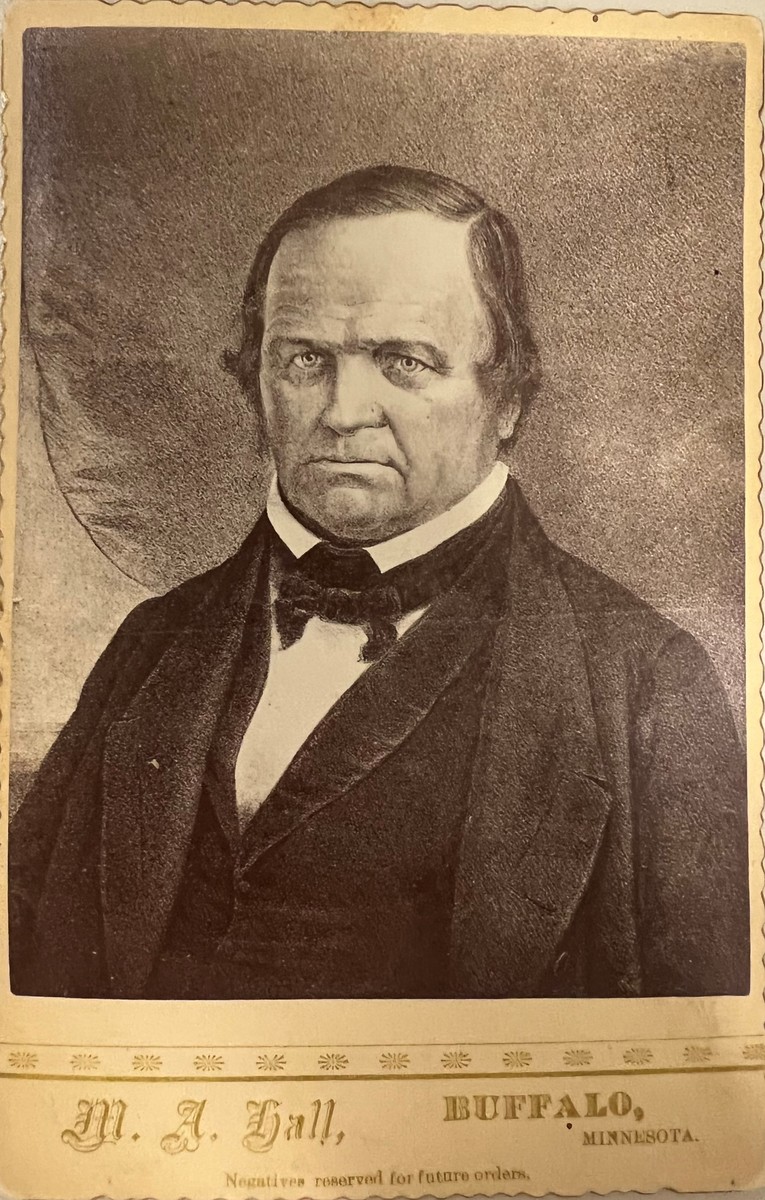
William Miller
From Jenks Collection, Aurora. Photo courtesy of Michael W. Campbell.
Millerite Movement (c. 1820s and 1840s)
By Michael W. Campbell
Michael W. Campbell, Ph.D., is North American Division Archives, Statistics, and Research director. Previously, he was professor of church history and systematic theology at Southwestern Adventist University. An ordained minister, he pastored in Colorado and Kansas. He is assistant editor of The Ellen G. White Encyclopedia (Review and Herald, 2013) and currently is co-editor of the forthcoming Oxford Handbook of Seventh-day Adventism. He also taught at the Adventist International Institute for Advanced Studies (2013-18) and recently wrote the Pocket Dictionary for Understanding Adventism (Pacific Press, 2020).
First Published: May 14, 2026
The Millerite movement was a religious revival largely centered in North America. The primary catalyst of the Millerite movement was William Miller (1782-1849), who proclaimed the premillennial Second Advent of Jesus Christ “about the year 1843.” Historians categorize him as “the most famous millenarian in American history.”1 The late 18th and early 19th centuries witnessed a significant number of expositors writing about Bible prophecy.2 Miller became one of most successful revivalists of the final phase of Second Great Awakening, with revivalism a defining characteristic of American Protestantism, as a particularly intense manifestation between the American Revolution and the American Civil War.3 When Christ did not return, the movement became a “crucible of dashed hopes.”4
Scope
Millennialism or millenarianism refers to beliefs about the future of the earth and its inhabitants. At least three major kinds have existed: premillennialism, amillennialism, and postmillennialism.5 Each interprets Revelation 19-21, describing the Second Advent of Christ connected to a millennium of peace on earth and final judgment. While these different interpretations have existed throughout history, and in particular, in American history, postmillennialism was the dominant perspective in the eighteenth and early nineteenth centuries.6 With the founding of the United States, along with westward expansion, there was a hopeful exuberance that a new and dawning age was on the horizon.
William Miller and the Millerite movement would challenge this interpretative dominance asserting a premillennial return of Christ—that various reforms would help them prepare for a new and better promised land. The Millerite movement or revival spread across the United States and Canada, with its primary concentration extending from Ohio to the east, and Maryland to the north, up through New England and what is today Ontario and Quebec. The movement also spread across the American South but was often inhibited in these regions by the affiliation of many Second Advent preachers with abolitionism.7
The movement benefited from an international network of students of Bible prophecy around the world. William Miller employed a “historicist” framework, interpreting Bible prophecy to point to Christ’s literal return before the millennium.8 American and Canadian expositors worked diligently to translate and ship literature around the world, and in turn, corresponded with global counterparts, especially in Europe. The North American manifestation had a significant amount of diversity. The term “Millerite,” initially a derogatory term in reference to Miller, was a name that stuck among its adherents who often referred to themselves as simply believing in the soon return of Christ, either as “Adventists” or adhering to the “Advent” or “Second Advent” doctrine in the broadest sense of the term. Miller himself was reluctant to specify a precise date, generally referring to “about the year 1843.” Some Millerites rejected all date setting, while others offered a range of dates that generally concentrated between 1843 to 1847.9 Initially the movement focused on Christ’s return between March 21, 1843, and March 21, 1844. This latter date became known as the Spring Disappointment but since there was some fluidity of opinion, the movement stayed largely intact.
Beginnings and Expansion
William Miller experienced a heartfelt conversion in 1816 after which he began to intensely scrutinize the Bible. He employed a Scottish Common-Sense Realism and Baconian deduction to compare biblical passages with one another utilizing Cruden’s Concordance. He furthermore applied, as he studied the prophecies of Daniel and Revelation, the year-day method equating a day in Bible prophecy to a literal year. He deduced from the 2,300 days of Daniel 8:14 that this period began with Artaxerxes’s decree in 457 B.C. to go forth and rebuild Jerusalem. He interpreted the “cleansing of the sanctuary” as referring to the purification of the earth by fire when Jesus Christ returned the second time. By 1818, after more than two years of intense study, he concluded that Christ would return in about 25 years.
Miller was an enthusiastic Bible student who was energetic, thorough, and methodical.10 He was driven by a strong conviction in his interpretation of Bible prophecy that God was behind his mission to the world. In 1831 he was “tricked” into making “a solemn covenant with God” to publicly share his faith that Christ would return in “1843, or 1847 at most” if God opened the way.11 He soon received an invitation and despite initial reluctance soon received additional invitations. On September 14, 1833, his local Baptist congregation issued him a license to preach. By the end of 1834 he was traveling full-time, leaving his farm in the care of his son. He lived from his savings and an annuity from his farm. He reported that he never received enough to cover his travel expenses, although his critics opined that he was exploiting the vulnerable.
Miller gained significant traction through print. On May 15, 1832, Miller published the first of a series of sixteen numbers published under his initials. The articles were thereafter printed in pamphlet form (1833, 1835). By 1836, he expanded his views as an enlarged edition titled Evidence from Scripture, which became a significant milestone for the expanding movement.12 His most significant convert, Joshua V. Himes (1805-1895), helped transform Millerism from a limited regional revival into a much broader religious awakening. Himes was one of the most effective promoters in antebellum America. Historian Nathan Hatch described Himes’ publishing efforts as “an unprecedented media blitz” and “an unprecedented communications crusade.”13 He harnessed cutting-edge communication technologies helping to raise the profile of Miller in the large cities across America. While he didn’t originate these tactics, he was an intense person who built Second Advent lending libraries, sent bundles of literature to post offices and on ships, developed stamps and stationery, as well as new periodicals. By May 1844, Himes claimed that they had circulated five million pieces of literature, enough for nearly one in every four persons in the United States at that time.14 Luther Boutelle (1806-1898) later reflected on their Millerite experience that these various “Advent papers” were “scattered broadcast and everywhere, like autumn leaves in the forest.”15
The world of Miller was furthermore filled with uncertainty. The 1837 Panic made Americans “unusually pessimistic.”16 Earlier “signs” such as the devastating 1755 Lisbon earthquake, the May 19, 1780 “Dark Day,” and the November 12-13, 1833, “falling of the stars,” were interpreted as a “striking and impressive fulfillment” of biblical prophecy, especially Matthew 24:29. Many Millerites also noted dramatic displays of the Aurora Borealis as additional evidence, and the Great Comet of February 1843 was seen as a portent of the Second Advent. Harriet Livermore’s (1788-1868) jeremiads terrified audiences with predictions of “great heats,” “great frosts,” “sore famines,” and “wars—pestilences—noisome beasts—awful delusions! And horrid desolations” that heralded the end of the world.17
Demographics and Growth
The contemporary Charles Lyell (1797-1875) estimated the number of Millerites to be between 60,000 and 120,000 adherents.18 Later estimates would enlarge this number to half a million or more believers. Most twentieth century historians have accepted much more conservative estimates of approximately 50,000 individuals right before the anticipated eschaton on October 22, 1844.19 Historian Gary Land (1944-2014), suggested that earlier estimates may have actually been too low.20 While such numbers are difficult to definitively estimate, a reasonable estimate suggests that the movement may have had a couple hundred thousand believers at its peak.
Scholars of Adventism have struggled to identify the socio-economic demographics of Millerites.21 David L. Rowe observed that “Millerites are not fascinating because they were so different from everyone else but because they were so like their neighbors.”22 Although typical of American Christianity, the movement was also “eclectic and diverse” showcasing how leaders came from “all classes . . . all sects, nations, and tongues.”23 Lists of Millerite believers in periodicals suggest that they came from a wide range of socio-economic backgrounds, perhaps even slightly above average in terms of wealth usually measured in land holding. Millerites therefore represented a cross-section of North American society. A breakdown of 174 Millerite preachers by Everett Dick provides some indication of religious affiliation amongst the different denominations: Methodism (44%), Baptist (27%), Congregational (9%), Christian Connection (18%), and Presbyterian (7%).24 Kevin M. Burton, studying approximately 1,800 Millerite believers, identified 35.3% as Baptist; 32.6% as Methodist; 15.3% as Restorationist; and 12.7% as Presbyterian or Congregationalist; and 4% for various others including Dutch Reformed, Quakers, etc.25 Millerites worked diligently to distinguish themselves from other religious groups, most notably the Church of Jesus Christ (Mormons) even though there were a few Mormons who converted to Adventism. In order to avoid any confusion, Joshua V. Himes issued a tract to “fully expose the iniquity of this [Mormon] delusion.”26
Although the movement was initiated by Miller, other Millerite ministers soon swelled the ranks of the growing revival. Himes estimated that in January 1842 there were from 300 to 400 Second Advent ministers. The Christian Herald six months later estimated there were 700, and at the height of the movement (Spring 1844) the Midnight Cry reported some 1,500 to 2,000 “lecturers [who] are in the field proclaiming ‘The Kingdom of Heaven is at hand.’” Some preached it part time, while others shared the message full time.27 Another gauge of influence was the print runs of Millerite papers. It was in 1822 that the first steam-powered cylinder press began operation in the United States. In the 1830s, daily newspapers became popular. In 1833 the largest newspaper print run in the country was the New York Courier and Enquirer’s with a print run of 4,500. In the 1830s and 1840s the number and circulation of newspapers expanded rapidly. Himes’s aggressive plan to promulgate Second Advent papers grew from 800 printed copies in March 1840, to 1,500 by the end of the year. By January 15, 1842, Himes claimed to have five thousand subscribers and fifty thousand readers.28 Himes harnessed the power of the press so that quickly there were millions of pieces of literature. This was “at the height of a revolution in printing in the United States that began in 1790 and saw an explosion of newspaper, periodical, and magazine literature, as well as more widely produced and cheaper books devoured by the white middle and upper classes.”29 In fact, one writer in 1823 opined that “the groaning press throws [religious newspapers] out in almost every direction.”30
Another measure of influence is their ability to spread their message outside of North America. While Millerites corresponded with European counterparts, and at various times, sent and received representatives to and from Europe, for the most part the largest amount of their influence was through sending literature on ships. One notable visit was when Joseph Wolff made a trip to the United States, ostensibly in search of the lost tribe of Israel. Still, his millenarian views, were noted widely in newspapers and American editions of his books circulated. Millerites believed that even though the world was about to end, that a notable sign of the end was the worldwide Protestant missionary program, translation of the Bible, and therefore such efforts were indeed vital to Christianity. Millerites did their best to resource missionaries in the farthest ports of the world by shipping literature to them.31
Social Reformers
For a movement that believed that the world was about to end, ironically, they spent a great deal of energy focused on reforming this earth. If they believed they were truly headed to a better land, then they should start living like it here on earth. Thus, Millerites were part of a flurry of reform activities. David M. Ludlum has observed how the Millerite flurry “represented the summation of all the reforms of the age.”32 Whitney R. Cross describes the concept of an immediate judgment as “the shortest possible cut to millennial perfection, the boldest panacea of the era.”33 This egalitarian vision led them to include women and Black participants and together strive against the evils of alcohol and slavery.
William Miller became introduced to such reform efforts through his friend Henry Jones (1804-1880), who was an ardent abolitionist and temperance advocate. Jones was so zealous in his temperance views, along with other abolitionists, he was banned from churches. Henry Dana Ward (1797-1884) was an ardent New York City abolitionist, but he was also a temperance organizer who developed his advocacy as part of the anti-Masonic movement of the 1820s. Elon Galusha (1790-1856), the son of the governor of Vermont, led a county anti-slavery society and an 1841 national convention that voted against slaveholding churches. Nathaniel Stoddard (1792-1878) was deeply involved in temperance, abolition, and education and served as acting editor of the Emancipator, a leading anti-slavery periodical. George Storrs (1796-1879) preached his abolitionist activism not only to anti-slavery groups but sought to convert those who were less than enthusiastic about such reforms. Joseph Bates (1792-1872) was an already well-known abolitionist, which got him in trouble in slave territory on the eastern shore of Maryland.34
The egalitarian ethos allowed for a variety of Black Millerite preachers to share their faith. This included William Foy (1818-1893), who shared his visions about the earth made new, John W. Lewis, who was a writer and minister who published a Millerite newspaper titled Morning Star, and William Watkins, Jr., a prominent abolitionist and educator who embraced the Second Advent message in Baltimore.35 Even Sojourner Truth (1797-1883) was influenced by the emerging Millerite movement.36 Similarly, women rose to prominence using the rationale that since it was women who proclaimed the news about Christ’s resurrection, it should be women at the vanguard of proclaiming the news about His soon return. Olive Maria Rice, Lucy Maria Hersey, Sarah J. Paine Higgins, Eliza Barnes, Emily C. Clemons Pearson (1818-1900), and Clorinda S. Minor (1806-1855) were noted communicators, often known for their speaking as well as writing abilities. The synergy surrounding these women led to the publication of the serial, The Advent Message to the Daughters of Zion, first released in May 1844.
Coming Out of Babylon
As Millerites gave the message of “ALARM” Himes argued that their opponents were unable to show better or more abundant fruits through spiritual revival. The prophetic times, he believed, were clearer and more certain than ever. With their opponents, notably Dowling, Stuart, and others unable to refute them, their opposition resorted to increasingly “obscene and blasphemous” means to discredit them. Himes described shocking caricature prints, ascension robes, and the suggestion that Millerism “makes people crazy” as attempts to bring their cause into contempt. Even the suggestion that Adventism made people mad due to fear of the end, he believed, was an untruth because Adventism instilled love for Christ, instead of fear of the end. He believed their critics did far more to cause insanity by the “terror” they preached that did far more to drive people into madness. All of these attempts were evidences of lack of good argumentation and Scriptural reasons to answer them.37 As the time drew nearer, Millerites adopted the stance shared by other “come outers,” especially among the abolitionists, who found themselves being jettisoned from their denominations. This led Charles Fitch to call for Adventists to come out of Babylon.38
Spirituality
As the embers of the Second Great Awakening faded, Millerite preachers “proved remarkably effective at stirring revival embers into flame.”39 At the heart of Miller’s message was an appeal to personal conversion. As the movement climaxed around 1843 to 1844, the deep spirituality and heart-searching was evident in their writings:
It produced everywhere the most deep searching of heart and humiliation of soul before the God of high heaven. It caused a weaning of affections from the things of this world, a healing of the controversies and animosities, a confession of wrongs, a breaking down before God, and penitent, broken-hearted supplications to Him for pardon of soul, such as we never before witnessed. As God, by Joel, commanded, when the great day of God should be at hand, it produced a rending of hearts and not of garments, and a turning unto the Lord with fasting, and weeping, and mourning.40
This spirituality of the Millerites could be witnessed in two distinct ways: the development of camp meetings and a vibrant hymnody at such and related gatherings. Milton L. Perry notes that among Millerites, the already popular camp meeting format was adopted as one of its tools for evangelism. It led to (a) thousands of conversions, (b) as separatism increased, it provided a center for nurture within the movement, and (c) provided a forum for studying “new truth” and clarifying other beliefs such as believer’s baptism and conditional immortality (both becoming standard beliefs among later Adventist groups). As they appropriated this format from others, notably the Methodists, they recast the format of services to avoid the ecstatic emotionalism associated with Methodist camp meetings.41 Some 125 camp meetings were held between 1842 to 1844.42 The first was held in Hatley, Quebec, on June 21, 1842, with the second one held at East Kingston, New Hampshire. The events reportedly drew crowds of seven to ten thousand people.43
Millerites had a vibrant hymnody that reflected their faith. “It is a fact that there was in those [Millerite] days,” recalled James White, “a power in what was called Advent singing, such as was felt in no other.”44 The first hymns appeared in the June 15, 1841, issue of Signs of the Times and Expositor of Prophecy. Six weeks later they advertised a small volume titled Songs of Zion. By the time it was published the name was changed to Millennial Musings with 121 hymns on 144 pages without any music. The July 27, 1842, Signs of the Times announced a new hymnal available in two parts bound together: the Millennial Harp, or Second Advent Hymns; designed for Meetings on the Second Coming of Christ (72 pages) with the second part being a reprint of Millennial Musings. The combined hymnal (1842) featured predominantly on the Second Coming of Christ with 169 songs. The first part featured music with words, while the second part had words only. The same year they produced a small disposable Second Advent Hymns: Designed to Be Used in Prayer and Camp-Meetings, which was only three by four inches, and contained 19 hymns. Again it had no music and was used in the Millerite Great Tent and other Second Advent camp meetings. In 1843 there was an “improved edition” of the Millennial Harp, with editions continuing to remain in print even after the Great Disappointment. Hymns and hymnals were a ubiquitous feature of Millerite spirituality. It was not unusual to close a Second Advent camp meeting gathered in a large circle while singing Second Advent hymns. The clasp of the hands submerged “sectarian prejudices” as they rallied around their common belief in Christ’s soon return.45
Another way Adventists shared their faith was through mass-produced religious images depicting their faith that echoed Joachim of Fiore’s Liber Figurarum.46 Prophetic charts were mass produced, sold and distributed as inexpensive commodities—as aids for traveling ministers, pasted into books, and as small group study guides. Although prophetic visual depictions were nothing new to Christianity, now they were presented to a wide popular audience, especially through the new medium of lithography. This created highly didactic images of biblical symbols from Daniel and Revelation. Probably the most striking was the “1843 prophetic” chart designed by Charles Fitch and Apollos Hale. It “plainly” depicted their understanding of Bible prophecy, and in turn, they believed the chart itself fulfilled the statement made in Habakkuk 2:2: “Write the vision, and make it plain upon tables.” This explosion of new technology was therefore simultaneously fulfilling and the fulfillment of Bible prophecy as they warned the world of an impending eschaton.47 As America experienced modernizing forces—especially democratization and market revolution—these provided an opportunity to invest these secular changes with positive religious meaning, and even traditional eschatological symbols (i.e. the millennium, Second Coming, and Last Judgment) “would advance in harmony.”48
Climax
As the anticipated eschaton drew near, pressure increased to specify a more exact date. In January 1843, after studying the Jewish calendar, Miller announced Jesus would return between March 21, 1843, and March 21, 1844. Increased opposition toward Second Advent believers led to calls to “Come out of Babylon” as taught by Charles Fitch in a July 1843 sermon. In the spring of 1844 Miller announced he had erred in his calculation. During the summer of 1844 Samuel S. Snow advocated the “seventh month” teaching that Christ would return on the tenth day of the seventh month, the Jewish Day of Atonement, which according to the Kairite Jews would take place that year on October 22. During the summer of 1844 momentum grew around the “Seventh Month” movement. They believed that the cleansing work of Christ (Daniel 8:14) on the Day of Atonement would lead to the purification of this earth by fire. This date became the best-known of the movement and described as the Day of Anticipation. Ultimately, it was Miller’s adherence to Christ’s impending return before the millennium that gained momentum and peaked around 1843 through 1844, and even Miller acquiesced to the October 22 date in late September or early October. Date setting was not an end all in the movement, even as the October 22, 1844, became the most well-known and prominent within the movement.
When Christ did not appear on October 22, the next day Millerites were bitterly disappointed. Most abandoned their hopes. A few faithful adherents clung to belief in the biblical chronology and that Christ’s return was only slightly delayed, through human error, so that this was a time of patience and waiting for the Bridegroom to return. In April 1845, the largest group of Adventists met in Albany, New York, to consolidate. Miller refused to set any more dates and died on December 20, 1849 and is buried near his home in Low Hampton, New York.
Response
One reported response was that community leaders, or “select men,” would harvest the crops at public expense and charge the owners after October 23 for the expense.49 In some places Sir Charles Lyell was shown the homes of some Adventists whose “owners . . . had been reduced from ease to poverty by their credulity, having sold their all.”50 Such religious convictions could earn, for some, the shame of being tar and feathered.51 Others simply described Millerites as “monsters.”52
Sir Charles Lyell attributed the Millerite phenomena to poor education in the United States. It “reflects much discredit on the educational and religious training in New England.”53 Not only was it an indictment on the poor quality of education, but specifically, demonstrated how even if “they who have gone through school and college, and have been for years in the habit of listening to preachers . . . proves that . . . their reasoning powers have not been cultivated, their understandings have not been enlarged, they have not been trained in habits of judging and thinking for themselves; in fact, they are ill educated.”54 At the very least, in the broader culture, over time Millerism would be equated with religious fanaticism.55 Perhaps G. W. Henry appears to have typified the perspective of many average Americans during the 1840s: “At the time when Millerism, as it was called, was all the rage, I neither believed nor disbelieved Mr. Miller’s theory, nor troubled myself much about it.”56
Two common tropes persisted during and after the Millerite movement of the 1840s: the idea that Millerism drove some people to insanity, and secondly, that at least some Millerites wore ascension robes. Millerite leaders worked diligently to combat such aspersions. Millerites requested testimonials, such as from a Dr. Crary who ran an insane asylum, that he did not know of any cases of insanity “caused by the doctrine of the second coming of Christ.”57 Similarly, Millerite editors rebuked publishers who promulgated such “ridicule” by insinuating that they wore “ascension robes” as early as the spring of 1843. They found it “hardly worth publishing” a response to such lies.58 Others later dismissed these ad hominin attacks as a “tissue of falsehoods.”59
Reception and Historiography
Other significant collections of Millerite writings and ephemera exist as part of the Advent Source Collection at the Center for Adventist Research at Andrews University, the American Antiquarian Society, the Loma Linda University Archives & Special Collections, Harvard University, Maine Historical Society, and the New York City Public Library.
Some of the earliest historiography of the movement was largely apologetic since it was produced by the descendants of the various Adventist denominations. Ellen G. White included several chapters about Miller in her magnum opus, The Great Controversy. She described Miller as one whom God used to raise up the Second Advent movement in preparation for Christ’s soon return. The Advent Christian denomination similarly published important historical treatments that preserved and retold the story of Miller and his followers.
More critical assessments arose in the early twentieth century. Most important was Clara Endicott Sears’ (1863-1960) Days of Delusions (1924) which placed the movement as aberrant. The pioneering social psychologist, Leon Festinger (1919-1989), used Millerism as a historical case study to support his groundbreaking theory of cognitive dissonance, which he formalized in When Prophecy Fails (1956), highlighting what happens when people refuse to admit defeat.60 Wider sociological treatments contextualized the Millerite revival against the backdrop of the Second Great Awakening, as revivalists “burnt out” the territory in places such as western New York.61 Adventist leader and editor, F. D. Nichol, published the first peer-reviewed academic article dispelling false narratives that Millerites wore ascension robes.62 He would go on to write the first comprehensive historical monograph within Adventism titled The Midnight Cry.63 Probably one of the most significant turning points in Adventist Studies was several academic initiatives in the 1970s and early 1980s. A series of academic lectures held in 1972-1973 at the Loma Linda University Church resulted in the edited volume, The Rise of Adventism.64 Then in 1984 a conference on “Millerism and the Millenarian Mind in 19th-Century America,” held in Vermont resulted in The Disappointed: Millerism and Millenarianism in the Nineteenth Century.65 George R. Knight provided a broad synthesis of scholarship in his Millennial Fever (1993, revised 2010). David L. Rowe has provided the most thorough biographical treatment of Miller so far. Various dissertations have explored topics ranging from the contributions of Himes to camp meetings and more. Andrews University Press has done a service by reprinting Everett N. Dick’s 1930 dissertation William Miller and the Advent Crisis (1994) as well as reprinting key source documents, Memoirs of William Miller (1853, 2005) and Isaac C. Wellcome’s (1874, 2009) History of the Second Advent Message. An updated bibliography of primary and secondary sources was released by the General Conference Archives in 2025.66 Most Millerite primary sources are now available through the Adventist Digital Library, with additional sources available through a variety of other digital repositories.
Overall, recent historical treatments have sought to contextualize Miller and the Millerite movement within its broad social and intellectual context. Paul Boyer describes the significance of the Millerite movement “as the definitive example of the perils of date setting.”67 At the same time it also “heralded the full democratization of prophetic belief.”68 Matthew Avery Sutton has noted how Premillennialism “was a conviction and an ideology.”69 Such historical research emphasizes the role of the everyday believer and how Adventist views shaped their lived experience. A new generation of Adventist historians has furthermore found new inspiration in the activist roots of Millerite Adventism, noting significant contributions by early believers in the abolitionist and temperance movements, among other social reforms, as an inspiration for Adventism today.70
Selected Sources
Arthur, David T. “Come Out of Babylon: The Development of Millerite Separatism and Denominationalism, 1840-1865,” Ph.D. dissertation, University of Rochester, 1970.
Arthur, David T. “Joshua V. Himes and the Cause of Adventism.” M.A. thesis, University of Chicago, 1961.
Bliss, Sylvester, and Apollos Hale. Memoirs of William Miller, Generally Known as a Lecturer on the Prophecies, and the Second Coming of Christ. Boston: J. V. Himes, 1853.
Burton, Kevin M. Apocalyptic Abolitionism: How Millennialists Helped Abolish Slavery and Reform America. New York: New York University Press, 2026.
Campbell, Michael W. and Edward Allen, A Global History of Seventh-day Adventism. Grand Rapids, MI: William B. Eerdmans, 2026.
Campbell, Michael W. William Miller, Millerite, and Adventist Imprints (1820-1850) with a Global Survey of Second Advent Materials: Including Select Secondary Sources in English. General Conference Archives Research Aids. Silver Spring, MD: General Conference Archives, 2025.
Crocombe, Jeff. “’A Feast of Reason’: The Roots of William Miller’s Biblical Interpretation and Its Influence on the Seventh-day Adventist Church.” Ph.D. diss., University of Queensland, 2011.
Dick, Everett N. William Miller and the Advent Crisis. ed. by Gary Land. Berrien Springs, MI: Andrews University Press, 1994.
Himes, Joshua V., ed. Views of the Prophecies and Prophetic Chronology, Selected from Manuscripts of William Miller; with a Memoir of His Life; by Joshua V. Himes. Boston: Moses A. Dow, 1841.
Himes, Joshua V. ed. Views of the Prophecies and Prophetic Chronology, Selected from Manuscripts of William Miller with a Memoir of His Life; by Joshua V. Himes. Boston: Joshua V. Himes, 1842.
Lyell, Sir Charles. A Second Visit to North America, 3rd ed., 2 vols. London: John Murray, 1855.
Lynskey, Dorian. Everything Must Go: The Stories We Tell About the End of the World. New York: Pantheon Books, 2024.
Knight, George R. William Miller and the Rise of Adventism. Nampa, ID: Pacific Press, 2011.
Nichol, Francis D. “The Growth of the Millerite Legend.” Church History 21, no. 4 (Dec. 1952): 296-313.
Nichol, Francis D. The Midnight Cry: A Defense of the Character and Conduct of William Miller and the Millerites, Who Mistakenly Believed that the Second Coming of Christ Would Take Place in the Year 1844. Washington, D.C.: Review and Herald, 1944.
Numbers, Ronald L. and Jonathan M. Butler, eds. The Disappointed: Millerism and Millenarianism in the Nineteenth Century. Bloomington, IN: Indiana University Press, 1987.
O’Leary, Stephen D. Arguing the Apocalypse: A Theory of Millennial Rhetoric. New York: Oxford University Press, 1994.
Rowe, David L. God’s Strange Work: William Miller and the End of the World. Grand Rapids, MI: William B. Eerdmans, 2008.
Rowe, David L. Thunder and Trumpets: Millerites and Dissenting Religion in Upstate New York, 1800-1850. Atlanta, GA: American Academy of Religion, 1985.
Sutton, Matthew Avery. American Apocalypse: A History of Modern Evangelicalism. Cambridge, MA: Cambridge University Press, 2014.
Notes
-
Ernest R. Sandeen, The Roots of Fundamentalism: British and American Millenarianism, 1800-1930 (Chicago, IL: University of Chicago Press, 1970), 50. Cited by George R. Knight, William Miller and the Rise of Adventism (Boise, ID: Pacific Press, 2010), 7.↩
-
For a survey, see LeRoy Edwin Froom, The Prophetic Faith of our Fathers: The Historical Development of Prophetic Interpretation, vol. IV (Washington, D.C.: Review and Herald, 1954).↩
-
Matthew Avery Sutton, “Redefining the History and Historiography on American Evangelicalism in the Era of the Religious Right,” Journal of the American Academy of Religion 92, no. 1 (March 2024): 37-60.↩
-
For background, see George R. Knight, William Miller and the Rise of Adventism (Nampa, ID: Pacific Press, 2011). Quote taken from the back cover.↩
-
For a survey of the history of prophetic interpretation, see LeRoy Edwin Froom, Prophetic Faith of Our Fathers (Washington, D.C.: Review and Herald, 1946-1954).↩
-
For a helpful overview, see Kevin M. Burton, “Millenarianism,” in American Religious History: Belief and Society Through Time, ed. Gary Scott Smith (Santa Barbara, CA: ABC-CLIO, 2021), 2:197-199.↩
-
For an overview of the Millerite spread across the American South see Robert W. Olson, “Southern Baptists’ Reactions to Millerism,” (Ph.D. diss., Southern Baptist Theological Seminary, 1972).↩
-
Matthew Avery Sutton, American Apocalypse: A History of Evangelicalism (Cambridge, MA: Cambridge University Press, 2014), 17.↩
-
One of Miller’s earliest statements about timing appears in a document dated February 15, 1831, in which he points to the termination of these prophecies as occurring sometime between 1843 to 1847. See “A Few Evidences of the Time of the 2nd Coming of Christ to Elder Andrews by Wm. Miller,” Jenks Collection, Box 1, Folder 1.↩
-
Knight, William Miller and the Rise of Adventism, 29.↩
-
For context and sources see David L. Rowe, God’s Strange Work, 72-83.↩
-
Knight, William Miller and the Rise of Adventism, 50.↩
-
Nathan O. Hatch, The Democratization of American Christianity (New Haven, CT: Yale University Press, 1989), 142, 145.↩
-
Knight, William Miller and the Rise of Adventism, 69.↩
-
Luther Boutelle, Sketch of the Life and Religious Experience of Eld. Luther Boutelle (Boston: Advent Christian Publication Society, 1891), 65.↩
-
Dorian Lynskey, Everything Must Go: The Storeis We Tell About the End of the World (New York: Pantheon Books, 2024), 32.↩
-
Quoted in John Howard Smith, A Dream of the Judgment Day: American Millennialism and Apocalypticism, 1620-1890 (New York: Oxford University Press, 2021), 228.↩
-
Sir Charles Lyell, A Second Visit, 90.↩
-
Cf. Jerome L. Clark, "Roots in a Worldwide Movement," ARH, September 15, 1983, 3-5.↩
-
Gary Land, ed. Adventism in America: A History, rev. ed. (Berrien Springs, MI: Andrews University Press, 1998), 27.↩
-
Ibid.↩
-
Paul Boyer, When Time Shall Be No More: Prophecy Belief in Modern American Culture (Cambridge, MA: Harvard University Press, 1992), 82.↩
-
J. V. Himes, “The Advent Cause,” Signs of the Times, October 18, 1843, 68.↩
-
Gary Land, ed. Adventism in America: A History, rev. ed. (Berrien Springs, MI: Andrews University Press, 1998), 27.↩
-
Kevin M. Burton, Apocalyptic Abolitionism: How Millennialists Helped Abolish Slavery and Reform America (New York: New York University Press, 2026), 35.↩
-
Cf. “Mormonism,” The Signs of the Times, and Expositor of Prophecy, April 13, 1842, 13.↩
-
Knight, William Miller and the Rise of Adventism, 95.↩
-
Cf. Knight, William Miller and the Rise of Adventism, 64-65.↩
-
John Howard Smith, A Dream of the Judgment Day: American Millennialism and Apocalypticism, 1620-1890 (New York: Oxford University Press, 2021), 227.↩
-
Quoted in Ibid.↩
-
See report of sending literature to the missions at Calcutta, Madras, Bombay, Ceylon, Burmah, Siam, Oreo-miah, Persia, Jerusalem, Sandwich Islands, and Oregon. Signs of the Times of the Second Coming of Christ, February 15, 1841, 173.↩
-
David M. Ludlum, Social Ferment in Vermont, 1791-1850, Columbia Studies in American Culture (New York: Oxford University Press, 1939), 250-260.↩
-
Whitney R. Cross, The Burned-Over District: The Social and Intellectual History of Enthusiastic Religion in Western New York, 1800-1850 (New York: Harper & Row, 1950), 317.↩
-
Charles Teel, Jr., “The Millerite Experience: Shared Symbols Informing Timely Riddles?” Adventist Heritage 16, no. 3 (Spring 1995): 4-8.↩
-
Benjamin Baker, “’The Year of Jubilee is Come,’: Black Millerites and the Politis of Christian Apocalypticism,” Church History 92, no. 1 (March 2023): 68-98.↩
-
Ibid.↩
-
Joshua V. Himes, “Letter to Charles Fitch,” Signs of the Times, April 19, 1843, 52, 53.↩
-
C. Fitch, “What Is It for God’s People to Come Out of Babylon,” The Signs of the Times, and Expositor of Prophecy, September 13, 1843, 27.↩
-
Paul Boyer, When Time Shall Be No More: Prophecy Belief in Modern American Culture (Cambridge, MA: Harvard University Press, 1992), 83.↩
-
From The Advent Shield, quoted in LS 104.↩
-
Milton L. Perry, "The Role of the Camp Meeting in Millerite Revivalism, 1842-1844," Ph.D. Dissertation, Baylor University, 1994.↩
-
Jerome L. Clark, "Roots in a Worldwide Movement," ARH, September 15, 1983, 3-5.↩
-
Ibid.↩
-
James White, Life Incidents.↩
-
See James R. Nix, Early Advent Singing: A Collection of 52 Early Adventist Hymns with Illustrating Stories (Hagerstown, MD: Review and Herald, 2000), 11-14.↩
-
David Morgan, Protestants and Pictures: Religion, Visual Culture, and the Age of American Mass Production (New York: Oxford University Press, 1999), 34-39.↩
-
Susan L. Palmer, “Unraveling Adventist Prophecy: The History and Meaning of the Millerite Charts,” Lectured Presented to Schingoethe Museum Gallery, November 8, 2012, https://aurora.edu/documents/jenks/unraveling-adventist-prophecy-palmer.pdf.↩
-
James H. Moorhead, World Without End: Mainstream American Protestant Visions of the Last Things, 1880-1925 (Bloomington: Indiana University Press, 1999), 18.↩
-
Sir Charles Lyell, A Second Visit, 87.↩
-
Ibid., 89.↩
-
Cf. “Letter from Cleveland,” The Midnight Cry! November 21, 1844, 168.↩
-
Gary Land, ed. Adventism in America: A History, rev. ed. (Berrien Springs, MI: Andrews University Press, 1998), 10.↩
-
Sir Charles Lyell, A Second Visit, 90.↩
-
Ibid., 92.↩
-
As a useful example, see Mrs. E. O. Gardner, “A Millerite Reminiscence,” The Ladies’ Repository: A Monthly Periodical 1854, 172-173.↩
-
G. W. Henry, Trials and Triumphs (for Half a Century) in the Life of G. W. Henry, as Experienced While Sojourning Forty Years in Egypt, One Year in the Slough of Despond, Three Years in Twilight, and Six Years in the Land of Beulah, = 2nd ed. (New York: The Author, 1853), 202.↩
-
“Retreat for the Insane,” The Signs of the Times, and Expositor of Prophecy, March 15, 1843, 11.↩
-
“Rebuke,” The Signs of the Times, and Expositor of Prophecy, March 8, 1843, 4.↩
-
Gary Land, ed. Adventism in America: A History, rev. ed. (Berrien Springs, MI: Andrews University Press, 1998), 17. For wider context, see Ronald L. Numbers and Janet S. Numbers, “Millerism and Madness: A Study of ‘Religious Insanity’ in Nineteenth-Century America,” in The Disappointed: Millerism and Millenarianism in the Nineteenth Century, eds. Ronald L. Numbers and Jonathan M. Butler (Knoxville, TN: The University of Tennessee Press, 1993), 92-118.↩
-
Lynskey, Everything Must Go, 32.↩
-
For context, see Whitney R. Cross, The Burned-Over District: The Social and Intellectual History of Enthusiastic Religion in Western New York, 1800-1850 (New York: Harper & Row, 1950).↩
-
Francis D. Nichol, “The Growth of the Millerite Legend,” Church History 21, no. 4 (Dec. 1952): 296-313.↩
-
Francis D. Nichol, The Midnight Cry: A Defense of the Character and Conduct of William Miller and the Millerites, Who Mistakenly Believed that the Second Coming of Christ Would Take Place in the Year 1844. Washington, DC: Review and Herald, 1944.↩
-
Edwin Scott Gaustad, ed. The Rise of Adventism: A Commentary on the Social and Religious Ferment of Mid-Nineteenth Century America (New York: Harper & Row, 1974).↩
-
Ronald L. Numbers and Jonathan M. Butler, eds. The Disappointed: Millerism and Millenarianism in the Nineteenth Century (Knoxville, TN: The University of Tennessee Press, 1993).↩
-
Michael W. Campbell, William Miller, Millerite, and Adventist Imprints (1820-1850) with a Global Survey of Second Advent Materials: Including Select Secondary Sources in English. General Conference Archives Research Aids. Silver Spring, MD: General Conference Archives, 2025.↩
-
Paul Boyer, When Time Shall Be No More: Prophecy Belief in Modern American Culture (Cambridge, MA: Harvard University Press, 1992), 82.↩
-
Ibid., 83.↩
-
Sutton, American Apocalypse, 26.↩
-
E.g. https://events.lluh.org/events/adventism-and-political-activism-symposium-history-adventist-social-and-political-engagement-04-12-2025↩