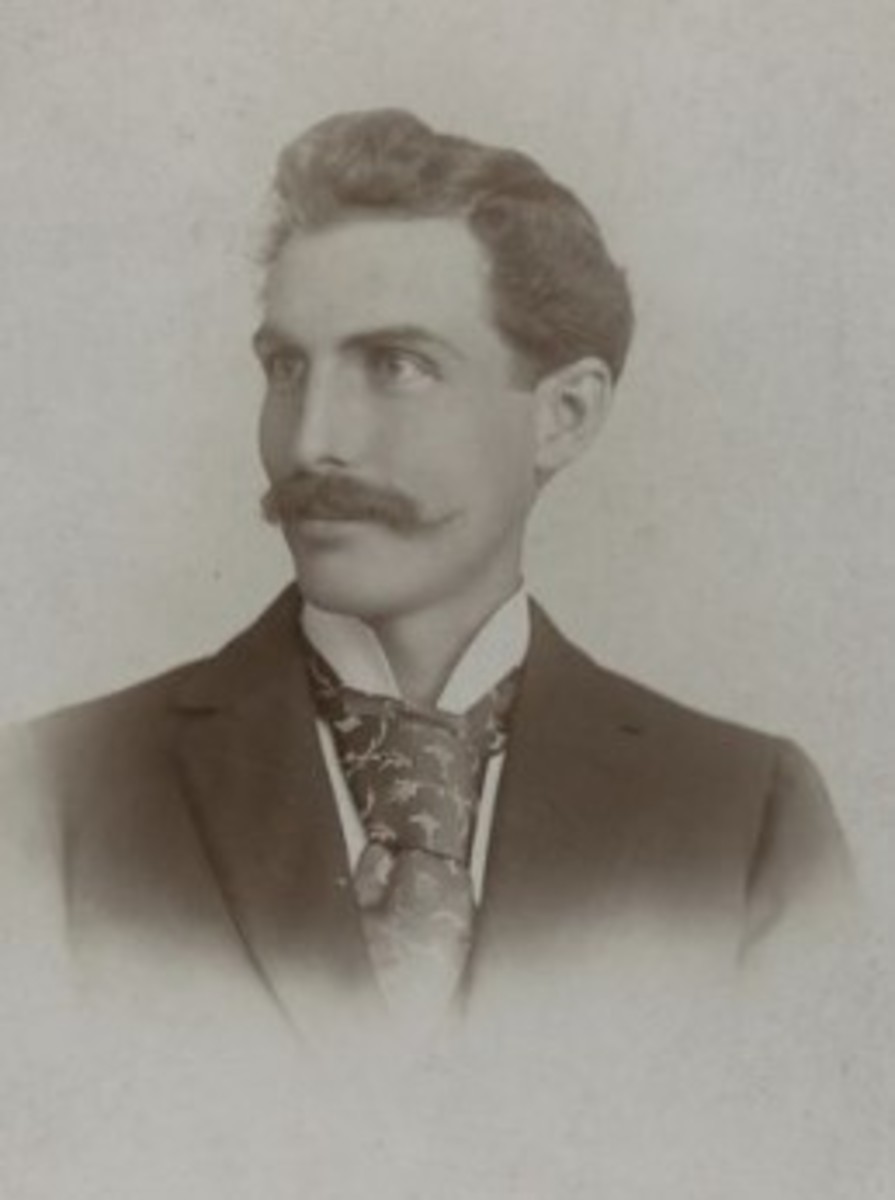
Warren E. Howell.
Photo courtesy of Adventist Digital Library.
Howell, Warren Eugene (1869–1943)
By Michael W. Campbell
Michael W. Campbell, Ph.D., is North American Division Archives, Statistics, and Research director. Previously, he was professor of church history and systematic theology at Southwestern Adventist University. An ordained minister, he pastored in Colorado and Kansas. He is assistant editor of The Ellen G. White Encyclopedia (Review and Herald, 2013) and currently is co-editor of the forthcoming Oxford Handbook of Seventh-day Adventism. He also taught at the Adventist International Institute for Advanced Studies (2013-18) and recently wrote the Pocket Dictionary for Understanding Adventism (Pacific Press, 2020).
First Published: January 9, 2023
Warren Eugene Howell was an educator, missionary, author, editor, academic, and administrator. He was one of the most influential Adventists in the early twentieth century who worked to expand Adventist education and missions.
Background and Education
Warren was born June 25, 1869, to Samuel C. (1827-1875) and Virginia Josephine née Andre (1841-1925) Howell in Scioto, Ohio.1 He grew up on a farm raised by his mother, “a soldier’s widow.”2 At the age of six, his mother took him to public school, and as he grew older would ride on horseback the three-mile journey. Four years later, in the same school, “she took me to see the prophetic and commandment charts, and hear the wonderful truth told by Elders E. H. Gates, D. M. Canright, and H. A. St. John, who stayed at our house much of the time.”3 Warren later stated that he was initially converted through the efforts of a farm neighbor, after which he read a tract and, at the age of 10, decided to become Adventist through the preaching of E. H. Gates (October 1879). Initially, he made his stand for his faith on his own, but soon his mother joined him in his newfound faith four years later.4 Warren was baptized in 1884 by O. F. Guilford in Columbus, Ohio. Here he began ministry as a colporteur and Bible worker under the direction of J. E. Swift.
Early on Gates planted the seed for him to attend Battle Creek College. It took a decade before his dream was realized when in September 1888 he began the literary course. He received his Bachelor of Arts degree in 1894. While attending Battle Creek College he met Lena E. née Kilgore (1871-1894), the daughter of Adventist minister Robert M. Kilgore. The couple wedded on Sept. 4, 1893, in Rhea, Tennessee. Warren, while attending school, served in several capacities, including halftime as bookkeeper of Battle Creek College; stenographer to the secretary of the Foreign Mission Board (six months); stenographer to the secretary of the General Conference (1891-93); assistant secretary in the International Religious Liberty Association and International Tract Society (1894).5 Tragically, it was this same year that Lena died on Aug. 30, 1894, in Battle Creek, Michigan.6
Early Missionary and Administrative Work (1894-1912)
After graduation Warren taught at Healdsburg College (1894-1897). In 1896 he remarried Hattie Bushnell Kinner (1876-1925), also a graduate from Battle Creek College and who was involved in the first Adventist College Mission Band.7 In 1897 They were called to the Hawaii Mission, with Warren serving as principal of the Chinese Mission School in Honolulu. Here their only child, Felicie Waldo Howell was born Sept. 8, 1897. By the second week of school, in 1900, Howell reported that they had 86 students.8
Howell returned to teach at a summer institute, the first ever classes held at the newly relocated Emmanuel Missionary College (today Andrews University), after the purchase of a farm in Berrien Springs, Michigan. The students during the summer of 1901 were part of a radical new endeavor to reform Adventist education spearheaded by E. A. Sutherland and Percy T. Magan. With their strong emphasis on agriculture and nature, coupled with simple Bible teaching, contrasted with the much earlier form of “classical” education as taught formerly at Battle Creek College. Sutherland and Magan recruited Howell to return to the new college to assist them with this new reform program. After getting new teachers to replace him settled and their belongings packed up, he returned to Emmanuel Missionary College where he taught the next two school years.
Howell returned to Healdsburg College, where he served once again as a teacher, and then as president (1904-1906).9 Howell was literally shaken while in San Francisco 1906 Earthquake, barely escaping with his life. Despite losing some plaster and collapsed chimneys, Healdsburg College didn’t even miss a day of school. Students and faculty slept outside, some for the next three weeks. That school year Howell fought off rumors that the school would close due to financial depression and lack of confidence. This contributed to a small attendance that year, and the day before the earthquake, the California Conference Committee voted not to sell the property but to downgrade the school to an intermediate school and release the faculty.10
During the summer of 1906 Howell again participated in another educational institute, this time in College View, Nebraska, from June 29 to July 6. This meeting was headlined by W. W. Prescott, C. C. Lewis, Marion E. Cady, and A. G. Daniells who pushed for a strong connection between the theoretical and practical, and how Adventist schools were needed to prepare committed workers for outreach. They noted the work of the Student Volunteer movement by Dwight L. Moody: “Their watchword was, The Evangelization of the World in this Generation. Ours is, The Third Angel’s Message to the World in this Generation. Make the educational work an integral part of this great [evangelistic] movement.”11 This conference resulted in a strong shift connecting Adventist colleges as institutions for preparing missionaries. In addition, the delegates voted that the General Conference provide sufficient funding so that the secretary of the education department could devote their energies full time to the work of Adventist education.12 Somewhat less known, but equally important, was that this conference resulted in Sarah Peck producing the first official Church School Manual that helped to standardize Adventist education.13 Similarly, a whole series of readers and textbooks, produced by Pacific Press formed a new Adventist elementary curriculum.14
Subsequently Howell “accepted an invitation to conduct educational work at the Loma Linda Sanitarium.”15 He would become the founding educational leader (as well as president of the board of trustees) of a newly organized “advanced training-school for workers”16 that would become known as the College of Evangelists17, in Loma Linda California, making him in effect the founding “principal” or “president” of what today is Loma Linda University. The announcement added that “the purpose [is] to make this institution an educational center for the training of gospel medical missionaries.”18 The strong connection between education and missions meant that Howell was willing to lead by example. An announcement on March 28, 1907, heralded that Howell had “recently resigned to accept a call to a foreign field.”19 In actuality, Howell received a call to mission service just after accepting the call to Loma Linda, and after their previous five years as missionaries in Hawaii, hoped for another call for mission service. In order to avoid “embarrassment” at this “critical juncture” they stayed long enough to make sure their “separation” would not in any way hurt this new institution. He afterward reflected that during their short stay, their time there was “some of the best and sweetest experiences in more than a decade of service” in ministry “were enjoyed at Loma Linda.”20
In late April 1907, Warren and Hattie, with their daughter, Felicie, and Hattie’s mother, Sophia B. Kinner (1849-1941) left as pioneer missionaries to Greece.21 They attended annual council in Gland, Switzerland, a major center of Adventism in Europe where an Adventist sanitarium was located, at which council they were encouraged to begin their work in Athens.22 After a collective journey of nine days at sea, and thirteen on land, they arrived. “Our first impressions of the people are favorable,” he wrote. “We have now settled in Kephisia (Kee-fee-see’ah), a village of thirteen hundred and sixty inhabitants, about eight miles from the center of Athens.”23
The Howells were the second wave of missionaries attempting to establish a missionary presence in Macedonia. In 1909 Warren reported how he received a letter from a family who had accepted the seventh-day Sabbath in nearby Albania. Their interest in the truth began nine years before when they received a tract, “Bible Facts on the Sabbath Question” by Baharian, from a reluctant colporteur for the British Foreign Bible Society who picked it up while in Constantinople.24 After two years, he finally accepted the seventh-day Sabbath. Four years later, his wife joined him, and then after three more years, they made contact with the Howells. Warren traveled to see them, resulting in the first converts in that country.25Howell translated the very first Adventist tract into modern Greek, “The Way to Christ,” along with Ellen White’s book, Steps to Christ.26
Howell then returned permanently, arriving in time to attend the 1909 General Conference session (May 13-June 6). Ill health was cited as the reason why he returned after two years of mission service. The previous Annual Council had voted to have Howell take the principalship of the Fireside Correspondence School, and to assist Frederick Griggs as an assistant editor of Christian Education.27This new correspondence school, conceptualized by Griggs, would take root under the capable leadership of Warren.28
The first Seventh-day Adventist correspondence school opened under Warren's direction on October 4, 1909. Howell made a special appeal for ministers to join in distance education. “That all young and middle-aged ministers, licentiates, and Bible students who find it impossible to call a halt in their present work, to go to school,” he invited, “may have an opportunity to gain this happy experience, the subject of New Testament Greek is offered by the Correspondence School.”29 Learning biblical languages, he further advised, could benefit by helping to understand difficult biblical passages. All Adventist pastors were strongly encouraged to learn biblical languages, and now, thanks to correspondence classes, it was possible for all pastors, young and old, to avail themselves of this opportunity. As an example, he wrote an article about “Baptism in the Greek” that showcased how in Matthew 3:16 and other texts an understanding of biblical languages strengthened the traditional Adventist understanding of baptism by immersion.30 Howell would be a tireless advocate of pastors learning biblical languages. In fact, he would showcase the importance of biblical languages in a book, Gospel Key Words, “in order to help workers to a more perfect understanding of what the Scriptures actually say.”31
Developing an Educational System (1912-1918)
In addition to Warren’s responsibilities with the Fireside Correspondence School, at the 1913 General Conference Session, he was asked to serve under H. R. Salisbury as the assistant secretary of the educational department for the North American Division (Salisbury accepted a post of mission service to India and was replaced in his role by J. L. Shaw).32 His role at the Fireside Correspondence School was taken over by Prof. C. C. Lewis, although he continued to devote his time to editing Christian Education, carrying on a column about education in the Review and Herald, along with other administrative aspects of his new role.33 Lewis, for his part, expressed appreciation for the well-honed organization along with quality lessons that were developed under Warren’s leadership. He added that the school, now making a profit, would give all proceeds to the General Conference Mission Fund.34
The rapid growth of Adventist schools during the early twentieth century meant that there was a severe shortage of educators. Consequently, Howell’s early administration's major focus was recruiting and training teachers. “The great cry everywhere,” he observed, “is for more and better-trained teachers.”35 Howell also noted that only 243 students were enrolled in Adventist colleges the previous school year, and that 80 percent of school age children were not in Adventist schools. In addition to the spiritual benefits, Howell suggested, students who attend Adventist schools tend to rise in their “social class.”36
One of Howell’s first tasks was to participate in educational councils at various unions, beginning first with the Central and North Union Conferences, followed by the Lake Union.37At these meetings, comprised of educational superintendents at the conference and union levels, new pedagogical policies were considered and adopted. In churches where there was an academy (school), the school was to be run under the supervision of the conference educational department. Second, the conference educational superintendent should be a school board member. Then third, each school should send to parents or guardians a monthly grade report.38 While these may seem obvious, in the development of an Adventist educational system these were vital organizational developments that changed Adventist education from a series of independent schools into an educational system working harmoniously together under the supervision of competent educators.
In 1913 the General Conference voted for the first time a “definite standard” for “entering the ministry as licensed preachers.” This included participation in a new course of readings. Howell coordinated this new task and noted that during 1914, the very first year, 98 individuals completed the “Ministerial Reading Course.”39 Soon Frederick Griggs and W. E. Howell were making regular rounds holding educational councils. In 1915, for example, there was a General educational and Missionary Volunteer council (June 4-14), followed by similar regional meetings in the Pacific Union (June 18-26), North Pacific Union (June 29-July 6), North Central and Southwestern Unions (July 9-17), Lake Union (July 19-26), Columbia and Atlantic Unions (July 29-Aug. 4) and Southern and Southeastern Unions (Aug. 6-14). At these meetings, Howell was listed as speaking about “Standardization of our academies,” indicating his continued thrust to professionalize Adventist education into a standardized system.40 At these educational meetings, Howell held a memorable “consecration service” to conclude the meetings.41
Adventist education was expanding rapidly during the 1910s. By the end of 1916, Howell reported that there were some 32,000 students at all grade levels, including 10,000 students in mission schools around the world.42A special point of pride was the new College of Medical Evangelists, which he had helped found, with an enrollment of over 100 students. Howell viewed Adventist education as a vital part of Adventist evangelism, and furthermore believed that it helped to reduce the number of young people who drift away and ultimately “offset largely the increase of converts to the faith.”43 Furthermore, as leaders wore themselves out or “dropped out of the race,” new and young recruits were needed to take their place.44 For Howell, Adventist education was vital to the mission and expansion of a global church. Howell frequently reported about the growth and expansion of Adventist missions around the world. One creative outreach that Warren developed was a regular “Educational Sabbath” to feature and promote Adventist education. The very first such event occurred on April 7, 1917.45He was also a strong advocate for faculty at Adventist colleges, strongly affirming schools that held regular faculty meetings.46 Also, as the war grew more intense, Howell joined the voices of others in urging American Adventists to remain patriotic by promoting school attendance, especially within parochial schools.47
As the war drew to a close Adventist enrollment in schools held strong.48 Howell had a special interest in the growing Oakwood Junior College, noting that enrollment could be greater if only they had larger facilities, along with helping them to raise more funds. “No institution and no people among us,” he noted, “have been made the object of more earnest and sympathetic appeal by our lamented Sister White than the interests represented in Oakwood Junior College.”49
On the World Stage (1918-1919)
At the 1918 General Conference Session Warren was elected as secretary of the General Conference Educational Department.50The newly elected Howell expressed, based on the most accurate research he could obtain, that at that point, he believed that the number of Adventist young people attending Adventist schools had increased to about 50 percent.51 This was not good enough for Warren, who launched a slogan that would characterize his leadership over the next decade: “Every Seventh-day Adventist boy and girl in our own schools; Every student in our schools a worker.”52 With his new role, Warren also served on several other important church committees. Of particular note was being a member of the War Service Commission.53 With the possibility of a draft, Howell urged young men, “GO TO SCHOOL THIS YEAR.”54 Warren tied his view of education closely to his eschatology. “I have always thought that we are losing a great deal with so many of our young people not in our schools,” opined Warren, “and I believe the way to finish the work is to train all our young people for the work.”55 Adventist education increased retention and facilitated new workers for evangelism.
Also, at the same 1918 General Conference session, it was voted for W. E. Howell to be ordained.56 This expanding recognition of his ministry was recognized the following month (June) when Warren was ordained at the Takoma Park Church with A. G. Daniells and W. T. Knox officiating.
As the war came to an end, and as the 1918 Influenza pandemic began, Warren advocated that it was vital that Adventist schools have an annual health inspection of all boys and girls in all grades. Each student had to have a health examination that helped to watch for students with hearing or sight impairment, along with a notation if students were vaccinated or inoculated for typhoid.57
Warren also developed the first system of Adventist accreditation. The newly voted General Conference educational standards needed to be met, along with new health guidelines. Warren believed it was necessary to personally inspect, bringing regional and local leaders with him, to conduct “a general inspection of the buildings and grounds in reference to sanitation, good order, and equipment.” Such inspections are always most valuable in-person. “I never feel that I have seen a school till I see it in action.”58They would then call “a meeting of the entire faculty, and went over together all our General Conference standards . . . in detail. Opportunity was given for questions, and free discussion of all points, so that all might understand fully the meaning and application of these standards.” The visiting committee would make an “inspection committee’s report” to be “reviewed by the educational department of the union, and by the faculty of the college to which the school is to be accredited, then finally reviewed by the General Department of Education and returned to the college faculty for the issuance of the certificate of registry.”59 Schools could receive either a “full” or “on condition” accreditation based upon this site visit.60 Warren furthermore noted that these plans for a system of accreditation had been first adopted by the 1915 Educational Council, even though church leaders “have been a little slow in putting these plans into operation.” The benefit of accreditation is that duly accredited schools could offer their own examinations and the right to admit students without examination. Schools that did not successfully meet these requirements were subject to using standardized examinations provided by the General Conference Education Department.61
Warren’s star continued to rise. In 1919 he was nominated to the General Conference Publishing Committee.62 At the end of the 1918-19 school year he would be granted an honorary Master of Arts degree by Emmanuel Missionary College.63 That summer he would participate in two far-reaching pedagogical conferences.
1919 Educational Councils
The summer of 1919 would witness two significant educational conferences. The first would be held from April 16-21 with college presidents.64 Warren appealed in the midst of the terrible influenza pandemic, that they were in the midst of a far worse spiritual epidemic. Adventist education was an imperative necessity for the mission of the church.65 “The issues of the war and the epidemic,” he urged, “have pressed to the front both the excellencies and the shortcomings of our educational endeavor.”66Adventist schools were urged to strengthen the missionary volunteer work. In addition, a standardized curriculum was voted for all Adventist academies and colleges. Specifically, the Adventist college curriculum would be made up of 128 total semester hours.67
In the second meeting, the 1919 Bible Conference, 28 of the 65 participants were part of a Bible and History Teachers’ Conference. These educators began to meet during the first three weeks of the Bible Conference (July 1-19), and continued afterward for an additional three weeks (until Aug. 9). Howell testified: “An excellent spirit of unity and fellowship prevails in all our studies and committee work.”68 The meetings furthermore contributed to a sense of the “deep conviction of the sacredness of their work” as teachers along with their “divine call to teach.”69 He added that the teachers expressed deep appreciation for their time spent together.
While not stated in his public report, it was Howell who, at the urging of these same Bible and history teachers, requested A. G. Daniells to come back and talk about how to properly understand and interpret Ellen White’s writings. This two-day “round table” discussion is recognized as a pivotal moment in the development of Adventist theology, one of the most candid discussions about the authority and interpretation of Ellen White’s writings after her death in 1915. Howell had a unique background as a missionary and a student of biblical languages, yet he tended to take an approach to Ellen White’s writings that utilized them as a “companion piece” through which to interpret the Bible.70 Daniells and other educators were quite candid in explaining the problematic aspects of some members pushing for an inerrant and infallible approach to Ellen White’s writings. In fact, at a point, they urged for more materials to be produced and for a committee to be established to look at educating the church at large. There is no evidence that Howell, who would have had primary responsibility to follow up on these suggestions, did anything to follow up.
Howell saw these meetings in 1919 as a key part of the role of the General Conference Education Department, which would hold a major conference for educators each year in a specific subject area. The first one, focused on the “normal department” or teaching, was held in 1917. Nothing was held in 1918 due to the war. And now, following the war, he was able to get key educational administrators to gather together to agree on a general curriculum, and then gather the Bible and history teachers to flesh out the details of how these courses should be taught—which was for him the main focus of the second conference for Bible and history teachers.71
After the conference was over, Warren was proud that the teachers produced “a distinct syllabus for each subject.”72 He added that these syllabi were being printed and would soon be available for teachers. Adventist colleges were growing, a problem that would force new discussions to separate colleges from academies. By 1920 there were 1,860 students in the five senior colleges, of which approximately half (about 900) were actual college students.73 Another notable shift, was that Howell began a five-year program beginning in 1915 that through sacrifice and pledges made it possible to wipe out most of the debt that plagued Adventist schools. Emmanuel Missionary College, for example, had a celebration when they finally finished “a successful campaign by students, teachers, and conference administrators” to publicly burn $40,000 worth of cancelled notes.74
Global Travels and Fundamentalism (1920-1921)
During the 1920s Howell would make several important international trips. The first was a trip to South America that began on January 4, 1920. The group would attend meetings in Brazil and Argentina, and included a memorable trip with Fernando Stahl to visit the rapidly expanding work around Lake Titicaca. They returned to New York City on July 14, 1920.
Then on April 6, 1921, Howell sailed for Europe. Stops included the Stanborough Park Missionary College, with meetings with the faculty about the purpose of Adventist education. He then traveled to Switzerland, Sweden, Norway, and Denmark, inspecting Adventist schools or potential sites for schools that were being planned. Other stops included an itinerary along the Baltic Sea to Czechoslovakia, Poland, and Lithuania. New properties had recently been purchased in Rumania and Constantinople. He concluded this tour with a stopover in Spain before attending the first European Adventist Council on Education (July 11-14, 1921) held at the Danish Training School in Naerum, Denmark. On his return, Warren stopped again in Great Britain to attend the British Union Conference (July 29-Aug. 7) before arriving home that August.
W. E. Howell attended the Autumn Council in Minneapolis, Minnesota, from October 19 to 24, 1921.75 His travels delayed a long-anticipated series of word studies from the Bible. These 55 articles became a major feature of the Review in 1922 through 1923.76 In this series Howell outlined his view of inspiration. Although he encouraged discussion, such as at the pivotal 1919 Bible Conference, he also leaned functionally toward a somewhat rigid, albeit tempered, functionally inerrant version of inspiration. Howell, ever the gracious gentleman, avoided the militancy of individuals such as B. G. Wilkinson, and especially Claude Holmes and J. S. Washburn.
By the time of the 1922 General Conference Session,77 Howell managed the third largest department at the General Conference. He now had four professional staff, including C. W. Irwin, associate secretary, O. M. Johns, assistant secretary, Sarah Peck, assistant for “Normal” or teaching and elementary education, and Flora H. Williams, who was responsible for editorial work.78 Howell was also a part of the original founders of “The Home Commission” that same year, managed by Arthur W. Spalding. This would be the founding of what would later become known as “Family Ministries” focused on “the various problems of the home.”79 Also, at this session, the periodical that he had edited on education was expanded to include the Home Commission and renamed as Home and School: A Journal of Christian Education. Spalding was added to the masthead as an associate editor.80 Howell later reflected that the most significant policy change at the 1922 General Conference session concerned “the tenure of office” for educational administrators. They voted for presidents of colleges and seminaries to be elected for the same term of office as any other union conference worker, which is four years. The same held true for academy principals, who were to be elected for no less than two years. And then any educator, “after three years of proved success” be “placed on a continuous tenure of service,” the same as other denominational employees.81
By late March, Howell reported that since returning from Europe, he had been “on the road continuously since the day before Christmas” except for one week in the office. This made it possible for him to visit 13 of the 15 colleges and 10 academies.82 At the 1922 General Conference session, Howell could happily report that debt on Adventist schools overall had been reduced. The ratio of liabilities to assets was only 21.96%.83 When one considers the per capita amounts brought in by Harvest Ingathering ($6.53 per student) or funds brought in by student colporteurs ($170,000) over the previous year, these are significant sources of growth and stability.84 Howell identified the biggest challenges facing Adventist education in 1922 as the strong “spirit of nationalism and so-called patriotism” following the war and the need for rising academic standards. He added: “The raising of standards required for admission to our medical college has placed before us the necessity of registering some of our colleges in some secular accrediting association so that our students in medicine may meet the legal requirements of the medical profession.”85 Another concern raised at the 1922 General Conference session was the need for educational administrators to remain longer in their posts, and that to build stability and influence, educational administrators “should not be transferred without very careful counsel.”86
Howell followed a similar trajectory to the historical Fundamentalist movement by pushing for Adventist schools that would be separate enclaves from the world.87Adventist education wasn’t merely teaching secular courses with a Christian label, it was a thorough and immersive experience anchored within a biblical worldview.88 After the 1922 General Conference session, Howell re-read Ellen White’s counsels on education, appealing for the denomination not to waver from these inspired counsels.89 For Howell, it wasn’t enough to have merely Christian education as this could describe any denomination that pursues their own educational interests. Adventist education was unique and distinctive, what he believed preferred to describe as “higher education” or “true education” (or sometimes combined as “higher true education”). This resulted, he believed, in three objectives: (a) “to save the children of the church”; (b) “to develop missionary workers”; and (c) “to pioneer in soul-winning.”90 He warned against “worldly influences,” which for him included various forms “of entertainments, games, lecture courses, class spirit and doings, banquets, graduation garb, display and expenditures in connection with commencement, features of our school papers and school annuals, holidays,” etc.91
Although Howell clearly loved ancient languages, especially Greek, he did not believe studying such languages was essential for everyone. He strongly discouraged teaching classical subjects, especially Latin, in Adventist schools. Similarly, he urged Adventist schools to avoid teaching any works of fiction. The study of English should pertain chiefly to the study of correct grammar. He upheld the ancient schools of the prophets as role models for Adventist education.92 Yet he still believed in the benefits of studying biblical languages for Bible study. He offered three reasons why Adventists, if they can, should take advantage of knowing biblical languages: (a) the Bible is a heavenly gift and should be treasured; (b) the Bible is an inexhaustible mine of truth; (c) the Bible contains the message of salvation.93 Thus, while studying biblical languages wasn’t for everyone, yet:
Getting underneath a translation to the original will greatly enrich the study of God’s Word. Much of the color and shade and vividness in the very language of inspiration does not appear in a translation, because of its natural limitations. To a considerable degree the same may be said of accuracy.94
He especially encouraged church members who were proficient in learning foreign languages, those who were young, ministers and Bible workers, editors and above all else, Bible teachers, should take advantage of learning the original languages. Up until Howell, there probably was no greater advocate for learning biblical languages than he was, and the fact that many Adventist theology departments began to widely adopt the teaching of biblical languages as part of a theology curriculum starting in 1918 onward is largely due to his influence.
No Rest for the Weary (1922-1924)
Beginning on July 15, 1922, Howell left on an extensive itinerary extending from South Africa to India, Singapore, and China. His visits would include speaking at camp meetings, visiting schools, and participating in various church meetings. He spent four months in South and Central Africa. Howell then visited Singapore, Hong King, Shanghai, and Nanjing, and then attended the Spring Council of the Division Committee. After his “roughest passage so far” on his trip, he made it across the China Sea to Hong Kong.
In China he met with D. E. Rebok, principal of the Shanghai Missionary College, where he spent one day in this ancient city. He spent the day looking at prospective properties since the school had grown sufficiently that it needed to be moved from the “cramped” mission compound. He then went north 160 miles to Nanking to visit the language school where many Adventist missionaries had received their language training. A new mission compound, with the foundation for the first Adventist church in that city and three mission homes, was being built.95 He then returned to Shanghai to attend the spring council of the China Division, the largest division in terms of membership (just under 11,000 members, according to Howell) of the world church outside of North America. He divided his time between the council and the college, giving two studies daily, between listening to reports and “sitting in counsel on large and difficult problems.”96
By April 11, 1923, Howell set sail on the “Empress of Canada” with W. E. Gillis and Albert Munson and family, who returned with him to America on furlough. They arrived in Vancouver after a journey of ten months later that same month, passing through Seattle back to church headquarters.
After returning home he was able to turn around in time to give the keynote address and attend the Educational and Missionary Volunteer Convention held at Colorado Springs, Colorado, from June 5-19, 1923.97 In his keynote address, he reviewed the state of Adventist schools around the world and the important role they played in advancing the mission of the denomination.98
On July 3, 1923, Howell left again on another overseas tour. This time he sailed on the S. S. “Quitania” from New York for Southampton, England.99 He arrived in time to attend the European Division meetings in Zurich, Switzerland.100 He presented on educational work.101
During that summer he joined J. F. Simon, traveling across Europe holding “a series of institutes on the Continent and in England.”102 From Aug. 30 to Sept. 8, 1923, there was a meeting for church workers in Reval, Esthonia.103 At this meeting, the Baltic Union Conference and the Baltic Union Training School were born.104 It is unclear, but presumably soon afterward, Howell returned home to the United States. He appears to have attended the Spring Council when “definite plans were made for rolling away the reproach of debt from our schools.”105 Yet, after extensive travels over the previous five years, Warren became so ill that he was unable to do much work.
On March 9, 1925, Warren’s mother, Josephine (b. 1841), passed away.106 Then his wife, Hattie, also died in New York City, May 18, 1925.107 These were challenging times for Warren, whose own daughter went in a very different direction with her life ultimately becoming a renowned artist who left her childhood faith behind.108While her father traveled abroad, his daughter Felicie studied painting at the Corcoran Art School (1910-14), receiving in 1921 the Peabody Prize from the Art Institute of Chicago and a silver medal from the Society of American Artists. In the 1920s she taught at the New York School of Fine and Applied Art, where her mother and grandmother stayed with her, at least while her father was away traveling.
Revivalist and Resister of Accreditation (1925-1926)
In July and August Howell participated in a School Homes Institute held at Pacific Union College. This meeting was for “deans of men, deans of women, matrons, preceptors, and preceptresses of the leading colleges and academies of the denomination.” At this gathering Howell led them through a process of studying Ellen White’s writings and they came up with a series of strict rules to govern student behavior at all Adventist colleges. Young men and women were allowed to have an opportunity to “associate” once every six weeks. Similar mixed events off campus to concerts, lectures, gatherings, etc., should not be held more often than once every four weeks and properly chaperoned. Women’s dress was closely regulated. Dresses could not be more than 12 inches from the floor, French heels were forbidden, hose to be inconspicuous, and rouge, lipstick, eyebrow pencils avoided since it “cheapens a young woman.” No jewelry, such as rings, bracelets, necklaces, or lockets may be worn. Hair should be simple, avoiding fads like ear puffs and bobbed hair.109
From Pacific Union College in Sept.1925110 Howell began an extensive study of Adventist schools in North America to conduct a financial survey of Adventist colleges. This round included Union College, Pacific Union College, Walla Walla College, Canadian Junior College, and Emmanuel Missionary College, plus six institutes and board meetings.111 At Pacific Union College he joined Meade MacGuireas they conducted meetings for the faculty about the spiritual nature of their role as educators and conducted meetings with students and faculty leading to a revival.112He also announced the implementation of a quarterly offering for Adventist church schools. These funds were “to assist our elementary schools in giving better service to our children.”113
Howell began to focus especially on the example of the ancient biblical school of the prophets. He believed Adventist schools were the closest thing to them during the intervening centuries. Howell, although he supported internal processes of accreditation, strongly resisted any attempt at allowing any entities outside of the denomination to conduct accreditation. The action he proposed, and passed stated:
That we do not accredit any of our schools to the State or to any secular association, unless legal pressure compels us to do so in order to keep our schools open; and that in such an event, every possible precaution be taken not to compromise any of our principles.114
Furthermore, he strongly discouraged students from studying outside an Adventist school. He quoted a certain Elder Roberts, who said, “he would rather send a teacher to the mission field to get a vision of the world’s need, than to send him to a university.”115 Such worldly schools lead to worldliness. Another significant danger was competitive sports. Instead, the proper substitute for games and amusements was “manual training” and “useful employment.” Thus the ”manual and missionary labor program demands our most earnest endeavor as the proper substitute for games and amusements in our schools.”116
“A World Plan of Education”117 (1926)
Howell attended the General Conference Session held in Milwaukee, Wisconsin, from May 27 to June 14, 1926.118 Hel was pleased to report that “not far from 70,000 students [are] enrolled in our schools of all kinds around the world.”119 Outside of North America, the largest number of Adventist schools resided in Asia. His aggressive recruitment program meant that he estimated approximately 60% of Adventist school-age children in North America were now in an Adventist school.120 Howell was pleased to report that overall debt at schools had been reduced or wiped out, provision was made for “regular subsidy to aid” Adventist schools, and a more uniform system of budget control has helped eliminate further indebtedness.121 Howell noted a “painful” admission that Adventist elementary enrollment in North America had actually dropped over the previous five years by 1,800 students. He attributed this to several factors including worldliness and a “tendency to shun the financial responsibility.”122 He was also happy to report that despite some pressure “to conform to certain State requirements or to the standards of some accrediting association” so far the impact had been “almost negligible.”123
Howell found the drop in elementary enrollment a reason to “sound an alarm.”124 Up until 1920 there had been a growth of 1,000 elementary students per year in North America, hence he believed they were 8,000 students behind in terms of enrollment from where they should be.125 Howell invested renewed efforts into a special Education Sabbath on August 14, 1926. He appealed to every Adventist pastor or elder to make sure that the worship service was devoted to the educational work. This was an “absolute minimum of what ought to be done in behalf of Christian education for our boys and girls.”126
At the 1926 General Conference session Howell was elected as part of a commission to visit Europe. They traveled through July and August 1926. They first held an educational council at Friedensau with about 70 participants plus overseas dignitaries.127 New schools had just been established outside of Prague and another in Romania. They hoped to soon have an additional school in Jugo-Slavia (Yugoslavia) and Poland.128
At the Autumn Council in Battle Creek Howell reported that a new initiative for supporting local church schools was proposed: setting aside 25 cents per adult or $1 per year to help “finance our church schools.”129 After the Annual Council Howell “set out on the delightful annual round of making a brief call at our larger schools in North America.” His first two stops included Emmanuel Missionary College and Union College.130
Howell developed an index to Ellen White’s statements about education. He specifically focused on the place of the Bible in education. It wasn’t merely one subject among many, nor was it bibliolatry, where the Bible eclipsed other subjects, but instead was the central focus and foundation out of which all subjects were studied (see illustration).131
Educational Statesman and Board of Regents (1927-1929)
The first half of 1927 was spent by Howell traveling to South America again. Once again, he attended a variety of denominational meetings. Important stops included attending the South American Division’s educational council at Colegio Adventista del Plata. He then left March 10th for Santiago, Chile. Always on the move, he arrived in time for the closing exercises of the Titicaca Normal School. From April 20-24 he attended a general meeting in Lima, Peru, before leaving to return home by way of Panama. Howell landed May 21, 1927 in Los Angeles, California.
On June 15, 1927, Warren remarried a third time to Frances “Alice” Fry (1884-1954). Although there is no record of Warren traveling with his previous wife, Hattie, apparently Alice did enjoy traveling with her husband. After the 1927 Annual Council they traveled together to visit fifteen Adventist colleges and academies.132
Through 1928 Howell wrote a series of articles about the distinctiveness of Adventist education. Adventist schools needed to remain separate from the world, and were completely different from secular education. They provided a balance of work and play, without frivolous amusements, and furthermore upheld social standards.133 He was especially concerned that Adventist schools were “slipping” by allowing for Saturday evening entertainment. This, he believed, was a waste of time and money.134 Other temptations included baseball, cricket, chess, checkers, tennis, croquet, archery, and the worst exercise of all, football.135 A quote by Ellen White that Howell often cited was: "Amusements are doing more to counteract the working of the Holy Spirit than anything else, and the Lord is grieved” (from Fundamentals of Christian Education, 221).136 He also worried about Adventist schools giving in to having Christmas vacation, time that could be better spent in work and study. Instead, he suggested that Adventist colleges follow the example of Southern Junior College by using Christmas break to send out small groups of students, led by a staff or faculty member, to conduct missionary work over the break.137 Truly, Adventist schools were to be “cities of refuge” for the youth.138
In 1928, with mounting pressure from state requirements and requirements by medical authorities for the pre-medical course, the Adventist denomination formed a survey committee that would become known as the Board of Regents. While Howell had pushed for such “accreditation” visits from the beginning of his administrative leadership, this renewed pressure through the 1920s and his commitment to making sure that Adventist education remained distinctive contributed to the very earliest attempt at forming an Adventist accrediting association. He believed this was in harmony with the action of the 1926 General Conference session not to pursue secular accreditation unless “absolutely necessary for legal reasons, in order to guarantee their continuance.” When such accreditation becomes necessary, “all facts and factors in the situation [must] be submitted to the General Conference Committee or division committee for approval before action is taken.”
From July 18-24, 1928, a Council of [Adventist] College Presidents was held in Berrien Springs, Michigan. The group included about 50 educational administrators and voted upon what was a teaching load (17-20 sixty-minute hour class periods per week) with a proportionate share of faculty and general committee work. They affirmed the need for an Adventist process for accreditation. Students applying to Adventist colleges must secure a health certificate with a physical examination. And furthermore, colleges had to “adhere strictly to territorial lines,” avoiding recruiting students from outside the territory and notifying colleges when students apply to another school.139
In 1929 Howell made the rounds of Adventist academies and colleges once more. This journey took him to 26 institutions across North America, covering some 12,000 miles.140 Each school was to be evaluated according “to the standards adopted by the Board of Regents and the General Conference Committee as a basis for the formation of our Association of Seventh-day Adventist Colleges and Secondary Schools.”141
Pedagogical Swan Song (1930)
Howell attended the 1930 General Conference Session.142 The gathering returned to San Francisco, California, where they met from May 28 to June 12, 1930. Howell delivered his final “clarion call” to world leaders about the importance of Adventist education. He offered three reasons every Adventist should care: (a) Adventist young people who attended Adventist schools had, according to him, a 90 percent retention rate; (b) graduates were the backbone of workers for the worldwide field; and (c) Adventist schools are evangelistic facilitating both nurture and outreach.143 He further admonished that in the midst of the great controversy, they lived in perilous times. Thankfully, Adventists had been called out to be separate, thus avoiding “radical or modernistic” teachings.144
Howell had much to celebrate. Adventist schools had been freed from indebtedness in the previous four years. He noted four of thirteen colleges, and twelve of thirty-eight academies, had been able to free themselves completely from debt.
Howell explained to delegates the background and development of a system of Adventist accreditation. Increased legal requirements “have arisen and multiplied” making it necessary to make “adjustments” to “place our colleges and academies generally on an accredited basis so as to give them a standing above question in the educational world.”145 An Adventist system of accreditation, he explained to delegates, “can now be secured under much more favorable conditions than heretofore, and involves an adjustment that is largely technical in character.”146 The main goals are:
-
Providing adequate housing facilities and sanitary conditions for work.
-
Providing adequate library facilities, number and kinds of books and periodicals, and efficient library service.
-
Equipping the laboratories with apparatus, materials, and room to satisfy the needs of instruction in the various sciences and vocations taught.
-
Assuring the school financial strength to carry on its work effectively.
-
Regulating the teaching load and the student load so as to ensure thorough work in scholarship.
-
Qualifying the teachers technically and professionally for their particular line of work.
-
Providing an adequate and well-balanced curriculum, and assuring a standard amount of time for teaching it.147
He added that these goals could be accomplished “without bringing in any of the teaching content that is contrary to our faith, and without compromising any of the principles held dear by us in the history of our educational work.”148 He further informed delegates that in order to facilitate this accreditation in the “safest and wisest way,” the church leaders at the 1923 Autumn Council appointed a board of representative educators, since increased to eleven, “to be known as the Board of Regents.”149 A constitution, by-laws, and standards were approved at the 1929 Spring Council. He believed that as schools eliminated debt, these resources could be invested in training “a few carefully selected and well-seasoned teachers in outside schools temporarily, till we can equip our own colleges with a teaching staff that will give them an accredited standing.” He foresaw the need for Adventism to “establish our own graduate school for advanced study.”150 With the admission of 28 schools at the 1930 General Conference session the system of Adventist accreditation officially began to function.151
Howell highlighted the importance of developing ministerial internships to give practical training for pastors. Over the previous four years Adventist schools in North America averaged 1,268 baptisms per year, or a little over 100 students per month.152 He was happy to report that Adventist elementary school enrollment had increased (a net increase of 1,241 students over four years).153 Yet overall, the percentage of Adventist young people in schools had slightly decreased to 40 percent of those who were eligible, slightly down from his original estimate of 50 percent when he became director of the General Conference education department 12 years earlier. Such a decline was offset by a rapidly growing church, especially outside of North America.154
On June 4, 1930, the nominating committee brought a report with the name of C. W. Irwin to become education secretary of the General Conference.155 Howell, now age 61, was ready for a change of pace. As a senior statesman, he would remain active in the affairs of the church, being an elected member of the General Conference Committee.156 He also remained a member of the Executive Council of the Board of Regents of the Association of Seventh-day Adventist Colleges and Secondary Schools.157
Continued Service, Death, and Legacy
After the 1930 General Conference session Howell began to function as private secretary to Charles H. Watson, who succeeded W. A. Spicer, as church president. His close involvement with church leaders at headquarters and knowledge of the world made him an ideal person to assist the president with important church matters. By today’s standards, he would probably be considered a “special assistant to the president.”
Professor Howell served as the chair of the “Committee for Revision” of Uriah Smith’s classic work, Thoughts on Daniel and the Revelation. He also headed up a “Spirit of Missions Committee” that sponsored “important mission language projects in the Theological Seminary and the colleges.”158 Howell led the response to Benjamin G. Wilkinson’s book, Our Authorized Bible Vindicated, which pushed for a “King James Only” approach. The committee, chaired by Howell, wrote A Review of “Our Authorized Bible Vindicated” defending the importance of learning biblical languages and the value of using different Bible translations. At the time of his death, he was secretary of the mission’s extension committee, making plans for missions following World War II.159
Howell never lost his passion for Adventist education and missions, two interconnected themes that were for him truly one. “The making of a missionary is the absorbing theme in the mind of every Seventh-day Adventist educator.”160 Adventist education for Howell was highly eschatological. Since Ellen White predicted that Adventism would need schools “as long as time lasts” he stated: “There is evidently a very close relationship between the service that our schools give and the finish of God’s work in the earth. It does not seem too much to say that the work of God will not be finished in all the world . . . until every child of school age is receiving the benefits of Christian education.”161
Howell believed that Adventist education had to be affordable. A consistent theme throughout his life was raising money for missionary schools, appealing for consistent subsidies for established schools, and raising funds to reduce school debt. He also believed that a reason why every Adventist college needed to have a work-study component was to provide an opportunity for every Adventist young person who was willing to earn their tuition “by the sweat of their brow” and thus graduate so as to “owe no man anything but to love one another.”162
Finally, Howell believed that Adventist education was a spiritual enterprise. In fact, he believed that church members and congregations that were “spiritually awake” would place “supreme importance” upon making sure their young people attend an Adventist school.163
Howell was described as “a cultured and Christian gentleman” who was “approachable, friendly, kind, and helpful.” One friend stated: “Few educators have made more valuable contributions to the cause of Christian education than has Professor Howell, and surely none has been more deeply loved or truly appreciated than he . . . as scholar, educator, friend.”164 A. W. Spalding in his Origin and History list Howell as one of several outstanding educators in Adventist history. His career demonstrated how “he stood staunchly by the revealed principles of Christian education.”165 Howell was a towering figure, who in meetings was described like the biblical Saul, literally towering over his fellow church leaders.166 His friend, Everett Dick, described him as “a Christian gentleman.” A man with “deep convictions” he was “always gracious and kind.”167 Howell died in Takoma Park, Maryland, on July 5, 1943. He is buried in George Washington Cemetery in Adelphi, Maryland. The announcement of his death was picked up by the Associated Press and printed in over 48 newspapers across the country.168
Sources
Hayton, Ruth Haskell. “The First Seventh-day Adventist College Mission Band.” ARH, June 19, 1924.
Howell, W. E. “Bible and History Teachers’ Council.” ARH, September 25, 1919.
Howell, W. E. “Education Report to General Conference.” ARH, June 2, 1930.
Howell, W. E. “God’s Way in Education.” ARH, July 12, 1923.
Howell, Warren E. “Progress of Our School Work.” ARH, July 31, 1919.
Howell, Warren E. “Report of the Educational Department.” ARH, June 10, 1926.
Howell, Warren E. “Response from Prof. W. E. Howell.” ARH, April 17, 1919.
Howell, W. E. “The Seventh-day Adventist Nurse Essentially a Missionary.” ARH, October 13, 1927.
Howell, W. E. “Should We Study Hebrew and Greek?” ARH, July 6, 1922.
Howell, W. E. “Working to the Pattern in Christian Education.” ARH, March 11, 1926.
Obituary, ARH, July 29, 1943.
Russell, Clifford A. “W. E. Howell—Scholar, Educator, Friend.” The Journal of True Education, December 1944.
Seventh-day Adventist Encyclopedia. Second revised edition. Hagerstown, MD: Review and Herald Publishing, 1996. S.v. “Warren Eugene Howell.”
Waters, John Francis. “Warren Eugene Howell: Seventh-day Adventist Educational Administrator.” Ph.D. diss., Andrews University, Berrien Springs, Michigan, 1988.
Notes
-
http://www.ancestry.com/family-tree/tools/tree/180119591/invitees/accept?inviteId=03bcf9b9-ed52-490f-ae97-74a50fa6a11b [accessed 8/5/22]↩
-
W. E. Howell, “Mother’s Devotion and Encouragement,” ARH, Aug. 31, 1916, 13.↩
-
Ibid.↩
-
Obituary, Columbia Union Visitor, April 30, 1925, pg. 6.↩
-
Even in his later years, Howell highly recommended stenography as a great field to get experience and as a “stepping-stone” to other opportunities. See B. P. Foote, “Opportunities for Stenographers,” ARH, Jan. 12, 1928, 19-20.↩
-
The obituary of Asenath Mary Kilgore (1840-1926) by way of Panama dates her daughter's death to August 28, 1894. See Obituary, ARH, March 11, 1926, 22.↩
-
Ruth Haskell Hayton, “The First Seventh-day Adventist College Mission Band,” ARH, June 19, 1924, 18-19.↩
-
W. E. Howell, “Honolulu, H.T.,” The Missionary Magazine, Dec. 1900, 565.↩
-
See note in ARH, Sept. 22, 1904, 24, that notes W. E. Howell as the newly elected president of Healdsburg College.↩
-
W. E. Howell, “Healdsburg College,” ARH, June 28, 1906, 20-21.↩
-
W. E. Howell, “The Educational Convention,” ARH, July 12, 1906, 19-20. See also: Idem., “The Education Convention (concluded),” ARH, July 26, 1906, 19; idem., “Christian Education Into All the World,” ARH, June 23, 1921, 17.↩
-
Ibid.↩
-
Sarah E. Peck, ed. Church School Manual for Parents and Teachers. Authorized by the Seventh-day Adventist General Conference Missionary Educational Convention, Held at College View, Neb., June 29 to July 10, 1906 (Mountain View, CA: Pacific Press, ca. 1906). Howell later identifies her as the editor of this Church School Manual, the first of its kind. See W. E. Howell, “Among the Schools,” ARH, May 17, 1917, 19.↩
-
For a list of textbooks and authors, see, W. E. Howell, “Among the Schools,” ARH, May 17, 1917, 19.↩
-
See announcement, ARH, June 21, 1906, 24.↩
-
W. E. Howell, “Healdsburg College,” ARH, June 28, 1906, 20-21.↩
-
It should be noted that the name first appears in print as the “College of Evangelists” but afterward became known as the “College of Medical Evangelists.” See announcement, ARH, Sept. 13, 1906, 22.↩
-
See announcement, ARH, June 21, 1906, 24.↩
-
“Notice!” ARH, March 28, 1907, 22.↩
-
W. E. Howell, “Greece,” ARH, Sept. 26, 1907, 16.↩
-
See announcement, ARH, May 2, 1907, 24.↩
-
W. A. Spicer, “The General Conference Committee Council at Gland, Switzerland, Fourth Report,” June 27, 1907, 6. In addition, Spicer notes the arrival of the Howell family at the Council. See: W. A. Spicer, “The General Conference Committee Council at Gland, Switzerland,” ARH, July 4, 1907, 6.↩
-
W. E. Howell, “Greece,” ARH, Sept. 26, 1907, 16, 17.↩
-
See W. E. Howell, “Experiences in Greece,” ARH, July 1, 1909, 18.↩
-
W. E. Howell, “A Macedonian Call,” ARH, March 4, 1909, 11, 12. It is worth noting that R. S. Greaves would follow up on this initial contact by Howell and baptize this family. See W. A. Spicer, “Another Year of Missionary Advance,” ARH, Nov. 18, 1909, 20.↩
-
See announcement, ARH, April 29, 1909, 24.↩
-
“Committee Actions,” ARH, July 22, 1909, 24.↩
-
Morten Juberg, “Thousands Study at Home Study Institute,” Columbia Union Visitor, Nov. 4, 1965, pg. 4.↩
-
W. E. Howell, “The Correspondence School: A Word to Ministers Who Are Applying for Studies,” ARH, Aug. 19, 1909, 18, 19.↩
-
W. E. Howell, “Baptism in the Greek,” ARH, Feb. 10, 1910, 8-9.↩
-
Clifford A. Russell, “W. E. Howell—Scholar, Educator, Friend,” The Journal of True Education, Dec. 1944, pg. 11.↩
-
“North American Division Conference Committee Recommendations,” ARH, July 3, 1913, 11.↩
-
See announcement, ARH, July 24, 1913, 24.↩
-
C. C. Lewis, “Financial Standing of the Fireside Correspondence School,” ARH, Aug. 21, 1913, 17.↩
-
W. E. H[owell], “Talks on Education,” ARH, Aug. 14, 1913, 20.↩
-
W. E. H[owell], “Talks on Education,” ARH, Aug. 21, 1913, 19.↩
-
W. E. H[owell], “Education Afield,” ARH, Aug. 28, 1913, 17, 18.↩
-
Ibid.↩
-
W. E. Howell, “Ministerial Reading Course Registrations Pouring In,” ARH, Jan. 7, 1915, 18.↩
-
Frederick Griggs, “The Educational Council,” ARH, May 6, 1915, 17.↩
-
Harvey A. Morrison, “Educational and Missionary Volunteer Convention for the Union College District,” ARH, Aug. 19, 1915, 18.↩
-
W. E. Howell, “The Prospering Hand of God in Our School Work,” ARH, Dec. 14, 1916, 17.↩
-
Ibid.↩
-
Ibid.↩
-
W. E. Howell, “Educational Sabbath—April 7,” ARH, March 29, 1917, 24.↩
-
W. E. Howell, “Among the Schools Again,” ARH, May 24, 1917, 20-21.↩
-
W. E. Howell, “Keep up the Standard of School Attendance,” ARH, Sept. 13, 1917, 2.↩
-
See reflections by Frederick Griggs, “A Cause for Gratitude,” ARH, Nov. 1, 1917, 2-3.↩
-
W. E. Howell, “Our Three Colleges in the South,” ARH, March 14, 1918, 20, 21.↩
-
“Report of Nominating Committee,” ARH, April 25, 1918, 14.↩
-
See discussion at 1918 GC Session, ARH, May 2, 1918, 21.↩
-
Warren E. Howell, “Educational Unpreparedness,” ARH, Sept. 5, 1918, 21; idem., “Progress of Our School Work,” ARH, July 31, 1919, 23; idem., “Expansion of Our School Facilities,” ARH, Feb. 19, 1920, 25. While in Europe, Howell took the price in getting these statements voted in educational councils in different languages (e.g., Swedish and Norwegian). Cf. W. E. Howell, “Christian Education in Europe—No. 3,” ARH, Aug. 4, 1921, 17-18. At the 1922 General Conference, Howell continued to use this slogan. See: W. E. Howell, “Revival and Rally in Christian Education,” ARH, Aug. 31, 1922, 19-20. Once again, in 1924, for the 75th-anniversary issue of the Review, he ended with these words as “Our Educational Aim.” Cf. Idem., “Fifty Years of Progress in Christian Education,” ARH, Sept. 18, 1924, 35; idem. “The Opening of Union College,” ARH, Oct. 15, 1925, 20.↩
-
See “War Service Commission,” ARH, Aug. 1, 1918, 3.↩
-
W. E. Howell, “Shall I Go To School This Year?” ARH, Aug. 22, 1918, 21.↩
-
W. E. Howell, “Tidings from the Campaign,” ARH, Sept. 12, 1918, 22.↩
-
See a list of “Credentials and Licenses,” ARH, May 9, 1918, 10.↩
-
W. E. Howell, “Health Inspection of Our Schools,” ARH, Nov. 14, 1918, 28.↩
-
W. E. Howell, “School Notes in South America—No. 7,” ARH, Aug. 19, 1920, 26.↩
-
W. E. Howell, “Inspection of Academies,” ARH, Nov. 28, 1918, 22.↩
-
Ibid., 23.↩
-
Ibid.↩
-
“Review and Herald Annual Meeting,” ARH, April 3, 1919, 25.↩
-
Seventh-day Adventist Encyclopedia (1996), s.v. “Warren Eugene Howell.”↩
-
W. E. Howell, “The Spirit of Our Educational Council,” ARH, June 19, 1919, 28.↩
-
Warren E. Howell, “An Emergency in Our Educational Work: How Shall We Meet the Exigencies of the Situation? Opening Address at the General Conference Educational Council, Takoma Park, D.C., April 16, 1919,” ARH, May 1, 1919, 2, 21-22.↩
-
W. E. Howell, “Our Educational Council,” ARH, July 3, 1919, 26.↩
-
Ibid., 27.↩
-
W. E. Howell, “Bible and History Teachers’ Council,” ARH, Aug. 14, 1919, 29.↩
-
Ibid.↩
-
Cf. W. E. Howell, “The True Missionary and the Testimonies,” ARH, March 21, 1918, 22. He states in referencing Ellen White’s writings: “Next to the Bible, these writings are primary, if rightly used and not abused; and as a companion-piece and interpreter of the Bible they are without parallel.”↩
-
W. E. Howell, “Bible and History Teachers’ Council,” ARH, Sept. 25, 1919, 27.↩
-
Ibid.↩
-
W. E. Howell, “General Policy for School Expansion,” ARH, March 4, 1920, 27.↩
-
W. E. Howell, “Financing Our Schools,” ARH, March 11, 1920, 24, 25.↩
-
See “Report of the Autumn Council of the General Conference Committee Held in Minneapolis, Minn., October 19 to 24, 1921,” ARH, Nov. 24, 1921, 7.↩
-
See advertisement, ARH, Jan. 12, 1922, 21.↩
-
W. E. Howell is listed as a delegate; see: “From Every Land: Delegates to the General Conference, May 11-31, 1922,” ARH, May 22, 1922—Extra, 10.↩
-
See description under “Educational Department” ARH, March 23, 1922, 26.↩
-
Arthur W. Spalding, “The Home Commission,” ARH, March 30, 1922, 24.↩
-
See announcement detailing new periodical: ARH, Aug. 17, 1922, 23.↩
-
W. E. Howell, “Report of the Educational Department,” ARH, June 10, 1926, 28.↩
-
W. E. Howell, “Among the Schools in North America,” ARH, May 4, 1922, 26-27.↩
-
Warren E. Howell, “Christian Education a Potent Factor in Our World Work,” ARH, May 25, 1922, 18-20. This report was presented on May 15 during the 3:15 P.M. meeting of the General Conference. See proceedings, ARH, June 1, 1922, 27.↩
-
Ibid., 20.↩
-
Ibid.↩
-
See report of the discussion: H. U. Stevens, “Educational Department,” ARH, June 12, 1922, 7.↩
-
Warren E. Howell, “Seventh-day Adventist Education: Why Our Own Schools,” ARH, Nov. 30, 1922, 5-6.↩
-
W. E. Howell, “Christian and Secular Education,” ARH, Jan. 20, 1921, 2.↩
-
Warren E. Howell, “Seventh-day Adventist Education: A Statement and an Appeal,” ARH, Nov. 16, 1922, 4.↩
-
Warren E. Howell, “Seventh-day Adventist: Importance and Object of True Education,” ARH, Nov.23, 1922, 5-7.↩
-
Warren E. Howell, “Seventh-day Adventist Education: The Peril of Worldliness,” ARH, Dec. 21, 1922, 4-5.↩
-
W. E. Howell, “The New Birth in Education,” ARH, Feb. 10, 1921, 2, 13.↩
-
W. E. Howell, “Should We Study Hebrew and Greek?” ARH, July 6, 1922, 3.↩
-
Ibid., 4.↩
-
W. E. Howell, “In the Far East,” ARH, July 5, 1923, 20.↩
-
Ibid.↩
-
“The Colorado Springs Convention,” ARH, July 5, 1923, 24.↩
-
W. E. Howell, “God’s Way in Education,” ARH, July 12, 1923, 5-8.↩
-
See announcement: ARH, July 19, 1923, 24.↩
-
Arthur S. Maxwell, “European Division Council: Held at Zurich, Switzerland, July 13-21,” ARH, Aug. 23, 1923, 3-5.↩
-
Arthur S. Maxwell, “The European Council,” Sept. 6, 1923, 9.↩
-
W. E. Howell, “Report of the Educational Department,” ARH, June 10, 1926, 27.↩
-
Steen Rasmussen, “Workers’ Institute in Reval, Esthonia,” ARH, Dec. 20, 1923, 18.↩
-
W. E. Howell, “Educational Notes,” ARH, May 1, 1924, 2.↩
-
W. E. Howell, “Among the Schools and Educators in North America,” ARH, Feb. 18, 1926, 2.↩
-
Obituary, ARH, April 16, 1925, 22.↩
-
Obituary, ARH, July 9, 1925, 22. See also: https://www.findagrave.com/memorial/212398049/hattie-bushnell-howell [accessed 8/30/22]↩
-
http://www.artnet.com/artists/felicie-howell/ [accessed 8/28/22].↩
-
“Deportment and Dress,” ARH, April 29, 1926, 15-16.↩
-
This date is based upon a later reference in W. E. Howell, “Two Impressive Incidents in our Colleges,” ARH, April 1, 1926, 17.↩
-
W. E. Howell, “Among the Schools and Educators in North America,” ARH, Feb. 18, 1926, 2.↩
-
W. E. Howell, “Stirring Experiences at Pacific Union College,” ARH, Dec. 10, 1925, 15.↩
-
W. E. Howell, “Quarterly Collection for Church Schools,” ARH, Jan. 23, 1926, 24.↩
-
W. E. Howell, “Working to the Pattern in Christian Education,” ARH, March 11, 1926, 6.↩
-
W. E. Howell, “Working to the Pattern in Christian Education,” ARH, March 18, 1926, 8.↩
-
W. E. Howell, “Working to the Pattern in Christian Education,” ARH, March 25, 1926, 7-9 (quote form pg. 9).↩
-
W. E. Howell, “Report of the Educational Department,” ARH, June 10, 1926, 27.↩
-
See minutes: ARH, May 27, 1926, 10.↩
-
W. E. Howell, “Report of the Educational Department,” ARH, June 10, 1926, 25.↩
-
Ibid.↩
-
Ibid., 27.↩
-
Ibid., 28.↩
-
Ibid., 29.↩
-
W. E. Howell, “A Real Cause for Alarm,” ARH, July 29, 1926, 5-6.↩
-
W. E. Howell, “The Question of Responsibility for Giving Children a Christian Education,” ARH, Aug. 5, 1926, 8-9.↩
-
W. E. Howell, “Appeal in Behalf of Education Sabbath, August 14,” ARH, Aug. 5, 1926, 24.↩
-
L. H. Christian, “Our Work in Europe,” ARH, Sept. 23, 1926, 2.↩
-
W. E. Howell, “Educational Convention and Outlook in Europe,” ARH, Oct. 7, 1926, 11-12.↩
-
W. E. Howell, “Supporting Our Church Schools,” ARH, Nov. 4, 1926, 21-22.↩
-
W. E. Howell, “Calls at Our Colleges,” ARH, Nov. 18, 1926, 15-16.↩
-
W. E. Howell, “Giving the Bible Its Rightful Place in Education,” ARH, Dec. 9, 1926, 19-20.↩
-
W. E. Howell, “Tidings from the Schools,” ARH, Jan. 5, 1928, 18.↩
-
W. E. Howell, “Christian Education: Will Our Schools Hold Steady?” ARH, Jan. 19, 1928, 20.↩
-
W. E. Howell, “Will Our Schools Hold Steady: Shall We Maintain Our Separation from the World in Education, and Make the Line of Separation Still More Distinct Than it is Now?” ARH, Jan. 26, 1928, 21-22.↩
-
W. E. Howell, “Shall Our Schools Hold Steady? Shall We Hold to Our Ideal of Manual Labor for Every Student Every Day, or Shall We Yield to the Pressure to Substitute Play Part of the Time? Can We Maintain the Work Standard for Our Schools in the City as Well as in the Country,” ARH, Feb. 16, 1928, 19-20.↩
-
Cf. W. E. Howell, “Shall Our Schools Come Up Higher? What Further Are Some of the ‘Common, Worldly Practices’ from Which Our Institutions and our Homes Should be Cleansed?” ARH, Aug. 23, 1928, 21-22.↩
-
W. E. Howell, “A Unique Outing at Southern Junior College,” ARH, April 26, 1928, 16.↩
-
W. E. Howell, “Our Schools as Cities of Refuge for our Youth,” ARH, June 7, 1928, 20.↩
-
“Recommendations from the Council of College Presidents,” ARH, Nov. 15, 1928, 13-15.↩
-
W. E. Howell, “Among the Schools of North America,” ARH, Feb. 20, 1930, 28-29.↩
-
W. E. Howell, “Among the Schools of North America—No. 2,” ARH, Feb. 27, 1930, 26-27.↩
-
Howell was listed under the “Delegates at Large,” see, ARH, May 30, 1930, 10.↩
-
W. E. Howell, “Education Report to General Conference,” ARH, June 2, 1930, 57.↩
-
Ibid.↩
-
Ibid., 58.↩
-
Ibid.↩
-
Ibid.↩
-
Ibid.↩
-
Ibid.↩
-
Ibid.↩
-
[W. E. Howell], “Letter from Prof. W. E. Howell,” ARH, Oct. 16, 1930, 6-9.↩
-
W. E. Howell, “Education Report to General Conference,” ARH, June 2, 1930, 59.↩
-
Ibid., 60.↩
-
Ibid.↩
-
“Partial Report of the Nominating Committee,” ARH, June 5, 1930, 112.↩
-
“Partial Report of the Nominating Committee,” ARH, June 10, 1930, 176.↩
-
“Christian Education,” ARH, Nov. 27, 1930, 14.↩
-
Clifford A. Russell, “W. E. Howell—Scholar, Educator, Friend,” The Journal of True Education, Dec. 1944, pg. 11.↩
-
“Former College Head Dies,” St. Helena Star, July 16, 1943, 3.↩
-
W. E. Howell, “The Seventh-day Adventist Nurse Essentially a Missionary,” ARH, Oct. 13, 1927, 14.↩
-
W. E. Howell, “The Gathering of Our Children Into Our Own Schools,” ARH, June 14, 1928, 19.↩
-
W. E. Howell, “A Monument to Christian Education: Dedication of Emmanuel Missionary College an Organ,” ARH, June 28, 1928, 19-20.↩
-
W. E. Howell, “The Urge of Christian Education,” ARH, Sept. 13, 1928, 22.↩
-
Ibid.↩
-
A. W. Spalding, Origin and History of Seventh-day Adventists, vol. 2 (Washington, D.C.: Review and Herald, 1962), 54.↩
-
Arthur S. Maxwell, “European Division Council: Held at Zurich, Switzerland, July 13-21,” ARH, Aug. 23, 1923, 3.↩
-
Obituary, ARH, July 29, 1943, 19.↩
-
Information about the location of Howell's grave was added on January 3, 2024: https://www.findagrave.com/memorial/212399035/warren-eugene-howell [accessed 12/27/23]. Based on a search of Newspapers.com for “Warren Eugene Howell” [accessed 8/30/22].↩