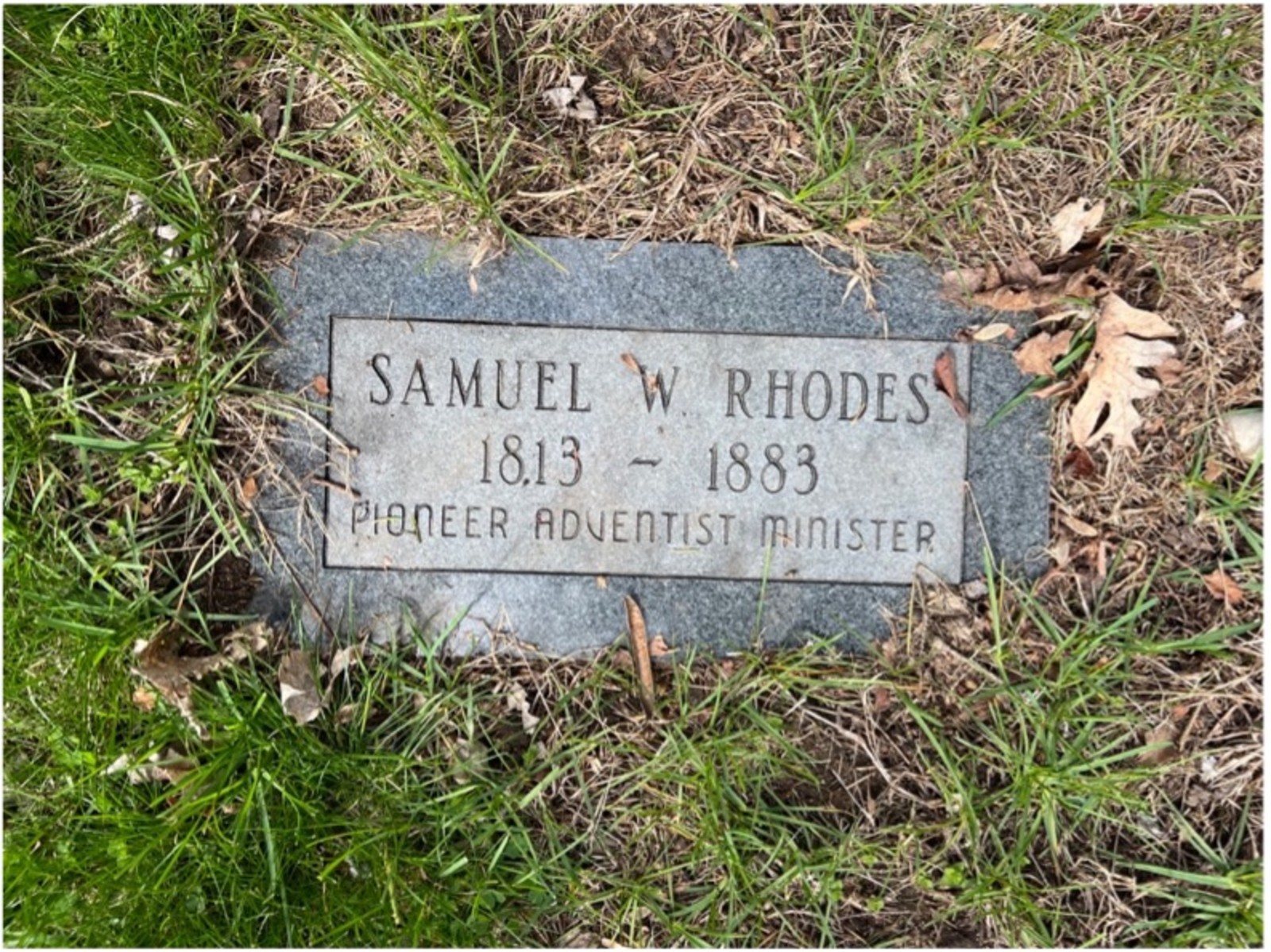
Shared by Michael W. Campbell.
Rhodes [Rhods, Roads, or Rhoades], Samuel Ward (1810–1883)
By Michael W. Campbell
Michael W. Campbell, Ph.D., is North American Division Archives, Statistics, and Research director. Previously, he was professor of church history and systematic theology at Southwestern Adventist University. An ordained minister, he pastored in Colorado and Kansas. He is assistant editor of The Ellen G. White Encyclopedia (Review and Herald, 2013) and currently is co-editor of the forthcoming Oxford Handbook of Seventh-day Adventism. He also taught at the Adventist International Institute for Advanced Studies (2013-18) and recently wrote the Pocket Dictionary for Understanding Adventism (Pacific Press, 2020).
First Published: November 3, 2026
Samuel W. Rhodes1 was an itinerant Millerite evangelist and early Sabbatarian Adventist minister from Scriba near Oswego in upstate New York. He was one of the original members of the publishing committee for the Advent Review. He designed a no longer extant prophetic chart (1850) that featured the two-horned beast of Revelation 13:11. He, along with George W. Holt (1812-1877) and Hiram S. Case (1814-1882), applied the uniting of apostate Protestantism and Republicanism to the dragon-like beast that typified spiritual and physical oppression within the United States.2 Rhodes was an influential early Sabbatarian Adventist minister whose extensive travels in the 1850s helped unify and expand the fledgling church’s work, including organizing the first groups of believers in Indiana and Illinois.3
Early Life
Samuel Ward Rhodes4 was born in 18105 to Silas (1759-1840) and Lydia née Ward (ca. 1764-1855) Rhodes. His father served in the American Revolution under Captain Ebenezer Sheldon and Colonel Seth Murray (July 18-October 10, 1780).6 Silas and Lydia were married May 28, 1790, in Middlefield, Massachusetts.7 Here their first two children, Lydia (b. 1791) and Silas (b. 1793) were born. Then they moved to Vermont in 1799, where another daughter, Rosanna (b. 1800), was born. Early in the century, the family moved westward to New York. Here they had three more children: Mary (1808-1833), Samuel (1810-1883), and Rhoda Bickford Rhodes Abbey (1813-1895).8
By 1865, Rhodes was married to Betsey E. (1814-1867). After her death, by 1870 he was remarried to Sophronia Ludington née Mighells (1825-1887), the widow of Job B. Peckham (1823-1859) of Volney, New York. She had married Peckham in 1848, and they had one son, Oliver Ludington (1853-1915), who became Samuel’s stepson.9 A later reminiscence recalled that Rhodes lived with a sister, possibly Rhoda Abbey, who lived in Brookfield, New York.10 His niece, Lucinda Abbey Hall (1839-1929), was a close friend and confidant of Ellen White (1827-1915).11
Second Advent Advocate
As early as June 22, 1843, one report noted his evangelistic ministry near East Hamilton, New York.12 About August 1843 he began laboring in Oswego County, New York.13 Samuel Rhodes, with L. Delos Mansfield (1821-1881), organized a Millerite camp meeting in Volney (near Hubbard’s Corners),14 which featured the preaching of Sister Lucy Hersey (1824-1888).15 In a letter dated August 28, 1844, he wrote to Nathaniel Southard (1812-1852):
[I] have been waiting and daily expecting the return of our King from a far country, not dreaming of a failure of the accomplishment of the prophecy to be fulfilled at the end of the days. I labored with untiring zeal in Oswego county for one year. The brethren and sisters are probably as unwavering in their faith of the near approach of the day of God, as in any other part of the land. The cause is still progressing; quite a number were baptized a few days since . . . We had a camp meeting held in Volney, Oswego county, which commenced the 25th of June, and continued seven days in peace and harmony, without being molested. The result of the meeting was the strengthening of the saints, and the conversion of a few sinners.16
After the camp meeting, he went with a Brother and Sister Griggs to labor at Ellisburgh, Jefferson County, New York, where they arrived on July 4, 1844. Other churches initially opened their meetinghouses to the Adventists, but Rhodes reported that opposition intensified when members began accepting their message.17 When the Methodist minister asked to challenge him publicly, Rhodes invited him to speak after the meeting. This appeared to be a “division line,” and the next night a group of boys gathered around their meeting place and:
fired their [fire] crackers in and about it, threw in sticks of wood in prayer time, burned tar and balls of tow in front of the house, and . . . entered the house, and poured great quantities of tar upon the seats, pulpit posts, doors, &c., finally about the house and locked it. They now howl like demons as we pass civilly through the village, saying, Away with you, away with you, woe, woe, woe, fire, fire, &c.18
After this, the Second Advent believers met in a home although he noted the strong opposition contributed to “a very deep interest [that] is awakened through the region.” He added: “My heart is encouraged to sound the alarm till my Master shall come.”19
J. N. Loughborough (1832-1924) later recalled that Rhodes was arrested while conducting meetings. A minister of another denomination claimed that Rhodes had disrupted his meeting and made a false accusation before the justice of the peace, resulting in Rhodes being arrested and imprisoned. Like Paul and Silas, Rhodes was reported to have been praying and singing praises to God (Acts 16:25). When some believers went to the justice and explained that the other denomination’s meeting had already closed before they started their own meeting, the judge let him go free. Rhodes refused to leave until he had a note stating he had been “wrongfully imprisoned” lest someone later claim he was a “jail bird.”20
On September 26, 1845, he wrote a letter to Enoch Jacobs (1809-1894) about his continued hope in Christ’s soon return, which he believed would occur no later than autumn 1845. By late 1845, after continued disappointments about Christ’s failure to return, Samuel became deeply discouraged. He had sold his property and invested heavily in alerting people to Christ’s soon return. He also “invested much in papers and publications” which were “scattered broadcast among the people.”21 As Hiram Edson (1806-1882) wrote in 1849:
Brother Rhodes was one of the most powerful and self-sacrificing lecturers in the second advent that ever lectured in this region. . . . He spent a handsome property in the cause,—in the distribution of publications, helping others out into the field, and in bearing his own expenses from place to place to sound the message,—until his means was entirely exhausted.22
Wilderness Recluse
According to J. N. Loughborough, the disappointment was so great that it “threw Brother Rhodes into despair.” Unable to explain his conundrum, he believed “he was a lost man” and had been “teaching an untruth.”23
He then lived as a recluse in the Adirondacks for three years (1846-1849). With continued taunts from his enemies, he finally cried out, “Good-by, proud world! I’m leaving you!”. He mounted his pony, took his traveling outfit and gun, and disappeared into the John Brown Tract (today known as the Adirondack wilderness).24 Near the Black River, he lived as a recluse hunting, fishing, and tilling a small patch of soil. According to A. W. Spalding (1877-1953), he felt “rejected of God and despised of men.”25 Edson had previously tried unsuccessfully to find Rhodes, believing that sharing new truths he had discovered would encourage him. James White (1821-1881) in 1857 recalled that Edson traveled over 1,000 miles looking for Rhodes.26
By late 1849, James White was publishing The Present Truth at Oswego, New York. Then a Bible Conference was held at Centerport, twenty miles south, at the home of William Harris (1801-1873) from November 17-18, 1849. Ellen White did not sympathize with Edson continuing to look for Samuel. As a small group gathered in prayer, Hiram Edson reported:
Brother Ralph asked the Lord, in secret, to pour out his Spirit upon us if it was His will that we should go after Brother Rhodes.
The Spirit was poured out, and it settled upon us, so that the place was awful, and glorious. While I was inquiring of the Lord if He had sent His servant so far to go with me to hunt up Brother Rhodes, at that moment Brother Ralph broke out in a new tongue, unknown to us all. Then came the interpretation—“Yes, to go with thee.”27
As the group knelt in prayer, Ellen White cautioned them to making sure they had “clear duty from the Lord.” The next morning, while in a season of prayer, Ellen White was taken off in vision and shown that they should go and look for him again.28 She subsequently shared about her visionary experience:
While in vision the angel pointed to the earth, where I saw Brother Rhodes in thick darkness; but he still bore the image of Jesus. I saw it was the will of God that Brethren Edson and Ralph should go.29
In the moment, Edson replied that he would go with Brother Ralph (1812-1897), who was greatly moved by the Spirit, and affirmed: “I will go.”30
Hiram Edson and Richard Ralph left on November 19, 1849, to travel the seventy miles to Boonville, and followed an old trail toward the Black River. As they looked across the river, they saw Samuel Rhodes:
[W]hen they were about thirty miles in the wilderness, they came to a clearing by the side of a fish brook, a little hut, a garden, a small meadow for hay raising, and a pasture for a pony. As they neared the hut, a man came out whom Brother Edson recognized at once as Brother Rhodes, for they were well acquainted. Brother Rhodes also recognized Brother Edson, and started at once for the forest to hide himself away from them. They started in pursuit of the object of their trip. In seeking to make his escape from them, Brother Rhodes stumbled over a log, and they caught him. He cried out, “I am a lost man. Let me go.” They replied, “No, we have a message direct from heaven for you, that you are not lost; we can make clear to you the cause of the 1844 disappointment. There is a third angel’s message which is now going with great power, of which we will tell you.”31
Hiram Edson recalled that upon meeting him, “God displayed his convincing power, and Bro. Ralph spoke in a new tongue, and gave the interpretation in power, and in the demonstration of the Holy Ghost.”32 This convinced him to agree to return with them the following day. Then when they were ready to leave, Edson shared what happened next:
When Bro. Rhodes came back the next day, he said to us, “I thought, by this time, that you had concluded to go without me, and let me stay here.” We told him no; he need not think any such thing. He turned from us and said, “It is too much, I cannot stand it:” and started for the woods. I feared that he was going away from us not to return again, so I started and ran after him, and found him on his face, asking the Lord what all this meant, why his children should feel so much for him.33
Another later account stated that his words were: “Lord, why do my brethren seek me out? Why do they love me so? . . . Can I yet be accepted of Thee?”34 They assured him of God’s love, and he chose to return with them to David Arnold’s (1805-1889) home in Volney. The next Sabbath, as he attended a meeting at Oswego, he rejoiced to learn the new truths they had discovered about the Sabbath and the Sanctuary. Soon Hiram Edson reported that Samuel Rhodes had returned as a powerful preacher.35 In a letter published in December 1851, Rhodes expressed his renewed commitment to James White: “Be of good cheer, my dear tried brother, and in Jesus’ name turn the battle to the gate. I mean to go to heaven with you! I love you more and more!”36
Sabbatarian Preacher & Chart Innovator
Upon his return, James White wrote: “No man has more freely given all for a treasure in heaven than Brother Rhodes. His commendable zeal in the cause, and success in convincing people of the truth, has caused our enemies to wickedly reproach him.”37 In August 1850, while traveling through Centerport, New York, James and Ellen White’s son, Edson (1849-1928), became deathly ill. As Rhodes was about to leave for Michigan, James White went five miles by horse to overtake him and bring him back. That evening they had a special season of prayer in which their son was miraculously healed.38 Later in 1850, Ellen White indicated that Rhodes himself had also experienced healing.39 In 1850, Rhodes traveled west to Michigan for the first time, venturing through Ohio and Indiana and as far west as Wisconsin, becoming the first Sabbatarian Adventist to enter these new regions.40
In August 1850, with the very first issue of The Advent Review, his name appeared on the masthead as a member of the publishing committee.41 Then by November 1850, when the periodical was combined with The Present Truth as the Second Advent Review, and Sabbath Herald his name continued on the masthead.42 He suggested to James White that each local church appoint a member to handle church publications. They would ensure that members received periodicals, kept addresses current, and collected funds.43
During the summer of 1850, he traveled with John C. Bowles (1800-1853) to Michigan. On this trip, they converted Hiram S. Case.44 He was also the first known Sabbatarian Adventist minister to visit Battle Creek, Michigan. On September 2, 1850, in a letter, he wrote about a stop after he visited Jackson, Michigan: “Stopped at Battle Creek, found one brother nearly lost in the darkness of the Laodeceans [sic].”45 He hoped the man would accept their message and traveled on to Indiana where, on September 9, he wrote that in Kingsbury, “three or four confessed the truth.”46 He then traveled to Wisconsin, becoming the first Sabbatarian Adventist minister to spread the Sabbatarian Adventist beliefs there, too.47 By the fall of 1851, he left Elmira, New York, where he had been laboring, to return to visit believers in Michigan a second time. Rhodes then returned to Oswego and Volney, New York.48 in a letter to friends, Ellen White rejoiced about his evangelistic outreach. “He [Rhodes] is valiant for the truth and God has been making him mighty. Many souls have been brought into the truth through his labors.”49
In 1850, Samuel Rhodes developed a prophetic chart that featured the two-horned beast of Revelation 13:11. The chart convinced Hiram S. Case (and confirmed what George W. Holt had already averred) about the danger of the two-horned beast when Church and State united together that with the Papal Beast to whom the dragon gave “his power, and his seat, and great authority.” This “Papal Beast was church and state united,” wrote Case. “An image must be like the thing imitated; therefore, the image-beast is composed of church and state united—Protestant churches and Republicanism. The word of the Lord is plain.”50 Unfortunately, historians do not know whether the chart survives, but it did inspire another chart published soon after by Otis Nichols (released in January 1851).51 Adventist historian Kevin M. Burton observes that this chart was part of a wider cause célèbre of early Adventist abolitionism and concerted opposition to the Fugitive Slave Law.52 Although such charts were commonplace among Millerite revivalists, Rhodes was the first to adapt and appropriate a prophetic chart in a way that built consensus around this emerging Adventist theological and apocalyptic framework. If Nichols’ later chart is any indication, it likely featured the statue of Daniel 2, the beasts of Daniel 7, and other significant dates in Bible prophecy that appeared in the earlier Millerite 1843 chart.53
In 1851, he went on a preaching tour with J. N. Andrews (1829-1883) through the east up into Maine.54 In May 1851, Ellen White wrote a letter of encouragement accompanying a longer vision (Ms 5, 1851).55 In an 1851 letter, Ellen White recalled his earlier struggle to abandon tobacco and commended his willingness to seek help.56 By late 1851 and early 1852, Rhodes and Andrews were on an extended tour through Michigan and Ohio.57 From March 12-15, Rhodes participated with Joseph Bates (1792-1872), Edson, George W. Holt, Frederick Wheeler (1811-1910), and others in a conference at Balston [Spa], New York. At this gathering, it was voted to divide the work between east [New England and Canada East] and west [New York and Canada West]. Another notable feature was a vote to purchase a press with type and that the paper be published on the new press in Rochester.58 Afterward, Rhodes went on a preaching tour around Oswego (visiting Camden, Lorain, Albion, Volney, Caughdenoy, McDonough, and Sterling).59 At Caughdenoy, from July 3-4 Rhodes held a revival meeting that resulted in 18 baptisms.60
By late 1853, Joshua V. Himes (1805-1895) accused Rhodes, among other things, of having “been and is deep in spiritual wifery.”61 James White refuted what he described as slanderous charges.62 Around the same time (late 1853 and early 1854), Ellen White also reproved Rhodes for his “overbearing spirit,” as well as his harshness and severity toward other believers.63 He confessed his wrongs as Ellen White entreated him not “to give up in discouragement.”64 Ezra Pitt Butler (1796-1875) observed that although Rhodes could at times be accused of being “harsh” or “severe,” the rumors and accusations by Himes were unfair and “unlike” anything he knew about his character.65 In early 1854, James and Ellen White held revival meetings with about 150 believers in Oswego, New York. James White attributed the “low state of the church” to a critical spirit over “little differences of opinion.”66 Instead, he hoped they would follow the principle of going directly to the person with whom they had a grievance, following Matthew 5:23-24.67 For most of 1854, Rhodes was severely ill, significantly limiting his preaching to the Oswego area, often to no more than once a week.68
In December 1854, he was well enough to labor at Roosevelt, New York, and wrote about his disappointment with the disaffected Messenger of Truth party. He felt a more appropriate term for them should be “messenger of folly.”69 In December 1854 through January 1855 he participated in a preaching tour with J. N. Loughborough (1832-1924) through Jefferson County, New York. They held meetings at Lorraine and Mannsville, and stopped to visit David Arnold in Volney.70 By late 1855, he again expressed his disappointment at not being able to speak publicly “through weakness of the speaking organs.”71 His poor health increasingly limited him from public ministry. In the latter part of the 1850s, Ellen White continued to admonish Rhodes for a series of challenges related to his critical and overbearing leadership. Specifically, she criticized his handling of donations, his demand that church members sell their property without delay, and his tendency to become too engrossed in “little particulars” regarding family matters in which he had no business. White charged that he exercised excessive control over other believers.72
Contemporary accounts also testify to the affection Rhodes inspired among believers. In 1851, Marshall M. Truesdell73 (1828-1856) described him as a “devoted servant of God.”74 In 1857, Abel Tuttle75 (1820-1878) recalled his frequent visits, usually at his own expense, and expressed gratitude for his fatherly concern.76
Friction
In 1859 Ellen White wrote a stern letter of admonition for his repeated failure to amend his harshness in how he interacted with church members and handled church matters (Lt. 16, 1859).77 Ellen White furthermore expressed concern about the “wrong course” and influence that Rhodes had exerted.78 He was unwilling to confess his faults and tried to cover up reproofs he had received.79
In May 1860, Rhodes requested the return of $100 he had invested in the Review Office.80 His financial support for fellow Adventists nevertheless continued: that August, he contributed $10 toward a home for Moses Hull (1836-1907).81 In December 1860, he publicly resigned from the ministry. His withdrawal from preaching did not end his involvement with the Adventist movement, as his subsequent correspondence and donations demonstrate.
Rhodes published a confession in February 1861, but James White questioned whether his acknowledgment adequately accepted responsibility for his conduct.82 In another confession, published in May 1862, Rhodes acknowledged his “murmuring and faultfinding” and his criticism of James and Ellen White during the earlier controversy surrounding the Messenger of Truth.83 Ellen White wrote that Rhodes and George W. Holt “have chosen to follow their own course and now they are of no use.”84 She added that although Rhodes “may suffer in mind,” “others have suffered on his account long enough.”85
Ellen White felt that by this time his ministry was done:
S. W. Rhodes was severe, exacting, and his teachings and example led the people of God to look more to each other than to look to God, and to watch the failings of their brethren and sisters. He was censorious, peevish, fretful, and in a high degree abusive. He abused the kindness of his brethren, and instead of teaching the commandments of God in an humble spirit as Christ’s ambassador and letting the truth do its work, he mixed up with these commandments his own overbearing commands, which caused some to be disgusted and turn away from the truth altogether…86
In 1866, he contributed $25 toward the Health Reform Institute.87 The next year, he gave an additional $150 to the Health Reform Institute and $200 to the Publishing Association.88 On September 18, 1867, his wife Betsey E. died from “cancer” in Oswego, New York. He described her as a “peacemaker” who now “sleeps in Jesus.”89 By November 1867, he wrote another confession, this time as a patient at the Health Reform Institute in Battle Creek, where he again reported a change of heart and newfound hope after a meeting with James and Ellen White at the Roosevelt Church the previous month.90
Later Life and Legacy
In April 1883, a petition for Rhodes’s admission to an asylum was granted. Described in the newspaper report as an “indigent pauper,” he was temporarily held in jail while awaiting an available place.91 Unfortunately, little is known about the final years of his life, and no obituary appears in any church periodical. He died on April 26, 1883. Although arrangements were initially contemplated to return his body to New York, he was buried in an unmarked grave in Oak Hill Cemetery in Battle Creek, Michigan.92 A gravestone was placed at his burial site in June 2020 but with an incorrect date of birth.93
In a reminiscence published in 1895, Julia H. Duffie traced her conversion to Rhodes’s kindness during a childhood visit. He spoke to her about God’s love, took an interest in her animals and favorite doll, and gave her a copy of the Ten Commandments. Her recollection preserved a personal dimension of his ministry alongside the accounts of his public preaching and later conflicts.94 Rhodes helped sustain the transition from Millerism to Sabbatarian Adventism through itinerant preaching, financial sacrifice, and participation in early publishing ventures. In 1857, James White, in one of the earliest historical reflections of the fledgling movement, highlighted Edson’s locating Rhodes, with his subsequent reconversion, as a specific example of God’s providential guidance in the formation of the Sabbatarian Adventist movement.95 Rhodes’s subsequent service on the Advent Review Publishing Committee and his work with the 1850-1851 prophetic chart contributed to the movement’s efforts to explain and disseminate its beliefs. Although conflicts over his conduct curtailed his ministerial career, his later donations and correspondence demonstrate continued involvement and support with Adventist believers and institutions. Mahlon E. Olsen (1873-1952) described him in 1923 as a particularly important “pioneer preacher.”96 Similarly, A. W. Spalding placed him among the “first rank” of early Sabbatarian Adventist ministers, just after Joseph Bates and James White, who remained highly influential during the denomination’s formation. He was listed, with George W. Holt and Hiram Edson, as “the most active Sabbath-and-sanctuary preachers in the early days, though now so much forgotten and neglected.”97
Sources
Burton, Kevin M. “Anti-Slavery, Social Justice, and the Three Angels’ Messages.” In A Prophetic Witness: Peace, Justice, and the Advent Message, ed. Glen M. Graham, Lisa Clark Diller, and Jeffrey A. Gang. Adventist Peace Fellowship and Signs Publishing, 2026.
Burton, Kevin M. Apocalyptic Abolitionism: How Millennialists Helped Abolish Slavery and Reform America. New York: NYU Press, 2026.
Butler, E. P. “States of Elder J. V. Himes.” ARH, December 13, 1853.
Campbell, Michael W. “Bible Conferences, 1848-1851.” In the Encyclopedia of Seventh-day Adventists, First published February 1, 2024. https://encyclopedia.adventist.org/article?id=BIR3&highlight=bible|conferences.
[Campbell, Michael W.] “Rhodes, Samuel W.” In The Ellen G. White Encyclopedia, 2nd ed., eds. Denis Fortin and Jerry Moon. Hagerstown, MD: Review and Herald, 2013, 497-498.
Campbell, Michael W. and Edward Martin Allen. A Global History of Seventh-day Adventists. Grand Rapids, MI: Eerdmans, 2026.
Case, H. S. “Letter from Bro. Case.” The Present Truth, November 1850.
Edson, Hiram. “Beloved Brethren, Scattered Abroad.” The Present Truth, December 1849.
[Hickerson, Stanley D., ed.] “Rhodes, Samuel W.” In The Ellen G. White Letters and Manuscripts with Annotations, volume 1, 1845-1859. Hagerstown, MD: Review and Herald, 2014, 1:882.
Holt, Geo[rge] W. “Letter from Bro. Holt.” The Present Truth, March 1850.
Loughborough, J. N. “Second Advent Experiences, No. 2.” ARH, June 14, 1923, 7-8.
Morgan, Kevin L. Early Adventist Letters and Recollections, 1842-1854: A Supplement. Calhoun, GA: Teach Services, 2025.
New York State Census, 1855, 1865, 1875.
Obituary, ARH, November 19, 1867, 358.
Obituary, ARH, January 17, 1888, 46.
Olsen, Mahlon E. “The Humble Beginnings.” Signs of the Times, August 14, 1923.
Rhodes, Samuel W. “A Cheering Revival.” The Midnight Cry, October 5, 1843.
Rhodes, S. W. “Communication from Bro. Rhodes.” ARH, December 3, 1867.
Rhodes, S. W. “From Bro. Rhodes.” ARH, February 12, 1861.
Rhodes, S. W. “From Bro. Rhodes.” ARH, May 6, 1862.
Rhodes, S. W. “From Bro. Rhodes.” ARH, December 2, 1852.
Rhodes, S. W. “From Bro. Rhodes.” ARH, February 3, 1853.
Rhodes, S. W. “From Bro. Rhodes.” ARH, November 7, 1854.
Rhodes, S. W. “From Bro. Rhodes.” ARH, December 26, 1854.
Rhodes, S. W. “From Bro. Rhodes.” ARH, December 4, 1855.
Rhodes, S. W. “From Bro. Rhodes.” ARH, January 8, 1857.
Rhodes, Samuel W. “Letter from Bro. Rhodes.” The Midnight Cry! September 19, 1844.
Rhodes, Samuel W. “Letter from Bro. Rhodes.” The Day-Star, October 11, 1845.
Rhodes, S. W. [“Letter from Bro. Rhodes”]. The Advent Review, September 1850.
Rhodes, Samuel W. Untitled published letter. ARH, December 23, 1851.
Rhodes, Samuel. "Letters. From Bro. Rhodes.” RH Sept. 16, 1852.
Rhodes, S. W. “Letter from Bro. Rhodes.” ARH, August 11, 1853.
Rhodes, S. W. “Letter from Bro. Rhodes to Bro. White.” ARH, February 21, 1856.
Rhodes, S. W. “Note from Bro. Rhodes.” ARH, October 22, 1857.
Rhodes, S. W. “Resignation.” ARH, December 18, 1860.
Rhodes, S. W. “To the Saints Scattered Abroad.” ARH, October 28, 1852.
Rhodes, S. W. “The Tongue.” ARH, August 19, 1852.
Robinson, D. E. “The Gift of Tongues in Early Advent History.” Center for Adventist Research, Andrews University, n.d.
Seventh-day Adventist Encyclopedia. Second revised edition. Hagerstown, MD: Review and Herald Publishing Association, 1996.
Spalding, Arthur W. Footprints of the Pioneers. Washington, D.C.: Review and Herald, 1947.
Strayer, Brian E. Hiram Edson: The Man and the Myth. Westlake Village, CA: Acorn Publishing, 2023.
United States Federal Census, 1800-1880.
Wheeler, Gerald. James White: Innovator and Overcomer. Hagerstown, MD: Review and Herald, 2003.
White, Arthur L. Ellen G. White: The Early Years. Vol. 1. Hagerstown, MD: Review and Herald, 1985.
White, James. “Eastern Tour.” ARH, August 27, 1861.
White, James. “Note to Brother Waggoner.” ARH, November 8, 1853.
[White, James], “Oswego Meeting.” ARH, February 14, 1854.
[White, James], “The Paper.” ARH, August 19, 1851.
W[hite], J[ames]. “A Sketch of the Rise and Progress of the Present Truth.” ARH, December 21, 1857.
Notes
-
This article has used variations of his name to help better identify and track genealogical documents, noting that various relatives used different variations of his surname. This includes Rhods, Roads, or Rhoades although he and his siblings appeared to have stuck with the “Rhodes” variety of their name. In Adventist research databases various forms of “S. W. Rhodes,” “Samuel W. Rhodes,” and “Bro. Rhodes” and “Bro. S. Rhodes” and so on have helped to better track his contributions within Sabbatarian Adventism.↩
-
Geo[rge] W. Holt, “Letter from Bro. Holt,” The Present Truth, March 1850, 64; H. S. Case, “Letter from Bro. Case,” The Present Truth, November 1850, 85.↩
-
Seventh-day Adventist Encyclopedia [1996] 11:450.↩
-
The middle name is inferred from his mother’s middle name.↩
-
No birth record has been located. His date of birth appears consistent from the 1855 New York Census, and the 1860, 1870, and 1880 United States Federal Census place his date of birth in 1810. The SDA Encyclopedia (1996) offers the date 1813 but provides no evidence; this appears to be in error as no contemporary or posthumous sources point to that later date (Seventh-day Adventist Encyclopedia [1996] 11:450).↩
-
U.S. Compiled Revolutionary War Military Service Records, 1775-1783, Ancestry.com database. They may have named their son after Samuel Ward (1725-1776), Rhode Island’s colonial governor and member of the Continental Congress.↩
-
Massachusetts, Compiled Marriages, 1633-1850. From the Family History Library, Salt Lake City, UT; Film #0823686 item 4. Accessed from Ancestry.com October 25, 2026.↩
-
For genealogical details, see: https://www.ancestry.com/invite-ui/accept?token=0Q_5hBtc6hGHRvf2v1EkpgtH7SE3uwWqAaCoEu4G_V4=↩
-
Obituary, ARH, January 17, 1888, 46.↩
-
Mrs. Jennie Ayars-Kellogg to Ruth Conrad, “Growing Up With the Third Angel’s Message—No. 4,” ARH, May 2, 1935, 15.↩
-
Tim Poirier, “Hall, Lucinda (Abbey),” in The Ellen White Encyclopedia, 2nd ed., eds. Denis Fortin and Jerry Moon (Hagerstown, MD: Review and Herald, 2013), 394-395.↩
-
“Strange Omission,” The Midnight Cry! June 22, 1843, 126.↩
-
Samuel W. Rhodes, “Letter from Bro. Rhodes,” The Midnight Cry! September 19, 1844, 86-87.↩
-
See announcement under “Camp-Meetings,” The Midnight Cry! June 20, 1844, 392.↩
-
Samuel W. Rhodes, “Letter from Bro. Rhodes,” The Midnight Cry! September 19, 1844, 86-87.↩
-
Ibid.↩
-
Ibid.↩
-
Ibid.↩
-
Ibid.↩
-
J. N. Loughborough gives this account as taking place before October 22, 1844, in Oswego, Michigan, but this appears to be an error as Rhodes’s work before the disappointment was confined to the Oswego, New York, area. For the story, see J. N. Loughborough, “Second Advent Experiences, No. 2,” ARH, June 14, 1923, 7-8.↩
-
J. N. Loughborough, “Sketches of the Past—No. 96,” Pacific Union Recorder, April 28, 1910, 1-2.↩
-
Hiram Edson as quoted in J. N. Loughborough, “Second Advent Experiences, No. 2,” ARH, June 14, 1923, 7-8.↩
-
J. N. Loughborough, “Second Advent Experiences, No. 2,” ARH, June 14, 1923, 7-8.↩
-
Arthur W. Spalding, Footprints of the Pioneers (Washington, D.C.: Review and Herald, 1947),149. In addition, note that James White attributes his discouragement to the “backsliding and covetousness of professed Advent brethren.” See J[ames] W[hite], “A Sketch of the Rise and Progress of the Present Truth,” ARH, December 21, 1857, 61.↩
-
Ibid., 150.↩
-
J[ames] W[hite], “A Sketch of the Rise and Progress of the Present Truth,” ARH, December 21, 1857, 61.↩
-
Hiram Edson, “Beloved Brethren, Scattered Abroad,” The Present Truth, December 1849, 35.↩
-
Spalding, Footprints of the Pioneers, 150.↩
-
Ellen G. White quoted in Hiram Edson, “Beloved Brethren, Scattered Abroad,” The Present Truth, December 1849, 35. J. N. Loughborough later recalled: “I saw a man who was an active laborer in the 1844 movement, in despair, hidden away in a dense forest, and you, Brother Edson, must go and get him out.” J. N. Loughborough, “Second Advent Experiences, No. 2,” ARH, June 14, 1923, 7-8.↩
-
Ellen G. White, quoted in J. N. Loughborough, “Second Advent Experiences, No. 2,” ARH, June 14, 1923, 7-8.↩
-
Ibid.↩
-
Hiram Edson and E. G. White, “Beloved Brethren, Scattered Abroad,” The Present Truth, December 1849, 34-36.↩
-
Ibid.↩
-
Spalding, Footprints of the Pioneer, 152.↩
-
Edson, cited by ibid.↩
-
David Arnold, letter, ARH, December 23, 1851, 69.↩
-
See note by James White, ARH, May 26, 1853, 8.↩
-
See Ellen G. White, Letter 12, 1850, ca. early August 1850, in The Ellen G. White Letters and Manuscripts with Annotations, volume 1, 1845-1859 (Hagerstown, MD: Review and Herald, 2014), 1:216 [hereafter 1LM].↩
-
See Lt. 30, 1850, December 13, 1850, in 1LM 266.↩
-
E.g. the obituary of Sister Chatfield who traced her conversion to Rhodes’s visit in 1850. Obituary, ARH, February 6, 1855, 174.↩
-
His name is listed with Hiram Edson, David Arnold, George W. Holt, and James White. The Advent Review, August 1850, 1.↩
-
With Joseph Bates, J. N. Andrews and James White as four members of the publishing committee. Second Advent Review, and Sabbath Herald, November 1850, 1.↩
-
[James White], “The Paper,” ARH, August 19, 1851, 16; Gerald Wheeler, James White: Innovator and Overcomer (Hagerstown, MD: Review and Herald, 2003), 67.↩
-
See note from H. S. Case, Second Advent Review and Sabbath Herald, December 1850, 16.↩
-
S. W. Rhodes, [“Letter from Bro. Rhodes”], The Advent Review, September 1850, 64.↩
-
Ibid.↩
-
Ibid.↩
-
David Arnold, letter, ARH, December 23, 1851, 69.↩
-
Ellen G. White to Reuben and Belinda Loveland, Letter 26, 1850, in 1LM 251.↩
-
Hiram S. Case, “Letter from Bro. Case,” The Present Truth, November 1850, 85; Ellen G. White to Stockbridge and Louisa Howland, August 15, 1850, Letter 12, 1850.↩
-
See Kevin M. Burton, “Anti-Slavery, Social Justice, and the Three Angels’ Messages.” In A Prophetic Witness: Peace, Justice, and the Advent Message, ed. Glen M. Graham, Lisa Clark Diller, and Jeffrey A. Gang (Warburton, Australia: Signs Publishing and Adventist Peace Fellowship, 2026), 28.↩
-
For additional background on the development of early Adventist abolitionism, see Kevin M. Burton, Apocalyptic Abolitionism: How Millennialists Helped Abolish Slavery and Reform America (New York: NYU Press, 2026), 43-68, 94-122.↩
-
Malcolm Bull and Keith Lockhart, Seeking a Sanctuary: Seventh-day Adventism and the American Dream, 2nd ed. (Bloomington, IN: Indiana University Press, 2006),137.↩
-
See 1LM 265, fn. 9.↩
-
1LM 282-283.↩
-
See reference in Letter 5, 1851, in 1LM 318. The reference is clearly to an earlier time, so this appears to have been after her 1848 health reform vision eschewing tobacco, but before 1851 when she wrote this letter. She commends him for his humble and transparent course in seeking help.↩
-
“The Conference,” ARH, March 23, 1852, 108.↩
-
Ibid.↩
-
S. W. Rhodes, “From Bro. Rhodes,” ARH, June 24, 1852, 31. For an account giving the impact of Rhodes’s ministry, see E. A. Poole, “From Bro. Poole,” ARH, July 8, 1852, 39.↩
-
Alexander Ross, “From Bro. Ross,” ARH, July 22, 1852, 46.↩
-
James White, “Note to Brother Waggoner,” ARH, November 8, 1853, 144.↩
-
Ibid.↩
-
1LM 488, fn. 10.↩
-
S. W. Rhodes, “Letter from Bro. Rhodes,” ARH, August 11, 1853, 55; 1LM 281, 358.↩
-
E. P. Butler, “States of Elder J. V. Himes,” ARH, December 13, 1853, 180-181.↩
-
[James White], “Oswego Meeting,” ARH, February 14, 1854, 28-29.↩
-
Ibid.↩
-
S. W. Rhodes, “From Bro. Rhodes,” ARH, November 7, 1854, 102.↩
-
S. W. Rhodes, “From Bro. Rhodes,” ARH, December 26, 1854, 151.↩
-
J. N. Loughborough, “Recollections of the Past.—No. 12,” ARH, March 3, 1885, 137-138.↩
-
S. W. Rhodes, “From Bro. Rhodes,” ARH, December 4, 1855, 75.↩
-
E.g. 1MS 351, 353-358, 565.↩
-
Obituary, ARH, June 26, 1856, 71.↩
-
Marshall M. Truesdell, Letter dated June 19, 1851, ARH, August 5, 1851, 7.↩
-
Genealogical records point to a John Tuttle (1783-1876) and Betsey Hurd who had a son, Abel Tuttle (1827-1878) who lived in Sandy Creek, New York. The letter cited below is dated from Sandy Creek, New York.↩
-
Abel Tuttle, “From Bro. Tuttle,” ARH, November 19, 1857, 15.↩
-
The letter appears with annotations in 1MS 741-745.↩
-
Ellen G. White, Letter 17, 1859, in 1MS 749.↩
-
1MS 742-745.↩
-
J[ames] W[hite], “What Shall be Done?” ARH, May 10, 1860, 200.↩
-
J[ames] W[hite], “A Home for Brother M. Hull,” ARH, August 14, 1860, 104.↩
-
S. W. Rhodes, “From Bro. Rhodes,” ARH, February 12, 1861, 102; 2LM 925, fn. 12. “He has so long wove into his confessions his ingenious manner of criminating others, and his masterly style of self-defense, that many really dread to have him attempt a public confession.”↩
-
S. W. Rhodes, “From Bro. Rhodes,” ARH, May 6, 1862, 182.↩
-
Ellen G. White, Letter 5b, 1861, April 5, 1861, in 2LM 355.↩
-
Ibid., 2LM 356.↩
-
Ellen G. White, Manuscript 8, 1861, c. May 1861, in 2LM 825.↩
-
“For the Western Health-Reform Institute,” ARH, June 26, 1866, 32.↩
-
See under “Receipts,” ARH, April 30, 1867, 252.↩
-
Obituary, ARH, November 19, 1867, 358.↩
-
S. W. Rhodes, “Communication from Bro. Rhodes,” ARH, December 3, 1867, 395.↩
-
The Citizen, [Battle Creek, Michigan] April 14, 1883, 8.↩
-
“Samuel W. Rhodes,” Find-a-grave, https://www.findagrave.com/memorial/324608722/samuel-ward-rhodes↩
-
Even the Oak Hill Cemetery records note that he died at age 73 in 1883 indicating a date of birth of 1810. See announcement from Adventist Heritage Ministries, https://www.facebook.com/watch/?v=2531687817080700↩
-
Julia H. Duffie, “A Pleasant Remembrance,” The Youth Instructor, September 12, 1895, 293.↩
-
J[ames] W[hite], “A Sketch of the Rise and Progress of the Present Truth,” ARH, December 21, 1857, 61.↩
-
Mahlon E. Olsen, “The Humble Beginnings,” Signs of the Times, Aug. 14, 1923, pg. 6-7, 15.↩
-
Spalding, Footprints of the Pioneers, 137, fn. 1.↩