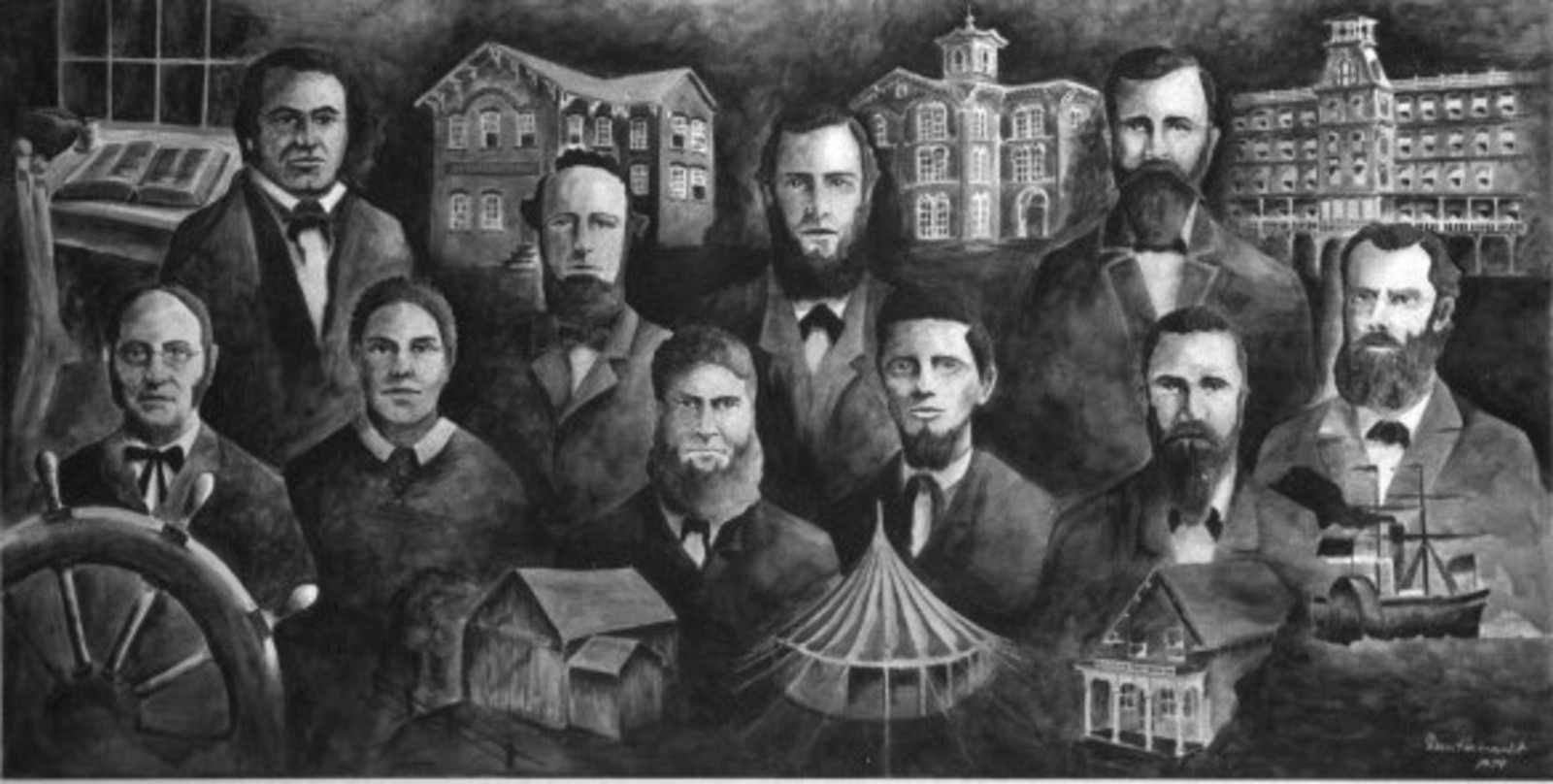
A portrait of Adventist Pioneers: Left to right, top row: William Miller, James White, Uriah Smith, John Harvey Kellogg. Left to right, bottom row: Joseph Bates, Ellen G. White, Hiram Edson, J.N. Loughborough, S.N. Haskell, J.N. Andrews.
Photo courtesy of Center for Adventist Research.
Sabbatarian Adventism
By Michael W. Campbell
Michael W. Campbell, Ph.D., is North American Division Archives, Statistics, and Research director. Previously, he was professor of church history and systematic theology at Southwestern Adventist University. An ordained minister, he pastored in Colorado and Kansas. He is assistant editor of The Ellen G. White Encyclopedia (Review and Herald, 2013) and currently is co-editor of the forthcoming Oxford Handbook of Seventh-day Adventism. He also taught at the Adventist International Institute for Advanced Studies (2013-18) and recently wrote the Pocket Dictionary for Understanding Adventism (Pacific Press, 2020).
First Published: August 5, 2026
“Sabbatarian Adventism” is the term commonly used to describe the movement of Sabbath-keeping Adventists that emerged from the Millerite Movement following the Great Disappointment when Christ did not return as anticipated on October 22, 1844. Although a small number of Millerites had accepted the seventh-day Sabbath before October 1844, the term generally refers to the small body of Second Advent believers who, after the Great Disappointment, continued studying Scripture. Influenced especially by Joseph Bates (1792-1872), increasing numbers accepted the seventh-day Sabbath. Altogether a small nucleus group embraced both the belief in Christ’s ministry in the heavenly sanctuary and the seventh-day Sabbath. The designation also distinguishes this movement from other post-Disappointment Adventist groups, particularly the larger Advent Christian movement that developed under the leadership of Joshua V. Himes (1805-1895).
Through a series of Bible Conferences held between 1848 and 1851, leading believers met in homes throughout New England and New York to study Scripture, resolve doctrinal differences, and establish a shared theological foundation. Participants later recalled Ellen White’s visions encouraged continued Bible study while affirming conclusions reached only after rigorous Bible study. This nucleus group numbered only about two hundred believers. James White led out in publishing the Present Truth (1849) and the Advent Review, which merged in 1850 as the Second Advent Review and Sabbath Herald, providing an important means of unifying scattered believers and transforming a small network of Sabbath-keeping Adventists into an organized movement. Through these Bible Conferences and subsequent theological discussions, five “pillar doctrines” formed into a cohesive system of beliefs: the seventh-day Sabbath, the Sanctuary ministry of Christ in the Most Holy Place of the heavenly sanctuary, the non-immortality of the soul, the continuing manifestation of the gift of prophecy through the ministry of Ellen G. White, and the imminent, literal second coming of Jesus Christ. During this period the movement gradually developed a voluntary plan of financial support known as “Systematic Benevolence,” church organization, and eventually adopted the name “Seventh-day Adventist” in 1860.
The expression “Sabbatarian Adventism” became widely used among Adventist historians during the second half of the twentieth century.1 In the 1970s, various authors in Adventist Heritage popularized the term further.2 The expression generally describes the period between the Great Disappointment in 1844 and the formal organization of the denomination in 1863. Adventist historians typically refer to this developmental period as “Sabbatarian Adventism” to set apart this time before the formal organization of the Seventh-day Adventist Church.
Sources
Campbell, Michael W. and Edward Martin Allen. A Global History of Seventh-day Adventists. Grand Rapids, MI: William B. Eerdmans, 2026.
Campbell, Michael W. “Millerite Revivalism and Post-Millerite Adventist Churches,” in The Oxford Handbook of Seventh-day Adventism. Eds. M. Campbell, C. Chow, N. Miller, and D. Kaiser (New York: Oxford University Press, 2024).
Damsteegt, P. Gerard. Foundations of the Seventh-day Adventist Message and Mission. Grand Rapids, MI: William B. Eerdmans, 1977.
Froom, LeRoy Edwin. Prophetic Faith of Our Fathers: The Historical Development of Prophetic Interpretation. vol. 4. Washington, D.C.: Review and Herald, 1954.
Froom, LeRoy Edwin. Movement of Destiny. Washington, D.C.: Review and Herald, 1971.
Knight, George R. A Brief History of Seventh-day Adventists. 2nd ed. Hagerstown, MD: Review and Herald, 1999.
Knight, George R. A Search for Identity: The Development of Seventh-day Adventist Beliefs. Hagerstown, MD: Review and Herald, 2000.
Knight, George R. William Miller and the Rise of Adventism. Nampa, ID: Pacific Press, 2011.
Land, Gary. ed. Adventism in America: A History, Revised Edition. Berrien Springs, MI: Andrews University Press, 1998.
Land, Gary. Historical Dictionary of the Seventh-day Adventists, 2nd ed. New York: Rowman & Littlefield, 2014.
Notes
-
LeRoy Edwin Froom, Prophetic Faith of Our Fathers: The Historical Development of Prophetic Interpretation (Washington, D.C.: Review and Herald, 1954), 4:941-963; idem., Movement of Destiny (Washington, D.C.: Review and Herald, 1971), 77-90.↩
-
E.g., Brian Strayer, “The Tragedy of Nathan Fuller,” Adventist Heritage 4, no. 1 (Summer 1977): 3; P. Gerard Damsteegt, “Health Reform and the Bible in Early Sabbatarian Adventism,” Adventist Heritage 5, no. 2 (Winter 1978): 13-21.↩