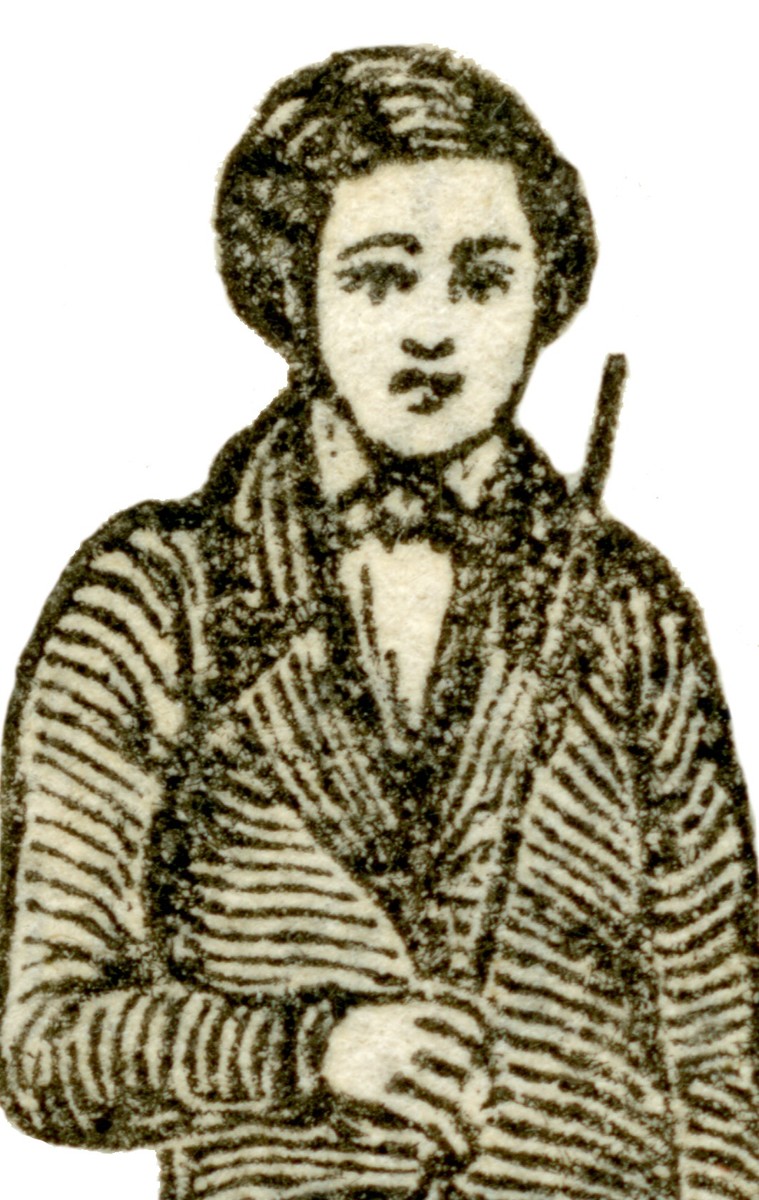
Nathaniel L. Southard as depicted in an engraving of Brunetti’s Model of Ancient Jerusalem. Credit: Advent Herald, December 30, 1848, courtesy of Center for Adventist Research.
Southard, Nathaniel L. (1812–1852)
By Douglas Morgan
Douglas Morgan is a graduate of Union College (B.A., theology, 1978) in Lincoln, Nebraska and the University of Chicago (Ph.D., history of Christianity, 1992). He has served on the faculties of Washington Adventist University in Takoma Park, Maryland and Southern Adventist University in Collegedale, Tennessee. His publications include Adventism and the American Republic (University of Tennessee Press, 2001) and Lewis C. Sheafe: Apostle to Black America (Review and Herald, 2010). He is the ESDA assistant editor for North America.
First Published: September 14, 2026
Nathaniel L. Southard was an activist, publisher, educator, and editor dedicated to immediate abolition of slavery and other radical causes, including the Second Advent movement. He edited the Midnight Cry, published in New York City, from its inception in 1842 to 1845.
Nathaniel was born May 24, 1812, in Lyme, New Hampshire. He was the eighth of nine children born to Nathaniel Southworth (1769-1840) and Patience Shaw Southworth (1770-1814). His father, a tanner in Lyme, apparently changed the family name to Southard by the time young Nathaniel reached adulthood.1
Reform Activist and Publications Innovator
After his primary education at a public school, Nathaniel studied at an academy for six months. In 1830, at the age of 18, he left home for Boston where he learned the printers’ trade.2 At the same time, he became immersed in the interracial movement for immediate abolition of slavery and racial injustice, galvanized by William Lloyd Garrison, editor of the Liberator. Southard was one of the 62 initial signatories to the “Declaration of the Anti-Slavery Convention” when the American Anti-Slavery Society organized in Philadelphia in 1833.3
Southard, then 21, was already a skillful journalist and persuasive writer, as evidenced in a letter he wrote to the Boston Courier (reprinted in the Liberator) detailing the inhumane treatment of another signer of the 1833 antislavery declaration, James G. Barbadoes of Boston, a distinguished Black businessman, aboard a steamship traveling to the Philadelphia convention. On account of race, Barbadoes was denied accommodation in the main cabin and forced to remain on deck for most of the night amidst a cold rain and high winds.4
In early 1834 Southard opened an “Evening School for People of Color” who had been denied opportunity for a grammar school education and announced plans for a private day school for “colored youth.” After the Smith School for Black children was established in 1835 next to the African Meeting House on Belknap Street, Southard continued to lead the evening school for adults in the same building, with the demand sometimes overwhelming the supply of teachers.5
With William C. Webster, Southard also formed a publishing company in 1834. One early title from Webster and Southard was The Testimony of God against Slavery; or a collection of Passages from the Bible, which show the Sin of Holding Property in Man (1835) by La Roy Sunderland, Southard’s friend and fellow Methodist reformer.6
In 1835 Southard initiated the American Anti-Slavery Almanac and edited its first three annual issues (for 1836, 1837, and 1838). This was his first major success. The almanac proved to be a highly effective medium for reaching the public, communicating the abolitionist message in digest form, along with popular features of a standard almanac such as astronomical calculations, monthly calendar pages, census and demographic data, and historical dates. The Almanac was filled with statistics, charts, lists of “startling” facts, graphic “pictorials,” and moving narratives credited with doing much to stir public consciousness about the evils of slavery. The 1836 and 1837 editions sold a combined total of 70,000 copies.7
Southard was also founding editor of the Youth’s Cabinet, the foremost abolitionist paper for young people. Published weekly, the periodical was “devoted to Liberty, Peace, Temperance, Purity, and Truth.”8
In September 1836, Southard was briefly incarcerated for his convictions as a “nonresistant.” He believed that, as a follower of Jesus, he could neither participate in warfare nor “warlike preparations commonly called ‘training.’” Thus, he refused to participate in required training for the state militia or even pay the fine for not doing so. He intended to serve the full six-day sentence but a relative paid his fine without his consent, freeing him after one day.9 In March 1840, Southard protested the U. S. war against the Seminoles in Florida by issuing a lithograph that graphically depicted the military’s use of bloodhounds.10
Not confined to the editorial desk, Southard filled numerous additional roles as a reform activist in Boston. He lectured, reported on antislavery conventions, located employment opportunities for Black people, and served as recording secretary for the Massachusetts Anti-slavery Society and on the managing committee of the Boston Young Men’s Antislavery Society. At a time when the Liberator’s subscription records had fallen into disarray, Southard stepped into the role (if not the title) of subscription manager for around a year (1836-1837).11
Marriage and Move to New York City
In January 1836, Nathaniel married Elizabeth M. Bean in Boston. Their first-born, Harriet, who had seemed a remarkably healthy and energetic infant, died suddenly on September 16, 1837, having lived only eight months. Nathaniel Leroy, their only child to survive infancy, was born in 1841.12
Elizabeth shared her husband’s passion for reform. After the couple moved to New York City in 1838, she became a leader in the city’s Female Wesleyan Anti-Slavery Society, serving as a member of the committee of arrangements for its third annual meeting in 1839 and as a member of the organization’s executive committee, 1839-1840. She was also an officer of the American Female Moral Reform Society which campaigned against the urban sex industry and the exploitation of young women, serving on the executive committee in 1839 and the board of managers in 1840.
Amidst a wide range of publishing activities for reform causes after the move to New York, Nathaniel continued as editor of Youth’s Cabinet. In 1838 he published Why Work For the Slave!, setting forth the Cent-A-Week plan whereby children, young people, and others of limited means could make a meaningful contribution to the cause. The idea caught on. As one example of its impact, the Massachusetts Antislavery Society at its 1839 annual meeting, reported receipt of $271.05 from the Cent-A-Week societies set up following Southard’s plan.13 During the 1840 election campaign, Southard and Joshua Levitt co-edited the Ballot Box, a short-term daily paper used to advocate for the new Liberty party, dedicated to the immediate abolition of slavery.14
Southard also continued to innovate in the use of visual images as an educational tool. For example, he developed a public lecture on astronomy using a magic lantern, an early technology for projecting slides.15
Midnight Cry Editor
Sometime after moving to New York City, Southard accepted Second Advent teachings through the influence of Henry Jones, a New York-based preacher, author and editor who, in the early 1830s, had been the first ordained minister to publicly endorse William Miller’s message that the premillennial return of the Messiah to rule the earth in person was “near at hand.”16 Jones, who became editor of the Second Advent Witness, launched in New York in 1841, became associated with both Southard and La Roy Sunderland in publication projects.
The Southard and Sunderland families lived in the same home in New York, and an office run by Sunderland at 126 Fulton Street became a hub for various publication endeavors involving both him and Southard. In the summer of 1841 Sunderland added Second Advent literature to other reform publications available at the office, thus becoming the first outlet in New York City for obtaining Millerite works.17
In November 1842, Southard brought his remarkable record of editorial success and innovation to a role of critical importance in the Second Advent movement. Joshua V. Himes of Boston, the movement’s leading publisher and mobilizer, secured Southard’s editorial services for an ambitious publication campaign. Himes, already editor and publisher of the weekly Signs of the Times (later Advent Herald) in Boston, launched the Midnight Cry, on November 17, 1842, as a daily paper in New York City, where inexpensive dailies—the “penny press”—had recently become popular. The purpose of the new paper was to “lay before the public in a cheap and popular form, some of the principal reasons for our faith in the Second Coming of Christ in 1843.”18
Though initially Himes’ name alone was listed prominently on the front-page as publisher, he entrusted Southard with the day-to-day editing responsibilities. Some of the editorial techniques that Southard had successfully developed in his antislavery publications can be seen in the pages of the Midnight Cry. Along with major articles by Miller and other leading lecturers, Southard included question-and-answer columns, a Bible Dictionary feature, and short rejoinders to objections to make the biblical and historical content more digestible. He also made effective use of apocalyptic imagery and bold typography.
Himes’ initial commitment was only for four weeks of daily publication, but in view of the favorable response, the Midnight Cry continued as a weekly starting December 23, 1842. Donations from supporters made possible widespread distribution of free or promotional copies. The December 23 issue, for instance, was sent to every Baptist minister in the state of New York.19 In January 1843 copies of a special “double” (16-page) issue were sent to “nearly every post-office in the west and the south,” for free distribution.20
Himes held overall financial responsibility for the paper and devoted profits from books sales to support it when warranted. However, Southard and Thomas Tullock, business manager of the Second Advent Book Depot and the Midnight Cry editorial office in New York, were largely responsible for raising and managing the funds for these mass circulation campaigns.21
Though paid subscriptions were sought, circulation by any possible means was the highest priority, particularly in view of the conviction that the opportunity to spread the message would likely end in 1843. New York City, as the largest hub for travel overseas and inland throughout the nation, was of premium importance for such circulation. By 1845, close to one million copies of the Midnight Cry had been circulated “in all parts of the United States, in Canada, Texas, Europe, the islands of the sea, on board outbound vessels, and various foreign ports.” Another million copies of tracts and pamphlets were also distributed from the New York office.22
Though it was not until the April 13, 1843 issue that Southard was formally introduced to readers as editor of the Midnight Cry and identified as such on the masthead, he was, in this capacity, looked to as a leading spokesperson for the Advent movement. Accordingly, he authored the first article in a reference work on Adventists as a distinct people or movement in He Pasa Ekklesia: An Original History of the Religious Denominations at Present Existing in the United States, edited by I. Daniel Rupp and published in April 1844. The movement had no official name and the term “Adventist” was only just starting to come into informal usage, so presumably that is why Southard entitled this three-page entry “Second Advent Believers.”23
Illness forced Southard to step aside from his editorial duties for around three months beginning in March 1844.24 It was a pattern that would recur for the remaining years of his life. In March 1845, Southard relinquished his editorship of the paper (renamed Midnight Cry and Herald of the Morning in January 1845).25 Later in 1845, after a period of recuperation at his home town of Lyme, New Hampshire, he moved to Walpole, Massachusetts.
More Advocacy on Multiple Fronts
Despite his ongoing struggle for health, Southard persisted in a variety of activities on behalf of the Second Advent message and other reforms. In a Liberator article published in December 1845, Southard spoke out in favor of abolishing the death penalty. Followers of Jesus, who told them not to “wield the sword of the executioner, but to conquer through suffering,” should “wage a war of extermination against the gallows,” Southard exhorted.26
While living in Walpole, Southard attended the annual conventions of the New England Anti-Slavery Society and the New England Non-Resistance Society and participated in the floor debates at these meetings. He also led a campaign to raise donations for the people of Ireland who faced starvation due to the potato famine.27
Southard resumed editorial work in 1847, serving as editor of the new Children’s Herald, a position he was “peculiarly qualified for,” Himes pointed out. Articles on Athens and Ephesus in the apostle Paul’s missionary journeys reprinted in the Advent Herald to promote the new paper suggest that its target audience was older children, perhaps closer to “youth” in more recent parlance.28
Southard’s interest in the instructive value of the physical spaces of the biblical world29 and understanding of the use of visual imagery in persuasive communication led him to a remarkable project in 1848. He developed an engraving of the highly-acclaimed model of ancient Jerusalem completed in 1846 by the artist Brunetti of Dublin, Ireland. Southard was hired to oversee the exhibition of the model at Armory Hall in Boston in the spring of 1848. He acquired the rights to publish a reproduction of the engraving with an explanatory pamphlet, and traveled throughout New England for six months lecturing on Brunetti’s model. In the Liberator, Garrison enthusiastically endorsed Southard’s work in connection with this “extraordinary work of art” that gives a “far more vivid and correct idea of ancient Jerusalem” than could be obtained by reading.30
In 1849, Southard entered gospel ministry in “the Advent church,” and was ordained in New York City on October 10. But after just a few months of ministry in Providence, Rhode Island, illness once again forced him to suspend his labors.31 Though his illness was never specified in the sources, mention of difficulty breathing suggests tuberculosis. Spending the winter months in the warmer climates of the South brought a measure of relief but no recovery.32
Southard died in the town where he was born, Lyme, New Hampshire, on September 2, 1852, at age 40.33 He went to his rest “in hope of a glorious immortality,” as he put it in a note sent to the Advent Herald on August 27, thanking all who had encouraged and supported him.34
Elizabeth M. Southard apparently did not remarry; she died 40 years later in 1892 and like Nathaniel, was interred in Old Lyme Cemetery. Their son, Nathaniel Leroy, died in Minnesota on January 2, 1860.35
Contribution
Sylvester Bliss declared his editorial colleague, Nathaniel L. Southard, to be “the best adapted to the editorial chair of any man entertaining our faith.”36 Southard’s achievements as an editor, publisher, and innovator of methods for reaching young people as well as a broader general audience to advance the abolitionist cause and spread the Second Advent message deserve greater recognition today.
Sources
A genealogy of the Southworths (Southards), descendants of Constant Southworth. Accessed August 14, 2026, Ancestry.com.
“Ancient Jerusalem.” Liberator, May 19, 1848.
B[liss], [Sylvester]. “Bro. N. Southard.” Advent Herald, September 18, 1852.
“Bro. N. Southard.” Advent Herald, November 3, 1849.
“Brunetti’s Celebrated Model of Ancient Jerusalem.” Advent Herald, December 30, 1848.
Burton, Kevin M. Apocalyptic Abolitionism: How Millennialists Helped Abolish Slavery and Reform America. New York: New York University Press, 2026.
Burton, Kevin M. “The Antislavery War on Evangelicalism: A Critical Interrogation of Abolitionism, Evangelicalism, and Apocalypticism.” PhD. Diss., Florida State University, 2023.
Burton, Kevin M. “Joshua V. Himes and the Spaces of a Mass Movement.” Unpublished manuscript, 2023.
“‘Children’s Herald.’” Advent Herald, August 7, 1847.
Goddu, Teresa A. Selling Antislavery: Abolition and Mass Media in Antebellum America. Philadelphia: University of Pennsylvania Press, 2020.
Froom, Le Roy Edwin. Prophetic Faith of Our Fathers, vol. 4 (Washington, D.C.: Review & Herald, 1954).
“The Late Trial: Williams vs. Himes, Opening Argument for the Defence.” Advent Herald, August 21, 1852.
“Note from N. Southard.” Advent Herald, September 4, 1852.
“The Midnight Cry.” Midnight Cry, November 17, 1842.
Southard, N. “Lecture on Geography, as Illustrating the Bible.” Advent Herald, May 18, 1850.
Southard, N. “The ‘Rights of God.’” Liberator, December 19, 1845.
Southard, N. “Second Advent Believers.” In He Pasa Ekklesia: An Original History of the Religious Denominations at Present Existing in the United States, edited by I. Daniel Rupp, 668-670. Philadelphia: J. Y. Humphreys, 1844.
Southard, Nath’l. “Copies of Letters Written in Jail, in Boston, Mass.,” Liberator, October 15, 1836.
“Union of the Advent Herald and Morning Watch.” Advent Herald, June 30, 1845.
Wellcome, Isaac C. History of the Second Advent Movement and Message, Doctrine and People. Boston: Advent Christian Publication Society, 1874.
Wells, Kentwood D. “The Magic Lantern in American Churches Before 1860.” Magic Lantern Gazette 27, no. 4 (Winter 2015): 3-33.
Notes
-
A genealogy of the Southworths (Southards), descendants of Constant Southworth, 111-112, accessed August 14, 2026, Ancestry.com.↩
-
[Sylvester] B[liss], “Bro. N. Southard,” Advent Herald, September 18, 1852, 301.↩
-
“Declaration of the anti-slavery convention. Assembled in Philadelphia, December 4, 1833” (Philadelphia: Merrihew & Gunn, printers), accessed August 17, 2026, https://www.loc.gov/resource/rbpe.15302600/.↩
-
Nathaniel Southard, Letter to the Boston Courier, December 23, 1833, reprinted in “Unkind Treatment,” Liberator, December 28, 1833, 208.↩
-
“Private School for Colored Youth” and “Evening School for People of Color” advertised in Liberator, February 1, 1834, 19; N. Southard, “Abolitionists of Boston,” Liberator, November 24, 1837, 190.↩
-
“New Publication,” Liberator, June 6, 1835, 91.↩
-
Teresa A. Goddu, Selling Antislavery: Abolition and Mass Media in Antebellum America (Philadelphia: University of Pennsylvania Press, 2020), 36-37, 50-52.↩
-
“Youth’s Cabinet,” Liberator, May 5, 1837, 75.↩
-
Nath’l Southard, “Copies of Letters Written in Jail, in Boston, Mass.,” Liberator, October 15, 1836, 167.↩
-
“The Bloodhound War,” Liberator, March 20, 1840, 47.↩
-
N. Southard, Letter to “Brother Garrison,” Liberator, January 7, 1837, 6; N. Southard, “Annual Meeting of the A.A.S.S.,” Liberator, May 14, 1836, 78; “To Farmers, or Mechanics,” Liberator, June 9, 1837, 95; “Wanted,” Liberator, January 12, 1838, 8; “Officers of the Massachusetts Anti-Slavery Society,” Liberator, February 4, 1837, 23; “Boston Young Men’s Anti-slavery Society,” Liberator, February 27, 1836, 35; “To Agents,” Liberator, March 24, 1837, 51; Nath’l Southard, “Is It Possible?,” July 28, 1837, 123.↩
-
“Married,” Zion’s Herald, January 13, 1836, 7; “Died,” Liberator, September 22, 1837, 155; “United States, Census, 1850,” FamilySearch, accessed August 17, 2026, https://www.familysearch.org/ark:/61903/1:1:MWZ6-L8M;.↩
-
Goddu, Selling Antislavery, 16-17; “Address to the Abolitionists of Massachusetts,” Liberator, March 1, 1839, 35.↩
-
Kevin M. Burton, “The Antislavery War on Evangelicalism: A Critical Interrogation of Abolitionism, Evangelicalism, and Apocalypticism” (PhD. Diss., Florida State University, 2023), 203.↩
-
Kentwood D. Wells, “The Magic Lantern in American Churches Before 1860,” Magic Lantern Gazette 27, no. 4 (Winter 2015): 18-19.↩
-
Kevin M. Burton, Apocalyptic Abolitionism: How Millennialists Helped Abolish Slavery and Reform America (New York: New York University Press, 2026), 31-32.↩
-
Burton, “The Antislavery War on Evangelicalism, 145-149; Kevin M. Burton, “Joshua V. Himes and the Spaces of a Mass Movement,” unpublished manuscript (2023), 32-35; “Light! Light!! Light!!!,” Signs of the Times, September 1, 1841, “Rev. Ethan Smith,” Signs of the Times, December 15, 1841, 144.↩
-
“The Midnight Cry,” Midnight Cry, November 17, 1842, 1.↩
-
“Papers Given Away,” Midnight Cry, December 23, 1842, 2.↩
-
“Very Important Facts,” Midnight Cry, January 27, 1843, 1.↩
-
“The Late Trial: Williams vs. Himes, Opening Argument for the Defence,” Advent Herald, August 21, 1852, 269.↩
-
“Union of the Advent Herald and Morning Watch,” Advent Herald, June 30, 1845, 200. Note that Texas was an independent republic during the time that the Midnight Cry was published; its annexation as a state in the United States had just been finalized on July 4, 1845.↩
-
N. Southard, “Second Advent Believers,” in He Pasa Ekklesia: An Original History of the Religious Denominations at Present Existing in the United States, ed. I. Daniel Rupp (Philadelphia: J. Y. Humphreys, 1844), 668-670.↩
-
J. V. Himes, “To the Readers of the Midnight Cry,” Midnight Cry, March 21, 1844. Internal evidence suggests that Southard had at least partially resumed his work with the paper by early July.↩
-
“Bro. Southard writes from Lyme, N.H. . . . ,” Midnight Cry and Herald of the Morning, April 24, 1845, 136.↩
-
N. Southard, “The ‘Rights of God,’” Liberator, December 19, 1845, 206.↩
-
“Sketches of the Sayings and Doings of the N. E. Anti-Slavery Convention,” Liberator, June 4, 1847, 91; “Non-Resistance Quarterly Meeting,” Liberator, July 9, 112; “Donations For the Starving People in Ireland,” Liberator, February 26, 1847, 35, and April 16, 1847, 63.↩
-
“‘Children’s Herald,’” Advent Herald, August 7, 1847, 4. See also “Athens” and “Ephesus” on pages 2 through 4 of the same issue.↩
-
See, for instance, N. Southard, “Lecture on Geography, as Illustrating the Bible,” Advent Herald, May 18, 1850, 1-2.↩
-
“Ancient Jerusalem,” Liberator, May 19, 1848, 79; “Ancient Jerusalem,” Non-Resistant and Practical Christian, June 10, 1848, 3; “Model of Ancient Jerusalem,” Liberator, November 17, 1848, 183; “Brunetti’s Celebrated Model of Ancient Jerusalem,” Advent Herald, December 30, 1848, 176.↩
-
“Bro. N. Southard,” Advent Herald, November 3, 1849, 112; “Elder N. Southard,” Advent Herald, March 30, 1850, 69.↩
-
“Letter From N. Southard,” Advent Herald, February. 14, 1852, 54; N. Southard, “Dr. Cox at Charleston,” Advent Herald, May 8, 1852, 152.↩
-
B[liss], “Bro. N. Southard,” Advent Herald, September 18, 1852, 301.↩
-
“Note from N. Southard,” Advent Herald, September 4, 1852, 288.↩
-
Nathaniel Southard (24 May 1812–2 Sep 1852), Find a Grave Memorial ID 121887422, citing Old Lyme Cemetery, Lyme, Grafton County, New Hampshire, USA, accessed August 27, 2026, https://www.findagrave.com/memorial/121887422/nathaniel-southard.↩
-
B[liss], “Bro. N. Southard,” Advent Herald, September 18, 1852, 301.↩