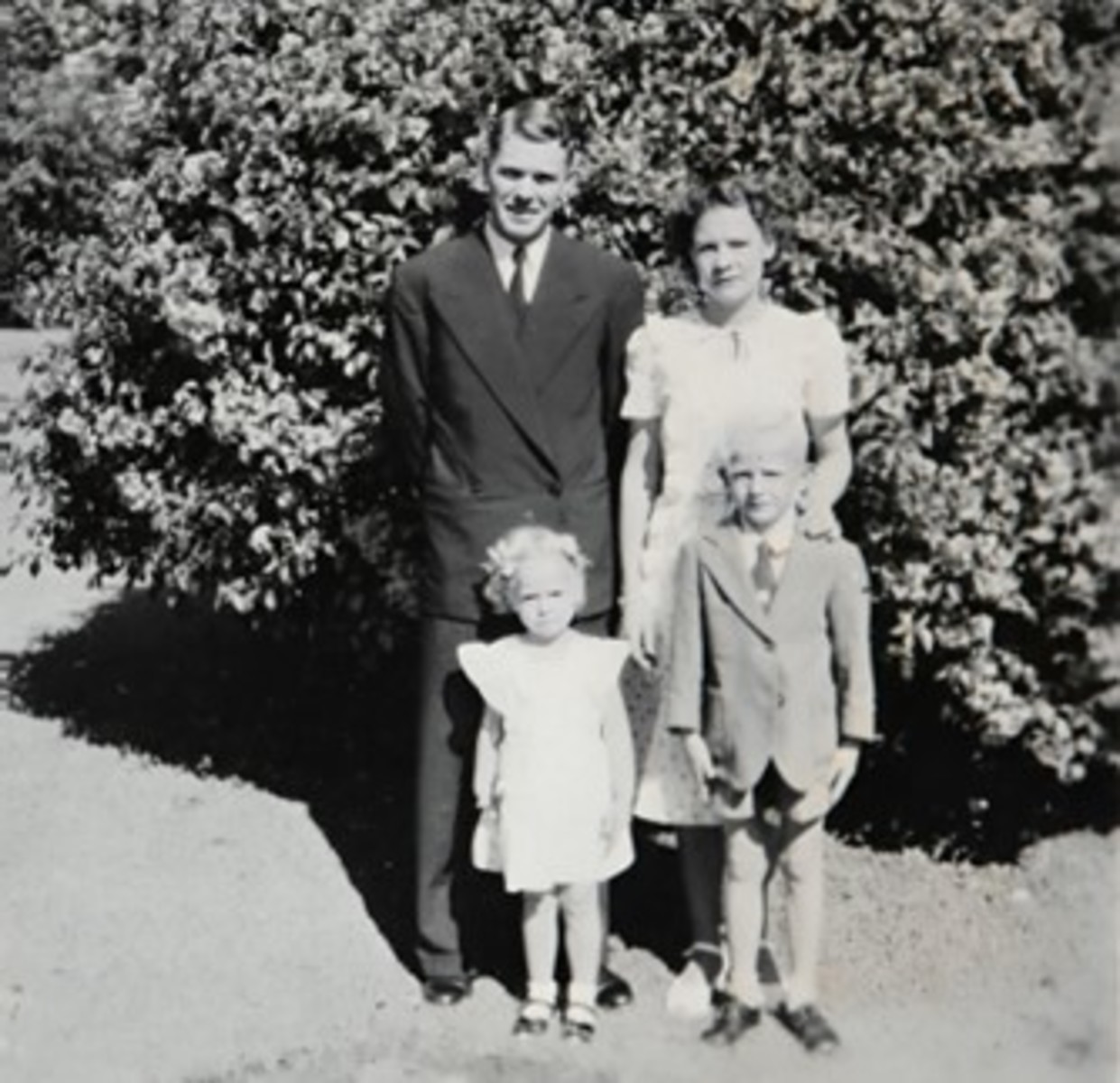
The Webster family during their time in Kenya. Kenneth and Mavis with their children Ferne and Victor. Photo courtesy of Godfrey K. Sang
Webster, Kenneth Gordon (1919–2001) and Mavis Pambalene (Wilson) (1918–1968)
By Godfrey K. Sang
Godfrey K. Sang is a historical researcher and writer with an interest in Adventist history. He holds a B.A. in History from the University of Eastern Africa Baraton and a number of qualifications from other universities. He is a published author. He is the co-author of the book On the Wings of a Sparrow: How the Seventh-day Adventist Church Came to Western Kenya.
First Published: October 30, 2024
Kenneth and Mavis Webster were long-serving missionaries in various countries in Africa, including Kenya when he served as the superintendent of the Nyanchwa Mission in Kisii and in various mission stations in Tanzania.
Early Life
Kenneth Gordon Webster was born on April 14, 1919, in South Africa.1 He was the second of the five children of William George Webster (1887-1969) of Kalomo, Northern Rhodesia (now Zambia), and Grace Emmelin Webster (née Butcher) (1895-1988).2 Kenneth’s parents were pioneer Adventists, his father becoming a settler farmer who raised his family on their farm in Kalomo. His mother’s parents were some of the earliest Adventists in South Africa, coming to the faith in the pioneering days of the first missionaries. Many of Kenneth’s family members served in various capacities in the Adventist Church either as missionaries, evangelists, or as administrators. His uncle, M. M. Webster (the brother of W. G. Webster), was a renowned Adventist administrator.3
Family
On December 22, 1942, Kenneth Webster married Mavis Pembalene Wilson.4 They were married at the church in the Ikizu Mission, Musoma, in northern Tanganyika. Mavis was the daughter of Pastor John Victor Wilson (1890-1955) and Jane Wensley Wilson (1890-1980).5 Mavis Pambalene Wilson was born on August 25, 1918, in Lusaka,6 Northern Rhodesia (now Zambia).7 She was the second daughter of Elder Wilson, who at that time served as the superintendent of the North Rhodesia Mission.8 Like most missionary children, Mavis and Kenneth attended Helderberg, which is where they met and dated before marrying.
Ken Webster’s elder brother, William Max Webster, was himself a veteran missionary who served in various countries in Africa including in Kenya. His other brother, Lionel V. Webster, who was a teacher at Helderberg College in South Africa. He had two sisters--Daphne Rhoda, who was married to Pastor Stephen Palvie, and Shirley Mae, who was married to Kenyan-born Pastor Ken E. Thomas.9 Ken Edwin Thomas was the son of veteran British missionary Pastor Frederick H. Thomas (1899-1987), who arrived in Kenya in 1925. The entire family on both sides were missionaries in various places in Africa.
Kenneth and Mavis were blessed with two children–Victor Webster and Ferne Elaine Webster.
Missionary Service
Kenneth Webster and his wife Mavis attended Helderberg College and, after completion of their studies, they joined missionary service. In 1942, K. G. Webster began serving at the Tanganyika Mission Field.10 He became a school teacher at the Suji Mission in Makanya, Tanga, in southern Tanganyika, serving under Harry Robson. After they were married in Ikizu in 1943, Mavis joined him at Suji where she ran the Suji Dispensary while he served as the headteacher at the Suji Primary School.11 In 1944, he was replaced at the school by G. van Niekerk, and he became the director of the Suji Mission while his wife continued to serve at the Suji Dispensary.12 They served there until 1948.13
Moving to Kenya
In 1949, the Websters accepted the call of service to Kenya. They moved to Nyanchwa Mission in Kisii in south-west Kenya.14 Mavis Webster served at the Nyanchwa Dispensary. In the first eight months of 1949, Kenneth Webster reported over 1,000 baptisms in his station alone.15 Webster worked in the Kenya Mission Field under E. W. Pedersen as president. He also served as an Executive Committee member.16
In 1951, Kenya was noted as one of the fastest-growing regions in the Southern Africa Division.
Between 1946 and 1950, the number of churches in Kenya increased from 62 to 87, marking a 40 percent rise.17 Baptisms saw a dramatic increase of 203 percent, with numbers growing from 1,099 to a total of 3,333 during that period. Church membership more than doubled, increasing from 7,706 to 15,825, reflecting a 105 percent rise.18 Bible classes also experienced significant growth, with the number of participants increasing by 150%, from 5,084 to 12,692. The number of adherents grew by 130 percent, from 12,357 to 28,447. Sabbath Schools increased by 25%, from 266 to 334, and Sabbath School membership saw a substantial rise of 172%, growing from 14,268 to 38,849.19 Adventist schools saw an addition of 208 new institutions, with pupil enrollment rising by 56 percent, totaling 15,829.20
Kenya, at this time, had six European-directed mission stations and districts in operation including one ran by an African. There Changamwe was under J. A. Schoeman while K. J. Berry led Chebwai. F. H. Muderspach managed Gendia, and W. C. S. Raitt oversaw Karura. Maliera, although directed by F. H. Muderspach, lacked its own station and was still operated from Gendia. Nyanchwa was directed by K. G. Webster, and T. F. Duke led the Ranen District.21 Additionally, there was an African-directed station, the Kipsigis Mission, managed by P. Nyamweya. The training school had V. E. Robinson as its principal, and the hospital was under Dr. Ammundsen’s care. In 1950, two new girls’ schools were established, increasing the total to four. These schools were located at Chebwai, managed by Mrs. Berry; Kamagambo, under the direction of Miss Leeper; Karura, led by Miss Thea Neilsen; and Nyanchwa, managed by Miss J. Teixeira.
In April 1952, Mavis Webster’s parents, Pastor John V. Wilson and Mrs. Wilson, visited them at Nyanchwa.22 The Wilsons had recently retired from their work at Helderberg College.
Growth in Kenya
Kenya was going through a period of tremendous growth. In 1952, East Africa Union President E. D. Hanson reported that mission directors who had previously managed the responsibility of a few hundred members now had to shepherd between 5,000 and 7,000 baptized members, with an additional 4,000 to 5,000 preparing for baptism.23
In 1951, Pastor K. G. Webster led the Nyanchwa Mission District and baptized 1,567 individuals. Pastor T. F. Duke baptized 1,170 in the Ranen District while Pastor F. H. Muderspach baptized over 700 and anticipated baptizing more than 1,000 in 1952.24
Moving to South Africa
In February 1955, Mavis Webster buried her father, Pastor John V. Wilson, who died suddenly while on transit via Nairobi. He had been battling ill health, but he got worse while they stopped over in Nairobi. He was on his way to visit his older daughter, Ferne Ellingworth, who was based in Tanganyika. Pastor Wilson was laid to rest in Karura, six miles from Nairobi.25
Later that year, the Websters accepted the call to move to South Africa. In 1956, the Websters moved to the Natal-Transvaal Conference and served at the North Bantu Mission. Webster was appointed the secretary-treasurer. He also served as a member of the Executive Committee. This conference was headed by Pastor A. W. Staples as president and Pastor R. E. Clifford as secretary-treasurer.26
Moving to Nyasaland
In 1957, K. G. Webster worked at Nyasaland Union Mission as the director of the Matandani Mission Station,27 serving there until 1959.28 The following year, in 1960, Webster was appointed the secretary-treasurer of the Rhodesia Conference.29 He also served as the departmental secretary for Book & Bible Study and also Publishing.30 He remained at the Rhodesia Conference (based in Gwelo–now Gweru) until 1964.31
Return to South Africa
In 1965, Webster returned to South Africa, serving as an ordained minister in the South African Union Conference and also as secretary-treasurer and auditor.32 He was now based in Bloemfontein. He remained in this position until 1981.33 During this same period he was also a member of the Board of Management of the denominationally-owned National True Foods Limited alongside E. C. Webster and M. L. Mills and six others. He served on the Board until 1977.34 In 1977, the SAU President F. Campbell was replaced by E. Armer, but K. G. Webster remained as the secretary-treasurer.35 In 1978, he became a member of the Board Trustees of the Helderberg College in Somerset West, Cape.36
In 1981, Webster retired and was replaced by C. D. Verwey as secretary while J. J. van der Ness became treasurer.37
Retirement and Legacy
K. G. Webster retired in 1982 after serving at the South African Union Conference from 1965 to 1982. This was a time of tremendous changes in the denominational structure, operating within a hostile racially charged national situation. In 1948, South Africa formally adopted the policy of Apartheid–legally sanctioned racial segregation. This would impact the Adventist Church enormously. While Webster had served in racially diverse nations, his return to South Africa in 1965 followed the decision to merge the racially divided Groups I and II of the South African Union Conference.38 The two groups had been created in December 1960, when representatives from the General Conference, the Southern African Division, and the South African Union Conference met with those from the local fields to plan a reorganization aimed at increasing responsibilities for the African ministry and membership. As a result, the South African Union was administratively divided into two groups: Group I consisted of organizations, both conference and field, serving the non-Bantu population within the union’s territory. Group II comprised organizations serving the indigenous African population, with headquarters in Johannesburg. To lead Group II, a union vice president, secretary-treasurer, field secretary, and auditor, along with both White and African departmental secretaries, were elected to oversee the work in the Republic of South Africa, Basutoland (now Lesotho), and Swaziland (now Eswatini).39
The African constituency was divided into nine fields, each headed by an African president and secretary-treasurer. The years following this reorganization confirmed the wisdom of placing greater responsibility upon the African ministry. Due to concerns that too many workers were absorbed in administration at the expense of departmental functions, the number of fields was reduced to five at the end of 1962.
In November 1965, it was decided to dissolve Groups I and II and form two separate unions: the South African Union, responsible for the work among White, Colored, and Indian people, and the Southern Union (SU), which focused exclusively on the Black work. It was at this point that Webster was appointed to take charge of the Southern Africa Union Conference (SAUC).40 These unions, comprising a combined 11 conferences and fields, ministered to approximately 15 million people in five languages. K.G. Webster oversaw the functions of the fields under the SAUC when he became the secretary-treasurer in 1965. In 1980, the territory covering the Transvaal and Orange Free State was reorganized into the Trans-Orange Conference. Despite the challenges of racial segregation, the Adventist work in South Africa continued to grow and today remains one of the largest denominations in South Africa.41
Kenneth Gordon Webster died in July 2001 in Port Elizabeth, South Africa.42 His wife, Mavis Pambalene Webster, passed away in November 12, 1968, after an illness. She died at the National Hospital, Bloemfontein.43 After her death, Kenneth remarried and was survived by his wife Loris.
Sources
Ellingworth, Mrs. Brian. “Excerpt from a Letter Received from Mrs. B. Ellingworth Regarding Her Father, Pastor J. V. Wilson.” Southern Africa Division Outlook, May 1, 1955.
Garne, G. E. “The Websters of Kalomo.” Southern Africa Division Outlook, May 15, 1963.
Familysearch.org. Accessed June-July 2024.
Hackman, E. F. “GOD’S TRUE CHURCH, News Notes.” Southern Africa Division Outlook, March 1, 1950.
Hanson, E, D, “East African Union, News Notes.” Southern Africa Division Outlook, May 1, 1952.
Hanson, E. D. “News Notes.” Southern Africa Division Outlook, May 1, 1952.
Hanson, E. D. “Sasa Hivi.” Southern Africa Division Outlook, December 1, 1949.
Hanson, E. D. “The Gospel Net in East Africa.” Southern Africa Division Outlook, August 1, 1952.
Pedersen, E. W. “Report of the President of the Kenya Mission Field.” Southern Africa Division Outlook, August 15, 1951.
Seventh-day Adventist Encyclopedia. Second revised edition. Hagerstown, MD: Review and Herald Publishing Association, 1996. S.v. “Webster, Kenneth.”
Seventh-day Adventist Yearbook. Various years. https://www.adventistyearbook.org/.
Notes
-
https://www.familysearch.org/ark:/61903/1:1:QK9Q-9TZ6, June 10, 2024.↩
-
https://www.1820settlers.com/, (William George Webster), accessed July 11, 2024.↩
-
E. F. Hackman, “GOD’S TRUE CHURCH, News Notes,” Southern Africa Division Outlook, March 1, 1950, 2.↩
-
https://www.familysearch.org/ark:/61903/1:1:QK9Q-9TZ6, June 10, 2024.↩
-
E. D. Hanson, “East African Union, News Notes,” Southern Africa Division Outlook, May 1, 1952, 5.↩
-
https://www.familysearch.org/tree/person/details/LRX7-CF5, accessed July 18, 2024.↩
-
https://www.familysearch.org/tree/person/details/G8JM-7CT, accessed July 18, 2024.↩
-
“North Rhodesia Mission,” Seventh-day Adventist Yearbook, 1922, , 141.↩
-
G. E. Garne, “The Websters of Kalomo,” Southern Africa Division Outlook, May 15, 1963, 9,↩
-
“Suji Primary School and Mission Station,” Seventh-day Adventist Yearbook, 1943, 162.↩
-
“Suji Primary School and Mission Station,” Seventh-day Adventist Yearbook, 1944, 160.↩
-
“Southern Africa Union Conference,” Seventh-day Adventist Yearbook, 1945, 161.↩
-
“Southern Africa Union Conference,” Seventh-day Adventist Yearbook, 1947, 162.↩
-
“Nyanchwa Mission Station,” Seventh-day Adventist Yearbook, 1949, 176.↩
-
E. D. Hanson, “Sasa Hivi,” Southern Africa Division Outlook, December 1, 1949, 5.↩
-
“Southern Africa Union Conference,” Seventh-day Adventist Yearbook, 1949, 175.↩
-
Ibid.↩
-
Ibid.↩
-
Ibid.↩
-
Ibid.↩
-
E. W. Pedersen, “Report of the President of the Kenya Mission Field,” Southern Africa Division Outlook, August 15, 1951, 5.↩
-
E. D. Hanson, “News Notes,” Southern Africa Division Outlook, May 1, 1952, 6.↩
-
E. D. Hanson, “The Gospel Net in East Africa,” Southern Africa Division Outlook, August 1, 1952, 7.↩
-
Ibid.↩
-
Mrs. Brian Ellingworth, “Excerpt from a Letter Received from Mrs. B. Ellingworth Regarding Her Father, Pastor J. V. Wilson,” Southern Africa Division Outlook, May 1, 1955, 8.↩
-
“Southern Africa Union Conference,” Seventh-day Adventist Yearbook, 1956, 163.↩
-
“Southern Africa Union Conference,” Seventh-day Adventist Yearbook, 1956, 163.↩
-
“Southern Africa Union Conference,” Seventh-day Adventist Yearbook, 1959, 174.↩
-
“Southern Africa Union Conference,” Seventh-day Adventist Yearbook, 1960, 183.↩
-
Ibid., 184.↩
-
“Southern Africa Union Conference,” Seventh-day Adventist Yearbook, 1964, 262.↩
-
“Southern Africa Union Conference,” Seventh-day Adventist Yearbook, 1965&66, 257.↩
-
“Southern Africa Union Conference,” Seventh-day Adventist Yearbook, 1981, 308.↩
-
“Southern Africa Union Conference,” Seventh-day Adventist Yearbook, 1978, 415.↩
-
“Southern Africa Union Conference,” Seventh-day Adventist Yearbook, 1977, 292.↩
-
“Southern Africa Union Conference,” Seventh-day Adventist Yearbook, 1978, 346.↩
-
“Southern Africa Union Conference,” Seventh-day Adventist Yearbook, 1982, 316.↩
-
Seventh-day Adventist Encyclopedia (1996), s.v. “Webster, Kenneth.”↩
-
Ibid.↩
-
Ibid.↩
-
Ibid.↩
-
https://www.familysearch.org/tree/person/details/LRX7-428, accessed June 10, 2024.↩
-
https://www.familysearch.org/ark:/61903/1:1:QK9Q-9TZ6, accessed June 10, 2024.↩