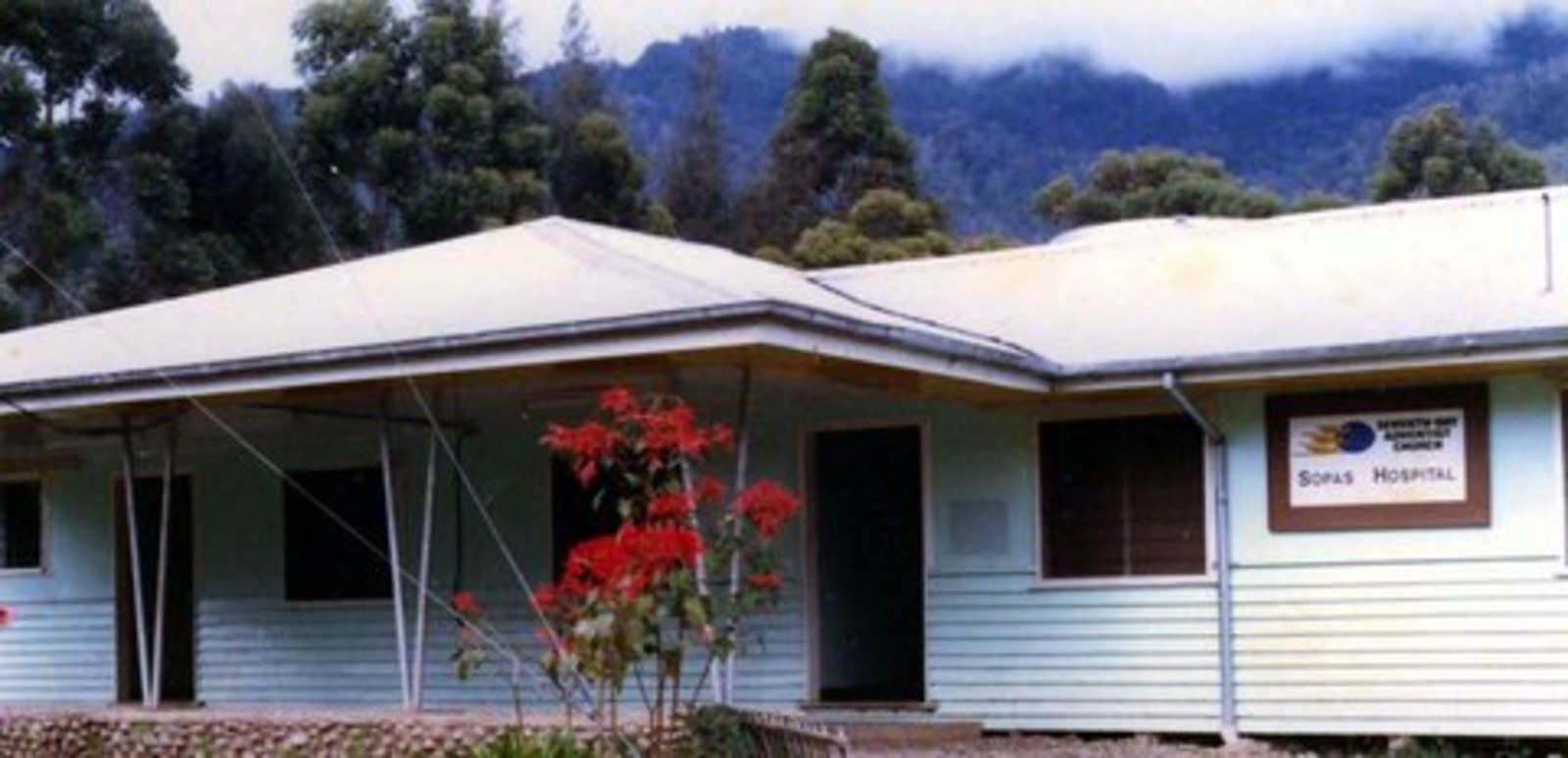
Front entrance of Sopas Hospital, c. 1984.
Photo courtesy of Lola Hill.
Sopas Adventist Hospital, Papua New Guinea
By Lola Hill Wilkinson
Lola Hill Wilkinson, Diploma of Nursing and Midwifery Education (N.S.W. College of Nursing, Sydney, Australia) retired in 1998 from Sydney Adventist Hospital, Wahroonga, Australia. An Australian, Lola has served the church in mission hospitals in East Africa and Papua New Guinea. In retirement she keeps busy volunteering in the retirement village where she lives and in her local church. She has authored several articles published in Australasian Record. She is happily married to Ray.
First Published: January 28, 2020
Sopas Adventist Hospital operated between 1963 and 2000 in Papua New Guinea. It was located near the town of Wabag in the Western Highlands Province. After independence in 1975 and the redistribution of provincial boundaries, the hospital was located in the Enga Province. A School of Nursing, one of the most significant Schools of Nursing in Papua New Guinea, was affiliated with the hospital between 1966 and 2000, when it was transferred to the campus of Pacific Adventist University, near Port Moresby.
Historical Background
Southeast New Guinea had been declared a protectorate of Britain in 1884 and created a colony in 1888. Germany annexed the northern part of the country. On September 3, 1906, control of British New Guinea was transferred to Australia and renamed Papua. During World War I Australian forces occupied German New Guinea.1 On May 19, 1921, Australia began civil administration of the Mandated Territory of New Guinea (the former German New Guinea).2
Beginning of Seventh-day Adventist Work
Seventh-day Adventist (SDA) missionaries from Australia started work in Papua in 1908, with a mission station being established at Bisiatabu.3 Advancement to other areas was slow and restricted by government regulations. After the end of World War I missions were started in the St. Matthias Group and then in New Britain. But there was still no work in the Highlands until 1934, when a mission station was opened on the Ramu Plateau4 and in 1937 at Bena Bena near Goroka.5
Then came World War II and the Japanese invasion and occupation of Papua and New Guinea, which resulted in the evacuation of most of the expatriate missionaries.6
Beginnings in Wabag Area
When the war was over, Australia was given mandate by the League of Nations and United Nations Trust to administer Papua and New Guinea as a single territory. This resulted in restrictions being lifted in areas that had formerly been closed to Missionaries. On July 1, 1947, restrictions were lifted in some uncontrolled areas in the western portion of central New Guinea, an area with a population of 250,000 people who all spoke the same language. Providentially, an ideal site for a mission and school was found and procured, just a few miles from the airstrip and government post at Wabag. The people were told that it was hoped to establish a hospital in the Wabag area.7 On November 4, 1947, Frank Maberly with his wife, Liela, and their baby daughter, Rhondda, arrived in Wabag to establish the mission.8 The Seventh-day Adventist Church was the first denomination to open a Christian mission in the Wabag area.9
Medical Work Begins in the Highlands
In June 1949 a hospital for lepers was opened at Togoba eight miles west of Mount Hagen by Leonard H. Barnard. The hospital was well received.10 In August 1953 a small hospital and a medical training school were opened at Omaura in what is now known as the Eastern Highlands. The missionary appointed to that task was Lester Hawkes.11 Infant and maternal welfare work was being done by the wives of the missionaries.12
Planning for the New Hospital
At the third quadrennial session of the Australasian Division, held in November 1959, it was reported that enough funds had been made available from the Sanitarium Health Food Company to enable the division committee to vote for “the establishment of a new hospital in New Guinea and the support of several families, including a doctor and nurses, to staff this institution.” 13
Laurence C. Naden, the secretary of the Australasian Division, in his presentation at the Annual Council held at Wahroonga, November 20–22, 1961, reported as follows: “The Thirteenth Sabbath Offering overflow for the third quarter of 1960 came to the Australasian Division, and we received £30,567 toward the construction of the hospital at Sopas in the Western Highlands of New Guinea.”14
The Search for Land
The search for suitable land began in 1960. It was decided that the site for the hospital should not be more than a few miles west of the Wabag airfield. This was the farthest west for the landing of DC-3 aircraft. The use of smaller planes, which could land on the smaller airfields, would cost more. Because of the mountainous terrain and few roads, air transport was essential. Other criteria were streams with ample potential for hydroelectric power and an abundance of timber nearby for the planned sawmill. The site at Sopas was the most suitable. Within reasonable proximity were seven organized churches. There were nearly six hundred church members and four thousand Sabbath School members in the area, with another 1,500 not far away.15
Negotiations to procure the land involved 132 landowners. This proved to be a lengthy and difficult process. The missionaries and church members prayed earnestly. A providential meeting at Wabag between John B. Keith, Coral Sea Union Mission (CSUM) president, and Sir Donald Cleland, the administrator, removed the obstacles. Within a short time the land was obtained and the work begun.16
The Building of the Hospital
F. L. Aveling, an Australian Seventh-day Adventist, had been working in the Mt. Hagen area since 1949. He was invited by J. B. Keith to supply the timber and oversee the building of the hospital. Mr. Aveling already had many years’ experience in saw milling and working with timber in the highlands and knew the difficulties.17
Ralph Murray, already working for CSUM, was invited to be head carpenter. Cliff Butler, an electrician who was also skilled in carpentry and plumbing, was appointed. There were many difficulties to be overcome. Timber was being milled locally, but almost everything else, including cement and roofing iron, had to be brought in by air, as there were no roads. This increased the cost considerably. For example, the cost of cement per ton was increased almost two and a half times because it had to be flown in from the port of Madang.18
Gravel for the concrete work was a major problem. Women and children were employed to collect small pebbles and rocks from the nearby Lai River, load them into their closely woven bilums (string bags), and carry them up the steep hill to the hospital site. There they sat and painstakingly cracked these stones into smaller pieces using another stone, or a metal hammer if available.19
The building work began in October 1960. Homes for the doctor and nursing staff were built first. Then work on the hospital itself began. An administration block, which included an operating theater, sterilizing room, X-ray, outpatient department, hydrotherapy, medical storeroom, offices, and toilets, soon took shape. A covered walkway in a herringbone shape connected the four wards. Two large underground water tanks for collecting rainwater were installed near the hospital. Finally, the hydroelectric scheme was completely installed and was supplying 240-volt AC current for light and power. By April 1963 all the buildings on the original plan were completed, and the hospital was in operation.19
The Medical Work Begins
Medical work began at the site in early 1961. Dr. Roy Yeatts, who had been director of Togoba Hansenide Hospital near Mount Hagen, returned from furlough in the United States in February 1961. A clinic was set up in a thatch-roofed bamboo building, part of which was also used as a toolshed and storeroom. It was not long before word spread that the doctor had arrived and the patients began coming. Mrs. Yeatts, a qualified nurse, assisted her husband.20
In September 1961 two Australian nurses, Linda McClintock and June Rogers, who had already spent some years at the Togoba Hansenide Hospital, arrived at Sopas.21 At this time outpatient care only was possible. In addition to assisting Dr. Yeatts in the outpatient clinic, the nurses set up a maternal and child welfare clinic.22
Official Opening
The official opening took place on September 18, 1963. The district commissioner officiated by cutting the ribbon. Present were Pastor Robert R. Frame, president, Australasian Division; O.D.F. McCutcheon, president, and J. Sherriff, secretary-treasurer, CSUM; Helier M. Pascoe, local mission director, with his wife, Joyce, as well as other missionaries. Several government officials were also present.23
Administrators at the time of the opening were Dr. Roy O Yeatts, medical officer; nursing supervisors Linda McClintock24 and Angelina Guizzardi.25
Initially there were 45 beds. With the establishment of the Nursing School, it became necessary to increase the bed numbers to meet Nursing Council (NC) requirements for the training of nurses. Three wards built of local materials were quickly constructed, and within a few weeks they were filled.26 Wards built of permanent materials were added later.27
Type of Care Given
Sopas Hospital provided medical care to the people living in a large area around the institution. For many years it was the only hospital west of Wabag with facilities for major surgery. It had basic X-ray and laboratory services. There were four main wards—male, female, pediatric, and maternity. The outpatient department was open six days a week. It was closed on Sabbaths, but emergencies were cared for. A small private ward was also available.
Many and varied were the reasons people came for help. Respiratory conditions, acute and chronic, often serious, were common. The nights in this area of high altitude (7,500 feet) were cold and wet, and the traditional houses were kept warm with an open wood fire, the smoke finding its way out through the thatched roof. This meant the atmosphere was often smoky, resulting in respiratory conditions. Pneumonia in both adults and children was common. Children sometimes rolled or fell into these open fires, with serious burns resulting. Broken bones from falls or vehicle accidents were common. Tribal fighting was a way of life. The injuries from these wars fought with bows and arrows, bush knives and axes could be superficial or very serious, with arrows entering and damaging vital internal organs. Pigbel, a form of acute, segmental, necrotizing enteritis, frequently followed a sing-sing (tribal dance), with its accompanying feast of pig meat. Treatment of this condition often required bowel resection and anastomosis. A tribal practice of “bush thoracotomy” to “treat” chest conditions would require closed chest drainage. The hospital physician and the nurses assisting were frequently called upon to find skills for which they had no specific training or experience. Prayer to the Master Physician was standard practice, not only before the operation, but often during the procedure when a need was felt.
Patients were referred to the hospital from the many health centers in the area. Expatriates—missionaries and others—would come for treatment, sometimes being flown in from distant places in PNG.
The number and intricacy of surgeries being performed at the hospital was increased when experienced surgeons from other countries such as Australia and the United States offered their time and expertise.
The reputation of the hospital became known internationally. This resulted in visits by nursing and medical students from Australia, New Zealand, and the United States.28
Award to Staff
In May 1977 Marlene Broad, director of nursing, was awarded the bronze Independence Medal for nursing care at Sopas Hospital.29
Further Developments
In 1985 Sopas Hospital was officially designated as the Provincial Hospital for the Enga province. This entitled the hospital to financial operating support from the government, but was still fully under the jurisdiction of Papua New Guinea Mission (PNGUM).30
On August 12, 1987, a new building, living quarters for qualified nursing staff, was opened. The building was commenced by two volunteer builders and completed by fly ’n’ build teams from Warburton, Wahroonga, Cooranbong, and Brisbane.31
In 1987, with financial assistance from ADRA, two-way radios that enabled the hospital to keep in touch with the flying doctor (see below) as well as with mobile units in their two vehicles were installed.32
A new modern obstetric ward was opened on April 11, 1995.33
Public Health Program
In February 1964 a public health program based at Sopas Hospital was begun. Dr. Robert Wood headed the program. Dr. Saleem Farag from Loma Linda University assisted for three months. Two nurses already doing missionary work in New Guinea, Olive Fisher and Ione Markey, were to work with Dr. Wood.
A training program for public health workers began on April 10, 1964. The students came from CSUM and Bismarck-Solomons Union Mission (BSUM). The course was for one year. Later a two-year ministerial health course was introduced. In 1965 Schools of Nutrition were introduced. By 1967, 470 had already graduated.34
In 1965 Dr. Wood replaced Dr. Yeatts as medical director of the hospital. Dr. Saleem Farag returned to Sopas to lead out in the public health program and training, as well as hold the position of health secretary of CSUM. The students in the public health program played a major role in the extensive health education program at the hospital as well as in 18 bush clinics in the surrounding area. Nurses conducted the infant welfare clinics, and the public health students gave talks and demonstrations on various aspects of health. At these clinics they would see as many as four thousand children per month. Travel was by Land Rover over very rough mountain roads. Every Sabbath the staff and students were involved in running branch Sabbath Schools in many of these areas. At the 1966 quadrennial session of the Australasian Division Dr. Siegfried A. Kotz, division medical secretary, reported that in 1965, as a result of these branch Sabbath Schools, there had been thirty baptisms at Sopas. One thousand interested people were attending the branch Sabbath Schools, with one hundred preparing for baptism.35
Early in 1969 Alwyn Galwey, an Australian, was appointed director of public health training to replace Dr. Farag, who had been appointed to the position of medical secretary of the Australasian Division. The program continued until the end of 1970.36 The maternal and infant welfare program continued until the closure of the hospital in 2000.
The School of Nursing
The first class commenced training in January 1966. Students came from BSUM as well as CSUM. Provisional accreditation only was given by the NC for one year.37 Approval was given in 1967 for students to continue for the second year.38 The Sopas students did very well academically, but the NC was concerned that they were not receiving adequate experience and training in medical and surgical nursing, so after two years and eight months at Sopas they were required to attend another eight months at Lae Hospital before sitting for the final government examination.
In 1971 Sopas Hospital was given registration to fully train “enrolled nurses.”39 On January 20, 1974, the first graduation for 13 enrolled nurses fully trained at Sopas was held.40 At the same time a two-year medical aid post orderly (“doctor boy”) course was completed by eight men. The nurses and aid post orderlies had been trained by Ron Plane (principal nurse educator), Olive Fisher, and Dr. Don Kelly. The results were excellent, with 100 percent passing the government examinations in both courses. In both courses first place in the country was awarded to a Sopas student: Linnah Pugian in nursing and Ropio Serepa in the aid post orderly course.41
In 1977 Sopas School of Nursing faced another crisis. The hospital was without a doctor for nine months. Patient numbers decreased, and no major surgeries were performed. The NC, with concerns relating to the practical experience in surgical nursing, required the third-year students to go to Mount Hagen Hospital, 110 kilometers (70 miles) away, for one month. The students went in pairs, until all had gained this experience. The new medical director, Dr. Hilda Rainda, arrived in October, and it was not long before Sopas was a fully functioning hospital again and soon overflowing with patients. The NC was informed of this, but word was received that the Nursing School had been deregistered. Strong representation was made, with the result that limited reinstatement was granted, dependent on continued good patient average numbers and diagnoses.42
In 1981, because Sopas nursing students were receiving a good amount and variety of surgical nursing experience at Sopas Hospital, the NC agreed that the students no longer needed to go to Mount Hagen Hospital.43
By 1983 the NC was phasing out the enrolled nurse course and required all nursing schools to upgrade to the general nurse course (registered nurse). To continue training nurses at Sopas, the hospital would need to be enlarged and facilities improved. There was also a requirement to increase the number of qualified nursing staff. The year 1983 was the last intake of nurses for the enrolled nurse course.44
In 1984 the Australasian Division gave approval for Sopas Nursing School staff to prepare the syllabus for the new course. Plans were also being worked on for the new building development.45 By the end of 1984 the syllabus had been submitted to the NC and approval given.46 The first class for the new course commenced in 1985 and graduated in 1988.47
In 1987 a new School of Nursing building was constructed. Funds came from a family bequest. The main work was done by a fly ’n’ build from Gosford SDA Church, assisted and supervised by Ken Boehm, projects officer for PNGUM.48
In 1989 the possibility of combining Sopas Nursing School and Pacific Adventist College for diploma-level nurse training was explored. The concept was supported by both government and church representatives.49
Sopas nursing students gained experience in caring for most types of conditions at Sopas, but tropical diseases were not common, because of the high altitude and cool climate. In 1990 a new program was commenced and funded through ADRA. Two senior students at a time were transported in the Adventist mission aircraft to a clinic at May River and stayed a month helping in the main clinic and several smaller ones. The clinic was staffed by volunteers from the lay organization Adventist Frontier Mission.50
Sopas nursing students continued to excel academically. In the final government examinations in 1991 they received the highest average ranking of all nursing schools in PNG.51
In 1994 Sopas School of Nursing was granted permission to continue until at least the year 2000.52
In 1998 the PNG, NC, and government Health Department approved the affiliation between Sopas School of Nursing and Pacific Adventist University (PAU) to offer a diploma in nursing course. This was to commence in 1999.53
When the hospital closed in November 2000, the Sopas School of Nursing was relocated to Pacific Adventist University.
The Flying Doctor Program
The flying doctor program was started early in 1982 by Ken Vogel (district director/pilot based at Rakamanda, Enga) and Dr. Robert Wat (medical director, Sopas Hospital). It started small at first, as there was no budget. Every two months Dr. Wat joined Ken Vogel as he did his regular visits to three places, Maramuni, Paiela, and Sisiman. Soon the word spread, and there were invitations to other places, such as Porgera. Some of these areas had a clinic usually staffed by an aid post orderly (APO). Some had no medical help at all. Where there was a clinic, there would be patients waiting to be seen by the doctor. Donations started to come in which meant that they were able to make flights just for the flying doctor work. The Engan provincial government offered K5,000 a year to assist, which enabled the program to expand its reach and frequency. It became routine for a qualified nurse and often a student nurse as well to be included. At the places where there was no medical service at all maternal and child health and immunization clinics were held, and treatments provided to the sick. The doctor often performed minor surgery, and sometimes a patient together with a family support person would need to be urgently transported to Sopas Hospital for major surgery or other hospital care.54
Problems with availability of aircraft and funds resulted in the program’s being stopped in the early 1990s. At the end of 1993 more funds became available, mainly through regular donations from churches in Australia. The program recommenced in 1994 and continued for the next few years. Monthly trips were made to remote areas in Enga and the Sepik and as far west as the Irian Jaya border.55
The Closing of the Hospital
On August 20, 1999, the hospital was temporarily closed because of harassment of staff and visiting contract workers by neighboring villagers. There was concern for the safety of the workers and the nursing students.56 After talks with these villagers the hospital was reopened on August 30.57
Unfortunately, peace did not last. Toward the end of 2000 there was an escalation in violence, there were repeated threats from armed individuals and groups, the hospital ambulance and bus were damaged, and an attempt was made on the life of the director of nursing, Francis Makop. The decision was made to close the hospital at the end of November 2000. Patients were transferred to other hospitals in Wabag and Mount Hagen.58
Conclusion
For almost 40 years Sopas Adventist Hospital cared for the health needs of the people of the Enga province and beyond. Public health workers, aid post orderlies, and nurses were trained, many of whom are still serving throughout Papua New Guinea and in other countries.
In March 2002 PNGUM gifted Sopas Hospital to the people of Enga. “A group of Engans are administering the 100-bed hospital on behalf of the province after reopening it.”59
Chief Medical Officers
Dr. Roy Yeatts, 1961–1965; Dr. Robert Wood, 1965–1969; Dr. Charles Hammond, 1969–1972; Dr. D. B. Kelly, 1972–1974; Dr. P. Truscott, 1974–1976; Dr. Trevor Kerr, 1976–1977; Dr. Hilda Rainda, 1977–1981; Dr. Robert Wat, 1981–1984; Dr. K. Nemba, 1985; Dr. Epeli Nailatikau, 1986–1989; Dr. J. Wallace, 1989–1992; Dr. J. Watts,1992–1994; Dr. F. Munoz, 1995–1998; Dr. Isaac Ogendi Menge, 1998–2000
Chief Executive Officers
Doug Gosling, 1994–1998; Dennis D. Tame, 1999–2000
Official Names
Sopas Hospital (1961 to 1967); Sopas Medical Training Centre (1968 to 1975); Sopas Adventist Hospital (1976 to 2000).
Address: P.O. Box 112, Wabag, Enga Province, Papua New Guinea.
Sources
“A telegram from . . .” Australasian Record, June 12, 1967.
“All of the . . .” Australasian Record, November 2, 1981.
“American Group for New Guinea.” Australasian Record, March 2, 1964.
Aveling, F. L. “You Can Speed the Building of the Hospital.” Australasian Record, September 26, 1960.
Barnard, L. H. “A Hospital for the Lepers.” Australasian Record, August 8, 1949.
Boehm, Ken. “The Heart of Sopas.” Australasian Record, September 23, 1985.
Campbell, A. J. “Advancement in Central New Guinea.” Australasian Record, June 14, 1937.
———. “Leaving New Guinea.” Australasian Record, July 7, 1942.
———. “The Man Who Changed His Mind.” Australasian Record, September 26, 1960.
Clifford F. G. “New Budget Provided for Advance in Home and Mission Territories.” Australasian Record, January 19, 1959.
“Continue Nursing.” Record, August 20, 1994.
Davis, Dot. “Hospital Manager’s Wife Sends Snippets from Sopas.” Record, August 8, 1987.
Dunstan, Lee. “Burns Baby Leads to Building of New Church.” Record, November 28, 1998.
———. “Flying with the Sopas Doctor.” Record, November 28, 1998.
“Exciting news from . . .” Australasian Record, May 18, 1985.
“Family Bequest Plus Fly ’n’ Build Provide New Sopas Nursing School in PNG.” Record, October 3, 1987.
Farag, S. A. “Progress of the Public Health Scheme in New Guinea.” Australasian Record, May 25, 1964.
———. “Sopas in 1967—A Story of Crisis and Success.” Australasian Record, May 29, 1967.
Fisher, Olive. “Seeing Results from the Clinics.” Australasian Record, October 26, 1964.
“Flying Doctor.” Record, December 8, 1990.
Gates, E. H. “Report of the Missionary Secretary.” Union Conference Record, September 7, 1908.
Greive, L. T. “Modern Hospital Opened.” Australasian Record, October 28, 1963.
Harrold, Percy/ Ray Coombe/ANN staff. “Tribal Conflict Forces Closure of Adventist Hospital in Papua New Guinea.” Adventist News Network, December 4, 2000, accessed July 19, 2018. https://news.adventist.org/en/all-news/news-go-2000-12-04/tribal-conflict-forces-closure-of-adventist-hospital-in-papua-new-guinea/.
Hawkes, L. N. “The New Venture.” Australasian Record, August 31, 1953.
———. “Sopas—for Dedication and Excellence.” Australasian Record, June 12, 1978.
Hill, Lola. “The Last Class?” Record, April 16, 1983.
Howell, L. I. “Advance Steps in Inland New Guinea.” Australasian Record, October 6, 1947.
“In May of . . .” Australasian Record, November 14, 1977.
Keith, J. B. “Coral Sea Union Mission.” Australasian Record, January 5, 1959.
Kotz, S. A. “Medical Department Report.” Australasian Record, December 5, 1966.
“Misses June Rogers . . .” Australasian Record, September 18, 1961.
“Mission Panorama—North-East New Guinea.” Australasian Record, October 1949.
Murray, Betty. “Sopas Begins to Shine.” Australasian Record, November 5, 1962.
Naden, L. C. “Pith of the Secretary’s Report.” Australasian Record, January 1, 1962.
“New Medical Scheme for Wabag.” Australasian Record, July 15, 1963.
“New Obstetric Ward for Sopas.” Record, July 8, 1995.
Nolan, H. W. “ ‘The Right Arm’ and the Central Highlands of New Guinea.” Australasian Record, December 8, 1947.
Noonan, Andie. “Timeline of Key Events: Papua New Guinea’s Road to Independence.” ABC News, updated September 15, 2015, accessed February 2, 2018. http://www.abc.net.au/news/2015-09-16/timeline-of-papua-new-guinea-road-independence-6748374.
“One of the . . .” Australasian Record, July 29, 1963.
Pascoe, Martin. “A Formidable Task.” Journal of Pacific Adventist History 2, no. 2 (December 2002).
Petrie, W. W. “The New Guinea Inland Mission.” Australasian Record, September 24, 1934.
Piez, E. R. “Coral Sea Union Mission.” Australasian Record, March 20, 1972.
“PNG Considers Diploma Nursing.” Record, September 9, 1989.
Research Guides, Papua New Records 1883-1942. Microfilm Collections: “Mandated Territory of New Guinea Records, 1921-42.” NAA National Archives of Australia, accessed September 27, 2018. https://www.naa.gov.au/sites/default/files/2020-06/research-guide-papua-new-guinea-records.pdf.
Roberts, S. “First Graduation at Sopas.” Australasian Record, June 10, 1974.
Roberts, Sandra. “Top Marks to Sopas Students.” Australasian Record, June 3, 1967.
Rogers, June. “Medical Attention in Kunai Clinic.” Australasian Record, February 19, 1962.
Seventh-day Adventist Yearbook. Washington, D.C.: Review and Herald Publishing Association, 1963.
“Sopas Closes Temporarily to Protect Staff.” Record, September 11, 1999.
“Sopas Graduation.” Record, July 16, 1988.
“Sopas Hopeful.” Australasian Record, April 14, 1984.
“Sopas Hospital Is Tops in PNG.” Record, November 23, 1991.
“Sopas Offers First Nursing Diploma.” Record, August 8, 1998.
“Sopas Reopens as Harassment Stops.” Record, September 18, 1999.
Stacey, Brenton/ANN. “Papua New Guinea: Church Gives Hospital to Community.” Adventist News Network, March 11, 2002. Accessed February 2, 2018. Https://news.adventist.org/en/all- news/news/go/2002-03-11/papua-new-guinea-church-gives-hospital-to-community/.
Stellmaker, Betty (Murray). We Can’t Just Sit Here and Do Nothing. No publisher, no date.
“The Papua New . . .” ARH, August 30, 1984.
“Thirteen nurses received . . .” Record, July 16, 1988.
Yeatts, Mrs. R. O. “Hospital in the Wabag Mountains.” Australasian Record, May 22, 1961.
Yeatts, R. O. “Wabag, New Guinea, Gets a Hospital.” ARH, September 28, 1961.
Notes
-
Andie Noonan, “Timeline of Key Events: Papua New Guinea’s Road to Independence,” ABC News, updated September 15, 2015, accessed February 2, 2018, http://www.abc.net.au/news/2015-09-16/timeline-of-papua-new-guinea-road-independence-6748374.↩
-
Research Guides, Papua New Guinea Records 1883-1942, Microfilm Collections: ”Mandated Territory of New Guinea Records, 1921-42,” NAA National Archives of Australia, accessed September 27, 2018, https://www.naa.gov.au/sites/default/files/2020-06/research-guide-papua-new-guinea-records.pdf.↩
-
E. H. Gates, “Report of the Missionary Secretary,” Union Conference Record, September 7, 1908, 6.↩
-
W. W. Petrie, “The New Guinea Inland Mission,” Australasian Record, September 24, 1934, 8.↩
-
A. J. Campbell, “Advancement in Central New Guinea, Australasian Record, June 14, 1937, 3.↩
-
A. J. Campbell, “Leaving New Guinea,” Australasian Record, July 7, 1942, 3.↩
-
L. I. Howell, “Advance Steps in Inland New Guinea,” Australasian Record, October 6, 1947, 5.↩
-
H. W. Nolan, “ ‘The Right Arm’ and the Central Highlands of New Guinea,” Australasian Record, December 8, 1947, 5.↩
-
“Mission Panorama—North-East New Guinea,” Australasian Record, October 10, 1949, 5.↩
-
L. H. Barnard, “A Hospital for the Lepers,” Australasian Record, August 8, 1949, 4.↩
-
L. N. Hawkes, “The New Venture,” Australasian Record, August 31, 1953, 4, 5.↩
-
J. B. Keith, “Coral Sea Union Mission,” Australasian Record, January 5, 1959, 3.↩
-
F. G. Clifford, “New Budget Provided for Advance in Home and Mission Territories,” Australasian Record, January 19, 1959, 2.↩
-
L. C. Naden, “Pith of the Secretary’s Report,” Australasian Record, January 1, 1962, 2.↩
-
A. J. Campbell, “The Man Who Changed His Mind,” Australasian Record, September 26, 1960, 2.↩
-
Martin Pascoe, “A Formidable Task,” Journal of Pacific Adventist History 2, no. 2 (December 2002): 12.↩
-
F. L. Aveling, “You Can Speed the Building of the Hospital,” Australasian Record, September 26, 1960, 3.↩
-
R. O. Yeatts, “Wabag, New Guinea, Gets a Hospital,” ARH, September 28, 1961, 14.↩
-
Betty (Murray) Stellmaker, We Can’t Just Sit Here and Do Nothing (no publisher, no date), 76, 77.↩
-
Mrs. R. O. Yeatts, “Hospital in the Wabag Mountains,” Australasian Record, May 22, 1961, 2.↩
-
“Misses June Rogers . . . ,” Australasian Record, September 18, 1961, 8.↩
-
June Rogers, “Medical Attention in Kunai Clinic,” Australasian Record, February 19, 1962, 4, 7.↩
-
L. T. Greive, “Modern Hospital Opened,” Australasian Record, October 28, 1963, 8-9.↩
-
“Sopas Hospital,” Seventh-day Adventist Yearbook (Washington, D.C.: Review and Herald Publishing Association, 1963), 346.↩
-
“One of the . . . ,” Australasian Record, July 29, 1963, 8.↩
-
S. A. Farag, “Sopas 1967—A Story of Crisis and success,” Australasian Record, May 29, 1967, 4, 5.↩
-
E. R. Piez, “Coral Sea Union Mission,” Australasian Record, March 20, 1972, 3.↩
-
Lola Hill Wilkinson, personal knowledge from working at Sopas Hospital from 1977 to1984.↩
-
“In May of . . . ,” Australasian Record, November 14, 1977, 16.↩
-
“Exciting news from . . . ,” Australasian Record, May 18, 1985, 16.↩
-
Ken Boehm, “The Heart of Sopas,” Australasian Record, November 23, 1985, 11.↩
-
Dot Davis, “Hospital Manager’s Wife Sends News Snippets from Sopas,” Record, August 8, 1987, 10.↩
-
“New Obstetric Ward for Sopas,” Record, July 8, 1995, 5.↩
-
“New Medical Scheme for Wabag,” Australasian Record, July 15, 1963, 3, 4; “American Group for New Guinea,” Australasian Record, March 2, 1964, 1; S. A. Farag, “Progress of the Public Health Scheme in New Guinea,” Australasian Record, May 25, 1964, 2.↩
-
S. A. Kotz, “Medical Department Report,” Australasian Record, December 12, 1966, 12.↩
-
Alwyn Galwey, Facebook message to author, August 29, 2018.↩
-
Farag, “Sopas in 1967,” 4.↩
-
“A telegram from . . . ,” Australasian Record, June 12, 1967, 8.↩
-
Piez, 3.↩
-
S. Roberts, “First Graduation at Sopas,” Australasian Record, June 10, 1974, 10.↩
-
Sandra Roberts, “Top Marks to Sopas Students,” Australasian Record, June 3, 1967, 1.↩
-
L. N. Hawkes, “Sopas—for Dedication and Excellence,” Australasian Record, June 12, 1978, 2.↩
-
“All of the . . . ,” Australasian Record, November 2, 1981, 16.↩
-
Lola Hill, “The Last Class?” Record, April 16, 1983, 1, 3.↩
-
”Sopas Hopeful,” Australasian Record, April 14, 1984, 16.↩
-
“The Papua New…, Adventist Review, August 30, 1984, 19.↩
-
“Sopas Graduation,” Record, July 16, 1988, 9.↩
-
“Family Bequest Plus Fly ’n’ Build Provide New Sopas Nursing School in PNG,” Record, October 3, 1987, 10.↩
-
“PNG Considers Diploma Nursing,” Record, September 9, 1989, 11.↩
-
“Flying Doctor,” Record, December 8, 1990, 9.↩
-
“Sopas Hospital Is Tops in PNG,” Record, November 23, 1991, 11.↩
-
“Continue Nursing,” Record, August 20, 1994, 4, 5.↩
-
“Sopas Offers First Nursing Diploma,” Record, August 8, 1998, 5.↩
-
Ken Vogel, email to author, September 4, 2018.↩
-
Paco (Francisco) Munoz, email to author, November 1, 2018.↩
-
“Sopas Closes Temporarily to Protect Staff,” Record, September 11, 1999, 11.↩
-
“Sopas Reopens as Harassment Stops,” Record, September 18, 1999, 11.↩
-
Percy Harrold/Ray Coombe/ANN staff, “Tribal Conflict Forces Closure of Adventist Hospital in Papua New Guinea,”, Adventist News Network, December 4, 2000, accessed July 19, 2018, https://new.adventist.org/en/all-news/news-go-2000-12-04/tribal-conflict-forces-closure-of-adventist-hospital-in-papua-new-guinea/.↩
-
Brenton Stacey/ANN, “Papua New Guinea: Church Gives Hospital to Community,” Adventist News Network, March 11, 2002, accessed February 2, 2018, https://news.adventist.org/en/all-news/news/go/2002-03-11/papua-new-guinea-church-gives-hospital-to-community/.↩