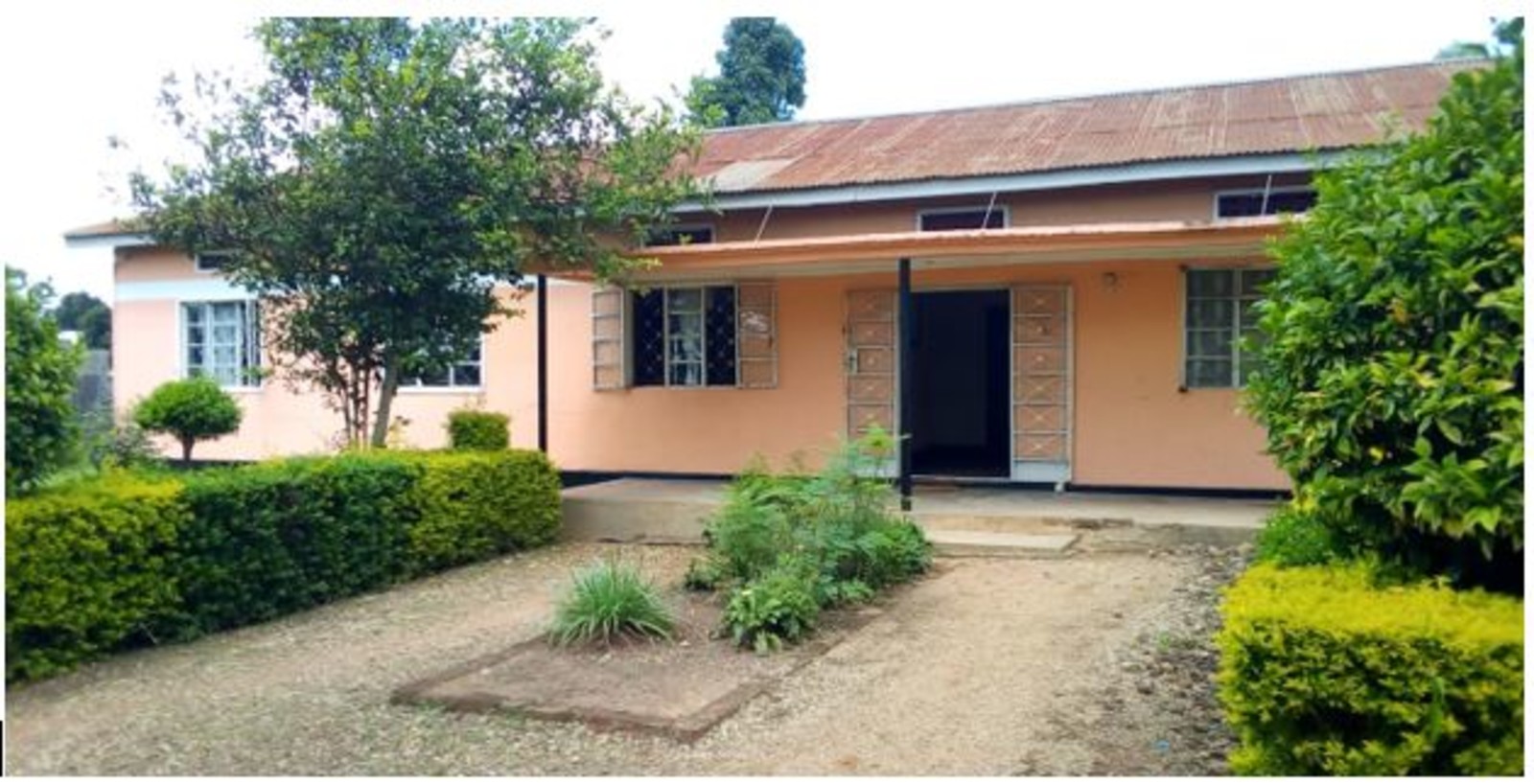
Eastern Uganda Field office building, Mbale Uganda.
Photo courtesy of Naigaga Florence Ronnah, Eastern Uganda Field.
Eastern Uganda Field
By Fredrick Ofwono
Fredrick Ofwono has been president of Eastern Uganda Field since 2016.
First Published: March 25, 2021
Eastern Uganda Field is a part of Uganda Union Mission of the East-Central Africa Division of Seventh-day Adventists. The field headquarters is located at Kamonkoli, Tirinyi Highway, Mbale, Uganda.
Territory: Districts of Abim, Amudat, Amuria, Budaka, Bududa, Bugiri, Bukedea, Bukwa, Bulambuli, Busia, Butaleja, Butebu, Buyende, Iganga, Jinja, Kaberamido, Kabong, Kaliro, Kamuli, Kapchorwa, Katakwi, Kibuku, Kotido, Kumi, Kween, Luuka, Manafwa, Mayuge, Mbale, Moroto, Nakapipirit, Namayingo, Namisidwa Namutumba, Napak, Pallisa, Serere, Sironko, Soroti, and Tororo.
Statistics (June 30, 2020): Churches, 180; membership, 35,589; population, 9,556,878.1 Eastern Uganda Field is served by 16 credentialed ministers, 18 licensed ministers, and 10 other workers in different categories, to make a total workforce of 44.2
Origin of Seventh-day Adventist Work in the Field
The establishment and growth of the work in Eastern Uganda Field have its rich history hinged on the arrival of R. E. Andersen, a medical missionary from Denmark to Kakoro in 1932. Kakoro was a territory of Kampala mission. In 1934, when Andersen was already in Kakoro, Kampala mission was divided into two missions, Central Uganda Mission and Eastern Uganda mission. Eastern Uganda mission covered Busoga, Budama, Bugwere, Bugisu, and Teso.3
Anderson moved from Nchwanga and arrived at Mbale in 1932. He met Patel Kupter, the mayor of Mbale, and asked for a place to establish a Seventh-day Adventist mission in Mbale town. Mayor Kupter referred Anderson to Nabweya, a place that was designated for missionaries to establish different denominations. Anderson found Nabweya to be a mountainous place which had no commercial area to attract people around for easy evangelism. He surveyed several other places, of which he preferred Kakoro, because it was a commercial center that attracted many people. Andersen established a church, elementary school, and a clinic in Kakoro around 1933, before the mission station in 1934.4
The work that Andersen started at Kakoro was to spread to other places of eastern Uganda. In 1935 Andersen conducted the first evangelism in Busoga, at Busei-Iganga, and established a church and elementary school. One of the first converts of that effort, Zakayo Mpata, became a pastor. The mission work continued, and a church was established in Kamuk, in Kaberamaido, in 1938. Many other churches were planted after Andersen left for Denmark in 1938.5
Missionary Magdalon E. Lind arrived from Norway in 1938. Lind worked until 1943, and was replaced by Pastor Robert J. Wieland, an American missionary coming from Kenya in 1944. Wieland did not stay for long, and in June 1948 was replaced by Pastor Eden Wilfred Clark, a missionary from America who worked up to 1953 and returned in 1954. He loved Kakoro and wished that when Christ returns, He would find him at Kakoro. When he died in America his remains were buried at Kakoro, according to his will.6
Other missionaries who came to Kakoro took on the mantle and continued planting churches. For instance, Nawanende was established in1939, Buwalasi in 1945, Busalamu in 1946, Nsube and Ivunamba in 1948, and Achongwen church in Kaberamaido in 1946.7 However, when foreign missionaries left and Pastor Y Bamanya was appointed the first Ugandan mission station director in Kakoro, the work did not thrive because of limited financial support. This led Eastern Uganda Mission station status to collapse.8
In 1986 Pastor Tibenda Yafesi was sent to revive the mission station. He replaced Pastor John Mwavu, who was a district leader from 1983-1986. In 1987 Eastern Uganda again became a mission station, and the first mission station director was Pastor Tibenda Yafesi.9
Organizational History
Eastern Uganda Field was organized in in January 1989.10 It was carved from Central Uganda Field when it had 11 church districts (Kakoro, Iganga, Nsube, Nawanende, Bulaago, Bukigai, Buyanja, Tororo, Kaberamaido, Soroti, Buwalasi),11 and a membership of 6,374 in 29 organized churches (Kakoro, Busei, Nsube, Nawanende, Buwalasi, Bulaago, Bukigai,Busalamu, Bugiri Busiki, Makoma, Buyanja, Buyaga, Busaba, Namanyonyi, Obulin, Kaberamaido, Soroti, Kamuli, Buwenge, Kasambira, Nawanyago, Butajube, Nabisiki, Namawa, Kisozi, Nambale, Budadiri, Buyinda). At the time of the organization, the Field had ten ordained ministers: Gerishom Wakabi Awuye, Kirya Balaam, Nanoka Dison, Elisha Sanyu, Ezekiel Matserere, Pande Wilson, Nsadha Samuel, Hawumba William Wilberforce, Mpata Zakayo, and Gamutambuli John.12
In March 1989 Dr. Bohanon, the first Uganda Union president, and Pastor Difers Idude Isabirye, the union executive secretary, commissioned the field's first officers. They included Pastor Gershom Wakabi Awuye, president; and Pastor Balaam Kirya, secretary-treasurer. There was only one departmental director, Ezekiel Matsereere. The following year, two others were added: Enock Otukol and Amos Ageru.
The field office at first was located on Gangama Road, opposite the current Islamic University in Uganda, in rented premises of the late Okia Asukanas, 300 meters off Soroti Road. The rent for the office was paid by Uganda Union. Meanwhile a committee was put in place to look for land in a place which was not water lodged within Mbale town, but all the land they found had conflicts which the church lost in court. Eventually Dr. Bohanon asked the field officers to look for land outside Mbale.
In 1990 the officers found land at Kamonkoli, seven kilometers from Mbale. The fact that the office was not going to be in Mbale town caused a serious conflict in the field by church members from the Mbale region, who felt that the field headquarters should be built in Mbale but not Kamonkoli, which is in Bugwere, and not in Bugisu. Many church districts in Bugisu region withheld their tithes and offerings, awaiting resolution to the conflict. To intervene, through the Uganda Union, the Eastern Africa Division, with headquarters in Harare, gave a loan to East Uganda Field to buy land in Mbale and build the office there, on condition that it was done in one year. Should they fail to secure land and build the office in one year, the office would go to Kamonkoli. After failing to get land in Mbale, a decision was made to build the office at Kamonkoli. In January 1991 Union President Jack Bohanon broke ground at Kamonkoli for the construction of the office. Thereafter, the field office was transferred to Kamonkoli in rented premises of Mr. Kichodo. George Bakaki was contracted to construct the office block and construction was completed at the end of 1991. Dr. Bohanon donated the office desks and two office cabins.13
The first (1989-1990) Field Executive Committee was comprised of the following people: Field President Gerisom Wakabi Awuye; Secretary-Treasurer Balam Kirya Secretary; Departmental Director Ezekiel Matsere; Departmental Director Amos Ageru; Dr. Mwanga Cleveland, lay representative representing health; Tanywa Zebedayo, lay representative representing the Bukedi region; Loyce Walimbwa, lay representative representing women; Tito Wolwa, lay representative representing the Bugisu region; Bataire Yeku, lay representative representing the Busoga region.
Institutions of the Field
The field runs four clinics and dispensaries:14 Bulago Seventh-day Adventist Dispensary; Buyanja Seventh-day Adventist Dispensary; Kakoro Seventh-day Adventist Dispensary, and Mbale Seventh-day Adventist Dispensary.
Since 1994 the field has run a ministerial institute training lay people for evangelism.
Executive Directors (1989-2021)
Gerishom Wakabi Awuye (1989-1990), Kirya Balaam (1991-1993), Mukaabya Livingstone (1994-2010), Kamiza John Byaki (2011-2015), Fredrick Ofwono (2016-present).
Sources
Anderson, R.Y.E. “The East Uganda Mission.” The Advent Survey, August 1934.
East-Central Africa Division. 4th Quarter Statistical Report, 2020. East-Central Africa Division, Ongata Rongai, Nairobi, Kenya.
Seventh-day Adventist Yearbook, various years. https://www.adventistyearbook.org/.
“With Our Missions in East Africa.” The Advent Survey, December 1935.
Notes
-
“Eastern Uganda Field,” Seventh-day Adventist Yearbook (2021), https://www.adventistyearbook.org/entity?EntityID=13676.↩
-
Eastern Uganda Field Secretary’s Report, 2nd Quarter, 2020.↩
-
R.Y.E Andersen, “Eastern Uganda Mission,” The Advent Survey, August 1, 1934, 4. Seventh-day Adventist Yearbook 2018, 62.↩
-
“With Our Missionaries in East Africa,” The Advent Survey, December 1935, 5.
Certificate of Title Lease Hold registration. Volume 155, Folio12 (Lease Hold Estate for 49 years from July 1, 1934). Enoka Otukol, interview by the author, June 20, 2018.↩
-
“With Our Missionaries in East Africa.”↩
-
Kulya Agrippa, telephone interview by the author, July 4, 2021. Agrippa was with Magdalon Lind, Robert Wieland, and Eden Wilfred Clerk.↩
-
Anyai Tom on Buwalasi land agreement 1945, telephone interview by the author on June 17, 2018.↩
-
Seventh-day Adventist Yearbook (Washington, D.C.: Review and Herald Publishing Association, 1956), 61.↩
-
John Mwavu, telephone interview by the author, June 12, 2021.↩
-
"Eastern Uganda Field," Seventh-day Adventist Yearbook, 2021.↩
-
Livingstone Mukaabya, interview by the author, July 10, 2021.↩
-
Balaam Kirya, interview by the author, July 7, 2021.↩
-
Balaam Kirya and Grace Makabayi, interview by the author, June 20, 2018.↩
-
"Eastern Uganda Field," Seventh-day Adventist Yearbook, 2021.↩