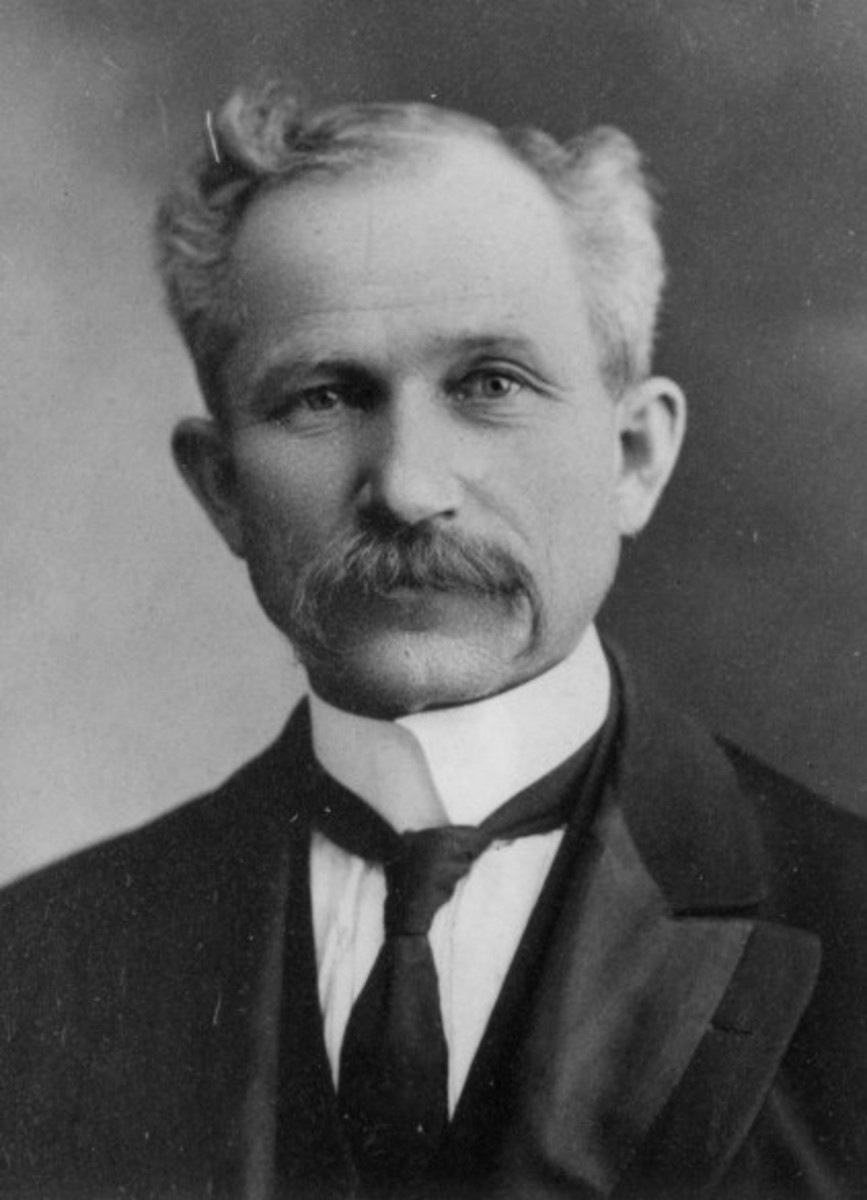
William R. Guthrie, 1920s.
Photo courtesy of Center for Adventist Research.
Guthrie, William Riley (1867–1952)
By Douglas Morgan
Douglas Morgan is a graduate of Union College (B.A., theology, 1978) in Lincoln, Nebraska and the University of Chicago (Ph.D., history of Christianity, 1992). He has served on the faculties of Washington Adventist University in Takoma Park, Maryland and Southern Adventist University in Collegedale, Tennessee. His publications include Adventism and the American Republic (University of Tennessee Press, 2001) and Lewis C. Sheafe: Apostle to Black America (Review and Herald, 2010). He is the ESDA assistant editor for North America.
First Published: March 4, 2025
William R. Guthrie, minister and conference president, served as president of the Canadian Union Conference and the Lake Union Conference.
Early Years
The first and only son of Elihu Guthrie (1849-1912) and Elizabeth Caroline Sherrill Guthrie (1850-1922), William was born on April 9, 1867, in Bedford, Indiana. He had three younger sisters: Laura Alice (Walter) (1879-1970), Myrtle May (Robertson) (1881-1925), and Estella Pearl (French) (1884-1970).1 Allie Guthrie, as William’s oldest sister was known, served as secretary and treasurer of the South Missouri Conference (1909-1912) and of the North Missouri Conference (1912-1914) prior to marrying Frank Walter.2
During William’s boyhood the family settled on a farm near Decatur, Iowa. His father began observing the seventh-day Sabbath in 1880 and in 1886 both William and his mother were baptized as Seventh-day Adventists. William began studies at Battle Creek College in 1889, where he met Clara Christina Williams (1871-1959), a daughter of Adventist minister Isaac Williams (1841-1934). Clara, after graduating from the college in 1892, became matron (dean of women) at South Lancaster Academy in Massachusetts. Meanwhile, William completed his studies at Battle Creek in 1894 and began gospel ministry in the Iowa Conference. He and Clara married on January 29, 1895, in Corydon, Pennsylvania, with her father as officiating minister. Their union would be blessed by three children: Ernestine Vashti (1896-1909), Burton Leander (1898-1970), and William Edward (1904-1979).3
Guthrie was ordained on November 20, 1898, at the conclusion of a workers’ meeting held at Osceola, Iowa.4 He must have acquired skill in the building trade as a young man because he led out in constructing “a number of churches” to house congregations that he raised up during his eight years of ministry in Iowa.5
Canadian Union Years
In 1902, Guthrie accepted a call to eastern Canada where, as part of the denominational reorganization of 1901, the Canadian Union Conference had just been formed, covering all of Canada east of Manitoba. The total number of Seventh-day Adventists in this field hovered around 1,000 during the early years of the 20th century. Approximately one-third of these were in the Maritime Conference, to which Guthrie was assigned. Its territory comprised the provinces of New Brunswick, Nova Scotia, and Prince Edward Island.6
After he was elected president of the conference in 1904, Guthrie’s major challenge was the relocation and upgrading of Farmingdale Industrial Academy. With authorization from the General Conference, Guthrie spent several months early in his presidency raising funds for the school in his home territory of Iowa and the adjacent state of Missouri. The school was of high priority because it seemed that Canadian young people sent to the United States for an Adventist education rarely returned and that this was one reason for the church’s slow rate of growth in Canada. Soon after the school opened in Farmingdale, Nova Scotia, in 1903, it became apparent that the land donated for its use was too hilly and rocky for operating a school farm. Under Guthrie’s leadership the move to Williamsdale, Nova Scotia, was accomplished in 1905 and construction of new facilities completed in 1906. Clara Guthrie served as matron at the academy.7
In 1908, William transferred to the presidency of the Quebec Conference, simultaneously serving as vice-president of the Canadian Union. Soon after moving to Montreal to take up these duties, William and Clara suffered the devastating loss of their 12-year-old daughter, Ernestine, who died of typhoid fever on January 4, 1909.8
Guthrie was elected president of the Canadian Union Conference in August 1910.9 His report to the next biennial session, held in July 1912, exhibited a thoroughness in presentation and analysis of data that became typical of his career. Guthrie seemed pleased that, at an expenditure of $35,000 for evangelistic work, 185 new members had been added throughout the union, making for an average cost of $189.18 per convert. This compared favorably, he pointed out, to a larger, unnamed union conference that gathered in 400 new members during the same time period, but at the cost of $150,000, or $375 per individual. Yet, he pointed out, in comparison to the millions in the Canadian Union territory who still needed to hear the Adventist message “our work looks very small.”10
Lake Union Years
After a decade in Canada, Guthrie returned to the United States in the Fall of 1912 to serve as president of the East Michigan Conference.11 One highlight of his three and a half years of leadership in that conference was a dramatic improvement in the financial health of its secondary school, Adelphian Academy. The $14,000 debt that the school faced when Guthrie arrived as conference president was cleared by July 1914 and the school operated in the black for the two subsequent years, with enrollment reaching the highest level in its history. Baptisms, totaling nearly 500 in 1914 and 1915, were also at an all-time high in the conference’s history. East Michigan, under Guthrie’s leadership, also gave vigorous support to the denomination’s nationwide program of advocacy for temperance and prohibition. In addition to large-scale distribution of temperance literature, Guthrie announced that the conference would be hiring two individuals to campaign full-time in the three months leading up to the November 1916 election, and thereby “give all our strength on the side of a dry state.”12
Guthrie transferred to the presidency of the West Michigan Conference, based in Grand Rapids, in 1916. But after just two years there, he accepted a call to higher responsibility as president of the Lake Union Conference in May 1918.13 At that time, the Lake Union, headquartered in Berrien Springs, Michigan, included eight local conferences in the states of Illinois, Indiana, Michigan and Wisconsin.
One of the foremost responsibilities that came with the Lake Union presidency was chairing the Emmanuel Missionary College (EMC) Board of Trustees. Guthrie’s 10 years in this role coincided with EMC’s “Golden Age.”14 In his presidential report at the 1928 Lake Union session, Guthrie asserted that EMC had “grown from one of the medium colleges of the denomination into what is now recognized as practically our largest and best institution.”15
During the first two years of Guthrie’s tenure, development of the campus advanced at what he called a “phenomenal” pace. In January 1920 he reported completion of a three-story addition to the “ladies’ dormitory” (Birch Hall), a new dormitory (Maple Hall) that could accommodate 124 male students, renovation of the old North Hall (Manual Arts Building) into 11 apartments for young married couples, a new music building, and installation of a new central heating plant. Enlargement of the normal building for teacher training and a new domestic arts building would soon become reality.16
Not everything went smoothly. A funding shortfall stalled construction of a new college chapel with an 800-seat auditorium, badly needed to accommodate the growing student body for daily assembly and Sabbath worship services. The college president, Frederick Griggs, wanted to push forward ahead of available funds, but when indebtedness of $50,000 was reported in November 1922, Guthrie and the college board put a halt to construction until funds were in hand. Fortunately, the basement was nearly completed, so the board agreed that it could be enclosed and heated so that the students could have an adequate assembly hall even before the above-ground chapel was completed. The basement chapel opened on January 1, 1924, and the entire college chapel was finally completed in 1928.17
General economic prosperity in the nation likely facilitated favorable trends in the Lake Union overall during Guthrie’s administration. In 1928 he reported that unprecedented increases in tithe and mission offerings had continued over the past quadrennium. Baptisms also had continued at record rates, making for a strong net growth of more than 2,000 members during the preceding eight years. Despite the positive numbers, Guthrie contended that careful analysis revealed the Lake Union to be “somewhat overinstitutionalized.”18 New schools and sanitariums, mostly small, had proliferated throughout the denomination during the 1901-1930 period. The number of local conferences had also greatly increased, with state conferences divided into two or, as in the case of Michigan, three smaller conferences—East Michigan, North Michigan, and West Michigan.
Even with the relatively good economic conditions, sanitariums were proving difficult to sustain. In 1921 the Lake Union had taken direct responsibility for the Wabash Valley Sanitarium in order to relieve the Indiana Conference of the financial burden and keep the institution viable. Guthrie highly valued the impact that the sanitarium continued to make on behalf of the church’s mission and its health principles. He had also led out in development of a new James White Memorial Home for the elderly, relocated from Battle Creek to Plainview, Michigan, as a Lake Union institution. Renovations had improved the facility and expanded its capacity to 40 residents by 1927, and the debt of $50,000 had been liquidated. On the other hand, though, it had become necessary to close Moline Sanitarium in Illinois and sell Madison Sanitarium in Wisconsin.19
The Lake Union had also begun to reverse the trend toward more local conferences by merging the North Michigan Conference into the West Michigan Conference in 1925 and combining the North and South Wisconsin conferences into a reunited Wisconsin Conference in 1927. The latter merger also entailed closing of Walderly Academy in Wisconsin, reducing the number of academies in the union from nine to eight.20 The movement toward consolidation thus begun by the Lake Union during Guthrie’s administration would soon greatly increase throughout the North American Division under the pressures of the Great Depression of the 1930s.
Final Years in California
Guthrie resigned from the presidency of the Lake Union in March 1928 due to serious gastrointestinal and cardiac conditions that made it necessary to step back from the pressures of leadership in order to regain health.21 He and Clara moved to Whittier, California, where they lived and shared expenses with a recently-widowed fellow believer. William occupied himself with carpentry, constructing a three-stall garage and a four-room apartment on top of it that the “widowed sister” could rent out. “This keeps me out of mischief and I feel is good for my health as well,” he wrote in a letter of September 4, 1929, reporting his activities to the General Conference.22
Soon thereafter he began engaging in personal evangelism through literature distribution as well as assisting in public evangelism.23 In 1932 he returned to ministry, joining the Southern California Conference workforce. He served on the conference executive committee from 1932 to 1943 and helped with construction of new houses of worship, much as he had during his early ministry in Iowa 40 years before. As he had during his years of administrative leadership, Guthrie particularly devoted attention to Christian education. In 1933 he became chair of the board of Los Angeles Seventh-day Adventist Academy and helped with construction of its successor—Lynwood Academy—in 1938. He continued as chair of Lynwood’s board until 1943. During these years Guthrie also served as a member of the Southern California Junior College in Riverside, which became La Sierra College (later University) in 1939.24
After a “ruptured ulcer of the stomach” required emergency surgery in November 1943,25 Guthrie retired at the age of 76. He and Clara moved to St. Helena, California, in 1948. A final illness took him to Paradise Valley Sanitarium in National City, California, near San Diego, where his son, William Edward Guthrie, served as manager. William Riley Guthrie died there on January 22, 1952, at age 84. He was buried in the Montecito Memorial Park Cemetery near Loma Linda, California.26 Clara Guthrie died on November 29, 1959, at age 88.27
Legacy
Guthrie’s legacy has probably made its strongest impact through the educational institutions that he nurtured throughout his career. It is a legacy of vigorous, principled leadership focused not on self-aggrandizement but fostering the work of those whom he was called to lead. “[W]hen God lays upon you the responsibility of directing the cause of God in any line,” he said to Lake Union workers in his 1928 farewell message, “remember He is not calling you to be lords over God’s heritage, but He is calling you to serve” and has placed “you in positions of influence where your service . . . may count for the most in the cause of humanity.”28
Sources
“Canadian Union Conference.” Canadian Union Messenger, July 3, 1912.
“Clara Christina Williams Guthrie obituary.” ARH, January 28, 1960.
Corliss, J. O. “The Iowa State Meeting.” ARH, November 29, 1898.
Daniells, A. G. “The Canadian Union Conference.” ARH, October 20, 1904.
“Elihu Guthrie obituary.” Central Union Outlook, January 28, 1913.
Guthrie, Wm. “An Introduction and a Farewell.” Lake Union Herald, March 21, 1928.
Guthrie, Wm. “An Unfinished Work.” ARH, October 5, 1905.
Guthrie, Wm. “Biennial Report of the East Michigan Conference.” Lake Union Herald, March 15, 1916.
Guthrie, Wm. “Maritime Conference.” ARH, October 6, 1904.
Guthrie, Wm. “Our New Chapel.” Lake Union Herald, November 15, 1922.
Guthrie, Wm. “President’s Address.” Canadian Union Messenger, July 3, 1912.
Guthrie, Wm. “President’s Quadrennial Report.” Lake Union Herald, March 8, 1928.
Guthrie, Wm. “Quadrennial Report of the President of the Lake Union Conference.” Lake Union Herald, January 1920 (Supplement No. 1).
Guthrie, Wm. “A Way to Greatness.” Lake Union Herald, March 21, 1928.
Ketring, H. F. “The Quebec Camp-Meeting.” ARH, October 22, 1908.
“Mrs. Elizabeth Caroline Guthrie.” Lake Union Herald, November 18, 1922.
Palmer, E. R. “The Canadian Union Conference.” ARH, October 22, 1908.
Robbins, F. H. “Earnestine Vashti Guthrie obituary.” ARH, May 13, 1909.
Salisbury, H. R. “Camp-Meetings in the Canadian Union.” ARH, October 20, 1910.
Seventh-day Adventist Yearbooks. General Conference of Seventh-day Adventists Online Archives (GCA), https://documents.adventistarchives.org/Yearbooks/Forms/AllItems.aspx.
Sustentation Files, RG 33. General Conference of Seventh-day Adventists Archives, Silver Spring, Maryland (GCA).
Thurston, W. H. “Maritime Conference.” ARH, October 18, 1906.
“William Riley Guthrie.” FamilySearch. Accessed February 26, 2025, https://www.familysearch.org/en/tree/person/details/9664-3W8.
“William Riley Guthrie obituary.” ARH, March 27, 1952.
“William Riley Guthrie obituary.” Pacific Union Recorder, February 25, 1952.
Woodman, I. J. “William Riley Guthrie obituary.” Lake Union Herald, February 19, 1952.
Notes
-
“William Riley Guthrie obituary,” ARH, March 27, 1952, 20; “William Riley Guthrie,” FamilySearch, accessed February 26, 2025, https://www.familysearch.org/en/tree/person/details/9664-3W8.↩
-
Seventh-day Adventist Yearbook, 1909-1914 (GCA); Laura Alice Guthrie Walter, Find A Grave, Memorial ID 55018806, July 16, 2010, accessed February 26, 2025, https://www.findagrave.com/memorial/55018806/laura-alice-walter.↩
-
“William Riley Guthrie obituary,” ARH; “William Riley Guthrie obituary,” Pacific Union Recorder, February 25, 1952, 13; “Mrs. Elizabeth Caroline Guthrie,” Lake Union Herald, November 18, 1922, 15; “Elihu Guthrie obituary,” Central Union Outlook, January 28, 1913, 8; “Clara Christina Williams Guthrie obituary,” ARH, January 28, 1960, 25; “Pennsylvania, County Marriages, 1775-1991,” FamilySearch, accessed February 26, 2025, https://www.familysearch.org/ark:/61903/1:1:VFM1-6CM.↩
-
J.O. Corliss, “The Iowa State Meeting,” ARH, November 29, 1898, 10.↩
-
“William Riley Guthrie obituary,” ARH.↩
-
“Directory of the Seventh-day Adventist Denomination,” General Conference Bulletin, Second and Third Quarter, 1902, 609-610; “Canada Union Conference (1901-1906),” General Conference Office of Archives, Statistics, and Research (ASTR), accessed February 26, 2025, https://adventiststatistics.org/view_Summary.asp?FieldInstID=8161.↩
-
Wm. Guthrie, “Maritime Conference,” ARH, October 6, 1904, 18-19; A.G. Daniells, “The Canadian Union Conference,” ARH, October 20, 1904, 16-17; Wm. Guthrie, “An Unfinished Work,” ARH, October 5, 1905, 18; W.H. Thurston, “Maritime Conference,” ARH, October 18, 1906, 14-15; Seventh-day Adventist Encyclopedia, 2nd rev. edition (1996), s.v. “Maritime Academy”; “Clara Christina Williams Guthrie obituary.”↩
-
H.F. Ketring, “The Quebec Camp-Meeting,” ARH, October 22, 1908, 19; E.R. Palmer, “The Canadian Union Conference,” ARH, October 22, 1908, 18-19; F.H. Robbins, “Earnestine Vashti Guthrie obituary,” ARH, May 13, 1909, 23.↩
-
H.R. Salisbury, “Camp-Meetings in the Canadian Union,” ARH, October 20, 1910, 14.↩
-
“Canadian Union Conference,” Canadian Union Messenger, July 3, 1912, 1; Wm. Guthrie, “President’s Address,” Canadian Union Messenger, July 3, 1912, 3-4.↩
-
“Report of Conference Proceedings,” Lake Union Herald, August 28, 1912, 1.↩
-
Wm. Guthrie, “Biennial Report of the East Michigan Conference,” Lake Union Herald, March 15, 1916, 1-2; regarding Adventism activism for prohibition in the 1910s see Douglas Morgan, Adventist and the American Republic (Knoxville: University of Tennessee Press, 2001), 62-63.↩
-
“William Riley Guthrie obituary,” ARH.↩
-
Meredith Jones Gray, “Emmanuel Missionary College (1901–1960),” Encyclopedia of Seventh-day Adventists, December 13, 2023, accessed February 26, 2025, https://encyclopedia.adventist.org/article?id=5JIL.↩
-
Wm. Guthrie, “President’s Quadrennial Report,” Lake Union Herald, March 8, 1928, 6.↩
-
Wm. Guthrie, “Quadrennial Report of the President of the Lake Union Conference,” Lake Union Herald, January 1920 (Supplement No. 1), 4.↩
-
Wm. Guthrie, “Our New Chapel,” Lake Union Herald, November 15, 1922, 3; Guthrie, “President’s Quadrennial Report,” Lake Union Herald, March 8, 1928, 6; Jones, “Emmanuel Missionary College.”↩
-
Guthrie, “President’s Quadrennial Report,” Lake Union Herald, March 8, 1928, 4-5.↩
-
Ibid, 4-5.↩
-
Ibid.↩
-
Wm. Guthrie, “An Introduction and a Farewell,” Lake Union Herald, March 21, 1928, 1; William R. Guthrie, Sustentation Fund Application, August 20, 1930, Sustentation Files, RG 33, Box 9701, GCA.↩
-
Wm. Guthrie to Claud[e] Conard, September 4, 1929, William R. Guthrie Sustentation File, GCA.↩
-
Wm. Guthrie to Claud[e] Conard, August 11, 1930, William R. Guthrie Sustentation File, GCA.↩
-
“William Riley Guthrie obituary,” ARH; Seventh-day Adventist Yearbooks, 1933-1944, GCA.↩
-
C.L. Bauer to H.H. Cobban, November 15, 1943, William R. Guthrie Sustentation File, GCA.↩
-
“William Riley Guthrie obituary,” ARH; I.J. Woodman, “William Riley Guthrie obituary,” Lake Union Herald, February 19, 1952, 7.↩
-
“Clara Christina Williams Guthrie obituary,” ARH.↩
-
Wm. Guthrie, “A Way to Greatness,” Lake Union Herald, March 21, 1928, 3.↩