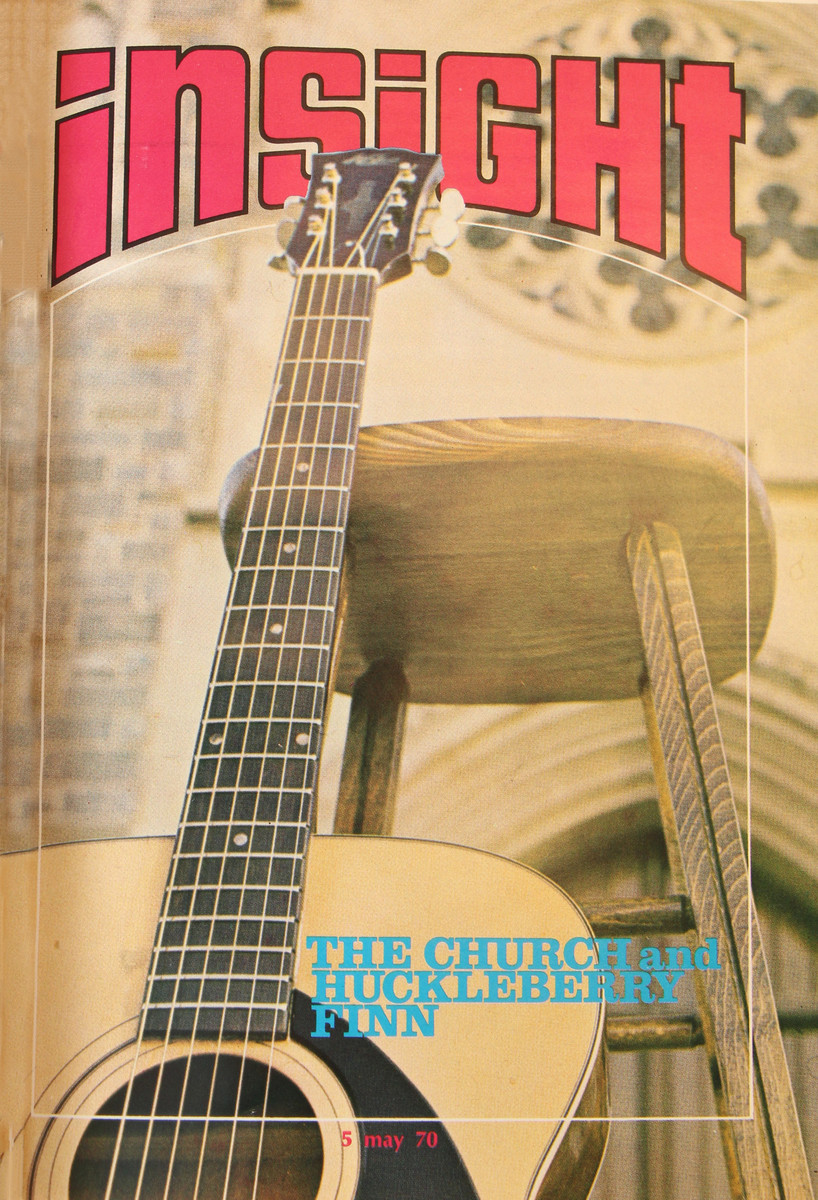
Cover of Insight’s first issue—May 5, 1970, Review and Herald Publishing Association.
Insight
By Tompaul Wheeler
Tompaul Wheeler, B.S., History (Southwestern Adventist University), M.Div. (Andrews University), MFA in Film and Creative Media (Lipscomb University), is a writer and filmmaker in Nashville, Tennessee. The author of several books, he has served as a columnist for Guide and Insight magazines; directed documentaries and short films distributed by entities including The Hope Channel; written scripts for audio dramas produced by Voice of Prophecy and Your Story Hour; and served as editor for the Youth Bible (Safeliz, 2018) and Bible Readings (Review and Herald, 2008).
First Published: March 9, 2023
The successor to the Youth’s Instructor (1852-1970), Insight magazine was published weekly for youth by the Seventh-day Adventist Church from 1970 to 2017. Once described as “the thinking Adventist’s magazine,”1 Insight was known for its moving short stories and incisive features on major topics of theology, lifestyle, and culture. Originally targeted at older high schoolers, college students, and twentysomethings, it eventually narrowed its focus to high school-age youth.
Catalyst for Change
In the words of Charles Scriven, one of Insight’s first two associate editors (1970-1973), in the 1960s the Youth’s Instructor “was drab in appearance, highly conventional in outlook, and wasn’t reaching the kind of young Adventist that was beginning to have an impact in the sixties.”2 According to Don Yost, Insight’s first editor (1970-1971), “The General Conference youth leaders, college deans of students, and others realized that either the Instructor must make some drastic changes or the church would need to give it a decent burial and allow a new magazine to be born.”3
As they grappled with the societal upheavals of the 1960s, Adventist baby boomers called upon the church to attend to the new realities they experienced, and the Adventist church listened. Columbia Union College student Roger Tatum, one of several college students to address the 1969 Autumn Council of the General Conference, gave voice to the growing urgency for change. Describing how irrelevant much of Adventist messaging seemed to young people, he declared, “Few youth are interested in articles about wedding rings. Many are unmoved by sermons on proper Sabbath observance or on the events of the last days. The youth are tired of stories about the virtues of honesty and the wickedness of moviegoers. We want to know how God can reach into our everyday life.”4
The 1968 Autumn Council voted to start a new magazine for “youth of secondary school age.” The committee noted that “in an age of changes in tastes and formats, although the objectives and standards of the denomination are unchanged, the church deems it advisable to update and materially alter the format of the Sabbath school lessons for youth, and to alter and rename the periodical which carries these lessons and communicates with the youth of the movement.”5 In a separate action, the Council also voted to launch “a new publication beamed to college-age Seventh-day Adventist youth.”6 Ultimately, though, instead of two separate publications, only one new magazine was launched, focusing on readers aged 16-25.7
The General Conference set up a committee to oversee the new periodical’s development. The committee’s work included a focus group with students from Adventist boarding academies. One student was quoted as saying, “If you really put out a magazine for us—just for us—you will do more for us than the church has ever done before.” A committee member pledged, “If we want it to succeed, we must make sure that everything in that magazine is youth oriented. We must serve the specific age group for which this particular publication is intended or forget about publishing it.”8
Readers were invited to enter “Help the Happening,”9 a contest to name the magazine. The winning name was submitted by Kit Watts.10
Insight’s first editorial team consisted of editor Don Yost, middle-aged with teenage children,11 and associate editors Charles Scriven and Patricia Horning (1970-1973), both in their twenties.12 Their preparation included a survey sent to 1,831 young people across the United States and Canada about the kind of content they desired in the magazine.13
An announcement in one of the last issues of the Youth’s Instructor assured readers that Insight would feature “vigorous Christian journalism” along with “unflinching candor and daring Christian commitment.”14 Insight advertised itself as “a magazine that understands the human cry for healing and for liberation. It understands the cry and takes up the cry.”15
In a statement in the Review and Herald, the denomination’s flagship magazine (now Adventist Review), General Conference President Robert Pierson wrote, “To Don Yost and his youthful associates who are charged with editing Insight each week, we say, Welcome to the field! Yours is the awesome responsibility and priceless privilege of speaking to the youth of the seventies. They will look to you to tell it like it is, and also as it should be!”16
The Adventist church designated March 28, 1970, to collect a special offering to support Insight subscriptions in local congregations.17
Controversy and Connection
“We had every kind of reaction [to the new magazine] that there was possible to be,” recalled Patricia Horning Benton. Youth and college students expressed “enormous support and elation. We saw an attitude of `wait and see' from some adults. We didn’t really get a lot of pushback before we had actually published, because nobody realized what was coming. Including us.”18
“The pressure from the General Conference Youth Department was that there needed to be a revolutionary change from what had previously been done for youth,” recalled Alan Forquer, who served as both the Youth’s Instructor’s last designer and Insight’s first. “[W]e made the magazine a new size, we tried to go for a very contemporary look and graphics, and we added more color.”19
Insight launched May 5, 1970. The first issue’s cover image of a guitar, and cover story, “The Church and Huckleberry Finn,”20 signaled that the new magazine took contemporary young people seriously. The cover story “was about a kid who didn’t look quite right coming to church, getting a chilly welcome. It was a statement of identification with younger, more intellectually adventurous Adventists.”21
Don Yost described Insight’s mission to the “Christian youth in his late teens and twenties.” The periodical, with “a personality new among Seventh-day Adventist magazines,” was determined “to avoid the mistakes of the past,” and not rest content “that past decisions and past programs will fulfill all the needs of the future.” He promised that Insight would “begin a conversation of understanding.”22
While Yost focused primarily on administrative details, the associate editors planned the issues, developing content and working with authors who might best take on a particular topic. Production and mailing deadlines kept them always working at least twelve weeks ahead, but they endeavored to highlight Adventist college events and to facilitate “a little bit more connection between the various college campuses.”
An editorial by Pat Horning summarized the environment in which Insight arrived. “It’s an era exploding with issues: race relations and rat-infested tenements, the war, abortion and birth control, drugs, civil disobedience, women’s liberation, urban crises, pollution, pornography, and poverty.”23
The largest generation in U.S. history, the baby boomers, was coming of age. The civil rights movement had stirred questions of social justice, while the Vietnam War made questions of morality and conviction into life-and-death issues. The prospect of a military draft loomed over young American Adventists, who wrestled with the church’s teaching and their own convictions about the sixth commandment.24 The societal upheaval sparked new questions about spirituality, sexuality, the role of women, environmentalism—and whether Christianity was equipped to answer them.
“Insight’s switch to contemporary issues and artwork left many readers energized, hopeful, and scandalized,” Insight editor (1986-1993) Christopher Blake reflected.25 As Scriven described it, “First of all you go from bland black and white, usually, tons of print on every page, to what was a two-color magazine and had slightly provocative covers. It felt like a minor sea change in that regard. Then it was deliberately if modestly provocative.”26
Though Adventist Church publications in the 1960s had largely avoided kitchen table topics like the civil rights movement, Insight faced them head-on. The new magazine sought to take honest looks at topics young people wrestled with and talked about, whether hair length, feminism, or participation in war, from a biblical and distinctly Adventist perspective.
A 1973 feature playfully examined “All the Hair in the Bible.”27 One cover asked, “The Hemline Hassle: Should We Weep or Laugh it Off”?28 over the image of a man grasping his nose after walking into a pole, distracted by a woman. Multiple articles explored the role of women in church ministry.29
“I think that Insight’s biggest contribution was starting conversations within the church about topics that many people wanted to avoid,” said Benton. “We left a lot unsaid, but at least opened the door a crack.”30
Early authors included Jonathan Butler,31 Roy Branson,32 LaVonne Neff,33 Gottfried Oosterwal,34 Penny Estes Wheeler,35 Tom Dybdahl,36 Roy Benton,37 and George W. Target.38 Articles sought to be relevant, practical, and engaging. Recalled Scriven, “We asked, Should we bear witness to Christ in the world and in the political arena? Our writers tended to say Yes.”39
Insight also became known for its compelling short stories, particularly through its annual writing contest, which helped foster emerging young writers.40 The magazine “provided an arts oasis,” as Blake put it. “Poetry, short stories, humor, substantive media analysis, and graphic arts flourished for the first time in an official Seventh-day Adventist Church publication.”41
The new magazine spurred a broad spectrum of responses—from “Cancel my subscription” and criticism of font choices, “psychedelic colors,” and perceived “hippie” and communist leanings, to warm letters of appreciation from young readers.42 “We went through periods where the criticism was enormous, and we were just young people ourselves,” recalled Benton. “We hadn’t lived long enough to know how to handle some of that criticism. But from the thoughtful young adults we were really concerned about we were getting a lot of praise and support, and beginning to cultivate those people, from readers into contributors.”43
Wrote one young reader, “Insight doesn't soft-soap truth. I know truth steps on people’s toes, and that brings criticism, but if a person is honestly seeking to love, your magazine can help show them how to do it better.”44
Insight’s publisher and editors had to negotiate ongoing “tension between the magazine's buying audience—adults—and target audience—youth,” Blake explained. “They carried vastly differing aims and tastes, yet to lose either audience meant losing both. Such was the constant tightrope walk.”45
Issues with Insight’s critics came to a crisis point in mid-1971, when Don Yost stepped down as editor. The magazine faced criticism both from without and within, including copy editors leaking potentially controversial material to critics at the General Conference.46 To quell the storm, church administration brought in Liberty magazine editor Roland Hegstad to serve as Insight’s interim editor.47
A news brief in the Review and Herald announced “exciting innovations” in Insight under Hegstad’s helm, including “[m]ore articles with Bible answers to contemporary issues.”48 From the perspectives of the two associate editors, the Hegstad interim indeed brought striking change for the better.
“He had standing with the brethren, and said if you want me to take this job you have to back off and let me be the editor,” recalled Benton. “And things got better pretty fast. It didn’t mean there wasn’t stuff simmering around the edges, but we began to breathe easier and Hegstad took the flak. That was really needed at that point.”49
“Pat and I loved working under [Hegstad’s] oversight,” Scriven recalled. “We took him to be a really accomplished editor. He came across trusting us. His advice was never condescending. His main work was Liberty magazine, and his main office was elsewhere, I think in the then-new GC building across the street, so, aside from planning meetings, he tended just to drop by—always with a smile and his trademark aura of irrepressible energy.”50
In a Review and Herald article reflecting the continuing controversy, General Conference vice president (and future president) Neal C. Wilson urged Adventists to support Insight. Wilson wrote, “In an age when many youth, notably in the Jesus Movement,51 are ridiculing doctrine, saying we need only love, Insight published a defense of doctrine. In spite of the fact that some adults may not like the format, my feeling is that the church’s youth magazine is fulfilling its mission. It appeals to the young for whom it is intended.”52
A 1972 advertisement promoting Insight emphasized its potential for fostering faith in young people who might otherwise “forsake the church,” describing it as “designed to keep our sons and daughters in the fold.”53 A 1974 advertisement highlighted the special issue on “Ellen White the Human Being,”54 declaring, “INSIGHT magazine is better than you think.”55
With articles targeted to older high schoolers, college-age young people, and twentysomethings, by late 1970 Insight’s subscriptions topped 52,000.56 Over time, however, Insight’s subscriptions gradually fell from that high. It was speculated that it lost the majority of the many older readers who had grown up on the Youth’s Instructor and continued subscribing to it for decades.
Change and Continuity
“If you have been a reader of Insight, you likely do not have a Laodicean [lukewarm] reaction to this magazine,” newly appointed editor Mike Jones wrote in a 1972 article promoting the magazine as a key resource in retaining young people in the church. “But then there's nothing lukewarm about Insight. Neither is there anything lukewarm about the spiritual war in which we are engaged today. And so the new youth magazine has waded into the battle, taken its lumps, had its successes, and has continued to mature.”57
Jones’s words underlined that after two years, Insight still faced significant skepticism, even with endeavors like a special evangelistic issue for sharing.58 In 1974 Jones and his staff issued “A New Declaration of Principles.” The statement pledged to devote less space to such “countless causes” as “ecology, social reform, consumerism, [and] women’s liberation.” While acknowledging such practical issues as “important,” and promising to continue to address them “with balance and perspective,” Insight promised increased focus on “such vital topics as the latter rain, how to develop an exciting prayer life, getting real victory over real sin, the power of surrender, saving a troubled marriage, how to really enjoy the Sabbath, getting ready for Christ's second coming, and witnessing with power.”59
Nonetheless, Insight continued to tackle topics teens and twentysomethings talked about. Trudy J. Morgan-Cole, a 1986 Insight writing contest winner,60 recalled the Insight of her youth as one which showed her how to “engage thoughtfully with popular culture, to use faith as the lens through which I could view and learn from the broader culture. It’s what I mainly associate with the Insight magazine of the late ‘70s and early ‘80s—thoughtful, critical engagement with the wider worlds, with political and social issues and questions of culture—that I didn’t see anywhere else in the church when I was growing up. It had a huge influence on the kind of Adventist I grew up to be.”61 Morgan-Cole reflected, “Names like [Insight editor] Dan Fahrbach, Katie Tonn, Mike Jones, Penny Wheeler and others shaped my perception of what an Adventist life and worldview might look like.”62
One of Insight’s biggest challenges over the years was, in the words of Patricia Horning Benton, “The whole concept that one publication could serve everybody from earliteens to 30.” Benton recalled, “Anybody knows that that’s a very diverse audience and we fought and fought and fought that, and were never successful at getting that focus age narrowed. As editors we chose to focus on the college crowd and that was our intentional focus, but we knew we were missing people on both sides of that.”63
A 1981 news release under then-acting editor Dan Fahrbach (1982-1985) described Insight as planning to feature “less theological argument and more emphasis on how to sustain Christian relationships.”64
Continuing Innovation
Assistant editor Kris Coffin Stevenson (1984-1986) recalled the office transition from typewriters to desktop computers, as well as the rise of independent ministries that sometimes criticized Insight. “As a teenage magazine, Insight was always easy to point fingers at, because that’s where you’re trying to deal with the youth when they’re in that tumultuous age.”65
Taking over as editor in 1986, Christopher Blake avowed, “I believe Insight can be, and needs to be, sensitive in the manner it addresses issues without diluting them. We're aggressively courting our members and inviting them to look us over.”66
By the mid-1980s, the Adventist church’s magazine Guide, which had previously included many high school-age stories, had settled into targeting middle schoolers, ages 10-14. The collegiate and twentysomethings-focused magazine College People had lasted only from 1981 to 1984, so Blake decided to target ages 15-19, reaching students through their sophomore year of college. He received significant pushback from the North American Division. Recalled Blake, “I told [them], `When you have something specifically for college students, we'll back it down.’”67 (The North American Division Youth Ministries Department published the quarterly magazine Adventist View, for ages 18-35, from 1993 to 1999.)
Blake continued Insight’s balanced looks at issues shaping young people’s lives. When the Branch Davidian tragedy in Waco, Texas, with its close connections to Adventism, made global headlines, Insight put Davidian leader David Koresh on its cover, the headline asking, “Could This Man Seduce You?”68 Themed issues examined topics from violence,69 unity in diversity,70 and substance abuse71 to entertainment,72 perfection,73 abortion,74 and “Nice People Who Aren’t Christians.”75 A six-issue series explored Jesus: “His Emotions; His Friends; His Surprises; His Enemies; His World; His Church.”76 The special issue “Things We Don’t Talk About” addressed topics including date rape77 and sexual abuse.78 A follow-up issue featured the first in-depth treatment about LGBTQ people by an Adventist denominational periodical.79
From 1988 to 1993 one issue a month was rebranded as Insight/Out. Developed as “the first Seventh-day Adventist missionary magazine for youth,”80 the monthly issue also sought to reach “marginalized Adventist youth.”81
Two book collections of Insight’s Most Unforgettable Stories82 collected many of the magazine’s most compelling narratives, including stories by three future editors of Guide magazine—Carolyn Rathbun Sutton, Randy Fishell, and Lori Pettibone Futcher.
Beginning in 1988, Insight collaborated with the Center for Youth Evangelism to develop Youth Summits. Approximately 40 discipleship events were held for teens throughout the North American Division, with rotating themes of honesty, communication, love, and freedom.83
In 1990 Insight partnered with the Adventist Development and Relief Agency to sponsor The Trip, a volunteer service project for teens on the Amazon river in Brazil.84 Its inspiration came to Blake while working out with a colleague in a hotel exercise room, as they discussed the idea of exercising mentally, physically, and spiritually.85 The project was particularly developed for young people from small churches or other circumstances who might otherwise have no opportunity for such an experience.
In 1991 Insight partnered with Maranatha Volunteers International, and the now-annual project was rebranded Ultimate Workout. Since its inception, Ultimate Workout has involved several thousand high school-age participants in service, building schools and churches and conducting outreach in countries across Latin America, as well as Kenya, the United States, and India.86
From 1992 to 2014 Insight devoted one issue a year to a report on Ultimate Workout. On the 1992 project in the Dominican Republic, lightning struck a group of participants on a beach outing. An 18-year-old participant died, and the special issue about the project chronicled the response to the tragedy.87 Ultimate Workout has continued into the 2020s as an annual Maranatha Volunteers International project.88
An Insight-sponsored Christmas-time project, the Extreme Workout, coordinated with local and independent ministries, served urban areas in the United States from 1995 to 1997.89
In 1992 Blake sought to radically reformat the magazine, using the burgeoning internet to make it more interactive for readers, with “an expanded format (32 pages) every other week and a more online presence (eight pages print) the other weeks.” The reformatting was cancelled at the last minute when publishing house administration deemed it impractical.90
In 1993 Insight released A Reason to Believe,91 a 10-lesson interactive youth doctrinal/baptismal course. The book included a unique section, “What Others Believe,” supplying context for Seventh-day Adventist official beliefs.
Focus on Teens in a Changing World
As baby boomers gave way to the smaller crowd of Gen Xers by the early 1980s, Insight subscriptions gradually dropped. By the mid-1990s, as Insight’s target demographic became exclusively high schoolers,92 the narrower age range contributed to a lower circulation, and subscriptions slid from 25,000 to just under 20,000. By 2000, subscriptions had fallen to about 16,000.93 Insight pushed for every academy and church to make the magazine available to its young people,94 but institutional support remained a consistent issue.
As editor, Lori Tripp Peckham (1993-2002) published reviews of contemporary Christian music95 and profiles of Adventist musicians,96 features appreciated by youth looking to connect with spiritual resources beyond the weekly magazine. Reader surveys in the 1990s, each of which received hundreds of mailed-in responses, asked readers to rate Insight’s content, and included questions about what contentious topics most concerned them and which contemporary Christian music and authors they enjoyed.97 In the mid-2000s, responding to a rising conservative movement in the church, Insight scaled back references to elements like contemporary music.
Many survey respondents noted how Insight helped them feel connected to other Adventist youth, and helped them better understand their faith. A seventeen-year-old reader named Natalie wrote in, “I think that the teen years are the hardest time for people. At this time we’re trying to figure out who we really are and where we want to go in life. Insight helps us figure this out.”98
In 1996 Insight produced Sabbath School in a Can,99 a half-hour video production for use in youth groups. Featuring a report on the 1996 Ultimate Workout project in Panama, Sabbath school discussion prompts, and other docu-features, it was distributed to churches on VHS cassette as a pilot venture. Without dedicated funding, however, the initiative was not repeated.
Despite scant resources, Insight sought to connect with youth where they were in a changing world. In 1998 Insight launched a website. Editor Dwain Esmond (2002-2013) oversaw development of theFlow, a social networking platform for Insight readers. Esmond believed that “We need to create places online where kids can ask and get answers to the questions that plague them most.”100 Described as “safe Internet territory to mingle, create profiles, upload videos, start discussions, and join groups,”101 theFlow welcomed “youth of all faiths” in a “Christ-centered atmosphere.”102 The project was supported by volunteer labor and drew the participation of teens from around the world, but turned out to be short-lived, eventually discontinued due to lack of funding.103
Final Years
Even as circulation declined, researchers found that Insight was far from reaching its potential. A 2010s survey of 1,215 Adventists under age 30 found that while Insight had by far the highest recognition of any Adventist resource for youth, only 43% of respondents were aware of the magazine, and only 24 percent reported any access to it. Of those familiar with Insight, “the majority assessed it as either an `excellent’ or `good’ resource for them.”104
Further study found that Insight was not reaching youth in the fastest-growing demographics of the church. Of approximately 1,000 Spanish-language churches in the U.S., for example, only one subscribed to Insight for their youth, despite teens raised in North America inevitably speaking English.105
Insight faced many of the same challenges as other magazines in the internet age, including its audience’s ever-increasing use of digital media.106 The challenges were compounded by administrative choices, tight finances, and lack of institutional support. Beginning in 2010, Dwain Esmond served simultaneously as Insight editor and vice president of the Review and Herald Publishing Association Editorial department.107 Its resources stretched thin, Insight began to regularly reprint old articles in place of new ones.
“We had plans for revitalizing Insight and its platforms,” recalled Tom Fraga, assistant editor from 2010 to 2013, “but time, money, and staffing were lacking.”108
Insight had launched in 1970 with four full-time editorial staffers, including a research assistant, helping it stay on top of current events and in touch with readers. For most of its history, it was served by an editor and an assistant/associate, with at least one support staffer. In 2010, the number dropped to one and a half. When Omar Miranda took over in 2013, he served as Insight’s sole editor— and sole full-time staffer.
In the end, erring on the side of caution may have proved a major factor in Insight's loss of readership. “It was a constant tension, always,” Patricia Horning Benton reflected. “It seems to me that part of the impetus for starting Insight was to be provocative and to speak to that generation, and not to let the old church fathers rule things. But it did not remain current and fresh and speaking to the generation at hand. And gradually over the years they started trimming the staff. In those early days a large portion of Scriven's and my time was spent cultivating authors, and that takes time.”109
In 2014 the Review and Herald Publishing Association, a General Conference institution, was closed as an independent publisher,110 with several of its magazines, including Insight, transferred to the Pacific Press Publishing Association. At the same time, ownership of Pacific Press transferred from the General Conference to the North American Division. Though Insight was created by action of the General Conference, to serve as an international magazine, this move made the North American Division responsible for it.111 The NAD faced the choice of financially investing in Insight and its ministry to young people, taking action to reinvigorate it, or discontinuing it. The NAD voted “to discontinue the printed Insight, but not the Insight brand.”112
In 2016 Lori Tripp Peckham returned as editor to curate one final year of Insight. The “farewell tour,” with no original material in each issue beyond a short editor’s message, reprinted story and feature highlights from throughout the magazine’s history. “Now it’s time for a change,” Peckham wrote to readers. “The North American Division Youth and Young Adult Ministries Department is launching something completely new. Keep watching right here to find out what’s coming next.”113
One year later Insight printed its last issue, dated July 1, 2017, though with no announcement of anything new to succeed it. While the NAD focused on developing resources for Sabbath school programming,114 the church created no new media to replace Insight.
As Insight editor Donald John (1975-1981) noted, “In the seventies it was a luxury for youth to have a journal—indeed, any `media'—beamed directly toward them. Today the young are the main target of the so-called media, advertising, TV, movies, entertainment, and even the design and production of goods and services.”115 That trend has only grown, yet the Adventist church no longer has a dedicated ministry developing media for young people, speaking directly to them and addressing their needs.
Perhaps what the story of Insight most strikingly reveals is that, at one point, the church failing to reach, engage, and disciple young people through media was considered a crisis, to which the church gave concerted attention. It was taken for granted that the church would replace the Youth’s Instructor. Less than half a century later, when history repeated itself and Insight folded, few seemed to notice. In contrast to the flurry of articles heralding its initial development, Insight’s demise made no headlines in the official church press.
Legacy
For several decades Insight served as a forum for spiritual exploration and a place where young people knew questions would be taken seriously. It included both moving short stories and incisive articles on topics young people cared about. It fostered careful, critical thinking about issues and served as a proving ground for up-and-coming writers. It connected young people to church events, service opportunities, and spiritual resources. In so doing the magazine won numerous national awards for editing, writing, and artwork from the Associated Church Press and Evangelical Press Association.116
“Insight gave youth a sense of ownership in the church,” said Karen Spruill, assistant editor from 1975 to 1977. “It gave them a safe place to challenge the old ideas, and a place where someone cared about young people.”117
In the words of one reader, who described attending a “small, rural church” in the early 2000s, “It was impactful most because it felt relevant to my life, the intersection of church and personal faith.”118
Editors
Donald Yost (1970-1971); R. R. Hegstad (1971-1972); Michael Jones (1972-1975); Donald John (1975-1981); Dan Fahrbach (1982-1985); Christopher Blake (1986-1993); Lori Tripp Peckham (1993-2002); Dwain Esmond (2002-2013); Omar Miranda (2013-2016); Lori Tripp Peckham (2016-2017).
Sources
“The 1996 Insight Survey.” Insight, March 9, 1996.
“1998 Survey, Keep It? Lose It?” Insight, May 23, 1998.
“An Interview With Josephine Benton.” Insight, January 3, 1978.
ARH, September 7, 1972; March 28, 1974.
“AU Freshman Wins `Insight’s’ $500 Gilkey Award.” Atlantic Union Gleaner, July 22, 1974.
Baasch, David. “Autumn Council Actions.” ARH, December 19, 1968.
Benton, Patricia Horning. “Staff of New Youth Magazine Samples Opinion on Content.” ARH, January 22, 1970.
Benton, Patricia Horning. “New Youth Magazine Named; Contest Winners Announced.” ARH, February 12, 1970.
Benton, Roy. “Soul Food Shop.” Insight, November 27, 1973.
Benton, Patricia Horning. “Our Turn: Without Polaroid Glasses.” Insight, June 2, 1970.
Bietz, R.R. “`Jesus People’ and `Street Christians,’” ARH, May 20, 1971.
Bietz, R.R. “Revivals Are of Two Kinds.” ARH, May 27, 1971.
Blake, Christopher. A Reason to Believe. Hagerstown, MD: Review and Herald Publishing Association, 1993.
Blake, Christopher, and Peckham, Lori Tripp. “Church Produces First Missionary Magazine for Youth.” ARH, June 7, 1990.
Blake, Christopher. “Redeeming Our Sad Gay Situation.” Insight, December 5, 1992.
Branson, Roy. “What if You Don’t Wanna Be a Preacher?” Insight, September 11, 1973.
Butler, Jonathan. “John Lennon and Original Sin.” Insight, September 25, 1973.
“Church Calendar.” ARH, March 26, 1970.
Daffern, Jan Eiseman. “Breaking the Mold.” Insight, August 30, 1977.
Demsky, Andrew. “Toxic Religion: What You Should Know About Cults.” Insight, October 9, 1993.
Dybdahl, Tom. “Sirens to Trouble Your Sleep: Scenes from Boston’s Tremont Street.” Insight, August 28, 1973.
Garcia, Theresa. “Incest/Abuse.” Insight, September 1, 1990.
Goddard, Kathy. “More youth reach the Summit!” Insight, July 24, 1993.
Graybill, Ronald. “All the Hair in the Bible.” Insight, May 29, 1973.
Hagen, Darren. “Discovering God’s Will.” Insight, August 12, 2000.
Hancock, John. “Insight Magazine Leads Youth to Christ.” ARH, September 2, 1971.
Hancock, John. “Offering to Be Received for New Youth Magazine.” ARH, March 5, 1970.
Hunter, D.W. “Academy Youth Plan Their Magazine.” ARH, December 28, 1968.
“In Brief.” ARH, November 26, 1970.
Insight, August 14, 1973; October 5, 1973; November 8, 1986; May 23, 1987; January 23, 1988; November 18, 1989; May 19, 1990; July 4, 1990; May 23, 1991; October 9, 1993.
“Insight Goes with `theFlow,’” Canadian Adventist Messenger, June 2008.
“Insight’s Focus Is Further Defined.” Pacific Union Recorder, November 30, 1981.
Insight's Most Unforgettable Stories. Hagerstown, MD: Review and Herald Publishing Association, 1990.
Insight Presents More Unforgettable Stories. Hagerstown, MD: Review and Herald Publishing Association, 1996.
“Jesus and His Church.” Insight, August 19, 1989.
“Jesus and His Emotions.” Insight, February 18, 1989.
“Jesus and His Enemies.” Insight, June 17, 1989.
“Jesus and His Friends.” Insight, April 8, 1989.
“Jesus and His Surprises.” Insight/Out, May 1989.
“Jesus and His World.” Insight, July 22, 1989
Johnson, Heidi. “Reverberations.” Insight, February 9, 1971.
Jones, Michael. “A New Declaration of Principles.” Insight, September 3, 1974.
Jones, Michael. “Enthusiasm Greets Insight Special Issue.” ARH, September 7, 1972.
Jones, Michael. “To Save Our Young People.” Atlantic Union Gleaner, September 26, 1972.
Krause, Gary. “What Bothers Me About Our Church and the Waco Tragedy: Did We Care More About Reputation than Compassion?”, Insight, October 9, 1993.
Lale, Tim. “Ye Have Done It Unto Me.” ARH, June 20, 1996.
Lucas, Theodore. “New Youth Magazine Benefits From March 28 Offering.” ARH, March 26, 1970.
Martin, Charles. “Insight Magazine Plans Changes in Format.” ARH, September 2, 1971.
McChesney, Andrew. “Adventist Church Overhauls North American Publishing Operations.” Ministry, August 2014.
McLeod, Merikay. “The Church and Huckleberry Finn.” Insight, May 5, 1970.
Minutes, February 16, 2016, NAD Youth Executive Committee, Ontario, California. Accessed December 15, 2022. See here.
Minutes, NAD Youth Advisory, January 11, 2017, Tucson Arizona, YI #17.04, “Resource Focus Group Report.” See here.
Morgan-Cole, Trudy. “Growing in Circles: My Struggle to Make Peace with God, Myself, and Just About Everything.” Accessed January 17, 2023. See here.
Morgan-Cole, Trudy. “Harry.” Insight, November 1, 1986.
Neff, LaVonne. “An Open Letter to Chauvinists of Either Sex.” Insight, August 14, 1973.
“New Insight Editor Repositions Magazine.” ARH, February 6, 1986.
“New International Youth Publication Names Staff.” British Adventist Messenger, January 2, 1970.
Oliver, Ansel. “Adventist World Budget Totals Nearly $180 Million.” ARH, December 25, 2013. Accesssed January 17, 2023. See here.
Oosterwal, Gottfried. “The Church is the People: Part 1.” Insight, October 30, 1973.
“Our Groovy Growth Spurts.” Insight, May 6, 1995.
Peckham, Lori Tripp. “Amazon Women (and Men Too!”), Insight, March 9, 1991.
Peckham, Lori Tripp. “Date Rape.” Insight, September 1, 1990.
Peckham, Lori Tripp. “Giving Till It Hurts.” Insight, January 23, 1993.
Peckham, Lori Tripp. “Hollywood or Bust.” Insight, July 6, 1996.
Peckham, Lori Tripp. “Insight Turns 25!”, ARH, June 1995.
Peckham, Lori Tripp. “Where You’re At.” Insight, November 23, 1996.
Peckham, Lori Tripp. “You’re Invited, Come Along on the Insight Farewell Tour.” Insight, July 2, 2016.
Peckham, Lori Tripp. “Youth Summits Keep Soaring!”, Insight, June 6, 1992.
Pierson, Robert H. “Associate Review Editor to Head New Youth Magazine.” ARH, October 16, 1969.
Robert H. Pierson. “GC President Salutes Insight; Bids Farewell to Instructor.” ARH, May 14, 1970.
“Plans Moving Forward on New Youth Journal.” ARH, January 1, 1970.
Sabbath School in a Can. Review and Herald Publishing Association Youtube account. Accessed December 10, 2022. https://www.youtube.com/watch?v=0wt_aF7XESM.
Seventh-day Adventist Yearbook. Hagerstown, MD: Review and Herald Publishing Association, 2011. https://www.adventistyearbook.org/2011.pdf.
“Social Networking Website: The Flow.” Columbia Union Visitor, June 2008.
Target, George W. “How to Meditate.” Insight, February 5, 1974.
Tatum, Roger. “We Want a Personal Relationship with God.” ARH, February 12, 1970.
Twenge, Jean M.; Martin, Gabrielle N.; and Spitzberg, Brian H. “Trends in U.S. Adolescents’ Media Use, 1976 –2016: The Rise of Digital Media, the Decline of TV, and the (Near) Demise of Print.” Accessed December 15, 2022. See here.
Watts, Kit. “Ordaining to the Ministry: Or Why We Need All the Help We Can Get.” Insight, January 22, 1975.
“What is `Insight’?: Adventist Youth Would Like to Know!”, Institute of Church Ministry. Accessed February 25, 2022. See here.
Wheeler, Penny Estes. “Hitchhiker.” Insight, September 25, 1973.
Wheeler, Tompaul. “Adventist Artist: Brandon Perry.” November 10, 2001.
Wheeler, Tompaul. “City Slickers.” Insight, July 18, 1998.
Wheeler, Tompaul. “Insight's Twilight-- What Killed Adventism’s Youth Magazine, and What We Should Do About It.” Spectrum, September 28, 2017. Access here.
Wheeler, Tompaul. “The Demise of Insight: What Killed Adventism’s Youth Magazine, and What We Should Do About It.” Spectrum, October-December, 2017.
Wheeler, Tompaul, director. Leap of Faith: The Ultimate Workout Story. Accessed December 10, 2022. https://www.youtube.com/watch?v=MXmDe-3Lb5Q.
Wilhelm, Lisa K. “Insight’s Fight for Youth.” Lake Union Herald, August 11, 1987.
Wilson, Neal C. “Is Insight Needed by Adventist Youth?” ARH, September 9, 1971.
“You Have a Right to Know…What’s Happening at INSIGHT.” Insight, December 31, 1988.
Yost, Don. “Entering a New Era.” Insight, May 5, 1970.
The Youth’s Instructor, March 17, 1970; March 31, 1970.
Notes
-
“Insight’s Focus Is Further Defined,” Pacific Union Recorder, November 30, 1981, 1.↩
-
Tompaul Wheeler, “The Demise of Insight: What Killed Adventism’s Youth Magazine, and What We Should Do About It,” Spectrum, October-December, 2017, 40-45.↩
-
“Insight Turns 25!”, Lori Tripp Peckham, ARH, June 1995, 26-27.↩
-
Roger Tatum, “We Want a Personal Relationship with God,” ARH, February 12, 1970, 15.↩
-
David Baasch, “Autumn Council Actions,” ARH, December 19, 1968, 22.↩
-
Ibid., 23, emphasis supplied.↩
-
Charles Martin, “Insight Magazine Plans Changes in Format,” ARH, September 2, 1971, 32. An article in the same issue, by General Conference Missionary Volunteer Department Secretary John Hancock, urged that “Each Adventist 16 to 30 years of age should have his personal subscription.” See John Hancock, “Insight Magazine Leads Youth to Christ,” ARH, September 2, 1971, 30.↩
-
D.W. Hunter, “Academy Youth Plan Their Magazine,” ARH, December 28, 1968, 21.↩
-
“Plans Moving Forward on New Youth Journal,” ARH, January 1, 1970, 23.↩
-
Patricia Horning Benton, “New Youth Magazine Named; Contest Winners Announced,” ARH, February 12, 1970, 32. Kit Watts later served as an assistant editor of Adventist Review.↩
-
Charles Scriven, interview with author, July 12, 2017. See also Robert H. Pierson, “Associate Review Editor to Head New Youth Magazine,” ARH, October 16, 1969, 32.↩
-
“New International Youth Publication Names Staff,” British Adventist Messenger, January 2, 1970, 7.↩
-
Patricia Horning Benton, “Staff of New Youth Magazine Samples Opinion on Content,” ARH, January 22, 1970, 4.↩
-
Youth’s Instructor, March 17, 1970, 18.↩
-
Youth’s Instructor, March 31, 1970, 11.↩
-
Robert H. Pierson, “GC President Salutes Insight; Bids Farewell to Instructor,” ARH, May 14, 1970, 32.↩
-
John Hancock, “Offering to Be Received for New Youth Magazine,” ARH, March 5, 1970, 21. “Church Calendar,” ARH, March 26, 1970, 22; Theodore Lucas, “New Youth Magazine Benefits From March 28 Offering,” ARH, March 26, 1970, 24.↩
-
Patricia Horning Benton, interview with author, February 14, 2022.↩
-
“Our Groovy Growth Spurts,” Insight, May 6, 1995, 12.↩
-
Merikay McLeod, “The Church and Huckleberry Finn,” Insight, May 5, 1970, 18-25.↩
-
Charles Scriven, quoted in Wheeler, “The Demise of Insight.”↩
-
Don Yost, “Entering a New Era,” Insight, May 5, 1970, 33-34.↩
-
Patricia Horning Benton, “Our Turn: Without Polaroid Glasses,” Insight, June 2, 1970, 22.↩
-
Abel Rios, “Vietnam War and Seventh-day Adventists," Encyclopedia of Seventh-day Adventists, May 10, 2022, accessed March 6, 2023. https://encyclopedia.adventist.org/article?id=7AYL.↩
-
Christopher Blake, email to author, January 28, 2022.↩
-
Charles Scriven, interview with author, July 12, 2017.↩
-
Ronald Graybill, “All the Hair in the Bible,” Insight, May 29, 1973, 12-15.↩
-
Insight, cover, October 5, 1973, 1.↩
-
See, for instance, Kit Watts, “Ordaining to the Ministry: Or Why We Need All the Help We Can Get,” Insight, January 22, 1975, 12-15; Jan Eiseman Daffern, “Breaking the Mold,” Insight, August 30, 1977, 2-6; “An Interview With Josephine Benton,” Insight, January 3, 1978, 8-13.↩
-
Patricia Horning Benton, email to author, February 23, 2022.↩
-
Jonathan Butler, “John Lennon and Original Sin,” Insight, September 25, 1973, 12-15.↩
-
Roy Branson, “What if You Don’t Wanna Be a Preacher?”, Insight, September 11, 1973, 6-9.↩
-
LaVonne Neff, “An Open Letter to Chauvinists of either Sex,” Insight, August 14, 1973, 8-10.↩
-
Gottfried Oosterwal, “The Church is the People: Part 1,” Insight, October 30, 1973, 12-15.↩
-
Penny Estes Wheeler, “Hitchhiker,” Insight, September 25, 1973, 4-5.↩
-
Tom Dybdahl, “Sirens to Trouble Your Sleep: Scenes from Boston’s Tremont Street,” Insight, August 28, 1973, 10-14.↩
-
Roy Benton, “Soul Food Shop,” Insight, November 27, 1973, 4-7.↩
-
George W. Target, “How to Meditate,” Insight, February 5, 1974, 12-14.↩
-
Charles Scriven, interview with author, July 12, 2017.↩
-
See, for instance, “AU Freshman Wins `Insight’s’ $500 Gilkey Award,” Atlantic Union Gleaner, July 22, 1974, 8.↩
-
Christopher Blake, email to author, February 1, 2022.↩
-
"Patricia Horning Benton, interview with author, February 14, 2022."↩
-
Ibid.↩
-
Heidi Johnson, “Reverberations,” Insight, February 9, 1971, 2.↩
-
Christopher Blake, email to author, February 1, 2022.↩
-
Patricia Horning Benton, interview with author, February 14, 2022.↩
-
Ibid.↩
-
Charles Martin, “Insight Magazine Plans Changes in Format,” ARH, September 2, 1971, 32.↩
-
Ibid.↩
-
Charles Scriven, email to author, February 26, 2022.↩
-
The informal Jesus movement formed in response to the socio-political turmoil of the 1960s, Christianizing many elements of the counterculture. General Conference Vice President R.R. Bietz examined this “spiritual revolution” in a two-part series in the Review and Herald, acknowledging the deep "hunger for spiritual things” from which the movement sprang. He saw both a need for caution and significant opportunity. See R.R. Bietz, “`Jesus People’ and `Street Christians,’” ARH, May 20, 1971, 4-6; Bietz, “Revivals Are of Two Kinds,” ARH, May 27, 1971, 7-9.↩
-
Neal C. Wilson, “Is Insight Needed by Adventist Youth?”, ARH, September 9, 1971, 31.↩
-
“Do the Blank Spots Have You Worried?”, advertisement, ARH, September 7, 1972, 24.↩
-
Insight, August 14, 1973, 1.↩
-
“Received Any New Insights Lately?”, advertisement, ARH, March 28, 1974, 20.↩
-
“In Brief,” ARH, November 26, 1970, 24.↩
-
Michael, Jones, “To Save Our Young People,” Atlantic Union Gleaner, September 26, 1972, 3. The article led with the oft-cited statistic, per a 1951 study, that half of young people raised in the Adventist Church leave it.↩
-
Michael Jones, “Enthusiasm Greets Insight Special Issue,” ARH, September 7, 1972, 20.↩
-
Michael Jones, “A New Declaration of Principles,” Insight, September 3, 1974, 5.↩
-
Trudy Morgan-Cole, “Harry,” Insight, November 1, 1986, 6-9.↩
-
Trudy Morgan-Cole, message to author, June 30, 2017.↩
-
Trudy Morgan-Cole, “Growing in Circles: My Struggle to Make Peace with God, Myself, and Just About Everything,” Spectrum, accessed January 31, 2022, https://spectrummagazine.org/article/book-reviews/2010/02/14/growing-circles-my-struggle-make-peace-god-myself-and-just-about-eve.↩
-
Patricia Horning Benton, interview with author, February 14, 2022.↩
-
“Insight’s Focus Is Further Defined,” Pacific Union Recorder, November 30, 1981, 1.↩
-
Kris Coffin Stevenson, interview with author, January 5, 2023.↩
-
“New Insight Editor Repositions Magazine,” ARH, February 6, 1986, 25-26.↩
-
Christopher Blake, email to author, February 23, 2022.↩
-
Cover, Insight, October 9, 1993, 1; see also Andrew Demsky, “Toxic Religion: What You Should Know About Cults,” Insight, October 9, 1993, 4-7; Gary Krause, “What Bothers Me About Our Church and the Waco Tragedy: Did We Care More about Reputation than Compassion?”, Insight, October 9, 1993, 8-9.↩
-
Insight, July 4, 1990.↩
-
Insight, November 18, 1989.↩
-
Insight, May 19, 1990.↩
-
Insight, November 8, 1986.↩
-
Insight, May 23, 1991.↩
-
Insight, January 23, 1988.↩
-
Insight, May 23, 1987.↩
-
“Jesus and His Emotions,” Insight, February 18, 1989; “Jesus and His Friends,” Insight, April 8, 1989; “Jesus and His Surprises,” Insight/Out, May 1989; “Jesus and His Enemies,” Insight, June 17, 1989; “Jesus and His World,” Insight, July 22, 1989; “Jesus and His Church,” Insight, August 19, 1989. The series led to the development of a popular series of art prints by Darrel Tank.↩
-
Lori Tripp Peckham, “Date Rape,” Insight, September 1, 1990, 2-5.↩
-
Theresa Garcia, “Incest/Abuse,” Insight, September 1, 1990, 12-14.↩
-
Christopher Blake, “Redeeming Our Sad Gay Situation,” Insight, December 5, 1992, 4-16. Several articles in church periodicals, including Insight, dealt with homosexuality prior to 1992 as an abstract issue, but the author has discovered no previous, in-depth article focused on LGBTQ people.↩
-
Christopher Blake and Lori Tripp Peckham, “Church Produces First Missionary Magazine for Youth,” ARH, June 7, 1990, 29.↩
-
Christopher Blake, email to author, February 1, 2022. Insight/Out was described as a magazine that “tackles tough questions everyone faces: Am I prejudiced? How can I be more creative? Is God like I picture Him? This isn’t lying, is it? . . . And it tackles them in a balanced, practical, Christian way.” See “You Have a Right to Know…What’s Happening at INSIGHT,” Insight, December 31, 1988, 4-5.↩
-
Insight's Most Unforgettable Stories (Hagerstown, MD: Review and Herald Publishing Association, 1990) and Insight Presents More Unforgettable Stories (Hagerstown, MD: Review and Herald Publishing Association, 1996).↩
-
Christopher Blake, email to author, February 1, 2022. See also Lori Tripp Peckham, “Youth Summits Keep Soaring!”, Insight, June 6, 1992, 2-3; Kathy Goddard, “More Youth Reach the Summit!”, Insight, July 24, 1993, 13.↩
-
Lori Tripp Peckham, “Amazon Women (and Men Too!”), Insight, March 9, 1991, 6-10.↩
-
Tompaul Wheeler (director), Leap of Faith: The Ultimate Workout Story, accessed December 10, 2022, https://www.youtube.com/watch?v=MXmDe-3Lb5Q.↩
-
The India Ultimate Workouts, conducted by Maranatha in 2007 and 2008, though using the name, were in addition to the annual project and unaffiliated with Insight. The success of the Ultimate Workout also helped inspire Maranatha to create an annual project for young adults.↩
-
Lori Tripp Peckham, “Giving Till It Hurts,” Insight, January 23, 1993, 10-11.↩
-
See “Ultimate Workout,” accessed March 3, 2023, https://maranatha.org/programs/ultimate-workout/.↩
-
See, for instance, Lori Tripp Peckham, “Hollywood or Bust,” Insight, July 6, 1996, 3; Tim Lale, “Ye Have Done It Unto Me,” ARH, June 20, 1996, 20-21; Tompaul Wheeler, “City Slickers,” Insight, July 18, 1998, 8-11.↩
-
Wheeler, “The Demise of Insight.”↩
-
Christopher Blake, A Reason to Believe (Hagerstown, MD: Review and Herald Publishing Association, 1993).↩
-
Christopher Blake, email to author, February 23, 2022.↩
-
“Insight Subscriptions 1998-2003 (Quarterly).” Document prepared for the Review and Herald Publishing Association Marketing Department.↩
-
Lisa K. Wilhelm, “Insight’s Fight for Youth,” Lake Union Herald, August 11, 1987, 4-5.↩
-
For example, Darren Hagen, “Discovering God’s Will,” Insight, August 12, 2000, 12-13.↩
-
For instance, Tompaul Wheeler, “Adventist Artist: Brandon Perry,” November 10, 2001, 13.↩
-
For instance, “The 1996 Insight Survey,” Insight, March 9, 1996, 14-16; “1998 Survey, Keep It? Lose It?”, Insight, May 23, 1998, 5.↩
-
Lori Tripp Peckham, “Where You’re At,” Insight, November 23, 1996, 4-6.↩
-
Sabbath School in a Can, Review and Herald Publishing Association YouTube account, accessed December 10, 2022, https://www.youtube.com/watch?v=0wt_aF7XESM.↩
-
Dwain Esmond, email to author, February 6, 2010.↩
-
“Social Networking Website: The Flow,” Columbia Union Visitor, June 2008, 8.↩
-
“Insight Goes with `theFlow,’” Canadian Adventist Messenger, June 2008, 19.↩
-
Nick Bejarano, message to author, January 3, 2023.↩
-
“What is `Insight’?: Adventist Youth Would Like to Know!”, Institute of Church Ministry, accessed February 25, 2022, see here.↩
-
Tompaul Wheeler, “The Demise of Insight.”↩
-
Jean M. Twenge, Gabrielle N. Martin, and Brian H. Spitzberg, “Trends in U.S. Adolescents’ Media Use, 1976 –2016: The Rise of Digital Media, the Decline of TV, and the (Near) Demise of Print,” accessed December 15, 2022, https://www.apa.org/pubs/journals/releases/ppm-ppm0000203.pdf.↩
-
Seventh-day Adventist Yearbook (Hagerstown, MD: Review and Herald Publishing Association, 2011), 708.↩
-
Tom Fraga, message to author, July 3, 2017.↩
-
Patricia Horning Benton, interview with author, February 14, 2022.↩
-
Andrew McChesney, “Adventist Church Overhauls North American Publishing Operations,” Ministry, August 2014, 27.↩
-
In contrast to Adventist World, a General Conference publication which, in 2014, received a General Conference subsidy of $5.5 million (see Ansel Oliver, “Adventist World Budget Totals Nearly $180 Million,” ARH, December 25, 2013, here) and employed 12 editors, Insight was entirely dependent on subscription and advertising sales for its production, marketing, and distribution.↩
-
Minutes, February 16, 2016, North American Division Youth Executive Committee, Ontario, California, accessed December 15, 2022, see here.↩
-
Lori Tripp Peckham, “You’re Invited, Come Along on the Insight Farewell Tour,” Insight, July 2, 2016, 2.↩
-
Minutes, NAD Youth Advisory, January 11, 2017, Tucson Arizona, YI #17.04, “Resource Focus Group Report,” see here.↩
-
“Insight Turns 25!”, Lori Tripp Peckham, ARH, June 1995, 26.↩
-
See, for instance, “You Have a Right to Know…What’s Happening at INSIGHT,” Insight, December 31, 1988, 4-5.↩
-
Ibid.↩
-
Dustin Kelly, message to author, January 27, 2022.↩