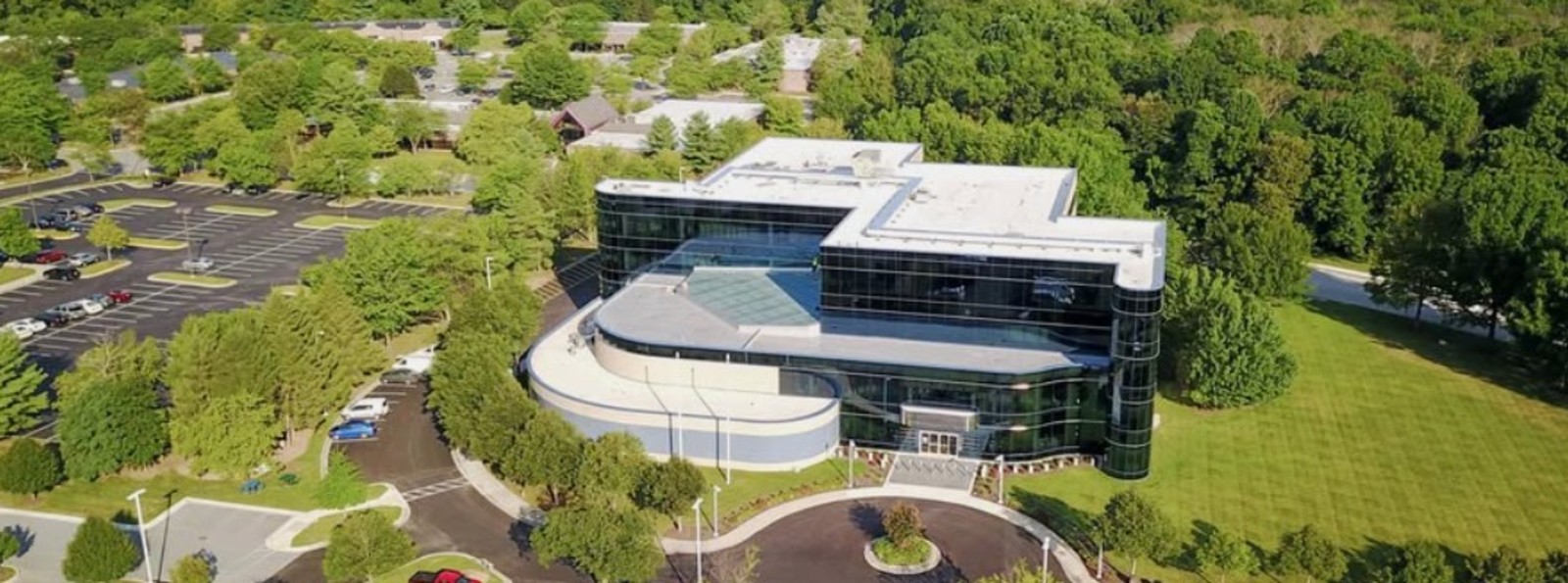
NAD headquarters, Columbia, Maryland, U.S.A.
Credit: NAD Facebook, https://www.facebook.com/NADAdventist/.
North American Division
By Bonita J. Shields and Michael W. Campbell, eds.
Bonita J. Shields and Michael W. Campbell, eds., Faith on the Move: The History of the North American Division of Seventh-day Adventists, 1895–2025 (Columbia, MD: North American Division of Seventh-day Adventists, 2025).
First Published: February 10, 2026
North American Division of Seventh-day Adventists (NAD) is a religious non-profit organization that serves church members and Adventist institutions in the United States, Bermuda, Canada, St. Pierre and Miquelon, Johnston Island, Midway Islands, and the islands of the Guam-Micronesia territory. The headquarters is located at 9705 Patuxent Woods Drive, Columbia, Maryland.1
Statistics: As of December 31, 2022, there were 5,700 churches and 893 companies, 1,234,109 members; 514 Pre-K through 8th grade elementary schools; 90 Pre-K through 10th grade schools; 75 Pre-K through 12th grade schools; 49 high schools (grades 9 to 12); and 189 early childhood education teachers.2 The division also has 3,293 ordained and 687 licensed ministers3; 2,732 elementary school teachers; 976 secondary teachers; and 4,964 college and university full-time and adjunct faculty teaching at 13 colleges and universities.4
Scope: The North American Division comprises nine union conferences (which are in turn composed of 59 conferences and 1 attached field), listed briefly and available as separate encyclopedia entries.
-
Atlantic Union Conference. Territory: Connecticut, Maine, Massachusetts, New Hampshire, New York, Rhode Island, Vermont, and the Bermuda Islands. Constituent conferences: Bermuda, Greater New York, New York, Northeastern, Northern New England, Southern New England.
-
Canadian Union Conference. Territory: Canada, also the French possessions of Miquelon and St.-Pierre. Constituent conferences: Alberta, British Columbia, Manitoba-Saskatchewan, Maritime, Newfoundland and Labrador, Ontario, Quebec.
-
Columbia Union Conference. Territory: Delaware, Maryland, New Jersey, Ohio, Pennsylvania, Virginia, West Virginia, and the District of Columbia. Constituent conferences: Allegheny East, Allegheny West, Chesapeake, Mountain View, New Jersey, Ohio, Pennsylvania, and Potomac.
-
Lake Union Conference. Territory: Illinois, Indiana, Michigan, and Wisconsin.
-
Mid-America Union Conference. Territory: Colorado, Iowa, Kansas, Minnesota, Missouri, Nebraska, North Dakota, South Dakota.
-
North Pacific Union Conference. Territory: Alaska, Idaho, Montana, Oregon, and Washington.
-
Pacific Union Conference. Territory: Arizona, California, Hawaii, Nevada, Utah.
-
Southern Union Conference. Territory: Alabama, Florida, Georgia, Mississippi, North Carolina, South Carolina, Tennessee.
-
Southwestern Union Conference. Territory: Arkansas, Louisiana, New Mexico, Oklahoma, Texas.
-
Guam-Micronesia Mission (Attached Field).
Background and Early Development (1903-1913)
Although there was a global awakening across the nineteenth-century about studying Bible prophecy and promulgating the news about Christ’s Second Coming, the early leaders of what became the Seventh-day Adventist Church emerged out of a North American context, with most of the Millerite revival focused on the New England states and eastern provinces of Canada. In its earliest phase, the denomination spread across the American continent, and only during the late 1860s through the 1870s did it begin to send missionaries to other regions of the continent and to Europe and other parts of the world. Initially, the church was organized into groups, largely as state conferences, beginning in 1860, and then in 1863 as part of a General Conference. By the 1890s, the work in the United States was divided into a series of districts, while some of the earliest experiments with divisions were being conducted in Australia and South Africa.
At the turn of the twentieth century, the denomination recognized the imperative need to reorganize. The lack of finances, inability to make decisions, and authoritarian tendencies of some church leaders contributed to retarding the mission of the church. With major restructuring, an attempt was made to broaden the leadership decision-making process by including more leaders in key policy decisions. A. G. Daniells cited that such “decentralization” and “distribution of responsibilities” were necessary to advance the mission of the denomination. This included the creation of unions and departments to broaden participation and align various aspects of the church, particularly in health and education.
In the wake of the 1901 General Conference session, further refinements would be made to this new structure, including a deliberate attempt to organize the denomination’s work in North America. At the 1903 General Conference session, delegates voted to assign two vice-presidents, each with a specific geographic designation: one for Europe and the other “to labor in the American union conferences and missions, as the Executive Committee may advise, and in the absence of the [General Conference] president, to preside at the councils of the members of the Executive Committee which may be held in America.”5 Veteran educator and administrator W. W. Prescott was elected as the first general vice-president responsible for North America and served for one term. Next, in 1905, George A. Irwin assumed this responsibility until 1911. Then Walter T. Knox assumed this responsibility for two years (1911-13) after which he was elected as treasurer of the General Conference.
Forming a Separate Division (1913-1818)
On May 26, 1913, the 372 delegates, during the General Conference session, voted to create the North American Division Conference with its own constituency and officers.6 This created an opportunity to further decentralize the denomination's leadership, especially to look after and strengthen the church's mission in its home base and to firmly establish outreach efforts. The church initially considered establishing itself in College View, Nebraska, or Kansas City, Missouri, but ultimately located in Takoma Park, Maryland, to easily obtain a working quorum for church business.
The first constituency meeting of the nascent North American Division Conference was held on May 30, 1913, to elect a president. At this meeting, chaired by W. T. Knox, they elected I. H. Evans (1862-1945), a seasoned administrator who until then was the leader of the denomination’s missionary work in China, as the first president. With him, they also elected O. A. Olsen as the first NAD vice-president.7 Next, the General Conference in session voted to officially establish the “North American Division Conference” to begin operations on June 1, 1913.8 Then, two days later, in the second constituency meeting, additional officers were selected: G. B. Thompson as NAD secretary, and W. T. Knox as treasurer.9 Departments were assigned based upon publishing, education, Sabbath School, Missionary Volunteer, Medical, Religious Liberty, and various ethnic groups. The North American Division was tasked with assuming “the general watchcare of all institutions located within its territory.”10 A practice was established of holding an annual “fall council” where the full NAD executive committee could meet. The first such gathering was held Oct. 14-22 in Takoma Park, Maryland.11
I. H. Evans (1862-1945), a seasoned administrator who had spent time in China, was elected as the very first North American Division president. With typical missionary zeal, soon after being elected, he sent a survey to all church leaders asking for statistics on the number of churches and church members, the number of church employees, and whether those employees were “productive” or not. He urged church administrators at all levels to assess and ensure that church resources were being adequately utilized for mission. He also had a special place in his heart for overlooked aspects of mission across North America, especially missionary work among the “Indians of North America,” whom he felt needed more intentional efforts to be reached.12 Another major initiative was the effort to establish a medical center for clinical education for nurses and doctors at the Loma Linda College of Medical Evangelists. Evans polled leaders for their input and support, which culminated in the dedication of the White Memorial Hospital on April 21, 1918.13 To facilitate communication across the North American Division, a new periodical, the Home Missionary Gazette, was established.14
Ultimately, the conflict between Evans and A. G. Daniells, as the General Conference president, led to the phasing out of the North American Division. Daniells wrote in 1917 that “a strong, self-directing, practically independent organization thrown in between the GC and its resources. . . . It transfers the control of the base of supplies from GC to the division.” Adventist scholar LeRoy Froom noted that financial constraints tied the hands of General Conference leaders. Tyler E. Bowen noted that at the Annual Council was recommended that the North American Division be discontinued. “While this organization has done good work in stimulating our people in the home land and building up the work in other lines at the base, yet with the world-wide work in hand, and America being the base of supplies, it seemed that the General Conference Committee should have immediate direction of the work in the home land.”15 Ultimately church leaders voted to return to the pre-1901 model without a separate division. Later leaders reflected that this was “an interesting experience” that resulted in “an unworkable arrangement.” The action became official at the 1918 Annual Council, phasing out the North American Division.
Under General Conference Auspices (1918-1985)
After 1918, a series of General Conference vice-presidents would be tasked with overseeing the leadership and finances of the church in North America. The 1918 session reinstated divisions in other parts of the world, and this arrangement was further refined in 1922, except for any autonomy for North America. Immediately afterward (1918), the North American Division Administrative Committee (NADCOM) ceased to function but was reinstated beginning in 1950. During the early stages of World War II (1939-1941), the vice presidency was left vacant due to wartime conditions. Most of the finances were subsumed by church leaders at the General Conference, who were largely from North America and had ultimate administrative control over this region. Reasons for this combined arrangement included “simplicity,” “economy,” “efficiency,” and “avoiding administrative duplication.” Thus, while divisions gained increasing autonomy in various regions of the world, within North America, the denomination became increasingly centralized and without a separate division committee.
Some administrative changes were made in 1931 when the number of unions in North America was reduced from 12 to 9. The question of a separate NAD structure arose again, but church leaders chose not to pursue it. In 1950, a separate NAD administrative committee was formed, but was limited from control over funds, and separate minutes began to be kept. In the 1960s, the need to have, at least in form, a technically separate North American branch of the denomination helped resolve issues raised by the Internal Revenue Service (IRS) regarding the licensing of ministers so they could receive parsonage benefits. A 1969 survey committee, along with subsequent 1970 and 1970 reorganization committees, voted to maintain the existing union structure and, if possible, combine unions.
The increased administrative authority of the General Conference president meant that, in the late 1970s, first under Robert H. Pearson and then under Neal C. Wilson (vice-president for North America under Pearson), who subsequently became General Conference president (1979-1990), the denomination would re-evaluate its administrative structure. Effectively, toward the end of Pearson’s tenure, the church president gained final say in the selection of division presidents. Once Wilson became church president, Charles Bradford was elected as vice-president for North America to replace him. Bradford assumed leadership, serving as chair of the NAD Committee on administration beginning on July 5, 1979. The next annual council included the NAD Committee on Administration, also chaired by Bradford. At this 1979 Annual Council, a new “Special Relationship” was established between the General Conference and the North American Division:
Voted: 1. To retain, in general, the “unique relationship” that presently and historically unites the General Conference and the North American Division.
2. To continue to study changes in the present relationship while not destroying the advantages of this arrangement, with greater flexibility, responsibility and accountability in the administration of the work in North America.
3. To appoint an ad hoc committee to recommend changes in the policies governing the North American Division Committee on Administration, incorporating the necessary changes in departmental and organizational arrangements.16
The 1980 General Conference session voted to add a section allowing North American representatives on the General Conference Nominating Committee to recommend officers and departmental directors assigned to North America. This is the first voted action formally taken, altering the structure of the work in North America. Robert Dale was assigned to assist Bradford as an administrative assistant responsible to the president for North America. At the same session, this “special relationship” with North America was reviewed, and it was voted that it would be “unwise” for North America to become a division “like all other divisions.” Instead, their relationship should be more of one of cooperation and unity.
Formulating a Division Once Again (1985 to present)
On July 1, 1985, the General Conference voted to grant autonomy, creating a separate North American Division once again. First, the NAD Committee on Administration (NADCA) was reformulated once again as the NAD Committee (NADCOM). New terms of reference were developed, including new officers and a separate budget to handle their own finances. This would begin the process of creating an autonomous organization focused specifically on the denomination’s mission in North America. While it would take some time, the NAD would slowly make its own appointments, develop its own retirement plan, oversee Adventist Book Centers, and establish its own Higher Education Board.
This decoupling would also be evident in 2010, when the NAD president was no longer the ex officio officer in charge of the GC Executive Committee in the president's absence. In 2012, the NAD made a formal request for parity with the other divisions of the world church. On July 3, 2013, all payroll and human resources functions were transferred to the NAD as a separate church entity. In 2014, Oakwood University and Pacific Press became NAD entities, and discussions were underway to evaluate tithe percentages. New efforts were made to oversee the work of Adventist Chaplains and Disaster Life funds.
On October 26, 2017, the North American Division relocated to its own 116,600-square-foot headquarters in Columbia, Maryland, with an auditorium seating 500 people. The previous headquarters was located on the second floor of the General Conference headquarters. In 2022, the NAD secretary and treasurer were dropped as associate secretary and treasurer of the General Conference, and NAD conference presidents were no longer invited to attend the General Conference Annual Council.
Division Leaders
Vice-president of North America (1903-1913): William W. Prescott (1903-1904); George A. Irwin (1905-1911); Walter T. Knox (1911-1913).
President, North American Division (1913-1922): I. H. Evans (1913-1918); E. E. Andross (1918-1922).
Secretary, North American Division (1914-1919): G. B. Thompson (1914-1918); H. E. Rogers (1919)
Treasurer, North American Division (1914-1919): W. T. Knox (1914-1919)
Vice-president of North America (1922-1985): Oliver Montgomery (1922-1926); James L. McElhany (1926-1932); William H. Branson (1932-1936); Malcolm N. Campbell (1936-1939); William Gordon Turner (1941-1945); Louis K. Dickson (1946); Nathaniel C. Wilson (1947-1948); William B. Ochs (1950-1962); Theodore Carcich (1962-1966); Neal C. Wilson (1966-1978); Charles E. Bradford (1979-1985).
President, North American Division (1985 to present): Charles E. Bradford (1985-1990); Alfred C. McClure (1990-2000); Don Schneider (2000-2010); Daniel R. Jackson (2010-2020); G. Alexander Bryant (2020-present).
Secretary, North American Division (1985 to present): Fred G. Thomas (1985-1987); Robert L. Dale (1988-1990); Harold W. Baptiste (1991-2002); Roscoe J. Howard III (2002-2008); G. Alexander Bryant (2008-2020); Kyoshin Ahn (2020-present).
Treasurer, North American Division (1985 to present): George H. Crumley (1985-1998); Juan R. Prestol (1999-2007); G. Tom Evans (2007-2018); Randy Robinson (2019-2023); Judy R. Glass (2023-present).
Sources
Annual Council Minutes, October 10, 1979, 79-122. Available from: https://documents.adventistarchives.org/Minutes/NAD/NAD1979-10.pdf [accessed 4/12/23].
“Constitution and By-Laws of the. North American Division Conference of Seventh-day Adventists.” ARH, June 5, 1913.
“Dedication of the Mrs. Ellen G. White Memorial Hospital.” ARH, March 28, 1918.
“Eighteenth Meeting.” ARH, June 5, 1913.
“North American Division Conference: Fourth Meeting, May 30, 4:15 P.M." ARH, June 12, 1913.
“North American Division Conference Committee Recommendations,” ARH, July 3, 1913.
Seventh-day Adventist Encyclopedia. Second revised edition. Hagerstown, MD: Review and Herald Publishing Association, 1996. S.v. “North American Division.”
Seventh-day Adventist Yearbook, various years. https://www.adventistyearbook.org/.
Shields, Joiner Bonita and Michael W. Campbell, eds. Faith on the Move: A History of the North American Division. Columbia, MD: The North American Division of Seventh-day Adventists, 2025.
T. E. Bowen to J. M. Johanson, February 26, 1917. General Conference Archives, Silver Spring, Maryland, U.S.A.
“The General Conference,” under the subheading, “Seventeenth Meeting.” ARH, April 28, 1903.
“”The General Conference: Thirty-Eighth Session, May 15 to June 8, 1913: Thirtieth Meeting, June 4, 10 A.M.” ARH, June 19, 1913.
"The North American Indians.” ARH, October 2, 1913.
Notes
-
This article is condensed and adapted with permission from Faith on the Move: A History of the North American Division, eds. Michael W. Campbell and Bonita Joiner Shields (Columbia, MD: The North American Division of Seventh-day Adventists, 2025).↩
-
Statistics courtesy of Brian Ford, eAdventist Membership Services, email to the author, April 12, 2023.↩
-
E-mail, Ivan Williams to Michael W. Campbell, April 12, 2023.↩
-
Educational statistics are available at: https://v1.adventisteducation.org/stat.html [accessed 4/12/23]↩
-
“The General Conference,” under the subheading, “Seventeenth Meeting,” ARH, April 28, 1903, 12 [article 5].↩
-
“Eighteenth Meeting,” ARH, June 5, 1913, 538-541.↩
-
“North American Division Conference: Fourth Meeting, May 30, 4:15 P.M.,” ARH, June 12, 1913, 569.↩
-
“”The General Conference: Thirty-Eighth Session, May 15 to June 8, 1913: Thirtieth Meeting, June 4, 10 A.M.,” ARH, June 19, 1913, 582.↩
-
“North American Division Conference: Fifth Meeting, June 3, 3:15 P.M.,” ARH, 569-570.↩
-
“”The General Conference: Thirty-Eighth Session, May 15 to June 8, 1913: Thirtieth Meeting, June 4, 10 A.M.,” ARH, June 19, 1913, 582.↩
-
“North American Division Conference Committee Recommendations,” ARH, July 3, 1913, 635.↩
-
“The North American Indians,” ARH, October 2, 1913, 945.↩
-
“Dedication of the Mrs. Ellen G. White Memorial Hospital,” ARH, March 28, 1918, 24.↩
-
“Eighth Meeting,” ARH, April 25, 1918, 13.↩
-
T. E. Bowen to J. M. Johanson, February 26, 1917, General Conference Archives.↩
-
Annual Council Minutes, October 10, 1979, 79-122, available from: https://documents.adventistarchives.org/Minutes/NAD/NAD1979-10.pdf [accessed 4/12/23].↩