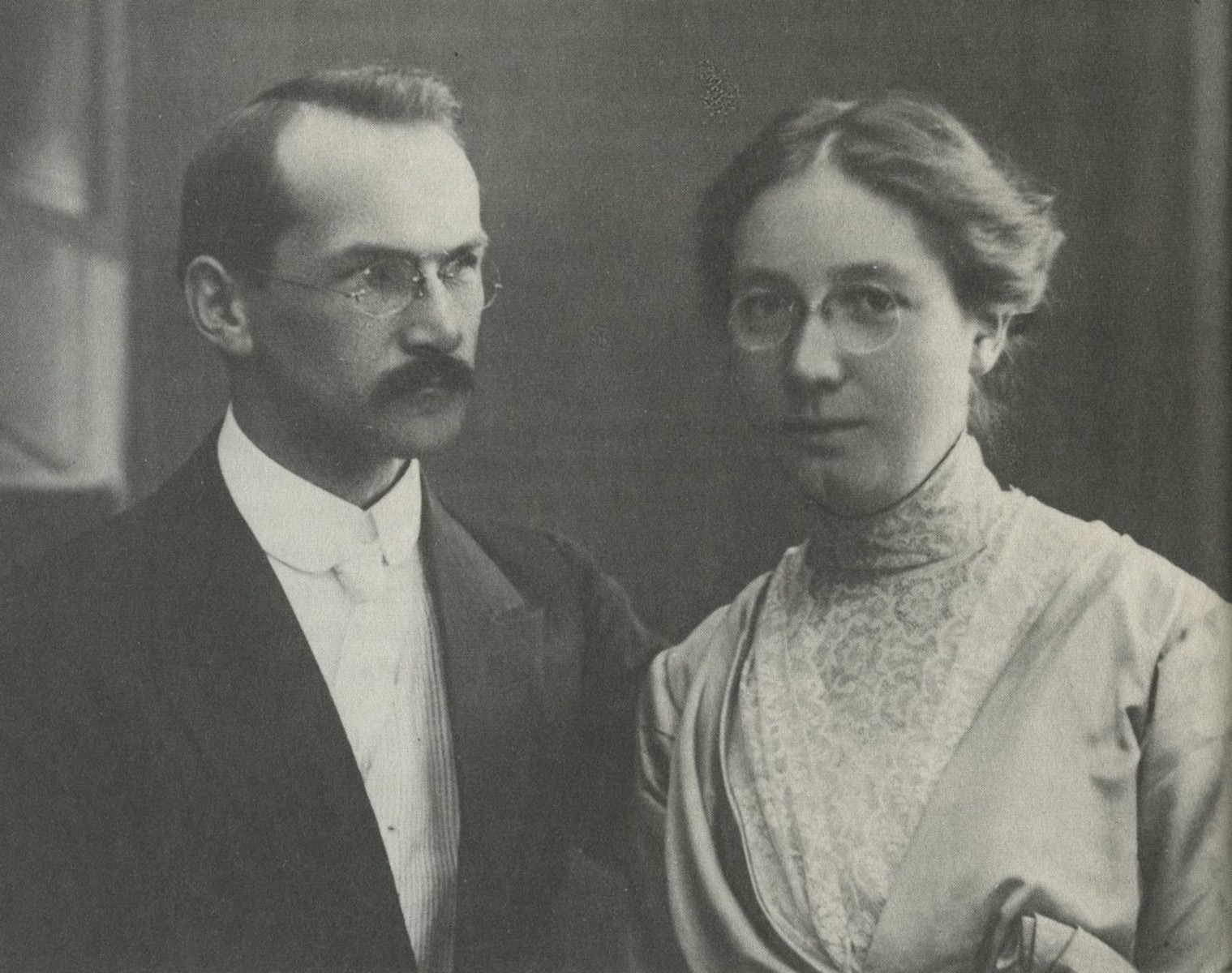
Frank and Florence Oster, taken on their wedding day in London, England, September 1, 1913.
Photo courtesy of the General Conference of Seventh-day Adventists Archives.
Oster, Frank Frederick (1881–1960)
By D. J. B. Trim
D. J. B. Trim, Editor of the Encyclopedia of Seventh-day Adventists, has been Director of Archives, Statistics, and Research for the General Conference of Seventh-day Adventists since 2010. A graduate of Newbold College (BA cum laude), where he later taught for ten years (1997-2007), and of the University of London (Ph.D.), he was Walter C. Utt Professor of History at Pacific Union College (2008–9) and been an adjunct professor of church history and mission at the Seventh-day Adventist Theological Seminary (since 2014). Dr. Trim’s many publications include ten books along with numerous book chapters and articles.
First Published: June 3, 2024
Frank Frederick Oster was a pioneer missionary to the Middle East. He served for thirty-five years, and his wife, Florence, for thirty-one. Much of their time was difficult and dangerous, but but they stayed the course and laid the foundations of the Adventist mission work in the Middle East.
Early Life and Education
Frank Oster was born in Frutigen, Switzerland on July 12, 1881, the son of Gilgian and Susan (Smidth) Oster. Two years later, Frank’s family emigrated to Wisconsin, where they were the first Seventh-day Adventists in the town of Fond du Lac—this is according to information recorded much later in life by Frank, who adds the date 1889, so the Osters must have converted to Adventism in the United States, rather than having been Seventh-day Adventists in Switzerland.
Frank’s family moved again in 1891 to Oregon, where Frank grew up. He was baptized in the spring of 1894. More than half a century later, recalling his life, a friend recalled that Frank “early had a desire to dedicate his life to God, and . . . began preparing for mission service.”1 At first, he took night classes at the Portland, Oregon, YMCA, while working as a tailor in the city, but in 1907 he entered Walla Walla College, where he studied for two academic years.2 He and other friends who became foreign missionaries may have come under the influence of the college’s president, W. W. Prescott, who, had a passion for foreign mission; they were certainly influenced by a teacher, Harry Washburn.3 In 1908, Frank served as a colporteur (literature evangelist) during the summer.4 The following spring, he went to the Foreign Mission Seminary at Washington, D.C., but either there or while still at Walla Walla he had already accepted a call to serve in “Persia” (as Westerners then called what is today Iran), and in the summer of 1909 he travelled onwards from Washington to Germany, to undergo further missionary training at the German training school in Friedensau.5
Training and Evangelizing in Germany
Oster found his time at Friedensau enjoyable and profitable, learning physical therapy and other practical skills; however, he wrote to a friend in the homeland, “I long to reach my field of labor”.6 Oster served in a tent evangelistic campaign in the summer of 1910, in a three-month campaign in southern Germany that evoked strong opposition from the local Catholic hierarchy.7
As already noted, Oster was under appointment to “Persia”; Iran and the rest of the Middle East came under the European Division. When the Division Committee convened in Hamburg in mid-September 1910, its members were joined at one of its meetings by Oster and one of its voted actions was: “That F. F. Oster proceed to Baku, take a Persian teacher, study the situation, and carefully report to this Committee his findings.” The second was for “H. Dirksen [another American missionary who had been training in Germany] to proceed to Baku” as well, departing December 1.8 On September 25, 1910, Oster duly left Hamburg, heading for the Caucasus Mountain region; traveling via Berlin, Warsaw, Kiev, and Rostov (near the Sea of Azov), he arrived in Baku on October 5. Two months later, on December 13, Dirksen, too, left Germany; he presumably arrived around Christmas 1910 or early in 1911.9 It took five weeks for a letter to reach Washington, D.C. from Baku,10 which gives a sense of Oster’s isolation there, let alone in Persia.
Oster and Dirksen were both heading for northern Persia, which was in the Russian imperial sphere of influence. The south of the country “had become a British protectorate in all but name”.11 It may be that the personal experience of L. R. Conradi—leader of Adventist work in Europe and the Middle East—in Russia, which had many German-speaking communities, led him to decide to set up work in the Russian-dominated north of Persia. At any rate, Oster and Dirksen headed for the cities of Tbilisi and Baku, which both lay in the Russian empire’s territories in the Caucasus; in doing so, both young men were following a well-recognized route of travel from Germany to northern Persia.12 Oster spent seven months in Baku, Dirksen five or six.13
Azerbaijan and Georgia
Today Baku is the capital of the nation of Azerbaijan, but historically Azerbaijan was also a province in northern Persia, which had only been annexed by Russia in the nineteenth century. Russian Azerbaijan was a good place to prepare for Iran, for many Persian-speaking tribesmen lived on the Russian side of the border, and there was a large community of Azeris south of the border in Persian Azerbaijan. Oster quickly found a teacher of Farsi (or Persian, as Oster always called it) and seems to have learned something of Arabic and Turkish as well.14 In sum, as Oster wrote home in 1911, the months in Baku were “an opportunity to become somewhat acquainted with Persian life. Some fifty thousand Persians reside in Baku”.15
There was also a small community of German-speaking Adventists in Russian Azerbaijan, dating back to 1906.16 The two missionaries, but Oster in particular, worked with this group of believers, who were drawn from across the Caucasus.17 By February 1911, Oster wrote to his pen-friend (and future wife) Florence White: “We cast many longing glances to the south, and are waiting now for instructions from headquarters concerning a forward move”.18 Oster wrote elsewhere of how he was eager to share “the gospel of Jesus Christ” and “the salvation that is found in Jesus alone” with the people of Iran and impatient to “carry the glad tidings to them”.19 But progress in learning Farsi was slow.20 Eventually, in early April the European Division Committee in Hamburg took an action: “That Brethren Oster and Dirksen be advised to visit northwestern Persia, calling at Urmia and Tabriz. They will remain at one of these places until they hear from us, after having reported to us fully the conditions and the outlook as they find them there”.21 Baku was on the telegraph line but not for more than a month did the two missionaries make the move to Persia, so probably they received the instruction by mail.
Oster wrote home: “On the evening of the 10th [of May] we met with the little company of Sabbath-keepers, with whom we had for a half-year been so closely connected, and to whom we had become so dearly attached, for a farewell meeting”.22 Early the next morning they took the train west; they partly retraced their journey of late the previous year, to Tbilisi, the capital of Georgia, a once-independent kingdom, then part of the Russian Empire (and today independent once more); from Tbilisi the railway ran 400 miles southeast through Russian Armenia to Julfa, then the terminus of the railway line.23 Georgia was historically Christian, and there was a group of between twenty and thirty ethnically German Adventist believers; like those in Baku, they were part of the Caucasian Conference.24 Oster and Dirksen reported: “We spent five very profitable days with our people in Tiflis [Tbilisi]. The Lord blessed our work, and hearts were melted by the Holy Spirit".25 Oster noted: “We had excellent meetings. It is seldom that traveling brethren visit this place, so they compelled us to stay a few days longer”.26 But this was just a brief stop before they moved on, into the wilds of Armenia.
Into Iran
On a late spring day in 1911, Oster and Dirksen, both still in their twenties (Oster aged 29 and Dirksen aged 21), were shivering somewhere in the Caucasus Mountains, in what was then Russian Armenia. They were within sight of Mount Ararat, and because they were fervent Bible-believing Christians, they were thrilled, as one wrote, to see “the huge giant towering into the azure sky. Though thousands of winters have passed over him, clothing him in long white locks, he stands there just as proudly now as the day when Noah scaled his summit, a silent witness to the power of God”.27 They were about to attempt to take the Third Angel’s Message for the first time into the ancient nation of Iran.28
They finally crossed the Aras River, which marked the Iranian border with the Russian Empire, departing Julfa in “a small open row-boat in the midst of a heavy rain storm” on May 18, 1911, thus commencing Adventist mission in Iran.29 They sent a postcard to Takoma Park:
This morning we crossed the Persian border, en route to Tabriz. We shall proceed by automobile in a day or two. The distance is eighty miles, and our destination is reached in seven or eight hours. . . . We are of good courage in the Lord.30
Oster later wrote and described how the two young men, having reached the Persian side of the river, “loaded our baggage on donkeys and went to the automobile station.” However, a combination of limited service and recent heavy rains meant that it was not until near midnight on the third day (May 21, 1911), that they arrived in Tabriz, in a horse-drawn carriage rather than an automobile, having “held candles against the window panes” for part of the journey to light the way.31
Early Mission in Persia
Tabriz is now a city of around 1.7 million people, but then its population was around 200,000.32 It had a relatively large population of foreign nationals. “Here they began language studies, and made themselves acquainted with the manners and customs of the people by visiting the villages”.33
Within three to four months of their arrival, Oster and Dirksen had begun to “hold Bible studies in the Persian language”.34 In a year-end review of mission progress during 1911, GC Secretary William Spicer hailed the achievement of “Brethren F. F. Oster and H. Dirksen [in] cross[ing] the Persian border,” so that “that ancient land of Cyrus and Darius is brought at last within our missionary boundaries.”35 There was little progress, however, and soon enough Oster and Dirksen moved to the city of Urmia. This lies 150 kilometers (90 miles) directly west of Tabriz, but a greater distance (nearly 250 kilometers or 150 miles) by road, as the large Lake Urmia lay in between. Today it has a population of around one million; in the early twentieth century it was known for its large Christian population.36 By the late summer of 1912, Oster and Dirksen were conducting Bible studies only with foreigners, especially expatriate Germans, as Dirksen reported to the European Division.37
Soon after sending this report, Dirksen returned to the United States—it seems that this was not due to illness but to finding the alien culture and language difficult to adapt to, combined with discouragement from the minimal results he and Frank Oster had achieved.38 A German missionary, Otto Staubert and his family, were sent to replace Dirksen, however, and were stationed in Tabriz.39
After two years in the Lake Urmia region, Frank journeyed back west as far as England, where on September 1st, 1913, he was married to Florence White. They had overlapped as students at Walla Walla and become pen-friends while Frank was in Germany, Russia, and Iran; thanks to this epistolary connection, their relationship deepened.40 Florence had been born on November 11, 1888, in Sweden, to two American Adventist missionaries, William B. and Nettie (Grant) White. After their wedding she accompanied Frank back to “Persia.”
The Stauberts and Osters soon settled in Maragheh, a town with a population of some 60,000 back on the east of Lake Urmia, south of Tabriz.41 The Osters’ first child, a daughter, Winona, was born December 1, 1914.42 Florence, like Frank, had put much effort into learning the local language and for a while taught English to interested ladies in Maragheh in exchange for their teaching her what is described as Turkish—perhaps actual Turkish, perhaps Azeri-Turkic.43 This was the only local language she learned, whereas Frank listed “German, Turkish and Persian” among his languages.44 This made him very unusual. Thirty years later, one American educator and missionary, “fluent in Persian,” believed himself “one of only six Americans” who could speak Farsi fluently.45 Oster’s determination to learn Farsi and Turkish speaks to his commitment to the mission work in which he was engaged.
In 1907, Russia and Britain had concluded a treaty, carving Iran into spheres of influence, while nominally preserving the country’s territorial integrity. Tabriz was in the northern, Russian, sphere of influence, which provided a degree of security and protection to foreigners living in Tabriz.46 The city was, too, one of the centers of foreign missionary activity in Persia; the first American missionaries to Persia had been sent by the American Board of Commissioners of Foreign Mission in 1833 and reached the area in 1834; they mostly focused on Nestorian Christians. A “tide of missionary activity in the Nestorian area around Urmiya [sic]” began in the 1850s.47 Several Adventist missionaries’ letters home mention American Presbyterian missionaries and their activities in Tabriz and Urmia.48
The Impact of War
In August 1914, World War I broke out in Europe and in October the Ottoman Empire declared war on Russia and the other Allies. Iran remained neutral, but the Turks and Russians alike mounted major campaigns in the Caucasus region. Elder Staubert was called up for military duty and travelled via Turkey back to Germany; his family fled to Tehran and later to Russia; Frank was once again the only church worker in Persia.49
However, in the winter of 1914-15, the war led to great danger to the Oster family. Iran was neutral, but bordered the Ottoman and Russian Empires, both of which were intent on enlarging their territories in the Caucasus region. The Russian sphere of influence around Lake Urmia was fair game in Ottoman eyes. The “great plain of Urmia . . . was dotted with villages and a veritable forest of vineyards and orchards. Russian presence in the area had established a degree of peace and order”.50 While Ottoman armies were deploying to the Caucasus, the Turks initially stirred up the Kurds, Muslim hill tribesmen occupying the mountainous region spanning Iran and the Ottoman provinces of Van and Mosul.51
The Russian presence around Urmia had not only resulted in political stability; because Christians did not have to fear Muslim persecution, they had achieved “high levels of education, and had come to enjoy a prosperity” that their Muslim neighbors envied and were embittered by.52 Kurdish bandits were a danger across the Caucasus region; for example, they threatened Christian missionaries in Van, in Ottoman Armenia, in the spring of 1913.53 On joining the war, the Ottomans declared it a jihad.54 Christian missionaries from the West, as well as the indigenous Assyrian and Armenian Christians, were potentially in grave danger. In November 1914, “the Kurds descended from their mountains, raiding, plundering, and killing the Christians who were living in those fertile plains around the lake”.55 Being from a neutral country was no protection, and the Presbyterian missionaries in Urmia, which was closer to the Ottoman border, quickly evacuated to Tabriz or Tehran.56
The Kurds were forerunners of an Ottoman army, which “crossed into Persian Azerbaijan from Mosul,” reflecting the fact that Persia was under Russian and British imperial domination and thus regarded as a threat by Ottoman commanders in what today is northern Iraq. “The Turkish commander. . . threatened to march all the way to [the capital] Tehran if the Russians and English did not withdraw their forces from Persia.” As a recent historian writes, in January 1915, Turkish forces “even briefly occupied ‘Russian’ Tabriz, where local jihadis had torched the largest Russian bank, temporarily putting . . . to flight” the Russian garrison.57 These “local Jihadis” were, according to the Osters, Kurds.
The Russians had sent troops to engage the Kurds, but they were driven back. The troops in Maragheh hastily fled back to Tabriz, taking a direct route across the mountains. The Osters and many other local Christians joined them, fearing both “the Kurds on the one hand, and an anti-Christian uprising of the Moslems on the other”.58 In the course of this nighttime journey, made on Christmas Eve 1914, the life of little Winona was, as it seemed, miraculously preserved after a precipitous fall.59 On reaching Tabriz they took refuge with the American Presbyterian missionaries.60 Here the Russian forces rallied and finally defeated the Ottoman forces in a battle in the city and drove the Turks and their Kurdish auxiliaries out of Tabriz.61 As Florence Oster wrote home some months later, “at last the Russians . . . drove away the dreadful Kurds.”62 After not having received any mail for months, in March 1915 the Osters’ “hearts were made glad to receive a bundle of letters from abroad”.63
Enduring Wartime Conditions
The Osters returned to Maragheh, but there, sadly, little Winona passed away. She was buried in the town’s Armenian cemetery and there still lies “Winona Lucielle Oster”.64 Winona’s death was traumatic for her parents. Florence wrote in a letter home: “Though our hearts are broken, for our greatest blessing here has been taken from us, yet we look up to God and he comforts us. We are more determined to work harder for the people”.65 Soon enough the enduring threat of Kurdish raids, massacres of Christians in the Urmia region by local Muslims, and perhaps the unhappy memories associated with Winona’s passing, led Frank and Florence to abandon Maragheh for Tabriz; but they were determined to remain there and not flee to Tehran or leave Iran completely.66
In 1914, work had begun on a railway to connect Tabriz with the Russian rail network. In 1916, Russian troops moved south to Tabriz as part of their operations against the Ottomans, and they added to the railroad as they moved; the extension from the railhead of Julfa to the city of Tabriz and on to Lake Urmia, was completed by 1916.67 This should have led to improved communications with the church headquarters and the Osters’ families, and for a time it probably did.68 However, soon enough political and military developments in the Russian Empire were to leave Frank and Florence more cut off than before.
The Russian Revolution toppled the imperial government in the late autumn of 1917, and early in 1918 the Bolshevik regime nullified the treaty partitioning Persia into Russian and British spheres of influence. No protection from Russian troops could henceforth be counted on. In May 1918, the Russian army was withdrawn north across the border and an Ottoman force occupied Tabriz for six months, until in November the Ottoman Empire collapsed and its army, too, was withdrawn. Again, the Osters remained in the city despite the dangers to Christians.69 But conflict in the region was not at an end. In 1920, troops of the new Union of Soviet Socialist Republics “put an end to the brief existence of the independent republic of Azerbaijan and occupied Baku”.70 The fighting to the north, and the Communist victory, destabilized the northern border regions of Iran; and since it was not until early 1921 that Moscow and Tehran concluded a treaty, there was the prospect until then of Bolshevik troops, hostile to Westerners and Christians, marching south and occupying Tabriz. Although this did not happen, the Russian Civil War and then the Communists’ victory in it, did mean that Christian missionaries could no longer have a line of communication across the nearby Russian border.71 Instead, they would have to direct all communication (and receive all funds and instructions) through the more distant ports on the Persian Gulf or Arabian Sea, or the even more time-consuming land route east across the Near East. In the face of all the dangers, however, the Osters remained at their posts.
From 1916 until after the end of the war, they only heard from their families in America about once a year, and were, as Oster wrote, “cut off from all bank connections,” so that no money could be sent to them by church officials. In addition, they were surrounded by a “great deal of sickness” in the winter and spring of 1918. In a letter that took nearly nine months to reach the church headquarters, Oster told GC Treasurer Walter Knox: “It has been so estimated that at one time there were twenty thousand sick with typhus. In this part of the country thousands have died of starvation and it is said that some villages are completely depopulated.”72 As it heard from Oster, the General Conference did what it could. After a report “speaking of the need of relief work among refugees fleeing into the regions where he is located,” it sent Oster $500 to help care for people displaced by the war.73
In late 1919 the Osters finally took their first furlough. After what they had experienced, many might have said “Enough” and remained in the United States. But the Osters had had two more children born in Tabriz, both sons: Winton, born in July 1916, and Francis, born in July 1918.74 In early 1922, with a third son, Kenneth, born while on furlough, the Oster family returned to Iran, to the people they had come to love.
Missional Impact
Like other Western missionaries, Adventists “found their attempts to convert Armenians and Assyrians from one denomination of Christianity to another more profitable than proselytizing activities among the Muslims”.75 In 1914, Frank and Florence began to meet with some interested Armenian Christians.76 By late 1914, the Osters had their first Sabbath-keepers in Maragheh—yet they were not Muslims but “well-educated Christian Jews” who served in a Lutheran mission station.77 In 1916, Oster was delighted to report “our first Sabbath-keepers in this city” [Tabriz], but noted that two of them had been previously converted by the American Presbyterian mission in Tabriz.78 By 1920, there were twenty members in the Persian Mission.79 But converts in Iran during the 1910s seem to have been drawn from local Armenian Orthodox, Assyrian (Nestorian), and Jacobite Syrian Christians.80
Yet, by 1924, the Osters’ years of effort were beginning to pay off. Oster wrote to the European Division reporting:
The work here in Persia is a fast-growing work. It is no exaggeration to say that more is being done in one month's time than in all of the work for the first ten years, excepting language study. I have had three baptismal services, baptizing more than forty persons, and quite a number are waiting both here and in other places. . . . More than half our members have left Tabriz for other parts of Persia, taking the light with them, and now come calls from them for a preacher or teacher to instruct their neighbors.81
However, Oster’s report goes on to speak of Armenians, Catholics, and “Christian villages,” making it plain that his converts were not coming from the majority Muslim population, while he is also known to have drawn converts from “Russians and Germans fleeing from the Red Revolution in Russia”.82
More than forty years after Frank Oster entered Persia, his son Kenneth, who succeeded him as a missionary in Iran, reflected that it was still the case that “the great majority of our membership has been from the Christian minority groups (Armenians and Assyrians).” However, as the growth of the oil industry led to economic development in the south, many “moved to Teheran [sic] . . . leaving but a handful of resident members in Tabriz.”83 Yet though Tabriz ceased to be a major outpost of Seventh-day Adventism, Adventists from the region spread out across Iran, leading to a growth in membership—it was above 300 in the early and mid-1960s.84 Members were, however, largely drawn from Adventist families or converts from Eastern Christian churches.
Later Developments
In the end, Frank Oster served for twenty-seven years in Iran and Florence for twenty-five. In 1938, Frank accepted a call to move from Iran to Turkey, where he and Florence served a further five years in Turkey.85 In all that time, the family had only three furloughs: in 1919, 1927, and 1936.86 When they did visit the United States, they did not only spend time with relatives; they also visited camp meetings and churches to encourage young people to go as missionaries. In the autumn of 1936, for example, Frank Oster was sent to attend the Annual Council of the General Conference Committee; first he visited family in the Pacific Northwest, but while there he spoke at local churches to encourage the new generation of young people to go as missionaries. He also attended and spoke at the New England and New Jersey Conference camp meetings.87 After their return to the United States, Frank served for four years in ministry in Indiana and then, in 1948, Frank and Florence retired to southern California. Frank died on March 22, 1960, aged 78; Florence died on June 8, 1981, aged 93.88
Conclusion
Frank and Florence Oster committed to mission in a remote and very difficult part of the world, but they stayed the course—they gave a huge proportion of their lives to the country they thought of for many years as “Persia” and this was followed by five years in Turkey. In all, Frank Oster was a missionary for thirty-five years, and Florence for thirty-one. Much of their time was difficult and dangerous, and it cost them two children (Winona and, in 1936, Francis), but they were committed. Later, their son Kenneth S. Oster himself became a long-term career missionary in the Middle East, including in Iran.
The Iranian Revolution has had dramatic and harmful effects on the Adventist Church in Iran, but the members who survive from the past (who continue to witness to their faith, despite great danger) are an inheritance from the foundations laid by Frank Oster and his family.
Note on Sources: This article is based in large part on original reports from the missionaries who first entered Iran but also utilizes a memoir of Frank and Florence Oster, co-authored by their son, Kenneth, which draws in part on Florence’s contemporary correspondence: Kenneth S. Oster with Dorothy Minchin-Comm, To Persia, With Love (Mountain View, Calif., Omaha, Nebr. & Oshawa, Ont.: Pacific Press, 1980). It is not always clear, however, which parts of the text are based on Florence Oster’s letters and which on her memories; at points, therefore, this article prefers contemporary sources to the memoir.
Sources
Algar, H. 1991. “Religious Forces in Eighteenth- and Nineteenth-Century Iran,” in P. Avery, G. Hambly, and C. Melville, eds. The Cambridge History of Iran, vol. 7 (Cambridge: Cambridge University Press, 1991).
Avery, P. 1991. “Printing, the Press and Literature in Modern Iran,” in in P. Avery, G. Hambly, and C. Melville, eds. The Cambridge History of Iran, vol. 7 (Cambridge: Cambridge University Press, 1991).
Avery, P., G. Hambly, and C. Melville, eds. The Cambridge History of Iran, vol. VII. Cambridge: Cambridge University Press, 1991.
Bethmann, E. W. Bridge to Islām. Nashville, TN: Southern Publ. Assoc., 1950.
“Canvassers’ Notes,” North Pacific Union Gleaner [hereafter NPUG] 3, no. 12 (July 15, 1908).
Conradi, L. R. 1910. Progress in the European Division. RH 87, no. 45 (Nov. 10).
“Deaths” [Oster, Florence W.], ARH 158, no. 40 (Oct. 1, 1981).
Dirksen, H. H. “A Word from Germany” [extracts from Henry H. Dirksen letter], NPUG 5, no. 11 (July 13, 1910).
Dirksen, H. H. “Persian Mission: [Letter from Henry H. Dirksen]. Quarterly Report of the European Division of the General Conference of S.D.A. 1, no. 3 (Third Quarter, 1912).
European Division. European Division Session, meeting of June 17, 1909, minutes in “General Conference Committee Proceedings,” GC Ar., RG 1, box 13738, vol. 8; meeting of Sept. 16, 1910, 2 p.m., minutes in “General Conference Committee Proceedings,” GC Ar., RG 1, box no. 13738, vol. 8; meeting of April 4, 1911, minutes in “General Conference Committee Proceedings,” GC Ar., RG 1, box no. 13738, vol. 8.
Farnworth, R. 2020. “Railways in Iran – Part 2 – 1910 to 1945”, https://rogerfarnworth.com/2020/03/24/railways-in-iran-part-2-the-1910-to-1945, accessed Aug. 8, 2021.
General Conference Executive Committee meeting of Feb. 7, 1918, minutes in GC Ar., RG 1, box 13740, “General Conference Committee Proceedings,”, vol. 10, pt. 2.
Information Form. 1936. F. F. Oster’s completed form “Information on Returning Missionaries,” Aug. 1, 1936. In Oster’s missionary appointee file, GC Ar., RG 21, box 9893.
“In Remembrance” [Henry H. Dirksen], ARH 142, no. 35 (Sept. 2, 1965).
“In Remembrance” [Frank Frederick Oster], ARH 137, no. 21 (May 26).
Johnson, T. G. “Upper Columbia Items” [untitled note, including extracts from a letter from Oster to Johnson], NPUG 4, no. 22 (Sept. 22, 1909).
Kazemzadeh, F. “Iranian relations with Russia and the Soviet Union to 1921,” in P. Avery, G. Hambly and C. Melville, eds., The Cambridge History of Iran, vol. 7 (Cambridge: Cambridge University Press, 1991).
Kidd, Thomas S. American Christians and Islam: Evangelical Culture and Muslims from the Colonial Period to the Age of Terrorism. Princeton, NJ: Princeton University Press, 2009.
Land, G. 2005. Historical Dictionary of Seventh-day Adventists. Lanham, Md.: Scarecrow Press.
McMeekin, Sean. The Berlin–Baghdad Express: The Ottoman Empire and Germany’s Bid for World Power (Cambridge, MA: Belknap Press of Harvard University Press, 2010).
Mission Board. 1940. Information Pertaining to Missionary Appointees, June 9, 1940. In “Personal Information Forms and Biographical material—O,” GC Ar., RG 21, record no. 114935.
“News Flashes; Union Office Notes,” NPUG 31, no. 40 (Oct. 13, 1936).
“Notes,” NPUG 4, no. 45 (March 9, 1910).
“Notes,” NPUG 5, no. 21 (Sept. 21, 1910).
Note. [Untitled news note]. RH 87, no. 43 (Oct. 27, 1910).
Note. [Untitled news note]. RH 87, no. 46 (Nov. 17, 1910).
Note. [Untitled news note, quoting postcard from F. F. Oster and H. Dirksen]. RH 88, no. 24 (June 15, 1911).
“Obituaries” [Martha Elizabeth Cole (née Oster)], NPUG 52, no. 28 (July 15, 1957).
“Obituaries” [Frank Frederick Oster], Pacific Union Recorder 59, no. 42 (May 16).
Oster, F. F. “A plea for a school,” Mission Quarterly 27, no. 4 (Fourth Quarter, 1938).
Oster, F. F. “A Word from Persia,” NPUG 5, no. 37 (Jan. 4, 1911).
Oster, F. F. “Biographical information blanks”, in “Personal Information Forms and Biographical material—O,” GC Ar., RG 21, record no. 114935.
Oster, F. F. “First Fruits from Persia” [F. F. Oster letter to J. E. Jayne, Oct. 1, 1916] Atlantic Union Gleaner 15, no. 46 (Nov. 15, 1916).
Oster, F. F. “Into Persia” [part 1 of 2], NPUG 6, no. 13 (July 26, 1911).
Oster, F. F. “Into Persia (continued)” [part 2 of 2], NPUG 6, no. 14 (August 2, 1911).
Oster, F. F. Letters to W. A. Spicer, March 7 and 17, 1915. GC Ar., RG 21, box 3280, file “Incoming Letters – 1915 -- Oster F. F.”
Oster, F. F. “The Persian Feast of Mourning,” RH 88, no. 26 (June 29, 1911).
Oster, F. F. Untitled [F. F. Oster letter to W. T. Knox, Aug. 28, 1918], NPUG 14, no. 6 (May 29, 1919).
Oster, F. F. “Word from Persia” [letter of Nov. 13, 1914], Pacific Union Recorder 14, no. 27 (Feb. 4, 1914).
Oster, F. F. and H. Dirksen [Dierksen (sic)]. “From the Land of Daniel and Darius,” ARH 88 no. 48 (Nov. 30, 1911).
Oster, Florence. Completed “Biographical information blanks”, in “Personal Information Forms and Biographical material—O,” GC Ar., RG 21, record no. 114935.
Oster, Kenneth. “Visiting the Seven Churches of Iran,” ARH 131, no. 61 (Dec. 30, 1954).
Oster, Kenneth and Dorothy Minchin-Comm. To Persia, With Love. Mountain View, CA, Omaha, NE & Oshawa, ON: Pacific Press, 1980.
Read, W. E. “Good News from Persia [including lengthy extracts from a letter from Oster],” ARH 101, no. 14 (Apr. 3, 1924).
“Sad News from Persia” [Florence Oster letter], Atlantic Union Gleaner 14, no. 44 (Nov. 3, 1915).
Seventh-day Adventist Conferences, Missions, and Institutions: Annual Statistical Report, 1920.
Spalding, Arthur Whitefield. Christ’s Last Legion. Washington, DC: Review & Herald Publ. Assoc., 1949.
Spicer, W. A. “A year-end look over the fields,” ARH 88, no. 49 (Dec. 7, 1911).
Sutton, Matthew Avery. Double Crossed: The Missionaries Who Spied for the United States during the Second World War. New York: Basic Books, 2019.
Trim, D. J. B. Adventist Mission in the Middle East: A History, General Conference Archives Monographs (Silver Spring, MD: General Conference Office of Archives, Statistics, and Research, forthcoming).
White, W. B. “Entering Persia” [including extracts from F. F. Oster letter], Atlantic Union Gleaner 10, no. 8 (Feb. 22, 1911).
1910 Yearbook of the Seventh-day Adventist Denomination: The Official Directories.
1913 Yearbook of the Seventh-day Adventist Denomination: The Official Directories.
1914 Yearbook of the Seventh-day Adventist Denomination: The Official Directories.
Yearbook of the Seventh-day Adventist Denomination: The Official Directories 1935.
Yearbook of the Seventh-day Adventist Denomination: The Official Directories 1936.
Notes
-
Frank Oster, completed “Biographical information blanks”, February 16, 1922, August 23, 1936, and December 28, 1943, in “Personal Information Forms and Biographical material—O,” GC Ar., RG 21, record no. 114935; Oster obit., “In Remembrance” [Frank Frederick Oster], ARH 137, no. 21 (May 26, 1960): 26, which is slightly more extended than the obituary in Pacific Union Recorder 59, no. 42 (May 16, 1960): 14.↩
-
Oster, “Biographical information blank,” Feb. 16, 1922.↩
-
K. Oster and D. Minchin-Comm, To Persia, With Love (Mountain View, CA, Omaha, NE & Oshawa, ON: Pacific Press, 1980), 16.↩
-
“Canvassers’ Notes,” North Pacific Union Gleaner [hereafter NPUG] 3, no. 12 (July 15, 1908): 7.↩
-
T. G. Johnson, “Upper Columbia Items” [untitled note, including extracts from a letter from Oster to Johnson]. NPUG 4, no. 22 (Sept. 22, 1909): 4; Oster and D. Minchin-Comm, To Persia, With Love, 17; and see also the issuance of a missionary license to Oster in European Division Session, meeting of June 17, 1909, minutes in “General Conference Committee Proceedings,” GC Ar., RG 1, box 13738, Proceedings vol. 8: 82; and see [Untitled news note], RH 87, no. 43 (Oct. 27, 1910): 24; and F. F. Oster, “A Word from Persia,” NPUG 5, no. 37 (Jan. 4, 1911): 1. The Foreign Mission Seminary later became Washington Missionary College, today’s Washington Adventist University.↩
-
Oster and Minchin-Comm, To Persia, With Love, 17; T. G. Johnson, “Upper Columbia Items” [untitled note, including extracts from a letter from Oster to Johnson]. NPUG 4, no. 22 (Sept. 22, 1909): 4; cf. Notes, NPUG 4, no. 45 (March 9, 1910): 6.↩
-
“Notes”, NPUG 5, no. 21 (Sept. 21, 1910): 5.↩
-
European Division of General Conference Committee meeting, Sept. 16, 1910, 2 p.m., minutes in “General Conference Committee Proceedings,” GC Ar., RG 1, box no. 13738, “Proceedings,” vol. 8: 282.↩
-
Oster, “A Word from Persia,” 1; L. R. Conradi, “Progress in the European Division,” ARH 87, no. 45 (Nov. 10, 1910): 6; [Untitled news note, quoting postcard from F. F. Oster and H. Dirksen], ARH 88, no. 24 (June 15, 1911): 24.↩
-
[Untitled news note], ARH 87, no. 46 (Nov. 17, 1910): 24.↩
-
Sean McMeekin, The Berlin–Baghdad Express: The Ottoman Empire and Germany’s Bid for World Power (Cambridge, MA: Belknap Press of Harvard University Press, 2010), 277.↩
-
Cf. ibid., 214.↩
-
The later recollection of Florence Oster that “Frank spent that whole year [1910] in Baku” (Oster and Minchin-Comm, To Persia, With Love, 17) cannot be sustained in light of the contemporary sources.↩
-
Oster, “A Word from Persia,” 2; Oster and Minchin-Comm, To Persia, With Love, 17.↩
-
F. F. Oster, “Into Persia” [part 1 of 2], NPUG 6, no. 13 (July 26, 1911): 1.↩
-
Oster, “A Word from Persia,” 2; and Gary Land, Historical Dictionary of Seventh-day Adventists. Lanham, Md.: Scarecrow Press, 2005), 30.↩
-
Oster, “A Word from Persia,” 2; F. F. Oster, “A Plea for a School,” Mission Quarterly 27, no. 4 (Fourth Quarter, 1938): 13-14.↩
-
W. B. White, “Entering Persia” [including extracts from F. F. Oster letter], Atlantic Union Gleaner 10, no. 8 (Feb. 22, 1911): 1.↩
-
F. F. Oster, “The Persian Feast of Mourning,” RH 88, no. 26 (June 29, 1911): 15.↩
-
White, “Entering Persia”: 1.↩
-
European Division of General Conference Committee meeting, April 4, 1911, minutes in “General Conference Committee Proceedings,” GC Ar., RG 1, box no. 13738, “Proceedings,” vol. 8: 391.↩
-
Oster, “Into Persia” [part 1 of 2]. NPUG 6, no. 13 (July 26, 1911): 1.↩
-
Oster, “Into Persia” [part 1 of 2]. NPUG 6, no. 13 (July 26, 1911): 1.↩
-
Yearbook 1910, 109; and Oster, “Into Persia” [part 1 of 2], NPUG 6, no. 13 (July 26, 1911): 1.↩
-
[Untitled news note, quoting postcard from F. F. Oster and H. Dirksen], ARH 88, no. 24 (June 15, 1911): 24.↩
-
Oster, “Into Persia” [part 1 of 2], NPUG 6, no. 13 (July 26, 1911): 1.↩
-
F. F. Oster, “Into Persia (continued)” [part 2 of 2], North Pacific Union Gleaner 6, no. 14 (August 2): 1.↩
-
For their ages see completed “Biographical information blank”, Feb. 16, 1922, in “Personal Information Forms and Biographical material—O,” GC Ar., RG 21, record no. 114935; Dirksen obit. “In Remembrance [Henry H. Dirksen],” RH 142, no. 35 (Sept. 2, 1965): 24, but NB his date of birth is given there as Nov. 21, 1899, which is a misprint for 1889: see Henry J. Dirksen’s “Biographical information blank”, Aug. 29, 1905, in “Personal Information Forms and Biographical material—Dia to Dyk,” GC Ar., RG 21, record no. 114890.↩
-
F. F. Oster, “Into Persia (continued)” [part 2 of 2], NPUG 6, no. 14 (August 2, 1911): 1. For the date see [Untitled news note, quoting postcard from F. F. Oster and H. Dirksen], ARH 88, no. 24 (June 15, 1911): 24. This news note in the Review & Herald quotes a “postcard from Brethren Dirksen and Oster, dated May 18” with the news that “This morning we crossed the Persian border.” Florence Oster in later life remembered the date as being May 11 (Oster and Minchin-Comm, To Persia, With Love, 18). But A. W. Spalding (who interviewed Frank Oster as part of his research) also gives the date of May 18: see Arthur Whitefield Spalding, Christ’s Last Legion (Washington, D.C.: Review & Herald Publ. Assoc., 1949), 11, 453. Furthermore, Oster, “Into Persia” [part 1 of 2], NPUG 6, no. 13 (July 26, 1911): 1-2) describes leaving Baku on May 10 (which was a Wednesday) and spending several days in Tblisi, leaving there on a “Tuesday night” i.e. May 16. Thus, they could not have crossed into Persia on May 11.↩
-
[Untitled news note, quoting postcard from F. F. Oster and H. Dirksen], ARH 88, no. 24 (June 15, 1911): 24.↩
-
Oster, “Into Persia (continued),” 1.↩
-
See https://en.wikipedia.org/wiki/Tabriz, accessed Nov. 14, 2021; and [Untitled news note, quoting postcard from F. F. Oster and H. Dirksen], ARH 88, no. 24 (June 15, 1911): 1.↩
-
E. W. Bethmann, Bridge to Islām (Nashville, TN: Southern Publ. Assoc. 1950), 271.↩
-
F. F. Oster and H. Dirksen [Dierksen (sic)],” From the Land of Daniel and Darius,” ARH 88 no. 48 (Nov. 30): 1.↩
-
Spicer, “A year-end look over the fields,” ARH 88, no. 49 (Dec. 7, 1911): 7.↩
-
Oster and Minchin-Comm, To Persia, With Love, 18; Yearbook 1913: 24; Bethmann, Bridge to Islām, 271. For the current population, see https://en.wikipedia.org/wiki/Urmia, accessed Nov. 14, 2021.↩
-
H. H. Dirksen, “Persian Mission,” Quarterly Report of the European Division of the General Conference of S.D.A. 1, no. 3 (Third Quarter, 1912): 43.↩
-
Bethmann, Bridge to Islām, 271; Oster and Minchin-Comm, To Persia, With Love, 17.↩
-
Yearbook 1914, 124↩
-
See Oster and Minchin-Comm, To Persia, With Love, 14, 16, 19-20 for the background and the wedding. The date is supplied in F. F. Oster, “Biographical information blank,” Dec. 28, 1943, in “Personal Information Forms and Biographical material—O,” GC Ar., RG 21, record no. 114935: 2; and Florence Oster, “Sad News from Persia” [Florence Oster letter], Atlantic Union Gleaner 14, no. 44 (Nov. 3, 1915): 2.↩
-
See Bethmann, Bridge to Islām, 271; and Oster and Minchin-Comm, To Persia, With Love, 32, 47, and 35 for the estimated population of the city; note that both these sources use the spelling Maragha, but the modern spelling is Maragheh (https://en.wikipedia.org/wiki/Maragheh, accessed Nov. 14, 2021) which is also the spelling used in Kenneth Oster, “Visiting the Seven Churches of Iran,” ARH 131, no. 61 (Dec. 30, 1954): 18. It is not quite clear when the move to Maragheh took place but certainly by the autumn of 1913 (cf. Yearbook 1914, 124), so presumably immediately after the Osters returned to Iran following their marriage.↩
-
Oster and Minchin-Comm, To Persia, With Love, 45.↩
-
Ibid., 33, 47.↩
-
Information Pertaining to Missionary Appointees, June 9, 1940, in “Personal Information Forms and Biographical material—O,” GC Ar., RG 21, record no. 114935.↩
-
Matthew A. Sutton, Double Crossed: The Missionaries Who Spied for the United States during the Second World War (New York: Basic Books, 2019), 175.↩
-
F. Kazemzadeh, “Iranian relations with Russia and the Soviet Union to 1921,” in P. Avery, G. Hambly and C. Melville, eds., The Cambridge History of Iran, vol. 7 (Cambridge: Cambridge University Press, 1991), 343-44.↩
-
Thomas S. Kidd, American Christians and Islam: Evangelical Culture and Muslims from the Colonial Period to the Age of Terrorism (Princeton, NJ: Princeton University Press, 2009), 41; P. Avery, “Printing, the Press and Literature in Modern Iran,” in Avery et al., Cambridge History of Iran), 824.↩
-
Dirksen, “Persian Mission,” 43; F. F. Oster, “Word from Persia” [letter of Nov. 13, 1914], Pacific Union Recorder 14, no. 27 (Feb. 4, 1914): 2; and F. F. Oster, “First Fruits from Persia” [F. F. Oster letter to J. E. Jayne, Oct. 1, 1916], Atlantic Union Gleaner 15, no. 46 (Nov. 15, 1916): 8.↩
-
Oster, “Word from Persia” [1914], 2; and Spalding, Christ’s Last Legion, 453.↩
-
Oster and Minchin-Comm, To Persia, With Love, 50.↩
-
Cf. Spalding, Christ’s Last Legion, 454.↩
-
Oster and Minchin-Comm, To Persia, With Love, 50.↩
-
McMeekin, The Berlin–Baghdad Express, 244; Oster and Minchin-Comm, To Persia, With Love, 49.↩
-
See McMeekin, The Berlin–Baghdad Express, chaps. 4-6 and 12-13 et passim.↩
-
Bethmann, Bridge to Islām, 271; cf. Oster, “Word from Persia” [1914], 2.↩
-
Oster, “Word from Persia” [1914], 2.↩
-
McMeekin, The Berlin–Baghdad Express, 219-220.↩
-
Oster, “Word from Persia” [1914], 2.↩
-
On this episode see Oster and Minchin-Comm, To Persia, With Love, 50-55; and Bethmann, Bridge to Islām, 271-72), but note that the latter’s description, which gives the date as Christmas Eve, implies that the Osters and other refugees were being plundered by Russian soldiers, whereas in fact they were being protected by them.↩
-
F. F. Oster, Letter to W. A. Spicer, March 7, 1915. GC Ar., RG 21, box 3280, folder “Incoming Letters – 1915 -- Oster F. F.”↩
-
Oster and Minchin-Comm, To Persia, With Love, 55.↩
-
Florence Oster, “Sad News from Persia,” 1.↩
-
Oster to Spicer, March 7, 1915. GC Ar., RG 21, box 3280, folder “Incoming Letters – 1915 -- Oster F. F.”↩
-
K. Oster, “Visiting the Seven Churches of Iran,” 18; Oster and Minchin-Comm, To Persia, With Love, 58-59.↩
-
Florence Oster, “Sad News from Persia,” 1.↩
-
Oster to Spicer, March 17, 1915, GC Ar., RG 21, box 3280, folder “Incoming Letters – 1915 -- Oster F. F.”; Oster and Minchin-Comm, To Persia, With Love, 62-63, cf. 71-72.↩
-
R. Farnworth, “Railways in Iran – Part 2 – 1910 to 1945,” https://rogerfarnworth.com/2020/03/24/railways-in-iran-part-2-the-1910-to-1945, accessed Aug. 8, 2021.↩
-
F. F. Oster, “First Fruits from Persia” [F. F. Oster letter to J. E. Jayne, Oct. 1, 1916], Atlantic Union Gleaner 15, no. 46 (Nov. 15, 1916). This letter was written on Oct. 1, 1916, but only published on Nov. 15, 1916—a six-week delay for a letter sent via St. Petersburg, despite the war that was raging.↩
-
Oster and Minchin-Comm, To Persia, With Love, 74-76; Spalding, Christ’s Last Legion, 454.↩
-
Kazemzadeh, “Iranian relations with Russia and the Soviet Union,” 345.↩
-
Ibid., 343-47.↩
-
F. F. Oster letter to W. T. Knox, Aug. 28, 1918, in NPUG 14, no. 6 (May 29, 1919): 9. On the typhus epidemic, see also Oster and Minchin-Comm, To Persia, With Love, 78-80—Frank came close to death himself.↩
-
General Conference Executive Committee meeting, Feb. 7, 1918, GC Ar., RG 1, box 13740, “General Conference Committee “Proceedings,” vol. 10, pt. 2: 728. The European Division was also able to transfer money several times up to the end of 1917: Oster and Minchin-Comm, To Persia, With Love, 68.↩
-
F. F. Oster, Completed “Biographical information blank,” Feb. 16, 1922, in “Personal Information Forms and Biographical material—O,” GC Ar., RG 21, record no. 114935; and Florence Oster, Completed “Biographical information blank,” June 15, 1937, in “Personal Information Forms and Biographical material—O,” GC Ar., RG 21, record no. 114935.↩
-
H. Algar, “Religious Forces in Eighteenth- and Nineteenth-Century Iran,” in P. Avery, G. Hambly, and C. Melville, eds. The Cambridge History of Iran, vol. 7 (Cambridge: Cambridge University Press, 1991), 730-31.↩
-
Oster and Minchin-Comm, To Persia, With Love, 32-33.↩
-
Oster, “Word from Persia” [1914], 2; Oster and Minchin-Comm, To Persia, With Love, 47.↩
-
Oster, “First Fruits from Persia,” 8.↩
-
Annual Statistical Report 1920, 6.↩
-
See Annual Statistical Report 1920, 6; Oster, “Word from Persia” [1914], 2; and the report of “four Assyrian girls who accepted the truth in Persia under the labors of Brother and Sister F. F. Oster,” mentioned at an “Informal Joint Meeting of the General and North American Division Conferences,” Jan. 25, 1917, minutes in “General Conference Committee Proceedings,” in GC Ar., RG 1, box 13740, “Proceedings,” vol. 10, pt. 2: 546.↩
-
W. E. Read, “Good News from Persia” [including lengthy extracts from a letter from Oster], ARH 101, no. 14 (Apr. 3, 1924): 21.↩
-
Read, “Good News from Persia,” 24; and Bethmann, Bridge to Islām, 272.↩
-
K. Oster, “Visiting the Seven Churches of Iran,” 18.↩
-
Trim, Adventist Mission in the Middle East: A History.↩
-
See the Osters’ completed “Biographical Information Blanks”: Completed “Biographical information blank,” Dec. 28, 1943, in “Personal Information Forms and Biographical material—O,” GC Ar., RG 21, record no. 114935.↩
-
Osters’ Completed “Biographical information blank,” June 15, 1937, in “Personal Information Forms and Biographical material—O,” GC Ar., RG 21, record no. 114935.↩
-
“Union Office Notes,” NPUG 31, no. 40 (Oct. 13, 1936): 4, 7 (North Pacific). Florence Oster stayed on in the U.S. into the spring of 1937 due to ill health: see Oster missionary appointee file, GC Ar., RG 21, box 9893; for Frank Oster’s attendance at the New England and New Jersey camp meetings, see ibid., letter from Oster to W. H. Williams, July 5, 1936.↩
-
See Oster obit. “In Remembrance” [Frank Frederick Oster]. RH 137, no. 21 (May 26, 1960): 26; cf. Cole obit. “Obituaries” [Martha Elizabeth Cole (née Oster)], NPUG 52, no. 28 (July 15, 1957): 6; Oster obit. “Deaths” [Oster, Florence W.], RH 158, no. 40 (Oct. 1, 1981): 23.↩