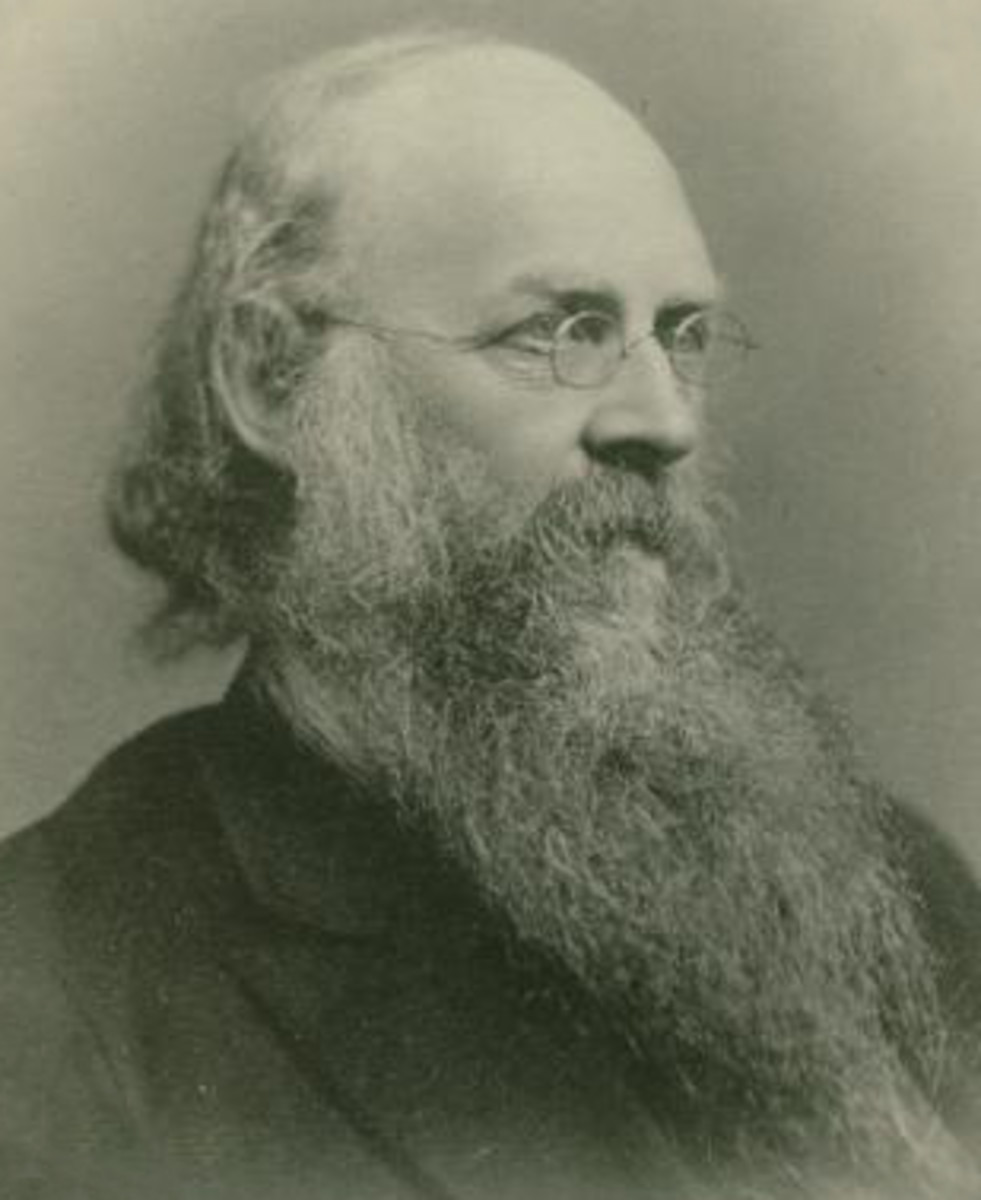
Horace Lorenzo Hastings
Photo is taken from the book H.L. Hastings by Mrs. H.L. Hastings, Boston, Mass., 1886. © 1900.
Hastings, Horace Lorenzo (1831–1899)
By Kevin L. Morgan
Kevin L. Morgan is a Seventh-day Adventist pastor, researcher, and book editor. He has a B.A. in theology and a Master’s degree in homiletics from Southern Adventist University. He studied history at Appalachian State University and has written and contributed to several books on the Sabbath, Ellen White’s literary productions, and Adventist history; he has also written articles published in Ministry and at Academia.edu; he has edited books on various topics.
First Published: January 28, 2020 | Last Updated: July 30, 2025
Horace Lorenzo Hastings, fifth-generation preacher and second-generation Adventist preacher, writer of books and hundreds of biblical tracts, was born November 23, 1831.
Originally a Methodist, Hastings accepted the Adventist message at twelve years of age, experiencing the Great Disappointment in 1844 and becoming an evangelist in 1848. His father, King Hastings, had been a Millerite preacher. Hastings was persuaded by George Storrs’ literature to accept the biblical teaching regarding the unconscious state in death. In 1852 he joined the staff of The Second Advent Watchman, launching his lifelong career of writing and publishing. In 1853 and 1855, He published pamphlets on the state of the dead. He believed that “this world is destined to be melted and purified by fire” but will “be restored . . . and made glorious by the power of God.”1
The sabbatarian Adventists respected Hastings and regularly promoted his books and tracts in the Review and Herald from 1854 to 1860.2 Maintaining correspondence with the periodical’s editor, he never accepted the third angel’s message with the biblical Sabbath.3 Unlike Ellen White’s 1858 book with “great controversy” in its subtitle, Hastings’ 1858 Great Controversy between God and Man was written to “show that a controversy has subsisted between God and Man from the beginning, and is to continue to the coming of Christ” when “the open and daring enemies of” God “will be swept from the world.”4
That same year Hastings and his wife witnessed Ellen White in vision. “Elder Hastings and wife, the doctor5 and family, as also Elder Phineas Smith, who had been bitter against our people, listened with interest to the presentation of the truth of the messages in these meetings with the Rochester company. Elder Hastings presented no objections to what he heard, and was apparently convicted of the truth, for when questioned with reference thereto his only answer would be, ‘Brethren, pray for me.’ In one of these meetings Sister White was in vision for nearly half an hour. He had opportunity to know for himself her condition in vision, and to realize the evident presence of the Spirit of the Lord accompanying the manifestation. The next night after this he had an appointment away from the city. On returning the next day, he said to me, ‘What subject do you suppose I spoke from last night?’ I replied, ‘I can not say.’ ‘Well,’ said he, ‘I spoke on the subject of the perpetuity of spiritual gifts.’ It was evident to us all that he was strongly convicted on the truth of the three messages. I do not think he ever openly opposed the work. But he, like many others, failing to act according to convictions on time, seemed to settle down to a state of indifference to the importance of the message. It was reported, however, that for several months his wife refrained from labor on the Sabbath. But she never fully identified herself with the Seventh-day Adventists.”6
In 1860, Hastings was elected President of the Christian Publication Society and the Christian Association, a position he resigned as a staunch non-sectarian when the name “Advent Christian” was adopted. His motto was: “No creed but the Bible, no master but Christ, no name but Christian.”7
In 1865, he founded the Scriptural Tract Repository in Boston and, in January 1866, began publishing the monthly periodical The Christian.8 He wrote the frequently quoted but anonymous thought gem, “the Greatest Want of this Age,” as part of a tract advertised in the Review and Herald, entitled “Sold Cheap.”9 Ellen White later condensed the gem into the much more succinct “greatest want of the world” thought gem.10
In the 1870s, Hastings’ wife began a ministry in the war-torn South, and Hastings supported her by bringing literature and needed supplies.11 Hastings’ publishing operation burned to the ground in 1872, leaving him with debts he constantly struggled to repay. Though The Christian reached a circulation of 35,000 by 1876, it “carried no paid advertising,” and, “by May 1885, Hastings found himself over ten thousand dollars in debt.”12
Hastings’ contributions to the cause of Christ include his evangelistic preaching, his 52 books, 450 hymn poems, and more than one hundred tons of tracts.13 He was best known for his poem “Shall We Meet Beyond the River?” and his Anti-Infidel Library of tracts. His book, The Inspiration of the Bible, or, Will the Old Book Stand? was translated into eighteen languages and sold nearly three million copies.
Hastings lived in Massachusetts, New York, and Rhode Island.14 He died at Goshen, Massachusetts, October 21, 1899.
Sources
Bendroth, Margaret Lamberts. Fundamentalists in the City: Conflict and Division in Boston’s Churches: 1885–1950. Oxford and New York: Oxford University Press, 2005.
“Books Received.” ARH, August 21, 1866.
“Elder Horace Lorenzo ‘H.L.’ Hastings obituary.” Find A Grave. Accessed April 9, 2019. http://www.findagrave.com/cgi-bin/fg.cgi?page=gr&GRid=66407064.
Harriet Barnett Hastings. Pebbles from the Path of a Pilgrim. Boston: H. L. Hastings, 1881.
Hastings, H. L. Plain Truths for Plain People. Boston: H. L. Hastings, 1894.
“H. L. Hastings Tunes,” Hymnary.org. Accessed March 12, 2017. https://www.hymnary.org/person/Hastings_HL?tab=tunes.
“Horace Lorenzo Hastings obituary.” Publishers Weekly, October 28, 1899.
Morgan, Kevin L. “Surprising Authorship of ‘The Greatest Want of This Age’ Quotation.” Accessed April 5, 2019. https://www.academia.edu/31885465/Surprising_Authorship_of_The_Greatest_Want_of_This_Age_Quotation.
Thayer, A. “Not Under the Law, but Under Grace.” ARH, April 1, 1858.
White, Ellen. “Our School at Healdsburg,” Signs of the Times, May 4, 1882.
Notes
-
Hastings, Plain Truths for Plain People (Boston: H. L. Hastings, 1894), 10, 11.↩
-
The Review and Herald advertised Hastings’ 24-page tract, “The State of the Dead,” taken from Milton’s prose on the state of the dead in Paradise Lost, advertised other books and tracts (ARH, Dec. 26, 1854, 152; July 31, 1856, 104), and mentioned and advertised Hastings’ monthly paper, The Christian (ARH, Feb. 20, 1866, 95; ARH, Jan. 29, 1867, 96; ARH, Feb. 19, 1867, 132; Nov. 12, 1867, 344; ARH, April 17, 1883, 241, 242), and his book Signs of the Times (ARH, May 6, 1873, 162). It also published the tract “The Three Worlds” (ARH, Nov. 14, 1854, 107, 110, 111; Nov. 21, 1854, 118, 119) and Hastings’ article, “What Manner of Persons Ought We to Be?” (ARH, Nov. 14, 1865, 185, 186). Uriah Smith reviewed Hastings’ 167-page book, The Great Controversy Between God and Man (“Book Notice,” ARH, March 18, 1858, 144) and advertised the book along with other books and tracts from February 1859 (ARH, Feb. 17, 1859, 104) to November 1860 (ARH, Nov. 6, 1860, 200).↩
-
A. Thayer, “Not Under the Law, but Under Grace,” ARH, April 1, 1858, 153.↩
-
David N. Lord, editor, Theological and Literary Journal, vol. 11, July 1858–April 1859 (New York: Franklin Knight, 1859), 170, available at https://books.google.com/books?id=6mfIkchw0WwC, accessed 3/6/17.↩
-
The doctor was a dentist named John Naramore (1820–1879). Hastings’ wife was Harriet Frances Hastings, née Barnett (1829–1913).↩
-
J. N. Loughborough, Pacific Union Recorder, August 17, 1911, 1.↩
-
See http://www.findagrave.com/cgi-bin/fg.cgi?page=gr&GRid=66407064.↩
-
H. L. Hastings, Ebenezers: or, Records of Prevailing Prayer (Boston: H. L. Hastings, 1887), 3, available at https://ia800209.us.archive.org/33/items/ebenezersorreco00hastgoog/ebenezersorreco00hastgoog.pdf, accessed 2/22/18.↩
-
ARH, August 21, 1866), 96.↩
-
Education, 57; Kevin L. Morgan, “Surprising Authorship of ‘The Greatest Want of This Age’ Quotation,” available at https://www.academia.edu/31885465/Surprising_Authorship_of_The_Greatest_Want_of_This_Age_Quotation, accessed 4/5/17.↩
-
See “H. L. Hastings > Tunes,” available at https://www.hymnary.org/person/Hastings_HL?tab=tunes, accessed 3/12/17; “Elder Horace Lorenzo “H. L” Hastings, available at http://www.findagrave.com/cgi-bin/fg.cgi?page=gr&GRid=66407064, accessed 3/12/17.↩
-
Margaret Lamberts Bendroth, Fundamentalists in the City: Conflict and Division in Boston’s Churches: 1885–1950 (Oxford and New York: Oxford University Press, 2005), 47, 198.↩
-
The Publishers’ Weekly (Oct. 28, 1899): 788.↩
-
Harriet Barnett Hastings, Pebbles from the Path of a Pilgrim (Boston: H. L. Hastings, 1881), 91, 258, 262, 263, available at https://ia801407.us.archive.org/28/items/pebblesfrompatho00hastiala/pebblesfrompatho00hastiala.pdf, accessed 2/22/18.↩