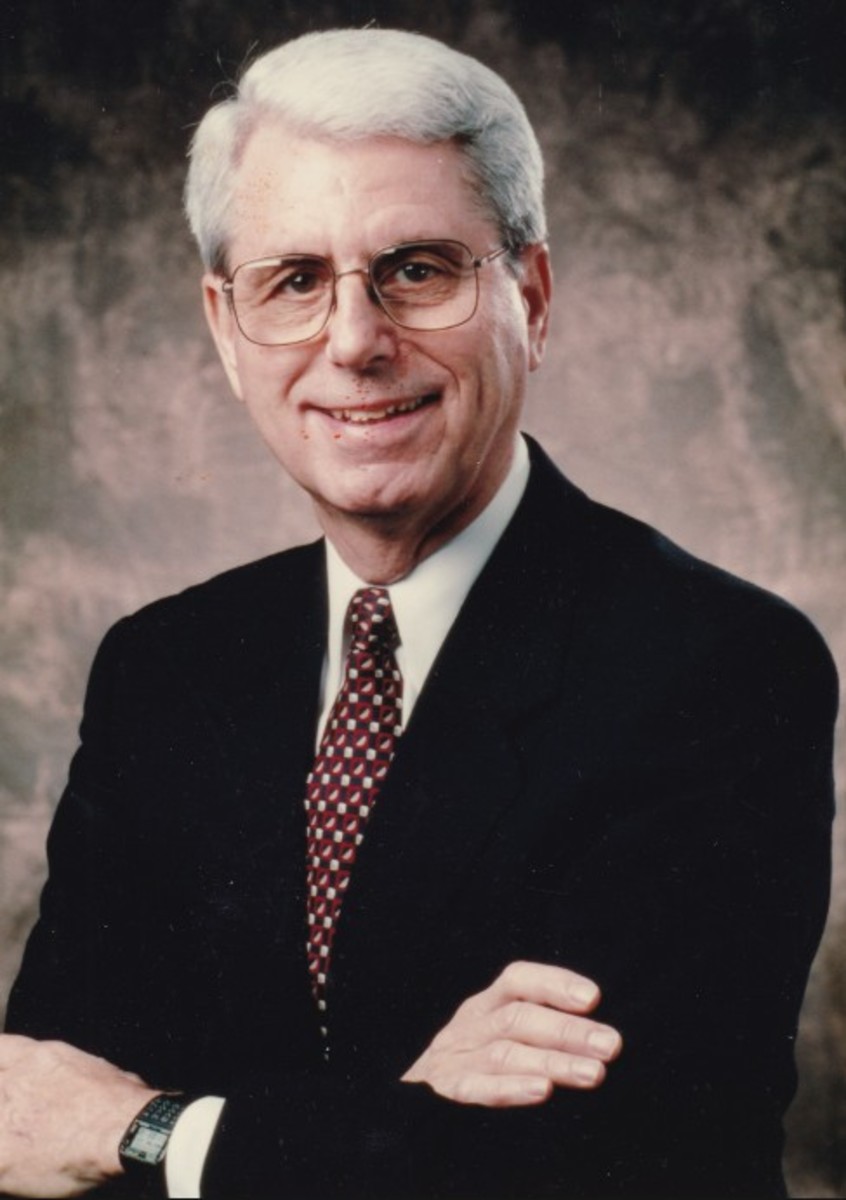
Alfred McClure
Photo courtesy of the McClure family. Shared by Michael W. Campbell.
McClure, Alfred Clinton (1931–2006)
By Michael W. Campbell
Michael W. Campbell, Ph.D., is North American Division Archives, Statistics, and Research director. Previously, he was professor of church history and systematic theology at Southwestern Adventist University. An ordained minister, he pastored in Colorado and Kansas. He is assistant editor of The Ellen G. White Encyclopedia (Review and Herald, 2013) and currently is co-editor of the forthcoming Oxford Handbook of Seventh-day Adventism. He also taught at the Adventist International Institute for Advanced Studies (2013-18) and recently wrote the Pocket Dictionary for Understanding Adventism (Pacific Press, 2020).
First Published: February 5, 2025
Alfred Clinton McClure was an Adventist pastor and administrator, and president of the North American Division from 1990 to 2000. He was at the forefront of innovative strategies for outreach, notably satellite evangelism that culminated in the NET and other satellite evangelistic series. During his leadership of the division, more than 250,000 people were baptized. He saw the need for planting new churches and was a major proponent of the SEEDS church planting initiative, which resulted in more than 600 new churches during the last four years of his leadership. His lifelong passion was to build within the church a “culture of evangelism.”1
Early Life and Ministry
Alfred Clinton McClure was born August 24, 1931, in St. Petersburg, Florida, to Alfred Vincent (1908-1992) and Edith Bird (1909-1988) McClure.2 He grew up in Indiana and Iowa where his father served as a pastor. He attended Oak Park Academy in Nevada, Iowa. McClure once wrote how his conversion was more of a slow “growing awareness that I was a sinner and in desperate need of a Saviour.”3
McClure attended Union College for two years and then graduated from Southern Missionary College, during which time he presided over, pastored, and chaired numerous student organizations. A class prophecy listed him as “most likely to succeed.”4 Here he met Mary Frances Taylor who was from Savannah, Georgia (1934-2019).5 She attended an evangelistic meeting in Savannah where she was baptized at age 12, and then attended Mount Pisgah Academy. During Spring Break in 1952, Al (as he was fondly called) stayed behind to work at the print shop. He earned enough money to buy an engagement watch, which he then used to propose to Frances. They were married on August 30, 1953, in Savannah, and after borrowing her father’s car for their honeymoon, they returned to Southern to complete their studies. They later had three children: Sally, Al Jr., and Scott.6
McClure began his ministry in the Florida Conference, where he first served in Key West, assisting with a series of evangelistic meetings in January 1954, and Frances took over the church school. He was ordained (1959) in Florida. He moved to the Missouri Conference in 1963, where, between the two conferences, he spent fourteen years. He was pastoring the Miami North Church during the Cuban Missile Crisis in 1962. In 1967, he moved to the Georgia-Cumberland Conference (1967-1973) as a departmental director (ministerial, communications, and stewardship secretary). He spent seven years as a Conference president: Wyoming Conference (1973-1977), Kansas Conference (1977-1978), and Kentucky-Tennessee Conference (1978-1980). On May 5, 1980, he was elected president of the Southern Union Conference. As union president he served as board chair of Southern Missionary College (“Southern College” after 1982), overseeing a rather tumultuous time in the early 1980s when three religion department faculty were dismissed for heterodox teachings.7 As board chair, in 1987, he teamed up with Des Cummings, Jr., executive vice president of Florida Hospital, to create an Adventist branded credit card that would raise scholarship funds for either Oakwood College (now Oakwood University) or Southern College. The program would allocate 10 cents for each transaction to one of the schools, and $7 of the $21 annual fee would also go to the school.8
Early Years as NAD President (1990-1993)
McClure was elected president of the North American Division on July 9, 1990. His election “comes amid challenges of church growth in the United States, Canada, and Bermuda and the evolving emergence of North America as a free-standing division, while maintaining necessary elements of the historical ‘special relationship’ to the world church.”9 In his first article published after his election, titled “The Enlarged Vision,” McClure challenged the church to see “a ripening harvest.” He saw Adventism in 1990 facing “formidable challenges,” but he also believed it was “our own complacency and self-dependence [that] sap our spiritual strength.” A major challenge was “our materialistic society” which “makes public evangelism increasingly difficult.”10
Two major initiatives were the creation in September 1990 of a Women’s Ministries Department. Elizabeth Sterndale was elected to both direct it and serve as a field secretary. The same session also elected Rosa Banks as an associate secretary, along with her work as director of the Office of Human Relations. Including two women in the inner NAD officer group allowed them to be seated as part of the 350-member GC Committee.11 McClure remained a firm advocate for women in ministry and leadership, and, advocated repeatedly for the denomination to adopt women’s ordination. Another major change soon after he took the helm of leadership was that McClure was part of the final process, ratifying and finalizing an earlier vote, in which the Loma Linda University constituency voted to separate the University’s Loma Linda and Riverside campuses. The new Riverside campus reverted to its previous owner, the Pacific Union Conference, and became officially La Sierra University.12
At the first NAD Year-End Meetings that McClure chaired (October 9-11, 1990), he suggested the denomination develop an evangelistic task force with the desire “to bring about an explosion in church membership.” He believed every congregation “should conduct some form of evangelistic outreach” every year. McClure urged that special attention be given to large cities, learning “new ways to reach the nearly unreachable.”13 Early in his tenure as division president, McClure was searching for new and innovative ways to strengthen evangelism across the division.
At the “centerpiece” of this leadership initiative were two research projects: Project Affirmation and Valuegenesis (see, for example, the Valuegenesis study in the South Pacific Division). The first was directed by Drs. Charles T. Smith, Gordon Madgwick, and Gilbert Plubell. They gathered information from 16,000 church members, including 12,000 students, 1,900 parents, and 700 pastors, among others. They partnered with Merton Strommen, founder of Search Institute, to look at ways to pass on the church’s fundamental beliefs. “Traditional methods used to hold the youth are not working,” wrote McClure, “Unless we reform our methods of raising the youth, we will lose them.” The second study, Valuegenesis, “identified the need to turn conditions around in the Seventh-day Adventist Church.” As a part of Project Affirmation, this study gave a more specific picture of the SDA family, congregation, and school. It revealed several major challenges that the church must address and developed new resources, notably a Vision to Action compendium with several other books.14
From January 22-26, 1991, 450 leaders from across the NAD participated in the first-ever NAD Church Ministries and Ministerial Convention held in San Diego, California, at the Town and Country Hotel. A consensus emerged that their greatest need was for a more profound spirituality and the need to integrate warmer personal relationships into evangelism and nurture. This resulted in “The San Diego Covenant.” Some of the latest research included the Adventist Family Opinion (AFO) Report 1 (1989), Sabbath School Needs Assessment, and the Valuegenesis study by Project Affirmation. They found:
North American Adventists of all races are now mostly middle class and upwardly mobile. Unless a local church radiates genuine warmth, demonstrates personal benefits, connects people to Christ and each other, and provides meaning to materialistically burned-out seekers, it will not grow.15
In his keynote address, McClure challenged participants toward revitalization. “Until love, acceptance, and forgiveness become the norm in a loving, caring church, growth will not occur.” He urged (1) a return to righteousness—falling in love with Jesus; (2) dependence upon the Spirit’s empowering; (3) unity in Christ; (4) a return to the scriptural priorities of evangelism and church growth; (5) prioritization of the needs of youth and young adults; and (6) the continued transmission of values to our children through efforts such as Project Affirmation.16 Evangelism would be a hallmark of McClure’s leadership of the NAD. Yet unless Christ’s model and method are followed, he warned, any negative motivation has, at best, limited value and application toward positive goals. If they were not careful, they could “produce contentious people who alienate not only those they seek to reach but even one another. Contentious methods produce contentious people.”17 McClure set a goal of increasing church attendance in Adventist congregations across the NAD to 1 million people by the 1995 General Conference session.18 He challenged church members to give every person living in the NAD territory an opportunity to hear the gospel message and in 1992 to donate 92 hours of service to the church.19
Another hallmark of McClure’s leadership was youth empowerment. A unique initiative was the participation of NAD youth in the Pasadena Tournament of Roses. In this initial debut, with the theme “Playing in Peace,” 650 volunteers gave more than 8,200 hours. Five tons of plants and other natural materials and 50,000 roses were used in the 55-foot-long float that was honored for best entry from a noncommercial sponsor.20 McClure, with Robert S. Folkenberg (1941-2015), created an 18-member Youth Kitchen Cabinet to advise them about youth concerns. The first advisory occurred in April 1991.21
From December 15-19, 1991, McClure led an initiative of an annual “Evangelism Council” sponsored by the North American Division. The first event was held in Daytona Beach, Florida.22 Some 1,100 church administrators, pastors, evangelists, students, and other church members heard him sound a “clarion call” to focus on an evangelistic ministry. “While fellowship is important, the purpose of the church is not to fraternize with the righteous but to call lost sinners to repentance. Our reason for existing is to bring men and women to Jesus Christ.”23 McClure saw a threefold initiative: (1) developing new methods and approaches; (2) setting people free from the bondage of poverty, ignorance, illness, prejudice, and fear; and (3) building up and edifying those who have made a spiritual commitment to move them to spiritual maturity.24 He reminded people about Pentecost as an inspiration for finishing the work.25
Then, from January 26-29, 1992, another 500 pastors and laypeople attended the second quinquennial North American Division Hispanic evangelism council held at Cohutta Springs, Georgia. McClure observed how the Hispanic members were leading the way in evangelism in the NAD. The theme, “Discovery ’92,” recalled the 500th anniversary of America’s discovery by Columbus and was featured in a logo that was on banners, posters, t-shirts, and some 80 silver medallions. Over the previous decade, the Hispanic membership of the NAD was growing at around 10 percent, compared to the division’s 2.6 percent. At that moment Hispanic membership stood at 52,299.26
In late 1991 through 1992, McClure participated in a NAD Governance Commission.27 McClure also developed a precedent of issuing statements on major public events such as the racial violence in Los Angeles that occurred on May 4, 1992.28 He also encouraged relief efforts, thanks to Monte Sahlin and the NAD Adventist Community Services, for Hurricane Andrew relief efforts.29 Similarly, the David Koresh (1959-1993) saga between the February 28 gun battle and the April 19 inferno in Waco, Texas called for a statement from McClure expressing deep sadness and suggested practical lessons in the wake of this tragedy.30
McClure initiated a special campaign to reach the estimated 1 million former Adventists in the NAD territory from 1993 through 1994.31 This culminated in a special Sabbath in which McClure asked church members to invite former members back to church on November 20, 1993.32 The NAD launched a special edition of Adventist View, a new periodical for young adults, to help disciple new members. The NAD posted a quarter-page ad that appeared in all editions of USA Today on Monday, November 15, 1993.33 The Reclaiming Committee would evaluate this initiative to develop long-term plans which included making this Home Coming Sabbath an annual event.34 A survey suggested that 28,000 persons returned to the church for this special Sabbath and that 75 percent of Adventist congregations planned a special program for that Sabbath.35
On February 13, 1993, McClure participated in the second broadcast of the new Adventist Communication Network. This satellite technology featured, in addition to McClure, Mark Finley, Ronald Halvorsen, John Carter, and Marvin Moore.36 The first test program of the new Adventist Communication Network (ACN) for Adventist churches across North America took place on Sabbath, July 3, 1993. The broadcast was beamed from Russia where an estimated 20,000 people were participating in an evangelistic meeting by evangelist Mark Finley. Later that same day, the second broadcast was from the Capital Hill Seventh-day Adventist Church in Washington, D.C., featuring Robert S. Folkenberg and church pastor Wintley Phipps with a special emphasis on religious liberty. Satellites were loaned to conference offices, and churches were encouraged to purchase satellite receivers. The ACN idea was born through the help of ASI. In 1991, Folkenberg and McClure met with ASI officers as ASI members pledged $500,000 to the project over three years, and another $100,000 set aside by the NAD for the project, and the GC with matching funds to cover the cost of production of its programs.37
Expansion and Innovation (1993-1994)
In 1993, the NAD leadership appointed a board of senior development professionals to manage the division’s Philanthropic Service for Institutions (PSI). The department was given a budget for a director. It was hoped that this would bring greater long-term stability for NAD institutions.38 Just prior to the 1993 NAD Year-End Meeting (October 29-31, 1993), McClure held a three-day spiritual retreat “marked by prayer, praise, worship, and evangelistic planning.”39 McClure insisted church leaders with the need to change before the division would experience significant growth. McClure argued that evangelism was the key to church growth. “We must make our churches more friendly. We should develop an atmosphere in which people will feel free and happy to connect with His church.”40 This meant that the NAD needed to “catch-up with the times.” Failure to do so would make the church “out of touch.”41 With small focus groups of church leaders, they identified seven goals for North America’s future:
A vibrant Christian experience for all church members; local churches that are mission-driven and active in meeting community needs; a doubling of the division’s growth rate; a management structure at the conference, union, and division levels that is geared to outreach and mission instead of institutional maintenance; and colleges that continually assess and address the spiritual growth needs of students.42
The groups addressed ways to accomplish these objectives, and these recommendations were compiled into a strategic plan voted by the NAD committee. The plan was to be followed up in June 1994 with a one-day planning session to prioritize an action plan with proposed funding. “We must ever adapt to the changing scenes and circumstances.”43 Later, on June 13-14, 1994, the NAD officers and union conference presidents met to review and make recommendations noting the need to avoid duplication of functions in multiple levels of the church structure, and to search for time and money saving tools provided by new technology.44
During the 1993 NAD Year-End Meeting (Nov. 1-3, 1993) The NAD joined the General Conference by adopting the “Hands Across the World” theme in support of the church’s Global Mission program. The NAD would fund “a major portion of the entire project, provide volunteer missions service opportunities, and establish 92 congregations.” Major initiatives included a 3 percent cost-of-living adjustment, adopting a new stewardship document emphasizing self-reliance of all church institutions, and additional funding for the Andrews Master of Arts degree in pastoral ministry ($466,619), a new medical assistance plan for employees, and an experimental Ingathering project. At this meeting, the division’s Church Ministries department was divided into separate departments for stewardship, children’s ministries, youth and young adult ministries, and adult ministries. The church also voted on sexual misconduct guidelines as well as guidelines on how to handle such complaints against denominational employees and approved volunteers. Concerns by pastors over the “Rejoice with Me” Sabbath to encourage former members to return prompted a survey initiative to study the “concerns and frustrations of pastors.”45
In early 1994, plans were begun for a Net ’95 division-wide evangelistic campaign with Mark Finley as the main preacher and C. D. Brooks (1930-2016) answering questions. The program would “be uplinked by satellite to all churches.” McClure noted that two to three hundred churches had already signed up to secure equipment even though an official announcement had not gone out.46 When the division did not have enough funds to support the project, McClure made a call to O. D. McKee (1905-1995) who helped fund this major evangelistic initiative.47 On March 28, 1994, the first of a series of training initiatives was broadcast by satellite. The first one was held by Mark Finley and McClure, sharing “the goals and objectives” of the Net series.48
Another major initiative was Adventist engagement with “a computer program called “Internet.” This appeared to be a promising area for ministry, and they proposed utilizing a commercial service provider such as CompuServe to create an Adventist online group with 18 “bulletin boards” to be used by anyone around the world who is online. CompuServe was accessed through local telephone numbers by 95% of the population in North America. It was urged that each office or department at the NAD plan to disseminate information over CompuServe saving money and offering greater access to information.49
In 1994, the NAD voted to bestow denominational status upon Adventist Colleges Abroad.50 It was also voted to make Jose Rojas the first NAD Youth and Young Adult Ministries director.51 McClure moved forward on his strategic planning initiative: (1) He proposed a simple and clear mission statement with measurable goals for each unit within the NAD each year; (2) a peer review process for all division officers and staff; and (3) a committee of 23 (including 12 laity and local pastors) to review the denominational structure and propose options.52 The NAD strategic plan would boil down to three words: proclamation, nurture, and service.53
As plans matured for the NET ‘95 evangelistic series, McClure was at the forefront of organizing several training events during the second half of 1994 and early 1995. Notable events included a series of lay training events with Mark Finley, a special satellite 1844 anniversary event (the 150th anniversary of the Great Disappointment), and a satellite prayer conference. The Amazing Discoveries Series (later dubbed “Discoveries in Prophecies”) evangelistic series would be available from February 17 through March 25, 1995.54 Of special note was the ability of the church to leverage national ad campaigns at little to no cost to the local church. In addition to church organizations and publications leveraging their influence, the denomination sponsored full-page ads in the January and February editions of the Saturday Evening Post. Some 7 million handbills were direct-mailed to homes along with radio and TV spots, billboards, and posters.55 The meetings would be held across multiple time zones, using broadcast delays, so that the program would be available at 7:15 p.m. in each time zone across the United States.56
Reports described 66,000 people across 676 locations in North America on the opening night.57 It was later reported that 5,000 baptisms resulted.58 “High technology makes it possible to have more ‘high touch’ ministry,” wrote McClure. “With a satellite evangelist, thousands of pastors can focus on personal work with families and individuals.” The meetings were later followed up with a special broadcast program titled “Welcome to the Family” aired on April 15.59
Women’s Ordination Debate
On October 3, 1994, NAD leaders called a special meeting of the division committee just prior to the Annual Council to discuss the issue of gender-inclusive ordination for the NAD. The meeting voted on the following action:
To request the Annual Council to refer the following action to the General Conference session for consideration: The General Conference vests in each division the right to authorize the ordination of individuals within its territory in harmony with established policies. In addition, where circumstances do not render it advisable, a division may authorize the ordination of qualified individuals without regard to gender. In divisions where the division executive committee takes specific actions approving the ordination of women to the gospel ministry, women may be ordained to serve in those divisions.60
On October 9, the Annual Council took up this item, reviewing the NAD request. McClure reminded the committee that the General Conference already officially voted to ordain women as local elders in 1984, and the earlier 1974 Spring Meeting action had opened the door for women elders:
Since that time, hundreds of churches have elected more than 1,000 women as local elders. For 20 years they have been serving with credibility and acceptance in their congregations. By invitation of their church, women have attended seminary for two decades. What kind of message do we send to young women who wish to respond to the call of God if we welcome them to professional training where they sit in classes with male peers who in a few years will be accorded full recognition of their calling while they are made to feel inferior by a less-than-full approbation by their church.61
McClure noted how such inconsistencies placed church administrators at the NAD in an “untenable position” in which “we now find ourselves in a position seen by many as discriminatory, unethical, and even immoral.” After a “lively debate,” the action was referred to the 1995 Utrecht GC session for consideration and decision.62
McClure observed in 1995 that an estimated 92 percent of the world church’s tithe came from the North American Division at approximately 1 billion dollars. World church membership stood at 8,382,558 with NAD membership at 743,023 or approximately 10 percent of the world church membership.63 The 1990-1995 quinquennium was the first, observed McClure, in which he saw the division taking increasingly independent steps as it matured into its own division status “in the same way that other world divisions operated.”64 McClure was re-elected as NAD president at the 1995 GC session. He also chaired several sessions. On July 5, 1995, at 2:00 p.m. McClure opened the afternoon business session with a 20-minute presentation giving the background and rationale for the NAD’s request to ordain women. P. Gerard Damsteegt and Raoul Dederen (1925-2016), each gave presentations explaining their rationale both against and for women’s ordination. Then, the motion to the floor stated:
Voted, To refer to the 1995 General Conference Session the North American Division request that the General Conference in Session adopt provisions on ordination as outlined below.
The General Conference vests in each division the right to authorize the ordination of individuals within its territory in harmony with established policies. In addition, where circumstances do not render it advisable, a division may authorize the ordination of qualified individuals without regard to gender. In divisions where the division executive committees take specific actions approving the ordination of women to the gospel ministry, women may be ordained to serve in those divisions.65
A secret ballot was taken in which 673 delegates (31 percent) stood in favor of the recommendation, 1,481 (69 percent) stood opposed. On September 23, 1995, the Sligo SDA Church in Takoma Park, Maryland, held an “ordination service” for three full-time women in ministry (Kendra Haloviak, Norma Osborn, and Penny Shell).66 The senior pastor stated that this service had authority within the local church. McClure said: “Our ecclesiology has not changed in regard to ordination, and local churches do not have the authority to ordain to the ministry of the world church. The process is valid only by vote of the conference and union committees. In this case, the Potomac Conference denied the request for endorsement and issuing of credentials.”67 In response, McClure announced the proposed establishment of a Presidential Commission on Women and Ministry to “find ways to send a strong message of encouragement and validation to our women pastors without placing them in conflict with our brothers and sisters in the world church.”68 In early 1996, McClure joined William G. Johnsson in urging for a “cooling-off period” to allow people time to “demonstrate respect.”69 McClure stated that the NAD both affirmed the position of the world church at the 1995 GC session, yet at the same time, it also affirmed the earlier 1979 Annual Council action “permitting unordained ministers to perform, in the church to which they are assigned, essentially all the functions of the ordained minister.” This allowed women to both baptize and officiate at weddings, and was “confirmed at the 1990 General Conference session in Indianapolis, and there has been no change in this position.”70 In a subsequent “open letter” from McClure to all NAD pastors and administrators he reminded church leaders, in spite of his personal disappointment, that they remain loyal to the world church. He also urged that the church “not make of it [ordination] more than Scriptures does” and therefore “that we not elevate ordination to a mystical and nonbiblical level.”71
After the vote in Utrecht, McClure believed that, more than ever, the North American Division needed to support the position of the world church, but the decreased representation was a clarion call to evangelism. The reality was that in future sessions, McClure also recognized, that the leaders of the NAD will have a diminished presence as delegates and on the nominating committee for the world church. This was “a result of the dramatic blessing of God on our commitment to world evangelization.” At the same time, he also admitted how “it is always hard to let go of the reigns and accept the fact that the other world divisions have the strength to outvote North America on about anything that comes before the delegates at a world business session.”72
Continued NAD Leadership (1995-2000)
In 1995, McClure commissioned Monte Sahlin to lead the Commission on Mission and Organization (COMO). The commission included 26 members; half denominational administrators, and the other half were pastors, educators, and lay leaders. Five were women, five were African-American, two were Hispanic, and two were Asian.73 The recommendations would be evaluated and brought to the union constituency sessions in 1996.
McClure was worried that fewer individuals were finding “the gospel ministry attractive” and seeking ways to encourage more young people to make “full-time ministry their life’s calling.” A special Sabbath, February 3, 1996, was devoted to prayer for this purpose. Many young people, who traditionally found the doctor, nurse, teacher, minister track attractive were now pursuing professional careers in business, law, and computer science instead.74
During his second quinquennium, McClure had a threefold focus for ministry: first, to draw men and women to the cross; second, to nurture believers in Christlikeness; and third, to deploy believers in selfless acts of service so that cycle might be repeated infinitely.75 McClure continued to embrace changes in technology. He expressed appreciation for the quarter of NAD congregations who now had the Adventist Communication Network satellite system. Regular monthly training sessions were taking place through this network. In addition, new resources, such as the CompuServe resource library, and automated fax-back for those who don’t have a computer (SDAFaxPlus, 1-800-474-4732), the PlusLine 800-number “help desk” (1-800-732-7587), and other materials easily distributed on CD-ROM. The Church Resources Consortium was rapidly partnering with a wide variety of departments and organizations to create user-friendly resources for church members. Yet even with this technology, McClure believed “the key ingredient is still the touch of the Spirit through a caring heart.”76 The success of the NET ’95 series led the GC Executive Committee to vote on January 3, 1995, to transfer ownership of the Adventist Media Center in Simi Valley, California, to the NAD. The GC Committee voted to give the NAD the 1996 media center budget of $3,530,000 and to reduce the percentage of tithe income the division remits from 11.35 to 10.72.77
New plans were put into place for NET ’96 which would take place from Orlando, Florida, October 5 through November 9, 1996. This time the meetings would be translated into three languages (French, Spanish, and Portuguese) and close-captioning would enable the deaf and hard of hearing to participate.78 By the end of the year, baptisms in the NAD increased to 39,004, an 8 percent increase over 1995, with an initial estimate of 4,000 baptisms over the same period due to the NET ’96 initiative.79 This growth represented the highest number of baptisms in the history of the NAD. “I feel like singing the doxology,” wrote McClure.80 Later, with careful review, it was determined that 1,910 churches participated in the NET ’96 series. This resulted in 171,182 people who attended the opening night, with 51,306 nonmembers in attendance, and 9,772 who were baptized.81
Another major initiative was a church-planting training event called SEEDS ’96, which was held on the campus of Andrews University. Sponsored by the North American Division Evangelism Institute, and held June 12-15, 1996, the meeting featured McClure as the keynote speaker with other notable speakers such as Robert Logan (a Baptist expert in church planting), Charles Bradford (1925-2021), and Rod and Donna Willey.82 The gathering attracted over 400 individuals as church leaders hoped this movement would spur a significant emphasis across the NAD to plant new churches. In his keynote, described as one of McClure’s most important talks given while NAD president, he said:
We’ve come here this week to change the way this division thinks about church planting. This is the day that North America turns a corner. Today the North American church establishes a new battle plan. Today this division launches the most aggressive and intentional church planting in its history. There are millions of people living in North America who are simply not attracted to the Adventist Church. If they were to stop by some Sabbath morning at 9:30 or 11:00 a.m. and look inside, they wouldn’t be irresistibly drawn to go inside. If we value the lost [as Jesus did], then it is imperative that we be willing to devise new wineskins to serve as vehicles for the water of life. Otherwise we cannot defend ourselves from the criticism that we hold tradition as more important than our mission.83
McClure planned with Russell Burrill to follow up this gathering by making the Seeds an annual event to keep church planting a “front-burner issue.”84 This endeavor was a significant risk because, as he acknowledged, “the failure rate for new churches is as high as 70 percent” but it was too important not to take the risk. Referencing George Knight’s book, The Fat Lady and the Kingdom, he urged that the lady was not fat; she was merely pregnant. “As with all cases of prospective motherhood, if she does not deliver, not only will her offspring never see the light of day, but her life will be endangered as well.” The NAD church was called to “labor!”85 McClure later reported that more than 50 new churches were planted in 1996.86
At the 1996 NAD Year-End Meeting, church leaders elected Rose Otis as the first female vice-president of the division. She became responsible for women’s ministries and supervised a larger portfolio of other departments. Another significant trend, observed by McClure, was how Hispanics, who composed 10 percent of the division’s membership accounted for nearly 25 percent of all NAD baptisms.87 McClure oversaw the expansion of the NAD executive committee from 240 to 265 members. While the division saw significant growth, church finances remained stable, thanks to a strong emphasis on evangelism. What was troubling, however, was that the church’s retirement fund was in trouble and according to NAD retirement fund administrator, Donald Pierson, “could run out of money in the next 10 years, unless adjustments” were “made to strengthen the fund.”88 Church leaders established a study group to propose solutions including “defined contributions” in order to remedy the potential imbalance, especially with a significant increase in the number of retirees as the swell of employees from the Baby Boomer generation anticipate retirement.89 At the 1997 NAD Year-End Meeting, the NAD executive committee voted to freeze the current “Defined Benefit” retirement plan and establish the new “Defined Contribution” plan by January 1, 2000.90 Furthermore, the “normal retirement age” would increase from 65 to 67 in 2003, and the North American unions would increase their percentage of appropriations for retirement to 9 percent of the tithe.91
Affirming women in ministry remained a top priority for McClure and the NAD leadership. At the 1997 NAD Year-End Meeting, church leaders received a report with 13 recommendations from the President’s Commission on Women in Ministry. Among the recommendations was the decision to hire a full-time woman to be part of the division’s Ministerial Association. The division would develop a professional association, including a newsletter, and provide more opportunities for mentoring and the placement of young women seeking to find positions in ministry.92 New changes under the U.S. Internal Revenue Code led to a recommendation for the denomination’s credentials and licenses policy. Along with the ministerial credential and ministerial license, they would now recognize two other levels of ministry: the creation of the commissioned minister’s credential (those with five years’ experience elected or appointed to an administrative position) and the commissioned minister’s license (those employed) who served as associates in pastoral care and institutional chaplains). Previously, the definition of ordination pertained to those who did or did not qualify for ministerial tax deductions. This new policy allowed women to qualify now as commissioned ministers for the parsonage exclusion tax deduction and effectively curtailed the long-standing debate over women’s ordination as women could now be eligible under U.S. tax law for the same benefits as an ordained minister.93
The year 1997 witnessed two evangelistic initiatives. The first was the Ebony Evangelism thrust among the Regional Conferences, resulting in 24 new churches and an estimated 300 new church members. Similarly, Eradio Alonso, the NAD associate ministerial director, reported that 22 percent of the division’s 39,000 baptisms in 1996 were Hispanic. He also reported on a satellite Hispanic evangelistic series, LA RED ’97 conducted by Alexander Bullón, Southern American Division ministerial director, held for eight consecutive nights in Spanish (November 8-15, 1997) and then Portuguese (November 16-22), and included over 400 Hispanic churches in North America.94 The meetings were organized by the NAD and transmitted by satellite to North, Inter and South America from Brazil. An estimated 3,500 people joined the church as a result of these meetings.95
In 1998, church leaders worked to raise the estimated 1.8 million dollars to fund the NET ’98 evangelistic series featuring Dwight L. Nelson. The series would take place from October 9 to November 14, 1998, five nights a week with the theme: “The NeXt Millennium Seminar: Finding a Forever Friendship With God.” The broadcast would take place at the Pioneer Memorial Church at Andrews University each evening with a 60-minute live broadcast at 7:30 p.m. (and a 15-minute optional praise segment and announcements). The series had its own website (http://www.net98.org). Nelson hoped to reach Gen Xers specifically as part of this outreach initiative.96 On the opening night at Pioneer Memorial Church, over 1,000 non-Adventists attended the meeting. This series was broadcast in 40 languages with over 7,000 download sites all around the world making this indeed the first Adventist evangelism initiative to go global with downlink sites on every inhabited continent.97
From October 27-30, 1999, McClure led a special race relations summit. At the prompting of President Bill Clinton calling upon faith communities to improve race relations, the church organized this gathering featuring an interfaith prayer breakfast, plenary sessions, 21 workshops, and a variety of small group breakout sessions.98 The event took a surprising turn when McClure “passionately apologized for the way the church [in North America] has treated its minorities through the years.” He added: “I’m sorry,” with a sense of “sincere and deep conviction.” In an emotional moment to “those who had personally experienced the pain of racism.”99 His apology was published in the Adventist Review to be widely disseminated.100 Delegates made a series of recommendations, including a follow-up race relations summit in 2001, and to create a vision for the future so that “its public and internal image will be one of integration and racial harmony.” They urged a strategic plan with measurable objectives and a unity that embraces “true diversity” by incorporating “culture, race, gender, and disability.” The main thrust overall, however, was to focus on education at all levels of the church.101
On March 16, 2000, the Southeastern California Conference executive committee voted to issue “ordained-commissioned” ministerial credentials. McClure and the NAD officers issued a statement on April 13 that the NAD had not changed its stance about women’s ordination supporting the earlier 1995 General Conference session vote. The officers furthermore urged “that no attempts be made to blur the line between ordination and commissioning.”102 McClure also attempted to calm the waters after controversy erupted over significant remuneration pay scale packages for Adventist healthcare executives.103
On July 1, 2000, at the Toronto General Conference session, McClure gave his final division report to the world church. Although the denomination originated in North America, he observed how it now had less than 10 percent of the worldwide membership, celebrating the success of sending the message around the globe. “We praise God for His blessings throughout the world.”104 He expressed gratitude for the three NET evangelistic meetings and the significant uptick in baptisms over the previous quinquennium. In September 1999, the division surpassed the 900,000 member mark, with over 40,000 baptisms in one calendar year. For the first time, it surpassed the 5,000 level for officially organized churches. In 1997, the division received more than 500 million dollars in tithe and by 1999 this amount had grown to 600 million dollars.105 McClure expressed gratitude to the Lord for the series of NET evangelistic meetings. After the first three NET series, McClure noted that satellite evangelism was rapidly multiplying around the world, with more than 10 series held the previous year. “Satellite evangelism,” remarked McClure, “has become almost routine.” This sparked a “resurgence of interest in evangelism” that was not “limited to satellite series.” He added: “Satellite series may have sparked it, but evangelism in all its forms shows up in every part of the division.106
| Series | Speaker | Location | Downlink Sites | Baptisms |
|---|---|---|---|---|
| NET ‘95 | Mark Finley | Chattanooga, TN | 700 | 5,000 |
| NET ‘96 | Mark Finley | Orlando, FL | 1,500 in North America and another 1,000 in Western Europe | 14,000 |
| NET ‘98 | Dwight Nelson | Berrien Springs, MI | 7,000 | 10,000 in North America with many more around the world |
Retirement and Death
In 2000, McClure retired and moved first to Florida and then to Georgia to be with family. William G. Johnsson remembered him for his “superb ability” at chairing committees “always seeking to lead by persuasion and consensus-building.” He added: “He is a Christian gentleman, a class act.” As only the second NAD president since it became an “entity distinct from the General Conference” he built on the work of Charles Bradford, his predecessor, and during his ten years “took the process further, bringing the NAD to full-fledged status.”107
He passed away on August 5, 2006, after fighting lung cancer for several years.108 Frances passed away after a slow battle with Alzheimer’s on July 12, 2019.109 They are both buried in the Collegedale Memorial Park Cemetery in Collegedale, Tennessee.
Sources
“Actions of General Interest From the 1992 NAD Year-End Meeting.” ARH, March 11, 1993.
“Alfred Clinton McClure—46&1/2 Years of Ministry for His Church.” Unpublished manuscript for undated NAD retirement party, ca. 2000.
Brooks, Rebecca. “Elder Alfred C. McClure: A Leader Remembered.” Southern Tidings, October 2006.
Bryan, Alex. “Church Planting Summit Brings Spirited Response.” ARH, September 19, 1996.
Calkins, Jack. “Church Ministries and Ministerial Convention Results in United Division.” ARH, March 7, 1991.
Calkins, Jack. “Our Boldest Outreach Ever!” ARH, July 7, 1994.
“Church Mourns Loss of Former NAD President.” ARH, August 24, 2006.
“Let’s Increase the Attendance.” ARH, July 2, 1992.
McClure, Alfred C. “After the Vote, Now What?” ARH, August 1995.
McClure, Alfred C. “After Waco.” ARH, June 3, 1993.
McClure, Alfred C. “Are You Ready for the Beginning?” ARH, March 2000.
McClure, Alfred C. “The Awesome Power of One.” ARH, April 1999.
McClure, Alfred C. “A Day in the Life . . .” ARH, June 1996.
McClure, Alfred C. “Discovering Joy.” ARH.
McClure, Alfred C. “The Enlarged Vision.” ARH, September 6, 1990.
McClure, Alfred C. “An Expression of Sorrow and Apology.” ARH, December 1999.
McClure, Alfred C. “Faith-building Stories.” ARH, October 1999.
McClure, Alfred C. “Forging an Intentional Future: How We Can Avoid Forever Playing ‘Catch Up.’” ARH, January 6, 1994.
McClure, Alfred C. “Grateful Praise and Focused Planning.” ARH, July 2, 2000.
McClure, Alfred C. “Growing Churches: It’s Not a New Idea—Only a New Emphasis.” ARH, April 1999.
McClure, Alfred C. “Growing up Worried: How to Have Assurance in the End-Time.” ARH, October 1996.
McClure, Alfred C. “An Intentional Future.” ARH.
McClure, Alfred C. “Leaders for a New Century.” ARH, January 1995.
McClure, Alfred C. “Learning to Lean.” ARH, February 1997.
McClure, Alfred C. “Let’s Talk About Courage.” ARH, April 1998, 6.
McClure, Alfred C. “Like Rain on a Hot Dry Day.” ARH, November 1999.
McClure, Alfred C. “Living on the Edge.” ARH, September 1996.
McClure, Alfred C. “Lonely at Christmas.” ARH, December 1997.
McClure, Alfred C. “Making Connections.” ARH, May 1998.
McClure, Alfred C. “The More I Pray, the Worse Things Get.” ARH, January 1997.
McClure, Alfred C. “My Dream for My Church.” ARH, January 1996.
McClure, Albert C. “My Journey.” ARH, April 19, 1995.
McClure, Alfred C. “NAD’s President Speaks on Women’s Ordination.” ARH, February 1995.
McClure, Alfred C. “Not Much Pomp in This Circumstance.” ARH, June 1997.
McClure, Alfred C. “An Old Plan for a New Millennium.” ARH, January 6, 2000.
McClure, Alfred C. “An Open Letter to Church Leaders From the North American Division President.” [Dated August 3, 1995] ARH, September 1995.
McClure, Alfred C. “Planting and Harvesting.” ARH, December 1996.
McClure, Alfred C. “The Power of Hope.” ARH, 1994 Anniversary Issue.
McClure, Alfred C. “‘Prayer is My Survival Kit,’” ARH, September 1997.
McClure, Alfred C. “Read It Again for the First Time.” ARH, May 1997.
McClure, Alfred C. “Remembering the Mission.” ARH, March 5, 1992.
McClure, Alfred C. “Reveling in God’s Richness.” ARH, February 2000.
McClure, Alfred C. “Something I Can’t Stop Doing.” ARH, February 1998.
McClure, Alfred C. “Stumps.” ARH, April 1997.
McClure, Alfred C. “This Is What I Demand.” ARH, November 1996.
McClure, Alfred C. “Together in Mission.” ARH, June 30, 1995.
McClure, Alfred C. “Wait Till You See the Future.” ARH, June 1995.
McClure, Alfred C. “What a Committee Meeting Taught Me About God.” ARH, March 1998.
McClure, Alfred C. “What’s an Interloper?” ARH, August 1996.
McClure, Alfred C. “Why Good Things Happen to God’s People.” ARH, October 1997.
McClure, Alfred C. “’You Can Have My Room.’” ARH, April 2000.
“McClure Reaffirms Division’s Position.” ARH, February 1996.
Medley, Carlos. “Annual Council 1994.” ARH, October 20, 1994.
Medley, Carlos. “NAD President Calls for New Growth Strategies.” ARH, November 1997.
Medley, Carlos. “NAD President Sounds Clarion Call to Ministry.” ARH, January 16, 1992.
Medley, Carlos. “NAD to Launch Satellite Network in September.” ARH, June 10, 1993.
Medley, Carlos. “NAD Recaptures Vision for Evangelism.” ARH, December 19, 1996.
Medley, Carlos. “President Appeals for Spiritual Leadership.” ARH, November 1994.
Mejias, Jocelyn A. “Evangelism Council Aims to Discover America for Christ.” ARH, March 26, 1992.
“NAD President Speaks Out on America’s Urban Crisis.” ARH, May 21, 1992.
“NAD [1993] Year-End Meetings.” ARH, November 18, 1993.
Obituary. The Chattanoogan, August 3, 2006.
“Project Affirmation: Resources for Action.” ARH, February 7, 1991.
“Recommendations from the Delegates.” ARH, December 1999.
Sahlin, Monte. “Finding New Ways to Do the Lord’s Business.” ARH, October 1995.
Sahlin, Monte. “‘The Story’ Behind NET ’95.” ARH, May 1995.
Widmer, Myron. “North America After the GC Session.” ARH, September 1995.
“Year-End Meeting Launches NAD Into the 1990s.” ARH, November 1, 1990.
Notes
-
Carlos Medley, “NAD President Calls for New Growth Strategies,” ARH, November 1997, 20.↩
-
Obit. Southern Tidings, August 1988, 22.↩
-
Albert C. McClure, “My Journey,” ARH, April 19, 1995, 6.↩
-
Doris Burdick, “A Great Place to Grow Leaders,” Southern Tidings, April 1989, 30.↩
-
https://www.nadadventist.org/news/frances-mcclure-wife-former-nad-president-alfred-mcclure-passes-her-rest↩
-
“Church Mourns Loss of Former NAD President,” ARH, August 24, 2006, 21.↩
-
The three religion faculty at the center of the controversy were James Zackrison, Jerry Gladson, and Lorenzo Grant. About this time, Southern president, Frank Knittel also was forced to resign creating significant controversy. The religion professors were suspect of being sympathetic to Desmond Ford, which becomes apparent when reviewing the recently acquired Zackrison papers now part of the Center for Adventist Research at Andrews University. Jerry Gladson documents his termination and eventual departure from Adventism in his autobiographical memoir. See Jerry Gladson, Out of Adventism: A Theologian’s Journey (Eugene, OR: Wipf and Stock, 2017).↩
-
Kent Setlman, “Financing Christian Education: Oakwood College and Southern College Introduce New MasterCard/Visa in Funding Effort,” Southern Tidings, October 1987, 2-4.↩
-
George A. Powell, “Farewell and Welcome,” Southern Tidings, August 1990, 4.↩
-
Alfred C. McClure, “The Enlarged Vision,” ARH, September 6, 1990, 4.↩
-
Kit Watts, “Adventist Women Regain a Voice,” ARH, November 29, 1990, 5.↩
-
“LLU Constituents Ratify Separate Campuses,” ARH, September 13, 1990, 6.↩
-
“Year-End Meeting Launches NAD Into the 1990s,” ARH, November 1, 1990, 23.↩
-
Ibid., 26.↩
-
Jack Calkins, “Church Ministries and Ministerial Convention Results in United Division,” ARH, March 7, 1991, 22.↩
-
Ibid., 23.↩
-
Alfred C. McClure, “Remembering the Mission,” ARH, March 5, 1992, 5.↩
-
“Let’s Increase the Attendance,” ARH, July 2, 1992, 20.↩
-
Ibid.↩
-
“Rose Parade Honors NAD Youth,” ARH, May 2, 1991, 7.↩
-
Myron Widmer, “Youth Ministry—In Need of a Boost,” ARH, April 9, 1992, 5.↩
-
See announcement ARH, June 6, 1991, 23.↩
-
Carlos Medley, “NAD President Sounds Clarion Call to Ministry,” ARH, January 16, 1992, 7.↩
-
Ibid.↩
-
A. C. McClure, “Seeking His Spirit for Service: It’s Time to Take Christ’s Promise of Power Seriously,” January 7, 1993, 24, 27. ARH,↩
-
Jocelyn A. Mejias, “Evangelism Council Aims to Discover America for Christ,” ARH, March 26, 1992, 20.↩
-
See committee terms of reference and list of members, ARH, February 27, 1992, 20-21.↩
-
“NAD President Speaks Out on America’s Urban Crisis,” ARH, May 21, 1992, 6.↩
-
“Adventists Show Concern in Wake of Hurricane,” ARH, September 17, 1992, 6.↩
-
Alfred C. McClure, “After Waco,” ARH, June 3, 1993, 5-6.↩
-
Jack Calkins and Monte Sahlin, “Rejoice With Me! A Miracle in the Making,” ARH, February 4, 1993, 20-21.↩
-
“Homecoming for All,” ARH, October 7, 1993, 7.↩
-
“Reaching Out,” ARH, November 11, 1993, 7.↩
-
NADCOM, February 23, 1994, 1-2.↩
-
“’Rejoice With Me’ Sabbath Attracts Thousands,” ARH, January 6, 1994, 6.↩
-
“Adventist TV Broadcasts Live on February 13,” ARH, January 28, 1993, 6.↩
-
Carlos Medley, “NAD to Launch Satellite Network in September,” ARH, June 10, 1993, 6. See also “Satellite Broadcast,” ARH, September 2, 1993, 7.↩
-
“Philanthropy Office Gets New Leadership Team,” ARH, November 11, 1993, 7.↩
-
“Nurturing an Evangelistic Culture,” ARH, November 18, 1993, 8.↩
-
Ibid.↩
-
Ibid.↩
-
Ibid.↩
-
Ibid.↩
-
NAD Initiates Strategic Planning Process,” ARH, July 7, 1994, 7.↩
-
“NAD Year-End Meetings,” ARH, November 18, 1993, 6-8.↩
-
NADCOM, February 23, 1994, 1.↩
-
Based on several oral history interviews with retired NAD leaders that currently remain unpublished.↩
-
Jack Calkins, “The Future is Here!” ARH, March 24, 1994, 6, 7.↩
-
NADCOM, February 23, 1994, 2.↩
-
Cf. establishment of finances NADCOM minutes, May 11, 1195, 95-28 and 95-93.↩
-
NADCOM, February 23, 1994, 5, 7.↩
-
NAD Initiates Strategic Planning Process,” ARH, July 7, 1994, 7.↩
-
Alfred C. McClure, “A Perspective on North America’s Year-End Meetings,” ARH, November 1994, 5.↩
-
“When You’ve Decided to Go Fishing, Here’s How to Get Started,” ARH, July 7, 1994, 28.↩
-
Monte Sahlin, “‘The Story’ Behind NET ’95,” ARH, May 1995, 20.↩
-
William G. Johnsson interview with Mark Finley, “The Most Ambitious Evangelistic Project Ever,” ARH, February 1995, 8-10.↩
-
Alfred C. McClure, “Together in Mission,” ARH, June 30, 1995, 15.↩
-
“Net ’95—The Sequel,” ARH, February 1996, 27.↩
-
“Thousands Make Decisions as NET ’95 Closes,” ARH, April 1995, 7.↩
-
Carlos Medley, “Annual Council 1994,” ARH, October 20, 1994, 6-8.↩
-
Ibid.↩
-
Ibid. For the full text of McClure’s speech, see: Alfred C. McClure, “NAD’s President Speaks on Women’s Ordination,” ARH, February 1995, 14-15.↩
-
Alfred C. McClure, “Wait Till You See the Future,” ARH, June 1995, 5.↩
-
Alfred C. McClure, “Together in Mission,” ARH, June 30, 1995, 15.↩
-
“North American Division Request—Ordination,” ARH, July 11, 1995, 30.↩
-
“Special Services Attracts Wide Interest,” ARH, October 12, 1995, 7.↩
-
Ibid.↩
-
Ibid. For more information on the commission, see: “After the Vote, Now What?” ARH, August 1995, 5.↩
-
“McClure Reaffirms Division’s Position,” ARH, February 1996, 6.↩
-
Ibid.↩
-
Alfred C. McClure, “An Open Letter to Church Leaders From the North American Division President,” [dated August 3, 1995] ARH, September 1995, 7.↩
-
Myron Widmer interviews Alfred C. McClure, “North America . . . After the GC Session,” ARH, September 1995, 11.↩
-
Monte Sahlin, “Finding New Ways to Do the Lord’s Business,” ARH, October 1995, 18-21.↩
-
Myron Widmer, “A Sabbath for Prayer—January 6,” ARH, December 1995, 4.↩
-
Alfred C. McClure, “My Dream for My Church,” ARH, January 1996, 14-16.↩
-
Ibid., 16.↩
-
“Media Center Ownership Transferred to NAD,” ARH, January 18, 1996, 7.↩
-
“Net ’95—The Sequel,” ARH, February 1996, 27.↩
-
“North America Sets All-Time Record for Baptisms,” ARH, March 1997, 25.↩
-
Alfred C. McClure, “Stumps,” ARH, April 1997, 6.↩
-
See report in ARH, April 1998, 4.↩
-
See announcement ARH, June 1996, 22.↩
-
Alex Bryan, “Church Planting Summit Brings Spirited Response,” ARH, September 19, 1996, 21-22.↩
-
Ibid., 22.↩
-
Alfred C. McClure, “Planting and Harvesting,” ARH, December 1996, 19.↩
-
“Two Church Leaders Reflect on Church Planting,” ARH, December 19, 1996, 21.↩
-
Carlos Medley, “NAD Recaptures Vision for Evangelism,” ARH, December 19, 1996, 21.↩
-
Ibid., 22.↩
-
Ibid.↩
-
Carlos Medley, “NAD President Calls for New Growth Strategies,” ARH, November 1997, 21.↩
-
Ibid., 22.↩
-
Kermit Netteburg, “New Plan Encourages Women Pastors,” ARH, November 1997, 21.↩
-
Carlos Medley, “NAD President Calls for New Growth Strategies,” ARH, November 1997, 22.↩
-
“Other NAD Actions,” ARH, November 1997, 22.↩
-
Carmelo Mereado, “Satellite Evangelism in Hispanic Churches: NET ’98 & La Red ’99,” Atlantic Union Gleaner, August 1998, 12. See also Luis E. Leonor, “La Red ’97 Brings Special Blessings to the Lake Union,” Lake Union Herald, April 1998, 5.↩
-
Any Nash Talks with Dwight Nelson, “NET ’98: Getting Relational,” ARH, 8-13.↩
-
Jack Stenger, “The NeXt Level; Responding to Fresh, Relation-Based Evangelism, Thousands Find a Forever Friendship with God,” ARH, December 1998, 8-12.↩
-
“Adventists Seek to Improve Race Relations at Summit,” ARH, November 1999, 32.↩
-
Richard Osborn, “’Floppy Disk’ Event or Revolutionary Summit?” ARH, December 1999, 10-11.↩
-
Alfred C. McClure, “An Expression of Sorrow and Apology,” ARH, December 1999, 12 (note responses on following page).↩
-
“Recommendations from the Delegates,” ARH, December 1999, 11.↩
-
“North America Clarifies Ordination Stance,” ARH, May 11, 2000, 20.↩
-
Carlos Medley, “McClure Reassures World Leaders: The NAD President Reaffirms Ordination Stance, Explains Health-care Remuneration Issue,” ARH, May 18, 2000, 18.↩
-
Alfred C. McClure, “Grateful Praise and Focused Planning,” ARH, July 2, 2000, 26-28.↩
-
Ibid.↩
-
Ibid.↩
-
“A Christian Gentleman,” ARH, August 2000, 12.↩
-
Rebecca Brooks, “Elder Alfred C. McClure: A Leader Remembered,” Southern Tidings, October 2006, 31.↩
-
https://www.nadadventist.org/news/frances-mcclure-wife-former-nad-president-alfred-mcclure-passes-her-rest↩