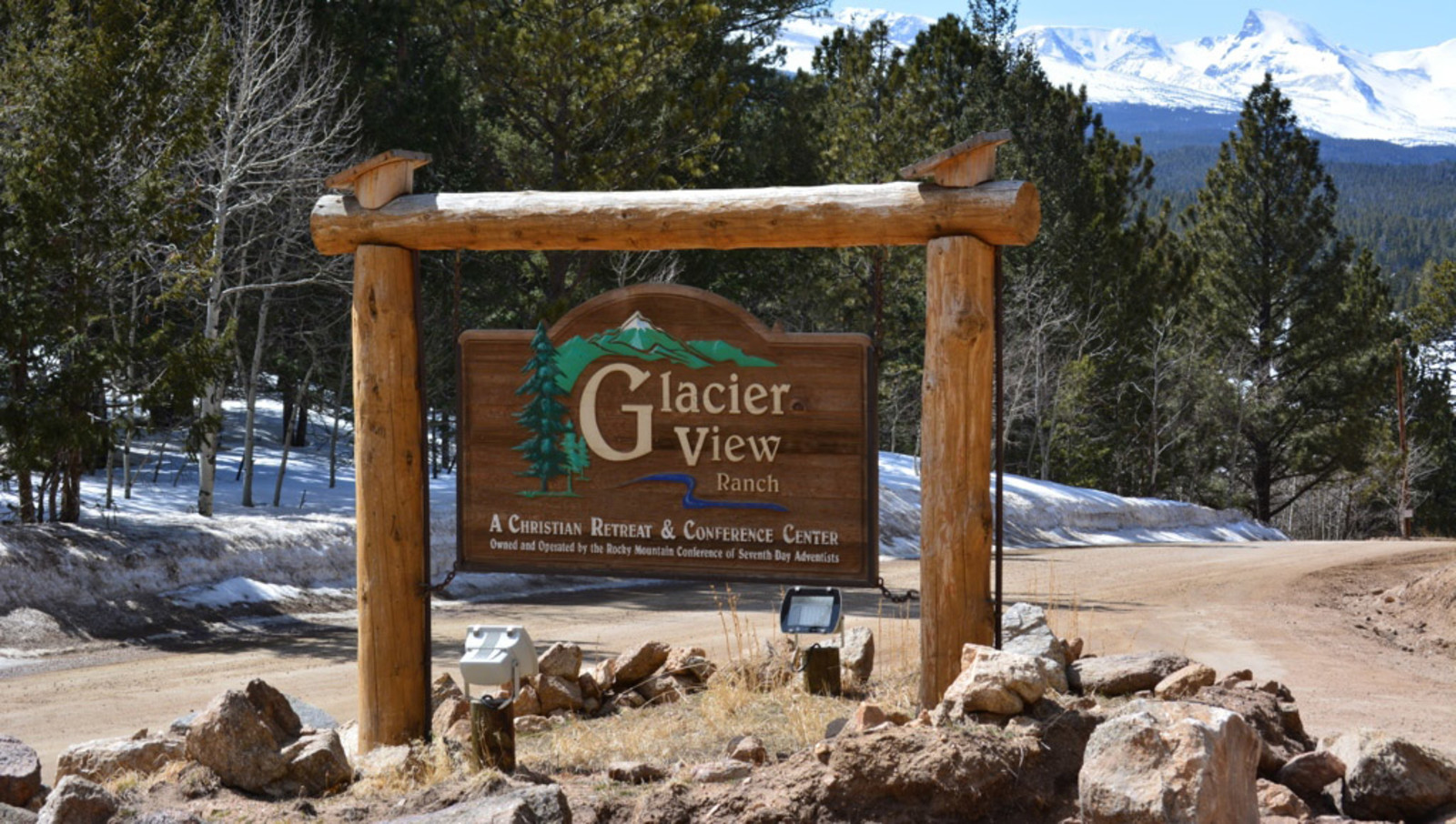
Glacier View Ranch
Photo courtesy of the General Conference of Seventh-day Adventists Archives.
Glacier View Sanctuary Review Conference (1980)
By Gilbert M. Valentine
Gilbert M. Valentine, Ph.D. has served internationally in teaching and senior administrative roles in Adventist higher education in Europe, Asia, the South Pacific and North America. He has written extensively in Adventist studies and has authored several books, including biographies of W. W. Prescott (2005) and J. N. Andrews (2019). The Prophet and the Presidents (2011) explored the political influence of Ellen White. He has also written for the Ellen G. White Encyclopedia (2013).
First Published: January 28, 2020 | Last Updated: June 3, 2026
An historic and controversial theological consultation, the Sanctuary Review Committee (SRC) involved approximately one hundred and fifteen Bible scholars and church administrators from around the world, who convened at Glacier View Ranch, forty-seven miles northwest of Denver, Colorado, from August 10-15, 1980. The unprecedented gathering was tasked with evaluating non-traditional interpretations of the Church’s sanctuary doctrine, which had caused widespread ferment when publicly expressed nine months previously by Australian theologian Desmond Ford. Former Adventist Review editor, Raymond Cottrell, described the meeting as “the most important event of this nature in Adventist history since the 1888 General Conference in Minneapolis.”1 Richard Hammill, former GC vice president and president of Andrews University, and coordinator of the consultation, considered the meetings to have constituted “the most earnest endeavor and the greatest investment of funds and in time of Adventist workers from all parts of the world field” that had ever been given to “the discussion of a doctrinal problem in the Adventist Church.”2
Much was perceived to be at stake at the conference, both for Seventh-day Adventism’s historic identity as well as its theological claims. The “sanctuary doctrine” had developed out of the endeavors of the church’s founders during the late 1840s and early 1850s to gain fresh understanding of the biblical prophecies that they had erroneously expected to be fulfilled by the return of Christ in 1844. In brief, the sanctuary teaching (described in Article 23 of the Church’s Fundamental Beliefs) posited that the prophecy of Daniel 8:14 concerning the “cleansing of the sanctuary” was fulfilled in 1844 by the beginning Christ’s final work as High Priest, entering the most holy place of the sanctuary in heaven at that time to begin a cleansing work. Later, in the 1850s, the final work of Christ came also to be understood as involving an “investigative judgment” to distinguish between believers who have remained faithful and are prepared for eternity and those who are not. This understanding has emerged as one of the foundational pillars of the Seventh-day Adventist movement, articulating its distinctive judgment message concerning the “last days.”
Immediate Background to the Conference
The immediate context for the convening of the SRC was a public presentation by Dr. Ford at a local chapter meeting of the Association of Adventist Forums at Pacific Union College (PUC) on October 27, 1979. Responding to an invitation from teaching colleagues, Adrian Zytkoskee, chair of the Behavioral Science department, and Wayne Judd from the Religion department, Ford had addressed the topic, “The Investigative Judgment: Theological Milestone or Historical Necessity?” The title, later perceived as a “provocation,” had been chosen by Ford’s department colleagues, according to PUC History department chair, Walter C. Utt.3 The initial negative response to the meeting announcement caused Ford to feel apprehensive about proceeding. colleagues assured him that the academic freedom afforded by the college environment and a small anticipated audience would render the presentation appropriate, and he decided to proceed.4 Initially the presentation had been scheduled for Paulin Hall, the 400-seat performance hall regularly used for such meetings, but due to an unexpectedly large response the organizers changed the venue at the last minute to the Irwin Hall Chapel, large enough to accommodate the more than 1,000 in attendance.
Ford’s presentation began with citations from Ellen White encouraging theological enquiry and investigation.5 He then briefly rehearsed the story of a “Problems in Daniel” Committee (1960-1966) appointed by the General Conference that had endeavored unsuccessfully to find solutions to contextual and exegetical problems related to the church’s central sanctuary teaching. He also cited several recent letters from Adventist scholars to demonstrate the topic’s broad recognition and relevance. Ford then proceeded to delineate the specific challenges such as the scriptural basis for the year-day principle of prophetic interpretation and linguistic issues related to key words in Daniel, Leviticus, and Hebrews which underpin the doctrine of the sanctuary. Ford contended that the doctrine of the sanctuary, “as traditionally held by Adventists,” lacked direct or exclusive support from scripture.6
Ford addressed this issue by reframing the teaching within the framework of “inaugurated” and “consummated eschatology,” as outlined by the Baptist theologian George Eldon Ladd.7 Ford argued that biblical prophecy could have a dual or repeated fulfillment as illustrated in Jesus’ application of the prophecy of Daniel to both the fall of the Jerusalem and the end of the world in Matthew 24. Ford referred to the hermeneutical approach underlying this interpretation as the “apotelesmatic” principle, a term he had borrowed from prominent Adventist author, George McCready Price.8 He affirmed the significance of 1844 as the foundational date for the providential emergence of the Seventh-day Adventist movement to bear the gospel and God’s last warning regarding a time of judgment. He supported his proposed solution with recent citations from Adventist authors and with Ellen White quotations. According to Utt, who heard the presentation, Ford did not “throw out the Spirit of Prophecy,” but instead raised questions concerning its authority in the establishment and validation of doctrine, while simultaneously maintaining that Ellen White’s role was “absolutely indispensable” to “the development and survival of the Advent movement.”9
In his response to Ford, Eric Syme, professor of religion and history at PUC, stated that he disagreed with him on only a few “extremely minor” points, which he chose not to address. He noted, “As most of my students will certainly confirm, so much that Dr. Ford has said in this very eloquent and very lucid presentation, I have been teaching myself.”10 In particular, Syme particularly appreciated that Ford had emphasized the need to avoid giving Ellen White “canonical” authority–a theme that later occupied more than half of the questions in the question-and-answer portion of the presentation.11 Syme further asserted that, in his view, Ford’s presentation “was not a denial of Seventh-day Adventism.” Instead, Ford’s teaching that the investigative judgment had as its purpose “the vindication of God and what God has done,” was “not heresy” but rather “in harmony with the finest traditions of our denomination.”12
When Ford’s mentor, retired seminary professor Edward Heppenstall, heard a tape recording of the meeting, he wrote a letter of encouragement, stating, “You express my convictions right down the line.” However, he expressed concern that some “negative reactions” might arise regarding Ford’s comments about the inspiration of Ellen White.13 As Heppenstall anticipated, the presentation did produce strong negative reactions. After hearing a sharp denunciation of Ford on a tape recording produced by Russell Standish, physician and director of Bangkok Adventist Hospital, and his brother, educator Colin Standish, Heppenstall informed Richard Lesher at the Biblical Research Institute (BRI) that he had “never in my life listened to such distortions at any time.” He trusted that church leadership and Lesher himself, would “speak out against such a miscarriage of the facts” concerning Ford.14
According to Utt, rapid and intense responses, both supportive and critical, emerged in unprecedented quantities from the community surrounding the college rather than from the PUC campus itself.15 Gillian Ford, Desmond Ford’s wife, later reported that Dr. Dean Jennings, a physician from the nearby St. Helena Sanitarium, recorded the meeting and sent out copies to seven acquaintances. A person in New Mexico obtained a copy and, without the permission of Ford or the Forum organizers, circulated approximately 1,000 copies domestically and internationally. Others then re-copied the tape. Within a very short time, copies of the tape were widely distributed.16 The PUC president, John Cassell, and academic dean, Gordon Madgwick, received copies in Singapore on their way back to Angwin from a visit to Australia. The General Conference officers also heard of the turmoil. Eight retirees from the Angwin community, representative of many who attended Ford’s presentation, perceived it not as an attempt to address well-known issues but as an attack on fundamental doctrines. In response, they wrote in protest to the General Conference president. Audience applause following certain points during the meeting led some of this retired group to “hang their heads in shame to hear the distinctive doctrines attacked by an S.D.A. minister.”17 Arthur White wrote a detailed defense of his grandmother, Ellen G. White, asserting that the presentation had undermined “her authority and integrity.” He sent the letter to his extended family and to officers at the General Conference.18
Ten days after returning to campus and consulting with their Union Conference officers, Cassell and Madgwick at their own initiative travelled to Washington, D.C., to discuss the issue with the General Conference officers. Following these consultations, they took a recommendation to the PUC board that Ford be granted a six-month leave of absence to be spent at the General Conference, to further document the arguments he had made in the presentation.19 As they explained to the college faculty at the time, the administration felt that this was the best way to protect Ford from those demanding his immediate dismissal. Utt observed that strong opposition to Ford emerged quickly, as polarization was already in place prior to the 1979 presentation, with debate focusing both on his ideas and his role in presenting them.20 In retrospect, thirty years later, Cassell felt that the decision to refer the issue of Ford’s presentation to Glacier View was “both tragic and counterproductive” for it “only served to embolden” Ford’s critics. He observed that it would have been better to have dealt with it “utilizing” PUC’s “well defined academic procedure.” But this was hindsight.21
Wider Background to the Glacier View Conference
The arrival of Desmond Ford on the PUC campus in mid-1977 from Avondale College in Australia, under the terms of a teacher exchange agreement between the two institutions, provides important contextual background for understanding the problems that led to the convening of the SRC. PUC had for many years previously offered its degrees on the Avondale campus through an affiliation agreement. Ford had accepted the appointment to PUC reluctantly. He had been assured by administration, however, that after the two-year assignment in California he would be returned to Avondale to his former role as chair of the theology department.
Ford was a charismatic preacher and teacher, noted for his biblical knowledge and intellectual engagement. Utt reported that at PUC his “dazzling style”22 moved and inspired both students and church members. He was thus much in demand for speaking engagements off campus.
In Australia in the 1960s, Ford had been highly influential, in partnership with Australasian Division (now South Pacific Division) President Laurence C. Naden, in successfully opposing the aberrant perfectionism associated with Robert D. Brinsmead’s “Sanctuary Awakening Movement,” which had caused division within many churches. In 1970, Brinsmead abandoned his view that end-time perfection could be achieved by physical eradication of human sinful nature, described as being “blotted out” from the subconscious mind of the believer just prior to the close of probation in a final cleansing of the “soul temple.” Subsequently, Brinsmead became an active proponent of a Reformationist view of soteriology that emphasized justification by faith as the foundation of Christian assurance, the source of sanctification, and the only basis for a victorious Christian life. This perspective aligned closely with the message Ford had consistently advocated.
During the 1970s, however, Adventist Review editor Kenneth H. Wood and associate editor Herbert Douglass reacted against what they perceived as an antinomian emphasis emerging in Australia. With the encouragement of General Conference President Robert H. Pierson, they began to promote end-time perfectionism, prioritizing sanctification. Australian church leaders found this development counterproductive within their context (see Palmdale Conference). As a result, Ford’s preaching attracted significant criticism from individuals with a more traditional perspective.
The criticism in Australia intensified when a number of retired pastors and evangelists expressed concern about perceived “worldly influence” at Avondale (see Avondale University), which they associated with enhanced academic standards required by government accrediting requirements. Academic programs were lengthened from two years to four years, curriculum content expanded, and the recruitment of faculty with terminal degrees was emphasized. Additional social changes on campus and the decline of the work-study program contributed to the perception that the college was deviating from the “blueprint” for Adventist education. Many self-styled “Concerned Brethren” (CBs) became highly critical of the college administration and of Ford, who had acquired a second Ph.D. in England, targeting him and his faculty colleagues issues.23 In particular, they perceived Ford’s forensic emphasis on righteousness by faith as a form of antinomianism at variance from official church teaching and as a serious departure from historic Adventism.24
Naden and his successor as division president, R. R. Frame, valued Ford’s role and his defense of the Church during the Brinsmead controversy. They understood the need for the college to enhance its courses, recognized the changing social context, and resisted external criticism.25 In the late 1970s, however, pressure from conservative groups within the division intensified and became more persistent. This movement was led primarily by Russell Standish and John Clifford, who promoted their book Conflicting Concepts of Righteousness by Faith in the Australasian Division.26 Frame’s successor as president, Keith S. Parmenter, finding the pressure difficult to deal with, arranged a teaching exchange for Ford at Pacific Union College in California.27 This measure was intended to alleviate theological tensions in the South Pacific. After beginning to teach at PUC in the fall of 1977, Ford’s popularity as a speaker for college Weeks of Prayer, camp meetings, and conferences soon made his name and gospel emphasis known more widely in the United States.
In the summer of 1979, Robert Brinsmead published a critical evaluation of the doctrine of the investigative judgment entitled 1844: Re-examined.28 The book addressed exegetical issues associated with the doctrine, particularly its perceived incompatibility, as traditionally taught, with Hebrews 6:19 and 9:12, which described Jesus entering the inner sanctuary in heaven at the ascension, not in 1844. Brinsmead also discussed the tension between the investigative judgment teaching and the biblical doctrine of justification by faith. To promote the book, Brinsmead conducted several meetings throughout California during the summer of 1979.
The widespread agitation stirred by Brinsmead, as Ford explained to General Conference President Neal Wilson, resulted in a sustained influx of calls and letters requesting clarification regarding the issue of Hebrews 9. Ford reported that, wherever he traveled, he was consistently asked to provide a statement addressing Brinsmead’s assertions.29 Thus, he accepted the invitation of his PUC colleagues to address the Forum on October 27 in order to respond to concerns raised among church members. Another reason Ford gave for making his views public was his frustration with prominent church leaders’ longstanding awareness of this issue, dating back to the early 1960s when then-president R. R. Figuhr established the “Problems in Daniel” committee to seek for answers. This committee had not made progress and had been disbanded. Ford also felt disappointed when he learned that the agreement that he would be returned to Avondale as head of the theology department after two years at PUC could not be honored, and he had been asked to remain in America for a third year.30
Ford believed that his attempt at addressing the exegetical problems with the sanctuary doctrine was an appropriate answer that had wide scholarly support among Adventist scholars. Ford had defended this interpretation for years at Avondale. As he explained to Wilson, he believed that he was not “opposing basic doctrines,” but rather an “incomplete expression of the doctrine of the pre-advent judgment.” Furthermore, he reported to Wilson, “theologians of the Church have written me saying they agree right down the line with the October 27 presentation.”31 Professors at major Adventist institutions had, he affirmed, “commented similarly.” Ford’s observation was corroborated by his PUC religion department chairman, Fred Veltman, who informed Cassell and Madgwick that the views enunciated by Ford were held by other “teachers teaching at PUC and at other colleges.” Veltman himself held “substantially the same position,” with views that were “similar in a number of places,” and he offered to resign as chair if required.32 Later, he communicated the same observation to the General Conference leadership.33
Ford noted that respected biblical scholar Raymond Cottrell had lectured at Andrews University two weeks before his October talk and had “set forth the identical problem.”34 In January1980, Cottrell had also presented the same material at Loma Linda University. In the estimation of the editor of the Australasian Record, Robert Parr, who shared the tapes of Cottrell’s presentation with Parmenter, the material was far more radical and critical of the exegetical problems than what Ford had presented at PUC. The latter, by comparison, was “but a peep and a mutter.”35 However, the tapes of Cottrell’s presentations had not been widely circulated. Ford’s presentation had been.
As Ford acknowledged to Wilson, the reaction and “the result” of his addressing of the problems were “a surprise to me and a matter of deep regret.” He apologized for adding to Wilson’s burdens and regretted being “the cause” of the administrative difficulties.36 The problem confronting administration as a result of the PUC talk was how to manage the unprecedented theological ferment, and the turmoil surrounding Ford’s name and personality as much as the exegetical problems. The concurrent emergence of two very public problems, the first associated with new claims about how Ellen White used literary sources much “more extensively” than previously realized, an issue publicized by Walter Rea of California, the second General Conference financial investment irregularities associated with Donald Davenport of California, an issue which also deeply troubled many in the church, greatly complicated the administrative task.37
Preparation for the Glacier View Conference.
During his six-month study leave in Washington, D.C., Ford was given access to materials in the General Conference Archives and the White Estate, and an office for research in the General Conference building. He was also provided with an advisory committee comprised of twelve scholars to provide feedback on the manuscript Ford was developing to document his views. Members of the committee were Fred Veltman, Donald Neufeld, James C. Cox, William G. Johnsson, Richard Lesher, Thomas Blinco, Gerhard Hasel, Fritz Guy, Kenneth Strand, Gerard Damsteegt, Duncan Eva, Robert Olsen, and Donald Yost. Richard Hammill, former president of Andrews University and about-to-retire vice president of the General Conference, chaired the group and served as Elder Wilson’s liaison for the planning of the meeting at Glacier View.
The committee convened four times during the preparation of Ford’s position paper, and committee members were asked to provide feedback as the six chapters were drafted. Ford felt that responses were of uneven value. Some dealt only with grammatical issues. Only a few dealt with substantive issues. Ford reported that at least four of the committee members generally agreed with his analysis, although not all supported the specifics of his proposed solution.38 Hammill reported that Ford seemed unwilling to make changes in his draft in response to the comments. According to Hammill, discussions in the meetings were lively and sometimes heated. Some participants “made practically no comments at all after it was decided to tape the meetings.”39 Ford also would not accept advice to shorten the manuscript, which eventually extended to 991 pages.
Entitled Daniel 8.14: The Day of Atonement and the Investigative Judgment, Ford’s manuscript comprised 300 pages in six chapters addressing the issues that had been raised in his Forum presentation.40 The chapters were followed by almost 600 pages of appendices providing supportive documentation. Its introductory chapter briefly discussed his methodology and then reviewed the experience of seventeen previous Adventist writers who had attempted to resolve the issues. Of these, seven ultimately left the church, while the others, “though perplexed remained with the church.” The objective in this 100-page first chapter was not to endorse any particular writer’s position, but rather to highlight the ongoing problem identified by General Conference Field Secretary M. L Andreasen in 1942. Andreasen reported to President J. L. McElhany and Vice President W. H. Branson that “a large number of ministers” in the church at that time, while generally accepting the Sanctuary teaching, also believed that the problems of Hebrews 6 and 9, as raised by A. F. Ballenger in 1905, had “never been fully met and that we cannot meet them.” As a result, these ministers tended to regard the doctrine as “not vital and relegate it to the background.”41
Chapter Two examined passages in Hebrews which used imagery of the Jewish Day of Atonement and applied it to Christ’s ascension. Chapter Three addressed complex exegetical questions in Daniel, specifically concerning the identity of the sanctuary, the terminology of “cleansing” or “restoring” of the sanctuary, and the legitimacy of the year-day principle in interpreting the 2,300 days. Chapter Four analyzed issues of judgment and sanctuary imagery in the book of Revelation, while Chapter Five outlined Ford’s proposed solution to these challenges. Ford stated, “I believe that the problems in Daniel and Hebrews may be solved by applying the apotelesmatic principle.”42 Building on Price’s conceptualization, he argued that “a prophecy fulfilled, or fulfilled in part, or unfulfilled at the appointed time, may have a later or recurring, or consummated fulfillment, with the recurring fulfillment repeating the main idea rather than precise details and each fulfillment being a pledge of that which is to follow.” This framework allowed Ford, he believed, to affirm that “Seventh-day Adventists have been right in seeing the theme of judgment in Daniel 8:14,” and that “1844 is a key date,” as it marked the period when "in the providence of God, He brought to birth the movement with the last message to the world."43
The final chapter of the manuscript discussed the nature of authority ascribed by Adventists to Ellen White in doctrinal formation and the resulting tension with the Protestant principle of sola scriptura. Ford contended that Ellen White’s gift was a genuine manifestation of the New Testament gift of prophecy, but its authority was not as “the sovereign interpreter of Holy Scriptures.”44 The entire document was distributed to SRC members in America six weeks before the meeting and to international participants three weeks in advance.45
Between December 1979 and the convening of the SRC at Glacier View in August 1980, the Adventist Review published more than twenty editorials and articles that vigorously defended the Sanctuary doctrine and its central place in Adventist theology. Editorials stressed the traditional arguments for the teaching and cautioned that church members should anticipate being “shaken violently” by attacks from apostate teachers, and that, during the shaking, “large numbers will forsake the historic faith.”46 The defense also encompassed the disputed teaching of end-time perfectionism, described as “a level of character development...hitherto never achieved by a significant number of God’s people,” which Wood characterized as “historic” Adventism, though it had previously caused considerable disruption in Australia.47 Another editorial expressed concern about “the strange winds of doctrine that blow on some campuses,” advising parents to send their children “only to those schools that teach historic Adventism.”48
Although the General Conference president later justified the actions of the Review editors as fulfilling “what the church expects them to do on the church’s clear positions,” several senior scholars strongly objected, arguing that the Review had set a negative climate. They criticized the use of the terms “heretic” and “apostate” as prejudicial to a fair hearing and deplored the editor’s policy of attempting to ensure that “Ford and his questions had to be publicly discredited in advance.”49 Widespread apprehensions that the “primary purpose” of the SRC was for “disciplinary action,” prompted President Wilson in early July to clarify that the issues under discussion were in fact “much greater than a person or persons.” It was right, he explained, that changing definitions and new terminology meant that the issues should be examined, but he reassured the Church that new light “does not make void the old,” and it was not expected that the “restudy of our distinctive truths” would “weaken the pillars of our message.”50 Pacific Union College President John Cassell, who had agreed to the arrangements for Ford based on assurances a fair process, later came to the conclusion that circumstances had become so complex that some administrators had predetermined an outcome.51
The Glacier View Conference Meets
The members of the SRC that gathered at Glacier View, August 10-15, were selected to ensure broad representation among Bible teachers and administrators. Eighty-two were selected from Bible teaching, editorial, ministerial, or higher-education contexts, while fifty-seven were drawn from local, union, or General Conference administrative backgrounds.52 In the event, only about 115 actually attended.53 At the Sunday evening opening session, President Wilson reviewed the background to the meeting, welcomed participants, and declared that “Dr. Ford was not on trial but that his ideas were.”54 Each morning, members participated in seven groups of sixteen, discussing set study questions related to the four main areas corresponding to the chapters in Ford’s manuscript, although the manuscript itself was not directly examined. In addition to Ford’s primary document, fifteen other papers had been distributed on various related topics. Each working group was tasked with formulating a consensus statement on the assigned questions, which were then presented verbally during the afternoon plenary sessions. Evening sessions were dedicated to the reading of papers and further discussion of the consensus statements.
According to Cottrell, one of the most influential papers was presented on Tuesday by Fritz Guy of the Seventh-day Adventist Theological Seminary. This paper was received “with instant and enthusiastic approval from all the delegates” because it pointed beyond “the confusing exegetical problems and focused attention on the ultimate reality.” Participants from all perspectives regarded this approach as the most constructive path toward a deeper theological synthesis.55
In an effort to separate the theological issues from personality, Wilson explained that Ford had not been appointed as a committee member and was initially not scheduled to speak during the meetings, except to answer questions if needed. However, at the request of delegates, Ford was invited to answer questions during the final three afternoon plenary sessions.56 These sessions introduced a number of dramatic exchanges, beginning with a misunderstood question from Edward Heppenstall and subsequent confrontations between Wilson and Ford regarding Ford’s observed unwillingness to take counsel to change. In an effort to have Ford affirm his confidence in the church’s distinctive mission and message, Heppenstall asked Ford about his understanding of what actually happened in 1844, thinking he would use his apotelesmatic principle to explain the date and defend his position showing how it was in “harmony with the tradition.” According to Veltman, Ford mistook the question and his answer failed to affirm what Heppenstall and others understood Ford to believe. The misunderstanding between Ford and his mentor led to shifting the discussion toward more personality traits and intense exchanges, involving Elder Wilson, Parmenter, and Ford and attempts by Jack Provonsha of Loma Linda to achieve reconciliation.57 The editor of Ministry later wondered if it might not have been better to have followed the “original plan of dealing exclusively” with Ford’s document and not have him speak at all.58
For his part, Ford felt that many scholars agreed with him, at least, regarding the identified problems, even if they did not endorse his proposed solution and support him publicly in the meetings. Richard Coffen, book editor and then vice president of the Review and Herald Publishing Association also observed this silence. For example, he was “shocked” when Heppenstall “demurred” and failed to affirm Ford in his analysis of Hebrews 9:24 when it was known by “Heppie’s” students, of whom Coffen was one, that he held exactly the same view. This incident too may have been a misunderstanding, but it “bewildered” Ford. In Coffen’s view, the “silence” was true of other scholars.59 In contrast, Veltman, a supportive colleague, observed in a set of notes made shortly after the meeting that Ford found it difficult to “present his viewpoints in a noncontroversial” way using “as much traditional language as possible.” If he had adopted less of a “polemical” approach in his answers and discussion of questions and if he had appeared more “teachable,” it would have helped to put “the best perspective on his work.” Instead, according to Veltman, Ford made “the case difficult for himself,” not seeming to sense a greater need for “pastoral sensitivity,” and this led to “disappointment” on the part of scholar colleagues and “a general sadness” on the part of others who wished to support him. Apprehension of disclosure or embarrassment through association played a significant role in the dynamics of the meeting.60 The participants cared deeply about the issues at stake and, for the most part, they respected Ford.61
Ford’s use of illustrative language and confident assertiveness of a point of view were not off-putting to South Pacific colleagues and contributed to his popularity as a speaker. In Australian culture, with its emphasis on camaraderie, “mateship,” and direct, even blunt, exchanges, this conversation style was not regarded as offensive. As William Johnsson (an Australian) later observed, “factoring in the culture,” is critical in order to “grasp the dynamics” of perceptions of Ford.62 To many in America or elsewhere outside his home country, Ford’s manner was often perceived negatively. To administrators unfamiliar with Australian conversational culture, and for those who did not share his point of view or who were not persuaded by his arguments, he came across as an over-confident crusader with a “know it all” attitude bordering on arrogance, observed Neal Wilson.63 To those who disagreed with him, particularly on doctrinal issues, Ford remained a controversial and often misunderstood figure. Yet many church leaders, especially in Australia, viewed his ministry positively and regarded him as an asset to the church.
On Thursday afternoon, as the conference neared its end, the mood darkened with the reading of an emotional letter from the absent former president, R. H. Pierson, that appealed to delegates not to “repudiate landmarks of truth” and implied that Ford had been teaching “cheap grace,” “Calvinistic predestination,” and “a life of spiritual defeat.”64 To Ford, the letter reflected what Pierson had earlier read in Standish’s and Clifford’s discredited attack on him. Pierson accused Ford of being “morally and ethically dishonest” in continuing to work for the church.65 In a similar vein, Walter Blehm, president of the Pacific Union Conference, faulted Ford for dividing churches and causing pastors to lose faith. “Anything that divides this church or leads to doubt is wrong,” he asserted.66
During the week, two small working groups had been tasked with synthesizing the various daily consensus statements into a general unified consensus statement with two parts, one on “Christ in the Heavenly Sanctuary,” and another on “The Role of Ellen G. White Writings in Doctrinal Matters.” The resulting fifteen-page document was carefully read by the plenary session on Friday morning and formally endorsed by consent of the entire committee page by page. The response to this achievement, Robert Olsen of the White Estate observed, was a joyful sense of unity. “The seven groups have all come to the same conclusions. This is our best understanding at the present time.”67 As Cottrell later reported, “all present, including Dr. Ford, found the statement viable, some because it affirmed the traditional interpretation and others because it recognized the problems and need for further study.”68 Both Cottrell and Veltman noted the several areas where the document had conceded key points that Ford had raised and where it made progress toward a common understanding on the issues.69 Others, such as Francis Wernick, a General Conference vice president, felt uncomfortable, after later reflection, with the consensus statement because it conceded an important issue Ford had raised and because Ford said he could agree with it.70 The consensus statement would eventually be published in the Ministry and in the Review, although the document was not highlighted and received little commentary in the overall reportage apparently because of the way Ford and others interpreted it.71
Following the approval of the consensus statement, as time ran out on the concluding morning of the conference, Wilson quickly introduced a further document that was read out to the full assembly, but not circulated. This “response” document had been drafted overnight by a group of six of the committee members. It was not an overall critique of Ford’s position paper, but rather a statement of ten points where the six writers felt that Ford differed from traditional Adventist teaching.72 Wilson explained to delegates at the final meeting that the “ten-point critique” was not being voted by the SRC because it was considered “preliminary” until Ford and the conference screening committee of twenty-six could review the accuracy with which it reflected Ford’s position. The document was not intended to be used as a determinator of orthodoxy. As Cottrell later observed, although formulated at Glacier View, the ten points could not be said to “reflect the thinking of the Sanctuary Committee, which did not discuss it or vote on it.”73
The Dismissal of Ford from Ministry
By Thursday afternoon, as the SRC moved toward conclusion, the focus of church leaders turned from doctrinal discussion to the urgent problem of management of church conflict and the person at the center of this particular conflict. At its Thursday afternoon meeting, the sixteen available members of the General Conference President’s Executive Advisory Committee (PREXAD), with two invitees, developed a consensus concerning the conditions that should be set for Ford’s continuing employment in the church.74 These conditions included a requirement that he acknowledge in writing that he could be wrong on some matters in his document and that it was not therefore his final argument; that he dissociate himself from the unofficial circulation of his document and express regret for its release; that he would “give complete support” to the statement of Fundamental Beliefs approved at the General Conference held earlier in the year at Dallas, Texas; and that he issue an appeal to young workers to follow the counsel of the church rather than himself.
On Friday afternoon, President Wilson called a smaller ad hoc panel of seven General Conference and two Australasian Division officials to meet with Dr. and Mrs. Ford for the purpose of discussing the employment terms agreed by PREXAD the previous day. The three-and-half-hour meeting focused first on Ford’s perceived attitude. The “impression” that “most people” gained from the meetings, Wilson observed, was that Ford was “totally unyielding and contentious.” Addressing Ford directly, he reported that it seemed to many in leadership that it was “quite impossible for you to be wrong.” Ford appeared to be “always the teacher” and not able “to learn from anyone else.” In order to be a team, there was need for flexibility in attitudes, Wilson stressed. Members of the panel were aware that he had a “charisma, a disarming way to rally people” around him, but they were concerned that he gave the impression that he was “the one person who could lead the church out of its theological morass.”75 The second issue concerned a perceived “lack of judgment” and absence of concern about the damage being done by unauthorized circulation of the tapes and the document. There was puzzlement that he could neither see his way clear to protest their circulation, nor to clearly dissociate himself from Robert Brinsmead by some public statement.
The third issue taken up with Ford in the Friday afternoon meeting was the doctrinal disagreement. This was discussed after Ford was given the ten-point document that set out ways in which his manuscript was assessed as being “incompatible” with “fundamental beliefs.” Ford responded that he agreed with eight of the points but suggested that two others were not accurately stated. Ford pointed out, however, that the consensus statement had acknowledged a number of important points he had made in his document, that he would “feel very comfortable preaching under the umbrella of the consensus paper,” and that he could evangelize and baptize on that basis. He pointed out also that significant changes had been made in the doctrinal language of the 1980 Dallas Fundamental Beliefs statement, which encouraged him, and he thought that over time there would be more adjustments. “The brethren have made tremendous progress these past few days. Your position is closer to mine than ever before.”76 Cottrell would observe later that the ten-point critique was, in his view, inconsistent with the consensus statement for it “condemned Ford for the very things the consensus statement implicitly commends him [for].” The critique, so Cottrell and some others believed, became a basis for administrators later misrepresenting some Bible scholars’ views.77 Several of the administrators in the meeting, however, did not “think the consensus paper showed such a shift.” Wilson observed that “statements made by some in the meetings are not necessarily the position of the church.”78
The minutes of the Friday meeting indicate that Ford was focused on theology and the perceived shifts in doctrinal understanding. The administration expressed concern regarding the urgent need for pastoral care for members and strategies to address the resulting confusion. Parmenter had reported to the SRC that, in Australia, the conflict had escalated into a crisis of “tremendous magnitude.”79 Francis Wernick asked Ford, “How can you help us with the fallout?” General Conference Vice President W. Duncan Eva further inquired whether Ford could “speak out on unity” and clarify “that you are not with those with whom you are identified [Brinsmead].”80
The Friday afternoon session concluded with Parmenter reading to Ford a draft letter, outlining his expectations. The letter assumed that the Glacier View discussions had not advanced understanding, but instead reaffirmed “confidence” in the “fundamental beliefs” and had identified “several positions” where Ford was “at variance” with “presently held fundamental doctrines.” The letter characterized Ford as “still challenging the pillars of our faith,” specifically referencing “the Sanctuary and the role of the Spirit of Prophecy.” Parmenter asked whether Ford would publicly state that “he could be in error” and “yield to the judgment and counsel” of his brethren, and whether “from henceforth your teaching and preaching will be in harmony with the ‘Fundamental Beliefs’ of the church”.81 Ford, perceiving that the Dallas statement was now being used as a creedal measure of his orthodoxy, responded that he did not need a long time to think about his answer. “I cannot conscientiously agree to your request.” He could not “lie.” He believed he could “still be a blessing to the church,” but could never be so “if I go against my conscience.” Gillian Ford, who had been tearful, requested permission to speak and commented about the negative climate set by the Review for the Glacier View meetings, the perception of some that the outcome had therefore been prejudged, and the damaging influence of the Pierson letter and Wilson’s rebuff of Ford following the misunderstanding conveyed in his response to Heppenstall. The meeting neared its conclusion with appeals to the Fords to reconsider their decision to reject Parmenter’s conditions. Ultimately, the Fords requested the appeals cease, and the meeting ended.
Wilson had not initially planned that the discussion with Ford about continued employment would follow the SRC discussions so soon. However, Parmenter had arrived at the meeting from Australia with a pressing request. Before leaving Australia, he had arranged for meetings with ministers in various conferences to be held immediately following the SRC, seeking prompt resolution of both the theological issues and the status of Dr. Ford. Parmenter had reported to PREXAD that turmoil in the Church in Australia had been exacerbated by the widespread unauthorized circulation of the 991-page study document, and he assumed that Ford was responsible.82 According to a later account by Robert Brinsmead, Parmenter had been visited by John Brinsmead, Robert Brinsmead’s younger brother who was upset by Robert Brinsmead’s publishing activity. John Brinsmead mistakenly believed that Ford had assisted Robert Brinsmead in writing his provocative 1844 Revisited and conveyed this perspective to Parmenter. John Brinsmead also reported his understanding that Ford had colluded with Brinsmead’s organization in the circulation of the 1979 Forum tape.83 Ford firmly denied any involvement in the release of the document and any cooperation or collusion in any way between himself or his wife with Robert Brinsmead. Nevertheless, the Australasian Division administration maintained that Brinsmead and Ford had collaborated in circulating the 1980 manuscript.
It was not until 2007 that Gillian Ford would learn that Dr. Dean Jennings, a physician at the St. Helena Sanitarium had obtained permission from Mrs. Reuben Figuhr to make a copy of her husband’s copy of the manuscript and that Jennings had been responsible for making it available to people in Australia.84 The “misrepresentation and mistrust” had a damaging impact on administrative perceptions of Ford’s attitude, suggesting an apparent “lack of pastoral care” and a lack of “loyalty to the denomination.” These misperceptions and Ford’s unwillingness to speak against Brinsmead contributed to the outcome of the meetings at Glacier View.85
In the weeks immediately following the SRC meeting, Ford and Parmenter exchanged additional correspondence. During this exchange, Ford affirmed his acceptance of the new Dallas Statement of Fundamentals but also indicated twelve significant doctrinal issues where he believed the consensus statemen reflected positions he had previously articulated in his document. PREXAD reviewed Ford’s letters and concluded that his responses were overly nuanced and conditional, making his continued employment untenable, especially given the challenging circumstances in the South Pacific. With trust eroded and the risk of schism increasing, PREXAD determined that Ford should not remain employed. They advised the Australasian Division leaders to revoke Ford’s ministerial credentials and dismiss him from denominational service should he choose not to resign.
A number of scholars hoped for a different outcome, expecting that PREXAD would acknowledge that Ford’s work contributed to ongoing theological discussion, even where his conclusions were not adopted.86
Ford declined to resign. Thus, at a six-and-a-half-hour joint meeting of both the Australasian Division Committee and the Avondale College Board on September 18, 1980, action was taken by secret ballot to remove Ford’s ministerial credentials and dismiss him. The chairman declined to declare the numbers in the ballot. The division in-house attorney, Kenneth Eastman, who had previously warned division officers that the proceedings were irregular and outside the requirements of New South Wales employment legislation, insisted that the action to terminate be subject to advice of the usual external legal firm retained by the division. His amendment to the action was approved. Persuaded of the doubtful legality of the meeting and alarmed that the failure to follow Australian employment termination due justice procedures would subject the church to legal challenges, Eastman subsequently sought external advice for the Church.87 Division officers declined to report the external advice even to Eastman with whom relationships broke down. Ford declined to seek redress, but Eastman continued to be distressed at what he perceived as the dubious legality of the proceedings.88
Aftermath of the Conference
Soon after the conclusion of the SRC and the follow-up meeting of PREXAD with Ford, official church publications reported to church membership on the proceedings and the outcome. The Adventist Review of August 28, 1980, carried a prominent back page announcement headlined “Variant Views Rejected.” The article stated that while there was “a need for further study in certain areas,” the meeting had “clearly affirmed the doctrinal positions the church holds and which were adopted by the General Conference session in Dallas.”89 However, some objected that this report was unbalanced because it made no mention of acknowledgement at the Glacier View meeting [in the consensus] of Ford’s contribution to a better understanding of some of the biblical issues.90 The following week the Adventist Review gave almost half of its twenty-four pages to a report on the meetings.91 William Johnsson provided an overview of the background to the conference, its procedures and the work of the discussion groups. He noted the documents that had resulted and that they reflected “the strong confidence of the Sanctuary Review Committee in our historic sanctuary doctrine.” He also reported that polls taken at the close of the meeting “showed a clear trend among delegates in the direction of our traditional interpretations.” The Review featured the ten-point statement of differences with Ford and later provided the overall consensus statement as two separate documents.92 In later use, the general consensus would be thought of as two consensus statements.
Ministry magazine devoted an entire special issue to its report on the SRC with a lengthy personal introductory assessment by the editor.93 The issue included copies of the correspondence between Ford and Parmenter with an appraisal by the editor and a brief account of several follow-up meetings between Ford and Wilson that had taken place in August and September. According to Ministry, Wilson cited Ford’s unwillingness to yield his apotelesmatic principle, or his belief that Antiochus Epiphanes was a partial fulfillment in Daniel, or to see “the difference between general and apocalyptic prophecies,” or to affirm Ellen White as “a reliable, inspired commentary of scripture,” as examples of his refusal to take counsel from his brethren.94 Ministry devoted the second half of its special issue to a section entitled “Questions and Answers on Doctrinal Issues” that had been prepared with the assistance of Seminary professors Gerhard Hasel, William Shea, and Raoul Dederen, which represented a formal assertion of the traditional positions and set forth a detailed rebuttal of many of Ford’s arguments.95 The special Ministry issue also carried a sampling of nine letters from university presidents, administrators, and Bible teachers who commented positively on the format of the SRC meetings and the commitment the church had made in convening the meeting. Other Adventist publications also devoted substantial space to coverage of the developments and carried correspondence.96
The Andrews Society for Religious Studies (ASRS), the scholarly association to which many Adventist religion teachers in the United States belonged, issued a statement of protest at the unbalanced reporting in the Adventist media. These scholars saw the consensus statements “as being in significant continuity with traditional understanding, while incorporating new understandings, reflecting the contribution of all the documents prepared for the Sanctuary Review Committee. We view these consensus statements as a stimulus to further study, and not as definitive formulations to end discussion. They were not intended to be used as a test of loyalty or orthodoxy.”97 A letter from Wilson to institutional leaders and conference presidents in North America upheld the administrative decisions but also sought to give assurances that the church was “not embarking on a hunting expedition to find pastors who teach variant doctrines,” or who might be sympathetic to Ford and some of the positions he had articulated.98
Richard Hammill, who had coordinated the Glacier View meeting, felt that the appointment of the small group to identify points where Dr. Ford’s document differed with the Church’s traditional teaching (the ten-point statement) “was a serious mistake in strategy,” and that it was “an affront to the members of the Sanctuary Review Committee.” As he perceived it, “the Bible teachers felt that they had been betrayed and that their work was just window dressing.”99 All but two of the theology department teachers at Southern Missionary College, for example, sent a jointly signed letter of protest at Ford’s dismissal.100 Hammill also expressed himself as being “very disappointed in the Ministry report.” In “several important respects,” he noted, “its articles were contrary to the intent” of the SRC. In its comments, for example, on the doctrinal issues arising from the Hebrews passages, he thought it “did not present the view of the Sanctuary Review Committee.” In fact, he felt it presented an “opposite” explanation and also ignored those of Ford’s major arguments about aspects of the cleansing of the sanctuary that had in fact been accepted by the committee.101 Some others at the Seminary, such as Old Testament professor Larry Geraty, lamented what they felt was the “biased and one-sided” view of Ford given in Ministry and protested the editor’s lack of “fair, evenhanded” treatment of Ford’s positions. He reported that many of the students on campus felt the same way.102
Hammill acknowledged the problem posed for administration. In spite of his having “several long talks” with Ford during the session, Ford had “declined to budge from any of his views,” and had chosen “his uniqueness above the community welfare.” In Hammill’s view, Wilson had not prejudged Ford, but had hoped “that in some way Dr. Ford could be salvaged, for…his lifestyle was above reproach and he was a gifted preacher and teacher.” In Hammill’s assessment, it was the need for a rapid solution in Australia that forced the General Conference president’s hand.103
In Australasia, numerous meetings were held with ministers in the last months of 1980 in order to answer questions and diminish the conflict, but these were only partially successful. Various estimates have been made of the loss of ministers and church membership during the decade that followed Ford’s dismissal. Some estimate 180 ministers in Australia and New Zealand (40 percent of the total employed) left the ministry of their own accord or were dismissed for reasons related to Glacier View. Substantial losses were also experienced in the United States and elsewhere.104 At the General Conference, on the recommendation of Hammill, the Biblical Research Institute reactivated a Daniel and Revelation Study Committee to give attention to the problems Ford had explored. During the decade following Glacier View, the committee, known as DARCOM, produced a series of seven major volumes defending and reaffirming traditional understandings. Edited by Frank Holbrook and known as the Daniel and Revelation Committee Series, the set included such volumes as Selected Studies on Prophetic Interpretation (revised edition, 1992); Symposium on Daniel (1986); The Seventy Weeks, Leviticus, and the Nature of Prophecy (1986); Issues in the Book of Hebrews (1989); Doctrine of the Sanctuary: A Historical Survey (1845-1863) (1989) and two volumes entitled Symposium on Revelation (1992).105
Upon his dismissal from the Adventist ministry, Desmond Ford undertook a preaching and teaching ministry with Good News Unlimited (GNU), a radio and television independent organization based in Newcastle, California, organized in 1981 by Adventist church members for the purpose of supporting Ford in a continued ministry. He retained his membership in the Pacific Union College church until his return to Australia in 2000. During the last years of his life, Ford attended the Caboolture Adventist church near his home in Caloundra, Queensland, where he shared in teaching a Sabbath School class.
Conclusion
The Glacier View meeting of the Sanctuary Review Committee was the most important twentieth-century attempt to affirm, clarify, and renew Adventist understanding of its foundational story and mission as expressed in its central doctrinal formulations about the heavenly sanctuary, the investigative judgment, and related prophetic interpretations. The task involved addressing exegetical difficulties perceived in several passages of scripture traditionally relied on for support of the doctrinal formulations in pursuit of a deeper understanding of the relevant biblical teachings. These questions raised by non-Adventist critics of the doctrine and by some Adventist scholars were addressed by Desmond Ford in late 1979 and attracted attention of church leaders, scholars, and members worldwide. The SRC was believed by church leadership to have succeeded in affirming confidence in the church’s teaching, and continuity in both the broad outlines of the sanctuary doctrine and the church’s historicist approach to prophetic interpretation. Their focus for the next few decades would be to promote apologetic studies addressing matters identified in the ten-point critique of the positions Ford took in his study document. In contrast, many scholars and pastors looked to the consensus statement as the main source of guidance going forward from Glacier View. In their view its parameters left space for further advances in understanding the doctrine
Following Glacier View, further extensive study given to the exegetical problems by the BRI produced results that the BRI considered a strong basis for the Church to officially continue its traditional teaching of an investigative judgment, but using the terminology of “pre-Advent judgment,” and a “two-phase” rather than a two-apartment ministry of Christ in the heavenly sanctuary. Within the context of the consensus statement, the interpretation of the sanctuary teaching has continued to expand to include broader theological dimensions implied in the sanctuary teaching with emphasis on the concepts of refuge, safety, and Christian assurance in the judgment along with an emphasis on and deeper appreciation of the social justice implications and Christian accountability aspects of the doctrine (see Investigative Judgment). The emphasis on the conviction of prophetic destiny for the church has also broadened for many scholars to embrace a providential view of mission and identity.
Church administration felt the dismissal of Ford was necessary in order to manage the intensified and hyper-partisan church conflict in Australia. The close proximity of the dismissal to the doctrinal enquiry, however, led to misunderstandings and mistrust of administrative intent on the part of many scholars and the ministerial work force both in America and Australia. In the years immediately following the conference, perceptions of the treatment of Ford as unfair intensified debate and led to significant numbers of ministers and church members withdrawing from the Church. While large parts of the Church felt the right administrative decision was made and there was a need to move past the conflict, a body of opinion, particularly in the South Pacific, has continued to hope that some form of rapprochement with Ford could have been achieved with church leadership before his death on March 11, 2019, and that some gestures might have been made to redress a lingering sense that Ford was treated unjustly. In the twenty-first century, the debate has subsided and the issues have become less pressing as the consensus statement has provided scope for growth in a range of interpretive perspectives in continuity with the established understanding of the doctrines.
Sources
“Ford Document Studied; Variant Views Rejected.” ARH, August 28, 1980.
“Some Observations Regarding Dr Desmond Ford’s Presentation” [undated]. Jointly signed by W. R. Fouston, W. B. Ochs, M. L Venden, Erwin E. Roenfelt, D. A. Ochs, G. M. Mathews, and S. T. Borg. RG 11, N. C. Wilson Glacier View Files.
Ballis, Peter, Harry. Leaving the Adventist Ministry: A Study of the Process of Exiting (Melbourne: Greenwood Publishing Group, 1992).
Blehm, W. D. “Comment at the Sanctuary Review Committee.” RG 11 VP-C B Hirsch GV Files. General Conference Archives, Silver Spring, Maryland, U.S.A. (GCA).
Brinsmead, Robert. 1844 Re-examined. Fallbrook, CA: Verdict Publications, 1978.
Brinsmead, Robert D., email to Gillian Ford, October 18, 2007. Copy in author’s possession.
Cassell, J. W. “Notes Prepared for Meeting with General Conference PREXAD, [1979].” Cassell Files, Folder “DF” Box 2, Walter C. Utt Center for Adventist History, Pacific Union College Library, Angwin, CA. The typescript notes are based on attached handwritten notes with further reflection apparently added in 2009.
Coffen, Richard. “Glacier View: A Retrospective. Adventist Today [online], August 10, 2016. Accessed April 09, 2019, https://atoday.org/glacier-view-a-retrospective/.
Cottrell, Raymond F. to Desmond. Ford, November 17, 1979. Copy in author’s possession.
Cottrell, Raymond F. “The Sanctuary Review Committee and Its New Consensus.” Spectrum, November 1980.
Cottrell, Raymond F. “The ‘sanctuary doctrine’–Asset or liability,” February 9, 2002 at the Association of Adventist Forums meeting in San Diego, CA. Raymond F. Cottrell (Collection 238) Center for Adventist Research, Andrews University, Berrien Springs MI. Also available at http://www.rethinkingadventism.com/support-files/cottrell_1844.pdf accessed, April 24, 2019.
Ford, Desmond. “Daniel 8.14 and the Day of Atonement.” Spectrum, November 1980.
Ford, Desmond. Daniel 8:14, the Day of Atonement and the Investigative Judgment, 3 Vols. Caloundra, Qld.: Desmond Ford Publications, 2018.
Ford, Desmond. “Ford’s First Reply.” Spectrum, 1980.
Ford, Desmond. On the Road to Glacier View (2012). Copy in author’s possession.
Ford, Desmond. Seventh-day Adventism, the Investigative Judgment and the Everlasting Gospel: A Retrospective on October 29, 1979, 7-26. Published by the author, n.d. Accessed March 4, 2019, https://www.desford.org.au/wp-content/uploads/2016/01/160105-Ford-Investigative-Judgment-free-ebook.pdf
Ford, Desmond and Gillian. The Adventist Crisis of Spiritual Identity. Newcastle, CA: Desmond Ford Publications, 1982.
Ford, Gillian. “Glacier Review Reflections.” 2017. Copy in author’s possession.
Ford, Gillian. “Interview with Desmond Ford.” Shelley Beach, Queensland. Australia, August 28, 2007. Copy in author’s possession.
Ford, Gillian. “The Distribution of the October 27, 1980 Forum Cassette,” 2007. Copy in author’s possession.
Ford, Gillian. Email to G. M. Valentine January 30, 2019. Copy in author’s possession.
Ford, Gillian to Ted N.C. Wilson, October 22, 2017. Copy in author’s possession.
Franz, C. O. “Teacher Given Leave to Prepare Doctrinal Paper.” ARH, December 20, 1979.
Geraty, Larry T. to Kenneth Wood, September 15, 1980. Copy in author’s possession.
Geraty Larry T. to Neal C. Wilson, September 15, 1980. Copy in author’s possession.
Haloviak Valentine, Kendra. “Sanctuary.” Spectrum, Spring, 2008.
Hammill, Richard. Pilgrimage: Memoirs of an Adventist Administrator. Berrien Springs, MI: Andrews University Press, 1992.
Heppenstall E. to Richard Lesher, November 2, 1979. Copy in author’s possession.
Holbrook, Frank, ed. Daniel and Revelation Committee Series, 7 Vols. Washington, D.C: Biblical Research Institute of the General Conference of Seventh-day Adventists, 1986-1992. https://adventistbiblicalresearch.org/sites/default/files/pdf/selected_studies_on_prophetic%5B1%5D.pdf.
Hook, Milton. Desmond Ford: Reformist Theologian. Portland, OR: Adventist Today Foundation, 2008.
Johnsson, W. J. “Overview of a Historic Meeting.” ARH, September 4, 1980.
Johnsson, W. J. “The Perils of Being Right.” Spectrum Website, March 13, 2019. Accessed, March 17, 2019. https://spectrummagazine.org/news/2019/des-ford-perils-being-right.
Lloyd, Trevor. “Interview with Desmond Ford.” Sydney, March 12, 1995. Copy in author’s possession.
McCready Price, George. The Greatest of the Prophets. Mountain View, CA: Pacific Press Publishing Association, 1955.
Parmenter, Keith S. to D. Ford, August 15, 1980. Copy in author’s possession.
Parr, Robert H. to W. Duncan Eva, March 11, 1980. Copy in author’s possession.
Pierson, R. H. “An Appeal to the Sanctuary Review Committee.” RG 17, R. Lesher, GV Files, GCA.
PREXAD Minutes August 13, 14, 15, 1980. Document File PREXAD 90. GC Archives.
Spangler, J. R. “Editorial Perspectives.” Ministry, October 1980.
Spangler, J. R. “Events Since Glacier View.” Ministry, October 1980.
Standish, Russell A. and A. John Clifford. Conflicting Concepts of Righteousness by Faith in the Seventh-day Adventist Church-Australasian Division. Wahroonga, New South Wales: George Burnside Press, 1978.
Utt, Walter C. “Desmond Ford Raises the Sanctuary Question.” Spectrum, March 1980.
Utt, Walter C. “Journalistic Fairness.” Spectrum, November 1980.
Valentine, Gilbert. “Fear, Hidden Agendas and the Social Context of the Ford Controversy (1979-80).” Unpublished paper, West Coast Bible Teachers Fellowship Annual Conference, April 5-6, 2019.
Veltman, Fred. “Sanctuary Review Committee,” [1980], 4, 5. 11. This 12-page office memorandum recollection was written within a few days of the Conference. Veltman Files, Walter C. Utt Center for Adventist History, Pacific Union College Library, Angwin, CA.
Wernick, Francis to Neal. C. Wilson, September 3, 1980. RG 11 NCW, GV Files, GCA.
White, A. L. “Comments on the SDA Forum Presentation at Pacific Union College.” Unpublished paper, November 18, 1979, Adventist Research Centre, Cooranbong, Australia.
Wilson, Neal C. “Opening Address.” SRC Minutes, August 10, 1980. RG 17, R. Lesher, GV Files, GCA.
Wilson, Neal C. RG 11, Neal C. Wilson GV Files, GCA.
Wilson, Neal C. “This I believe about Ellen G. White.” ARH, March 20, 1980.
Wilson, Neal C. “Update on the Church’s Doctrinal Discussions.” ARH, July 3, 1980.
Wilson, Neal C. “Wilson Responds.” Spectrum, November 1980.
Wood, Kenneth H. “Church of Destiny: A People Who Will Triumph.” ARH, August 21, 1980.
Wood, Kenneth H. “Colleges in Trouble.” ARH, February 21, 1980.
Wood, Kenneth H. “Satan Versus the Church.” ARH, January 24, 1980.
Notes
-
Raymond F. Cottrell, “The Sanctuary Review Committee and Its New Consensus,” Spectrum, November 1980, 2.↩
-
Richard Hammill, Pilgrimage: Memoirs of an Adventist Administrator (Berrien Springs, MI: Andrews University Press, 1992), 197.↩
-
Walter C. Utt, “Desmond Ford Raises the Sanctuary Question,” Spectrum, 1980, 3-8.↩
-
Ibid, 4; Milton Hook, Desmond Ford: Reformist Theologian, (Portland, OR: Adventist Today Foundation, 2008), 227; John Cassell Jr. to Trevor Lloyd, January 13, 1999, Avondale College, Heritage Room.↩
-
“Investigative Judgment Forum transcript, October 27, 1979,” complete transcript with the response by Eric Syme and the follow-up questions and answers in Desmond Ford, Seventh-day Adventism, the Investigative Judgment and the Everlasting Gospel: A Retrospective on October 29, 1979 (Published by the author, n.d.), 7-35, accessed March 4, 2019, https://www.desford.org.au/wp-content/uploads/2016/01/160105-Ford-Investigative-Judgment-free-ebook.pdf.↩
-
Utt, 4.↩
-
George Eldon Ladd, The Presence of the Future (Grand Rapids, MI: Eerdmans, 1974), first published as Jesus and the Kingdom (New York: Harper and Rowe, 1964).↩
-
George McCready Price, The Greatest of the Prophets (Mountain View, CA: Pacific Press Publishing Association, 1955), 16.↩
-
Ibid.↩
-
“Investigative Judgment Forum transcript, October 27, 1979,” 23.↩
-
Ibid., 27-34.↩
-
Ibid., 26.↩
-
E. A. Heppenstall to D. Ford. November 3, 1979, cited in Hook, 230, 231.↩
-
E. Heppenstall to Richard Lesher, November 2, 1979, Adventist Heritage Centre, Australia.↩
-
Utt, 5.↩
-
Gillian Ford to Ted N. C. Wilson, October 22, 2017, copy in author’s possession. Robert Brinsmead was not responsible for the mass distribution as was commonly believed nor did Ford have a part in or authorize the distribution of tapes, although as a general policy he did not object to people copying his work if they desired. An archived version of the audio tape is part of the Adventist Digital Library collection and can be listened to at https://adventistdigitallibrary.org/islandora/search/Desmond%20Ford?type=edismax&cp=islandora%3Aroot&islandora_solr_search_navigation=1&f%5B0%5D=mods_typeOfResource_ms%3A%22Spoken%5C%20Word%22, accessed April 8, 2019.↩
-
“Some Observations Regarding Dr. Desmond Ford’s Presentation,” [undated]. The letter was jointly signed by W. R. Fouston, W. B. Ochs, M. L Venden, Erwin E. Roenfelt, D. A. Ochs, G. M. Mathews, and S. T. Borg. RG 11, N. C. Wilson Glacier View Files (hereafter cited as GV Files), General Conference Archives, Silver Spring, Maryland, U.S.A. (hereafter cited as GCA).↩
-
A. L. White “Comments on the SDA Forum Presentation at Pacific Union College,” unpublished paper, November 18, 1979, Adventist Heritage Center, Cooranbong, Australia.↩
-
C. O. Franz, “Teacher Given Leave to Prepare Doctrinal Paper,” ARH, December 20, 1979, 23.↩
-
Utt, 4.↩
-
J. W. Cassell, “Notes for Meeting with General Conference PREXAD,” [2009], J. W. Cassell Files in the Walter C. Utt Center for Adventist History at Pacific Union College.↩
-
Walter Utt, “Desmond Ford Raises the Sanctuary Question,” Spectrum 10:4 (March 1980), 4.↩
-
Gillian Ford email to G. M. Valentine January 30, 2019, cites specific examples of the “concerted effort” and the deliberate hostility in “systematic” attempts to have Ford removed from teaching.↩
-
Russell R. Standish and A. John Clifford, Conflicting Concepts of Righteousness by Faith in the Seventh-day Adventist Church-Australasian Division (Wahroonga, New South Wales: George Burnside Press, 1978), 1.↩
-
Gilbert Valentine, “Fear, Hidden Agendas and the Social Context of the Ford Controversy (1979-80),” West Coast Bible Teachers Fellowship Annual Conference, April 5-6, 2019, unpublished paper, 8-10.↩
-
Ibid.↩
-
Desmond Ford, interview by Gillian Ford, Shelly Beach, Queensland. Australia, August 28, 2007, 6, copy in author’s possession.↩
-
Robert Brinsmead, 1844 Re-examined (Fallbrook, CA: Verdict Publications, 1978).↩
-
Desmond Ford to N. C. Wilson, December 12, 1979, RG 11, Neal C. Wilson GV Files, GCA.↩
-
Hammill, 186, 189; Valentine, 11, 12; Desmond Ford interview, 13, records Ford as saying, “I was frustrated because Keith Parmenter back home had already sent me a letter saying I was not going to be teaching at Avondale anymore, I was going back into pastoral work. So, I was a bit frustrated. The brethren had not kept their promises about meetings to be held dealing with the problems, hadn’t kept their promises about Avondale. Parmenter hadn’t even listened to my side of the story.” See also Trevor Lloyd, “Interview with Desmond Ford,” Sydney, March 12, 1995, 5, copy in author’s possession.↩
-
Desmond Ford to N. C. Wilson, December 12, 1979, RG 11 Neal C. Wilson GV Files, GCA.↩
-
F. Veltman to J. W. Cassell and Gordon Madgwick, July 12, 1980, Fred Veltman Files in the Walter C. Utt Center for Adventist History at Pacific Union College.↩
-
F. Veltman to N. C. Wilson, C. E. Bradford, F. W. Wernick, and W. Duncan Eva, September 15, 1980, Fred Veltman Files in the Walter C. Utt Center for Adventist History at Pacific Union College.↩
-
Ibid.; Raymond F. Cottrell to D. Ford, November 17, 1979, copy in author’s possession.↩
-
Robert H. Parr to W. Duncan Eva, March 11, 1980, copy in author’s possession. “The hearing of the Cottrell tapes was the most mind-blowing experience I have had for a long time.” The criticism of Ford he thought, “seems completely out of proportion,” compared to what Cottrell had said.↩
-
Desmond Ford to N. C. Wilson, December 12, 1979, RG 11 Neal C. Wilson GV Files, GCA.↩
-
Neal C. Wilson attempted to calm the alarm in the church over this issue in “This I believe about Ellen G. White,” ARH, March 20, 1980, 8.↩
-
Desmond Ford, interview by Gillian Ford, August 28, 2007, 14.↩
-
Hammill, 189.↩
-
Ford provided a short, convenient précis of his larger study in “Daniel 8.14 and the Day of Atonement,” Spectrum, November 1980, 30-36.↩
-
M. L. Andreasen to J. L. McElhany and W. H. Branson, December 25, 1942, cited in Ford, “Daniel 8:14 and the Day of Atonement,” 31.↩
-
Ibid., 34.↩
-
Ibid.↩
-
Ibid., 38.↩
-
Hammill, 190. The manuscript was republished in three volumes by Desmond Ford Publications as Daniel 8:14, the Day of Atonement and the Investigative Judgment in 2018.↩
-
Kenneth H. Wood, “Satan Versus the Church,” ARH, January 24, 1980, 13.↩
-
Kenneth H. Wood, “Church of Destiny: A People Who Will Triumph,” ARH, August 21, 1980, 11.↩
-
Kenneth H. Wood, “Colleges in Trouble,” ARH, February 21, 1980, 3.↩
-
N. C. Wilson, “Opening Address,” SRC August 10, RG 17, R. Lesher GV Files, GCA; Walter Utt, “Journalistic Fairness,” Spectrum, 1980, 63; L. R. Geraty to J. R. Spangler, October 6, 1980, in Desmond Ford and Gillian Ford, The Adventist Crisis of Spiritual Identity (Newcastle, CA: Desmond Ford Publications, 1982), 51-53.↩
-
Neal C. Wilson, “Update on the Church’s Doctrinal Discussions,” ARH, July 3, 1980, 24.↩
-
J. Cassell to Trevor Lloyd, January 20, 1999, cited in Hook, 242.↩
-
Hammill was responsible for making up the list and having it approved by PREXAD; Hammill, 192.↩
-
J. R. Spangler, “Editorial Perspectives,” Ministry, October 1980, 6.↩
-
SRC Minutes, August 10, 1980, 1, 5, RG 17, R. Lesher GV Files, GCA.↩
-
Cotttrell, 22.↩
-
Ibid., 8.↩
-
A summarized transcript of some of these tense exchanges can be found in Cottrell, 10-12.↩
-
Spangler, 8.↩
-
Richard Coffen, “Glacier View: A Retrospective,” Adventist Today [online], August, 10, 2016, accessed April 9, 2019, https://atoday.org/glacier-view-a-retrospective/.↩
-
Fred Veltman “Sanctuary Review Committee,” [1980], 4, 5. 11.↩
-
Kendra Haloviak Valentine, “Sanctuary,” Spectrum, Spring, 2008. 22, 23.↩
-
William J. Johnsson, “The Perils of Being Right,” Spectrum [online], March 13, 2019, accessed March 17, 2019, https://spectrummagazine.org/news/2019/des-ford-perils-being-right. See also the discussion of cultural differences in Valentine, Ibid., 19-23.↩
-
Neal C. Wilson, “Report to members of the Theological Consultation,” a subsequent meeting of scholars at Glacier View commencing Sunday August 17, RG 11, Neal C Wilson GV Files, GCA.↩
-
Robert H. Pierson, “An Appeal to the Sanctuary Review Committee,” 6, RG 17, R. Lesher GV Files. GCA. The letter was read by Clyde Franz.↩
-
Ibid. W. D Eva indicates that the Pierson manuscript distressed Ford. “Notes on Meeting with Dr. Desmond Ford, [August 15, 1980],”15, RG 11, N. C. Wilson GV Files, GCA.↩
-
W. D. Blehm “Comment at the Sanctuary Review Committee,” RG 11, VP-C B Hirsch GV Files, GCA.↩
-
Cottrell, 15.↩
-
Ibid.↩
-
Fred Veltman “Sanctuary Review Committee,” [1980], 5, 6; Raymond F. Cottrell, “Group Dynamics at Glacier View,” 12, 13.↩
-
In a confidential paper Wernick sent to Wilson, Wernick expressed concern that the SRC had allowed the interpretation that Daniel 8:14 referred “mainly to a judgment upon the ‘little horn’ and a final end to the cosmic controversy,” rather than to the idea that “confessed sins” of the saints had “polluted the heavenly sanctuary.” Wernick worried that if the SRC statement conceded this “then there was nothing of real significance that happened in heaven in 1844, other than the beginning of a message to prepare for the end.” He feared that the “historic teaching” without some effort to preserve it, “could soon disappear.” Francis Wernick to Neal. C. Wilson, September 3, 1980, 4, September 3, 1980. RG 11 Neal C. Wilson GV Files, GCA.↩
-
R. F. Cottrell, “Group Dynamics at Glacier View,” 13.↩
-
PREXAD Minutes August 13, 1980 (7.45 am Meeting), Document File PREXAD 90, GCA. The decision to form this small group was not part of the original planning. Members of the group of six were J. Robert Spangler, Raoul Dederen, Herbert Douglass, Arthur Ferch, James Londis, and Norman Young. They were unaware of how the document would be used.↩
-
Cottrell, 15.↩
-
PREXAD Minutes August 14, 1980 (12.45 pm Meeting), GCA.↩
-
“Notes on Meeting with Dr. Desmond Ford,” 3. This document is a “reconstruction of what took place” at the meeting “based on notes taken by J. R. Spangler and Charles Hirsch.” Other members of the group. but not Ford, submitted in written form their recollections. The contents correlate closely with the personal manuscript Wilson used to report to members of the Theological Consultation that met at Glacier View commencing Sunday, August 17. RG 11, Neal C Wilson GV Files, GCA.↩
-
“Notes on Meeting with Dr. Desmond Ford,” 20. RG 11 Neal C. Wilson GV Files, GCA.↩
-
Cottrell, 20, 22.↩
-
“Notes on Meeting with Dr. Desmond Ford,” 20. RG 11 Neal C. Wilson GV Files, GCA.↩
-
Ibid., 11.↩
-
Ibid., 16, 17.↩
-
K. S. Parmenter to D. Ford, August 15, 1980, in “Ford-Parmenter Correspondence,” Ministry, October 1980, 10.↩
-
R. D. Brinsmead email to Gillian Ford, October 18, 2007, copy in author’s possession.↩
-
Gillian Ford, “The Distribution of the October 27, 1980 Forum Cassette” (2007), copy in author’s possession.↩
-
Gillian Ford, “Glacier Review Reflections,” 2017, copy in author’s possession.↩
-
Valentine; Ibid., 19.↩
-
Larry Geraty, professor of archaeology and history of antiquity at the Theological Seminary reported to Elder Wilson that the unwillingness to acknowledge “the growth and development” that had taken place at Glacier View had produced protests from many of his colleagues from “all over the country,” who had engaged in the discussions in “good faith” and now felt betrayed (Larry T. Geraty to Neal C. Wilson, September 15, 1980, copy in author’s possession).↩
-
Kenneth Eastman to Australasian Division Officers, September 12, 1980; Kenneth Eastman to Ron Taylor, September 19, October 30, 1980; Kenneth Eastman to Keith Parmenter, September 26, November 19, 1980; Kenneth Eastman, “Points and Queries to be Raised with Messrs Allen, Allen and Hemsley,” unpublished paper September 25, 1980; Kenneth Eastman to Milton Hook, December 8, 2006. All cited in Hook, 273-278.↩
-
Kenneth Eastman to Australasian Division Officers, February 18, 1981, cited in Hook, 278.↩
-
“Ford Document Studied; Variant Views Rejected,” ARH, August 28, 1980, 32.↩
-
Larry T. Geraty to Kenneth Wood, September 15, 1980, copy in author’s possession.↩
-
ARH, September 18, 1980, 4-15.↩
-
W. J. Johnsson, “Overview of a Historic Meeting,” ARH, September 4, 1980, 4-11.↩
-
J. R. Spangler, Editorial Perspectives, Ministry, October 1980 4-7.↩
-
J. R. Spangler, “Events Since Glacier View,” Ministry, October 1980, 14-15.↩
-
Larry Geraty to J. R. Spangler, October 6, 1980.↩
-
Spectrum, for example, published two representative major papers presented at the conference, one by William Shea and the other by Fritz Guy, an interview with Desmond Ford by the PUC professor who had invited Ford to give his 1979 Forum talk and other analysis. See Walter Utt, “Journalistic Fairness?” and “Ford’s First Reply,” Spectrum, November 1980, 63, 64; 76.↩
-
The full statement can be found in “Theologians’ Statement,” Spectrum, November 1980, 65.↩
-
“Wilson Responds,” Spectrum, November 1980, 65-67.↩
-
Hammill, 196.↩
-
Cottrell, 22.↩
-
Hammill, 195-198.↩
-
Larry Geraty to J. R. Spangler, October 6, 1980.↩
-
Hammill, 196.↩
-
See the discussion in Wikipedia of Glacier View, accessed April 9, 2019, https://en.wikipedia.org/wiki/Sanctuary_Review_Committee. See also Peter H. Ballis, Leaving the Adventist ministry: A study of the process of exiting (Westport, Conn.: Praeger, 1999); the author himself was an Adeventist minister who left as a result of the Ford controversy.↩
-
Frank Holbrook, ed., Daniel and Revelation Committee Series, 7 vols. (Washington D.C.: Biblical Research Institute of the General Conference of Seventh-day Adventists, 1986-1992), https://adventistbiblicalresearch.org/sites/default/files/pdf/selected_studies_on_prophetic%5B1%5D.pdf.↩