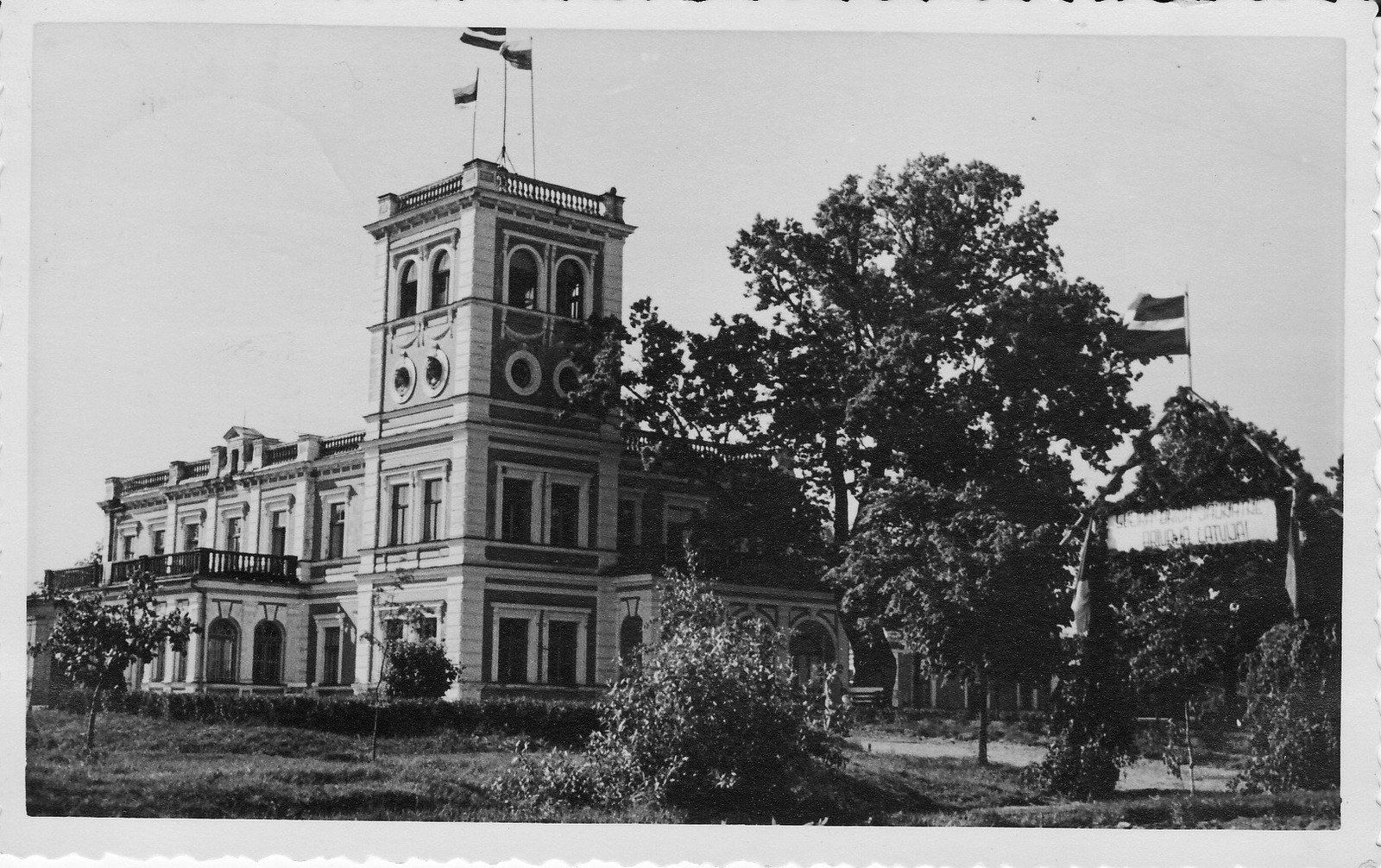
The Adventist Mission Seminary in Suzhi, Riga, Latvia, c. 1935.
Photo courtesy of Andris Pešelis.
Baltic Union Mission School, Suzhi, Latvia
By Andris Pešelis
Andris Pešelis, M.A., is a pastor in the Latvian Conference of the Seventh-day Adventist Church. He holds a B.A. in religion from Griggs University, an M.A. in geography from the University of Latvia, and an M.A. in leadership from Andrews University. He is the author of a book on the history of the Adventist Church in Latvia and many articles in the Latvian Conference publications.
First Published: August 1, 2024
The Baltic Union started this Adventist Mission School in 1923 with the purpose of providing a Christian education for those who attended, and equipping Bible workers for ministry. It was located in a manor at Suzhi (Suži) near the capital city of Riga, on the shores of a lake. The education embraced both intellectual knowledge and practical skills learnt on the farm, which was a part of the school. For some of the students, employment on the farm was the only way they could earn money to pay for their studies. The school opened with 3 teachers and 34 students, with the latter being drawn from Estonia, Latvia and Lithuania. L. H. Christian, the president of the European Division, V. M. Landin, the head of the Division Education Department, and D. N. Wall, the president of the Baltic Union, consecrated the school on January 10, 1925.
In 1930, the Adventist Mission School was renamed as the Advent Mission Seminary, but local Adventists shortened that to “Suzhi”, which meant: school, education, quality, and good company to them. To this day, this school is remembered by generations of Adventists as an example of excellence in spiritual education.
This fine institution educated many Bible workers, pastors and other missionaries from 1923 until 1940, who ministered in the Adventist Church within all three Baltic countries. In fact, the education they gained even had a positive impact on their pastoral ministry during the long years of subsequent exposure to Soviet ideology. This seminary also prepared four missionaries to work abroad: Amanda Nuka (Estonia) in Sierra Leone; Richard Vinglass (Estonia) in Bolivia; Wilhelm Purmalis (Latvia) in Ethiopia; and Andrejs Sprogis (Latvia) in Tanzania. It also prepared 26 pastors for Latvia, five for Estonia, and four for Lithuania. Three of its graduates – Ernests Klotinsh, Janis Oltinsh and Arvids Cholders – later became local conference leaders. Augusts Birzgals became the Bible teacher at Friedensau Seminary in Germany, and Pavel Macanov became a leader of the Seventh-day Adventist church in Moscow, USSR.
The School’s program included a complete set of secondary school (high school) subjects, but without the last or 11th class (gymnasium). The program offered Seventh-day Adventist theological education along with a set of the subjects that were taught in secular state schools. Additionally, it included practical education in agriculture, gardening, cattle husbandry and housekeeping. In 1938 the Latvian government restricted the attendance at the school to Adventist Church members or the children of Adventist families.
The school’s first principal was Leopold Oswald from the United States (1923-1929), who was followed by Karlis Roze (1929-1932) and 1934-1937). During Roze’s ministerial duties in the United States Roberts Kipurs (1932-1934) served as principal. Then for one year (1937-1938), Karlis Brutans was the principal, and he was followed by the last principal – Ernests Klotins (1939-1940).
According to the available documents there were approximately 500 students who attended during the 17 years of the school’s existence. It was, however, also a center of the local Conference life: a place for youth events, children’s summer camps, pastoral meetings and Adventist Song Festivals.
In the summer of 1940, the Soviet army annexed Latvia. The new Communist administration closed the Advent Mission Seminary, nationalized the school’s property, and handed it over to the Red Army for use as a military base. Since then the school has never been restored.
Sources
Čerņevskis, Edgars. Baltijas ūnijas misijas semināra vesture. Unpublished and undated manuscript.
Čerņevskis, Edgars. Adventes kustība Latvijā. Rīga: Patmos, 1998.
Pešelis Andris, Septītās dienas adventistu Latvijas draudžu vēsture. Rīga: Patmos, 2013.
Raģe, Valija. “Adventes misijas seminars Sužos.” Adventes Vēstis, no. 11 (2008, November): 14-16.
Raģe, Valija, Adventistu misijas seminārs. Unpublished and undated manuscript.