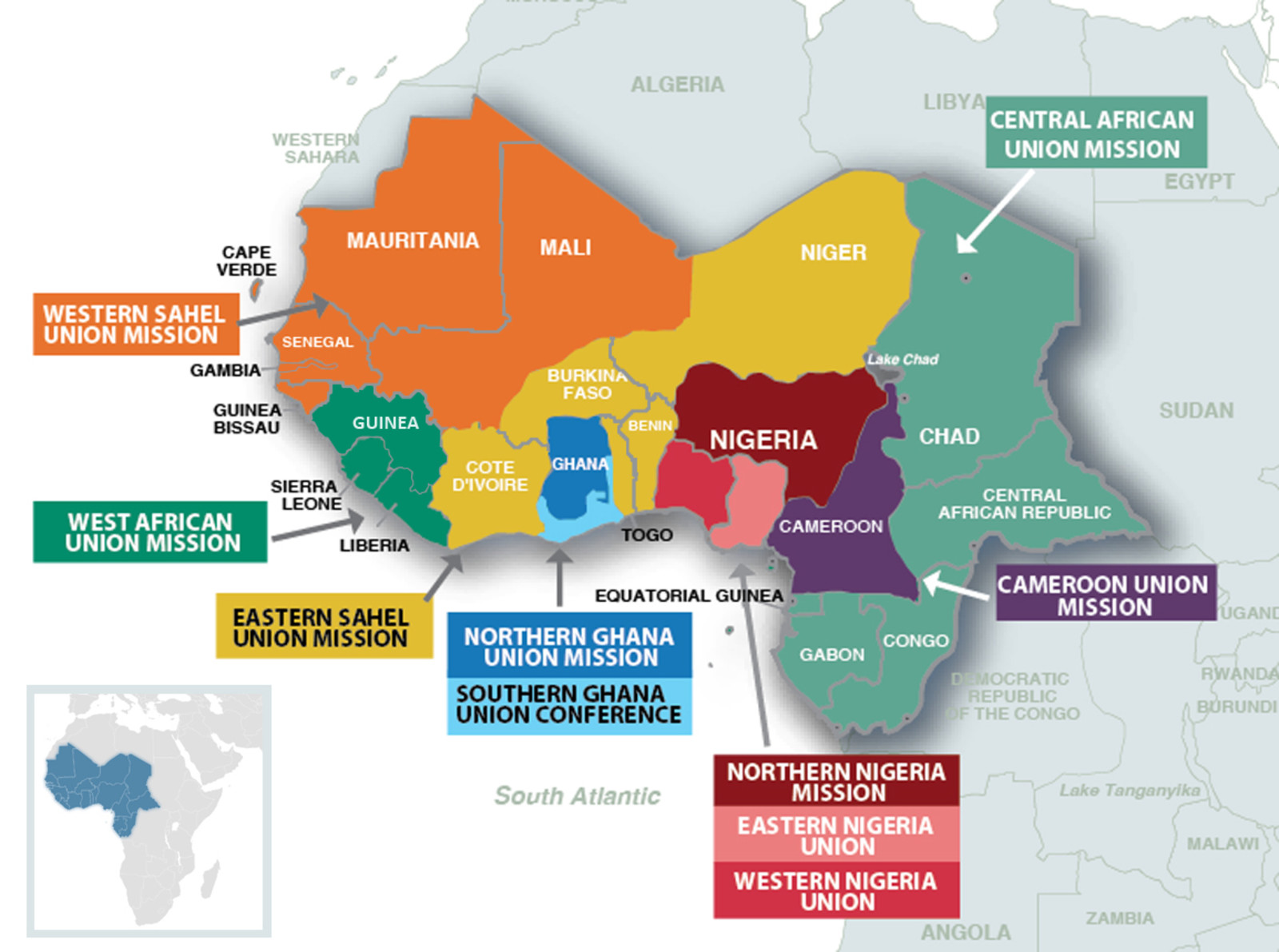
Map of the current territory of West-Central Africa Division (2015-present).
Photo courtesy of West-Central Africa Division archives.
Public Evangelism In West-Central Africa Division
By Ikechi Chidi Ekpendu
Ikechi Chidi Ekpendu (Ph.D.) is an ordained pastor, chaplain, theologian, and educator with over twenty-seven years of impactful ministry and academic leadership across Africa and the United Kingdom. He currently serves as Senior Pastor in the Sheffield District, UK, an Associate Professor of New Testament. Formerly a Union Evangelist and Head of Religious Studies at Babcock University, he is passionate about contextual theology and advocates small groups as a transformative tool for evangelism and discipleship.
First Published: May 14, 2026
Public evangelism, utilizing Christ’s Method of Ministry, has served as a primary approach for disseminating the Adventist message in the West-Central Africa Division.
Introduction
Evangelism has long been central to the mission and identity of the Seventh-day Adventist Church. Since its 19th-century origins, the Church has viewed itself as a missionary movement commissioned to proclaim the gospel and prepare the world for Christ’s return.1
This conviction is grounded in the Great Commission in Matthew 28:18–20 and has shaped Adventist outreach methods such as public preaching, Bible studies, health ministries, and community engagement. In Africa, evangelistic activities have been instrumental in the rapid expansion of Christianity during the 20th and 21st centuries. Adventism entered West Africa in the early 20th century through missionary initiatives led largely by European missionaries, who introduced Adventist doctrines and evangelistic strategies to indigenous populations. These early efforts laid the foundation for local Adventist communities and later developed into structured evangelistic programs coordinated by regional Church administrations.2
Public evangelism has become one of the most visible strategies used by the Church in Africa. Organized preaching campaigns, evangelistic series, and revival meetings are designed to communicate Adventist teachings and invite conversion and Church membership. Supported by pastors, evangelists, and lay members, these initiatives often produce large numbers of baptisms and have contributed significantly to Church growth across the continent.3
Within the West-Central Africa Division of Seventh-day Adventists, public evangelism remains a primary strategy for Mission expansion across several West African countries. The Division coordinates mass evangelistic campaigns, media outreach, and member participation in missionary work, reflecting the Adventist belief that evangelism is the “heartbeat” of the Church’s mission.4
However, despite notable growth, scholars and Church leaders increasingly question the sustainability of event-based evangelistic models. Public campaigns often prioritize immediate results such as baptisms, while long-term discipleship, member retention, and community transformation may receive less attention. Consequently, missiologists have called for a critical evaluation of current evangelistic paradigms to ensure their contextual relevance and biblical grounding.5
A widely proposed corrective framework within Adventist theology is “Christ’s method of ministry,” derived from the life and ministry of Jesus. As articulated by Ellen G. White, this model emphasizes relational engagement, compassion, and holistic ministry by mingling with people, meeting their needs, gaining their confidence, and then inviting them to follow Christ.6
Against this background, the study critically examines public evangelism in the Adventist Church within West-Central Africa. It explores the historical development, theological foundations, and practical approaches of Adventist evangelism in the region while assessing the strengths and limitations of current strategies. The study also identifies structural gaps and proposes integrating Christ’s relational model as a more holistic framework for sustainable and contextually relevant evangelism in the African church context.
Historical Development and Expansion of the Seventh-day Adventist Church in West-Central Africa
The development of the Seventh-day Adventist Church in West-Central Africa began primarily through literature evangelism and the efforts of early converts before the arrival of official missionaries. Printed Adventist materials introduced the Church’s teachings to the region, leading to some of the earliest conversions.7
One notable example was F. I. U. Dolphijn of the Gold Coast (present-day Ghana), who received Adventist literature from a visiting ship captain at Apam harbor. After studying the materials, he accepted their teachings and began observing the Sabbath in 1888, demonstrating the early impact of literature evangelism in establishing Adventism in Africa.8
Formal missionary activity began in 1893, when E. L. Sanford and K. G. Rudolph were sent as the first official Adventist missionaries to West Africa. Their mission was short-lived due to severe health challenges associated with the tropical climate. Nevertheless, their efforts marked the beginning of organized Adventist missionary work in the region.9
A second missionary team arrived in 1895 under the leadership of Dudley Upton Hale, accompanied by medical missionaries Mr. and Mrs. George T. Kerr and literature evangelist G. P. Riggs. They established a Mission station at Cape Coast Castle on land donated by a local supporter named Essien. Their activities included preaching, distributing literature, and building a mission base. However, tropical diseases such as dysentery and blackwater fever affected many missionaries, forcing some to withdraw. During this period, African believers such as Dolphijn and G. P. Grant played an important role in sustaining and spreading the Adventist message.10
Mission work was revived in 1903 when D. U. Hale returned with additional missionaries, including J. M. Hyatt and his wife, strengthening the Church’s presence despite ongoing health challenges. In 1905, D. C. Babcock expanded the Mission by establishing the headquarters in Freetown, Sierra Leone, from where Adventist activities spread through churches, schools, and literature evangelism.11
Administrative reorganization also shaped the Church’s growth. In 1929, West Africa was placed under the Northern-Europe Division (NED), which later became the Northern Europe–West Africa Division between 1971 and 1980.12
In 1980, further restructuring led to the creation of the Africa-Indian Ocean Division (AID), which supervised much of West and parts of Central Africa.13
Under the AID, Adventism expanded significantly. By 1981, the division had 1,789 churches and 320,924 members. This growth accelerated over the following decades, reaching 1,521,307 members in 5,311 churches by 2002.14
Due to this rapid expansion, the General Conference reorganized the Church’s administrative structure in Africa on October 8, 2002, after membership exceeded four million. Three new divisions were created effective January 1, 2003: the East-Central Africa Division (ECD), the Southern Africa–Indian Ocean Division (SID), and the Western Africa Division (WAD).15 In July 2003, the Western Africa Division was renamed the West-Central Africa Division (WAD) to reflect its territorial coverage.16
Today, the West-Central Africa Division, headquartered in Abidjan, Côte d’Ivoire, is one of the 13 global divisions of the Seventh-day Adventist Church. It coordinates Adventist activities across several countries in West and parts of Central Africa, including Nigeria, Ghana, Sierra Leone, and Cameroon, through a network of union conferences and union missions, supporting the continued expansion of the church in the region.17
Theological and Doctrinal Foundations of Adventist Evangelism
A central foundation of Adventist evangelism is the Great Commission in Matthew 28:19-20, which calls believers to make disciples of all nations. Adventist theology interprets this as a direct responsibility to proclaim the gospel globally before Christ’s return. As noted in Seventh-day Adventists Believe, mission and evangelism are integral to the Church’s identity, expressed through activities such as public campaigns, literature distribution, and community outreach.18
Adventist evangelism is also shaped by its eschatological perspective, particularly the interpretation of Revelation 14:6-12, known as the Three Angels’ Messages. These messages proclaim the everlasting gospel, call people to worship the Creator, warn against false systems of worship, and announce the nearness of divine judgment. This apocalyptic worldview, which scholars like George R. Knight describe as central to Adventist identity, creates a sense of urgency that motivates large-scale evangelistic efforts such as crusades, tent meetings, and stadium campaigns.19
Another key doctrinal element is the Church’s understanding of itself as a prophetic remnant movement, based on passages such as Revelation 12:17 and 14:12. This identity emphasizes the responsibility to proclaim God’s final message to the world. According to Angel Manuel Rodríguez, the remnant concept highlights the Church’s missionary responsibility rather than exclusivism.20
Adventist evangelism also reflects the principle of holistic mission, inspired by the ministry of Jesus, who combined preaching with acts of compassion and service. Adventist scholars such as Russell Burrill argue that effective evangelism should integrate proclamation with relational and community-centered ministry that addresses broader social needs.21
The writings of Ellen G. White have significantly influenced Adventist evangelistic theology and practice. She emphasized active missionary engagement, the participation of both clergy and laity, and the integration of preaching with practical service as part of preparing people for Christ’s return.22
Evaluation of Public Evangelistic Methods of the Seventh-day Adventist Church in Africa
Public evangelism has long been central to the missionary strategy of the Seventh-day Adventist Church. Since its early expansion in Africa, the Church has employed various organized evangelistic approaches carried out by pastors, evangelists, and lay members to proclaim its theological message and invite conversion and Church membership. In West-Central Africa, several methods have become particularly prominent, each contributing to church growth while also raising important missiological considerations.
One of the most visible approaches is mass evangelistic campaigns, often conducted in tents, open fields, or stadiums. These campaigns involve a series of sermons focusing on biblical teachings, prophecy, salvation, and distinctive Adventist doctrines, usually culminating in baptismal appeals. Historically, such campaigns have significantly contributed to the numerical expansion of the Church in Africa.23 Their appeal is strengthened by the African cultural openness to public religious gatherings and preaching, which fosters fellowship and unity among believers. However, while mass campaigns often produce large baptismal numbers, scholars note that they sometimes struggle to ensure sustained discipleship and long-term integration of converts into church life.24
Another important method is campmeetings, which originated from 19th-century Protestant revival movements and were adopted by early Adventists as opportunities for worship, teaching, and spiritual renewal.25 Ellen G. White described camp meetings as one of the most effective means of attracting public attention and presenting the gospel to diverse audiences.26
In West-Central Africa, these gatherings typically occur annually and bring together members from several congregations for preaching, prayer, and Bible study. While campmeetings can encourage conversion among attendees, they often serve primarily as spaces to strengthen existing members rather than as direct engagement with the broader community.
Health and holistic ministry also play a distinctive role in Adventist evangelism. Rooted in the belief that Christ’s ministry addressed both spiritual and physical needs, the Church integrates medical outreach, health education, and lifestyle promotion into its evangelistic work.27 In many African communities, free medical consultations, screenings, and wellness programs attract individuals who might not attend traditional religious meetings. By responding to practical needs, such initiatives build trust and demonstrate the gospel through compassionate service.28 Yet, the connection between health outreach and sustained discipleship is sometimes inconsistent.
Literature evangelism has historically supported Adventist missionary expansion through the distribution of books, magazines, pamphlets, and Bible study guides by literature evangelists or colporteurs.29 This approach allows individuals to encounter Adventist teachings privately and reflectively, especially in contexts where direct preaching opportunities are limited. However, the growing dominance of digital communication has reduced the influence of traditional print media, requiring adaptation to modern information consumption patterns.
More recently, media and digital evangelism have expanded the church’s outreach through radio, television, social media, and online platforms. These technologies enable the dissemination of sermons, Bible studies, and religious programs beyond the physical limits of traditional campaigns, particularly in urban settings where digital connectivity is widespread. They also provide opportunities to engage younger audiences familiar with online communication. Nevertheless, scholars emphasize that digital outreach must be complemented by personal relationships and community-based ministry to foster authentic discipleship and spiritual accountability.30
Structural Lacunae in the Evangelistic Paradigm
Although public evangelism has contributed significantly to the Adventist Church’s growth in Africa, several structural weaknesses limit its long-term sustainability. A major concern is the overreliance on event-centered evangelism, where short-term campaigns emphasize immediate baptism rather than sustained spiritual development. Such campaigns often conclude once baptisms occur, leaving local congregations with the responsibility of integrating new members without adequate preparation or support.
Closely related to this issue is the problem of weak post-baptismal discipleship and member retention. Without intentional mentoring, small-group structures, and follow-up programs, many converts struggle to remain actively engaged in church life.31 This challenge is compounded when local congregations lack the resources or capacity to nurture large numbers of new members.
Limited contextualization also represents a significant structural gap. In some cases, evangelistic methods still reflect imported Western missionary models that do not fully address African socio-cultural realities such as communal identity, poverty, traditional beliefs, and social justice concerns. An effective mission requires engaging these contextual realities to make the gospel message more transformative and relevant.32
Another weakness is the separation between evangelism and holistic mission. Public campaigns often prioritize doctrinal preaching while giving less attention to ministries of compassion such as healthcare, education, and social support. Yet authentic Christian mission integrates proclamation with practical service, following the example of Christ’s ministry.33
Institutional reliance on professional evangelists further limits lay participation in mission. When evangelistic work becomes concentrated among visiting speakers or specialists, grassroots evangelism by ordinary church members may decline, weakening the Church’s ongoing presence within local communities.
Finally, the short-term nature of many campaigns limits the development of meaningful relationships with communities. Sustainable mission increasingly requires long-term relational engagement, trust-building, and community partnership rather than brief event-based encounters.34
Christ’s Method of Ministry as a Corrective Missiological Paradigm
Christ’s ministry provides an important corrective to some limitations of contemporary evangelistic strategies that focus mainly on large events. The Gospels present Jesus, not only as a public preacher, but also as a teacher who intentionally invested in a care group of disciples. This approach shows that His evangelism was relational and discipleship-centered rather than purely event-driven. Consequently, His care group ministry, also known as a small group, offers a missiological model capable of strengthening evangelism, discipleship formation, and community integration within the Adventist Church in West Africa.
Jesus deliberately selected 12 disciples and formed them into a close community that lived and ministered with Him (Mark 3:13-15). In this setting, they received deeper instruction than the crowds, as He explained the meaning of His teachings to them privately (Mark 4:34). Through daily interaction, mentorship, and participation in ministry, Jesus shaped their character and prepared them for leadership. This model demonstrates that effective evangelism involves both proclamation and intentional discipleship, as seen in the later transformation of the disciples into leaders of the early church (Acts 2:14-41).
A central feature of Christ’s care group ministry was mentorship. Jesus actively involved His disciples in mission, sending them out to preach and heal while still under His guidance (Luke 9:1-6). Through shared experiences, such as travelling, eating together, and interacting with marginalized individuals (Luke 5:29-32; John 4:7-26), the disciples learned compassion, humility, and servant leadership. This relational approach highlights that evangelism aims not only at conversion, but also at developing disciples who can continue and multiply the mission of the Church.
Ellen G. White strongly affirmed Christ’s relational approach to ministry. She described Christ’s method as mingling with people, showing sympathy, meeting their needs, winning their confidence, and then inviting them to follow Him. She also encouraged the formation of care groups for prayer, Bible study, mutual support, and outreach.35 Such groups, she argued, nurture believers more effectively than large gatherings alone and extend the Church’s influence into the wider community through relational engagement and practical service.
Benefits of Care Groups in Convert Internalization
Personalized Spiritual Support: Converts often face doubts, questions, or spiritual challenges. In a care group, they receive one-on-one guidance, encouragement, and prayer support, which helps them internalize biblical truths.
Closer Relationship with God: Regular participation in Bible study, worship, and prayer within a group helps converts connect faith with daily life, turning abstract beliefs into personal experience.
Accountability and Discipleship: Being part of a care group encourages converts to practice what they learn, stay accountable in their spiritual walk, and grow in obedience to God’s Word.
Sense of Belonging and Community: Many new believers struggle with isolation after conversion. Care groups provide a supportive community, fostering friendships that reinforce faith and belonging.
Encouragement to Serve: In a small group, converts are often given opportunities to serve in practical ways, through teaching, hospitality, or outreach, which strengthens their commitment and helps them internalize the gospel.
Safe Space for Growth: Care groups offer a non-judgmental environment where converts can ask questions, share struggles, and explore their faith honestly, which promotes deep understanding and internalization.
Facilitates Spiritual Maturity: Over time, consistent involvement in small groups helps converts move from being passive believers to active disciples, integrating their faith into everyday decisions, relationships, and actions.
Practical Integration of Christ’s Model into the Adventist Evangelistic Framework In West-Central Africa
Christ’s ministry demonstrates that evangelism grows most effectively within relational communities where believers are mentored and spiritually nurtured. Ellen G. White similarly emphasized that believers should form small groups for prayer, Bible study, and missionary activity because such settings nurture spiritual growth and strengthen evangelistic outreach.36
Establishing a Care Group Vision within the Church Structure Organize Members into Small Care Groups
The following steps outline how care groups can be systematically integrated into the Adventist evangelistic framework in West-Central Africa.
The integration of care groups must begin with a clear theological and strategic vision within local congregations and church leadership. Church leaders should teach that evangelism is not limited to public campaigns but includes a relational discipleship modelled by Christ. By presenting the biblical foundation of small group ministry from the life of Jesus and the counsel of Ellen G. White, members can understand that care groups are an essential part of the Adventist mission rather than an optional program. This orientation encourages the whole church to view evangelism as a continuous relational process rather than a periodic event.
Following Christ’s model of discipline, small group congregations should organize members into care groups of manageable size, typically consisting of eight to 12 individuals. Each group should include both mature members and newer believers so that mentorship can occur naturally. These groups function as spiritual families where members pray together, study Scripture, and support one another’s spiritual development. Ellen G. White emphasized that small companies of believers working together for others can accomplish far more in missionary work than isolated individuals.37 In this way, care groups become the foundational unit for both discipleship and evangelism.
Training Care Group Leaders as Spiritual Mentors
For care groups to function effectively, leaders must be intentionally trained as mentors rather than merely facilitators of meetings. Christ personally guided and instructed His disciples, explaining His teachings and modelling ministry through daily interaction (Mark 4:34; Luke 9:1-6). Similarly, care group leaders should be equipped to guide Bible discussions, provide spiritual counselling, and encourage members in their faith journey. Training should also emphasize relational ministry, compassionate listening, and community engagement so that leaders reflect Christ’s approach of mingling with people and meeting their needs.
Connecting Care Groups with Public Evangelistic Campaigns
Care groups should also function as preparatory and follow-up structures for public evangelistic meetings. Before evangelistic campaigns, care group members can build relationships within their communities and invite individuals to attend the meetings. Because trust and friendship have already been established, these invitations are often more effective than general announcements. After the campaign, newly baptized members can immediately join care groups where they receive mentorship, spiritual guidance, and fellowship. This connection ensures that evangelistic campaigns lead to long-term discipleship rather than temporary enthusiasm.
Providing Ongoing Discipleship and Spiritual Accountability
Care groups play a vital role in sustaining the spiritual growth of converts and existing members. Within these groups, individuals participate in regular Bible study, prayer, and mutual encouragement. This environment allows members to discuss personal struggles, ask theological questions, and receive support from fellow believers. Such relational accountability helps converts internalize biblical teachings and develop a consistent spiritual life. Over time, this process transforms new believers into mature disciples capable of contributing to the Church’s mission.
Encouraging Multiplication of Care Groups
The final step involves the multiplication of care groups as the Church grows. Just as Christ trained His disciples to continue His mission, mature members within care groups should eventually lead new groups. This multiplication expands the Church’s relational network and ensures that evangelism remains active within local communities. Through this process, evangelism becomes a continuous cycle of discipleship, mentorship, and outreach rather than an occasional campaign.
Conclusion
Integrating care groups into the Adventist evangelistic framework in West-Central Africa represents a practical application of Christ’s method of ministry. By organizing believers into
relational communities for mentorship, service, and outreach, the church can strengthen discipleship and improve the long-term effectiveness of evangelistic efforts. This approach aligns with the biblical model demonstrated by Christ and affirmed in the writings of Ellen G. White, emphasizing that sustainable mission is built on relationships, compassion, and intentional discipleship.
Sources
Ajibade, Onaolapo. “West-Central Africa Division.” Encyclopedia of Seventh-day Adventists, December 25, 2020. https://encyclopedia.adventist.org/article?id=8CAV.
Bosch, David J. Transforming Mission: Paradigm Shifts in Theology of Mission. 20th anniversary ed. Maryknoll, NY: Orbis Books, 2011.
Burrill, Russell. Radical Disciples for Revolutionary Churches. Hart Research Centre, 2004.
Ogugbuaja, Ephraim M., Omijeh, E. and Adewuyi, S., Factors Militating Against the Spread of Adventism in Onitsha. International Journal of Psychological Science 5, no. 2 (2025): 34–42.
Eregare, E. O. “Seventh-day Adventist Missionary Enterprise in Africa (1914–1940): A Nigerian Narrative.” Journal of Asia Adventist Seminary 21, no. 1–2 (2018): 1–18.
Fisher, Barbara. “Before and Beyond Baptism: Study Finds Challenges in Nurturing Baptized Adventists.” Adventist Review, August 12, 2015. https://adventistreview.org/news/study-finds-challenges-in-nurturing-baptized-adventists/.
General Conference of Seventh-day Adventists Executive Committee. Minutes of the 2003 Annual Council: Action GCC 03-89, October 10, 2003. https://documents.adventistarchives.org/Minutes/GCC/GCC2003-10AC.pdf (Accessed March 10, 2026).
Knight, George R. A Search for Identity: The Development of Seventh-day Adventist Beliefs. Hagerstown, MD: Review and Herald, 2000.
Masfa, Godfrey. “Indigenous Leadership in the Seventh-day Adventist Church in the West-Central Africa Division.” Encyclopedia of Seventh-day Adventists, 2021. https://encyclopedia.adventist.org/article?id=7H2U.
Olsen, M. Ellsworth. A History of the Origin and Progress of Seventh-day Adventists. Washington, D.C.: Review and Herald Publishing Association, 1926.
Peprah, W. K., R. Kesis, W.S. Simatele, A. E. Nwaomah, D. Dei, and D. Razafiarivony. Evangelism Strategies, Conversion Patterns, and Membership Retention Strategies in the Seventh-day Adventist Church in Sub-Saharan Africa (Nairobi: Jasiri AdBranding, 2024).
Rodríguez, Ángel M. Message, Mission, and Unity of the Church. Silver Spring, MD: Biblical Research Institute, 2009.
Schwarz, Roland W., and Floyd Greenleaf. Light Bearers: A History of the Seventh-day Adventist Church. Rev. ed. Nampa, ID: Pacific Press, 2000.
Seventh-day Adventists Believe: An Exposition of the Fundamental Beliefs of the Seventh-day Adventist Church. 2nd ed. Nampa, ID: Pacific Press, 2018.
Seventh-day Adventist Yearbook. Various years. https://www.adventistyearbook.org/.
Stetzer, Ed, and Daniel Putman. Breaking the Missional Code: Your Church Can Become a Missionary in Your Community. Nashville: Broadman & Holman, 2006.
Trim, David J. B. A Living Witness: The History of the Seventh-day Adventist Church. Nampa, ID: Pacific Press, 2018.
White, Ellen G. Evangelism. Washington, D.C.: Review and Herald Publishing Association, 1946.
White, Ellen G. Testimonies for the Church. Vol. 6. Mountain View, CA: Pacific Press Publishing Association, 1901.
White, Ellen G. Testimonies for the Church. Vol. 7. Mountain View, CA: Pacific Press Publishing Association, 1902.
Notes
-
David J. Bosch, Transforming Mission: Paradigm Shifts in Theology of Mission, 20th anniversary ed. (Orbis Books, 2011), 220.↩
-
E. O. Eregare, “Seventh-day Adventist Missionary Enterprise in Africa (1914-1940): A Nigerian Narrative,” Journal of Asia Adventist Seminary 21, no. 1-2 (2018): 1-18.↩
-
W. K. Peprah, R. Kesis, W. S. Simatele, A. E. Nwaomah, D. Dei, and D. Razafiarivony, Evangelism Strategies, Conversion Patterns, and Membership Retention Strategies in the Seventh-day Adventist Church in Sub-Saharan Africa (Nairobi: Jasiri AdBranding, 2024)↩
-
Peprah, Kesis, Simatele, Nwaomah, Dei, and Razafiarivony, Evangelism Strategies, 45.↩
-
Bosch, Transforming Mission, 277.↩
-
Ellen G. White, The Ministry of Healing, 67.↩
-
Godfrey Masfa, “Indigenous Leadership in the Seventh-day Adventist Church in the West-Central Africa Division,” Encyclopedia of Seventh-day Adventists, 2021, https://encyclopedia.adventist.org/article?id=7H2U.m.↩
-
Ellsworth Olsen, A History of the Origin and Progress of Seventh Day Adventists (Washington, D.C.: Review and Herald Publishing Association, 1926), 45.↩
-
Masfa, Indigenous Leadership in the Seventh-day Adventist Church in the West-Central Africa Division, 57.↩
-
Olsen, A History of the Origin and Progress of Seventh-Day Adventists, 65.↩
-
Ibid., 67.↩
-
Onaolapo Ajibade, “West-Central Africa Division,” Encyclopedia of Seventh-day Adventists, December 25, 2020, https://encyclopedia.adventist.org/article?id=8CAV.↩
-
David J. B. Trim, A Living Witness: The History of the Seventh-day Adventist Church (Nampa, Idaho: Pacific Press, 2018).↩
-
Seventh-day Adventist Yearbook (2002), https://www.adventistyearbook.org/2002.pdf.↩
-
Ibid.↩
-
General Conference of Seventh-day Adventists Executive Committee, Minutes of the 2003 Annual Council: Action GCC 03-89, October 10, 2003, https://documents.adventistarchives.org/Minutes/GCC/GCC2003-10AC.pdf. Accessed March 10, 2026.↩
-
Ajibade, “West-Central Africa Division.”↩
-
General Conference of Seventh-day Adventists, Seventh-day Adventists Believe: An Exposition of the Fundamental Beliefs of the Seventh-day Adventist Church, 2nd ed. (Nampa, ID: Pacific Press, 2018), 66.↩
-
George R. Knight, A Search for Identity: The Development of Seventh-day Adventist Beliefs, (Hagerstown, MD: Review and Herald, 2000), 45.↩
-
Ángel M. Rodríguez, Message, Mission, and Unity of the Church, (Silver Spring, MD: Biblical Research Institute, 2009), 34.↩
-
Richard Burrill, Radical Disciples for Revolutionary Churches (Hart Research Centre, 2004), 78.↩
-
Ellen G. White, Evangelism (Washington, D.C.: Review and Herald Publishing Association, 1946), 54.↩
-
Schwarz and Greenleaf, Light Bearers: A History of the Seventh-day Adventist Church, 87.↩
-
Bosch, Transforming Mission, 380.↩
-
Schwarz and Greenleaf, Light Bearers: A History of the Seventh-day Adventist Church, 99.↩
-
Ellen G. White, Testimonies for the Church, vol. 6 (Pacific Press Publishing Association, 1901), 31.↩
-
Ellen G. White, The Ministry of Healing, 88.↩
-
Bosch, Transforming Mission, 399.↩
-
Schwarz and Greenleaf, Light Bearers: A History of the Seventh-day Adventist Church, 55.↩
-
Bosch, Transforming Mission, 380.↩
-
Barbara Fisher, “Before and Beyond Baptism: Study Finds Challenges in Nurturing Baptized Adventists,” Adventist Review, August 12, 2015. https://adventistreview.org/news/study-finds-challenges-in-nurturing-baptized-adventists/.↩
-
Ephraim M. Ogugbuaja, E. Omijeh, and S. Adewuyi, “Factors Militating Against the Spread of Adventism in Onitsha,” International Journal of Psychological Science 5, no. 2 (2025): 34-42.↩
-
Ellen G. White, Evangelism, 199.↩
-
Ed Stetzer and Daniel Putman, Breaking the Missional Code: Your Church Can Become a Missionary in Your Community, (Broadman & Holman, 2006).↩
-
Ellen G. White, Testimonies for the Church, vol. 7 (Pacific Press Publishing Association, 1902), 24.↩
-
Ibid., 23; Ellen G. White, Evangelism, 192.↩
-
Ellen G. White, Testimonies for the Church, vol. 7, 24.↩