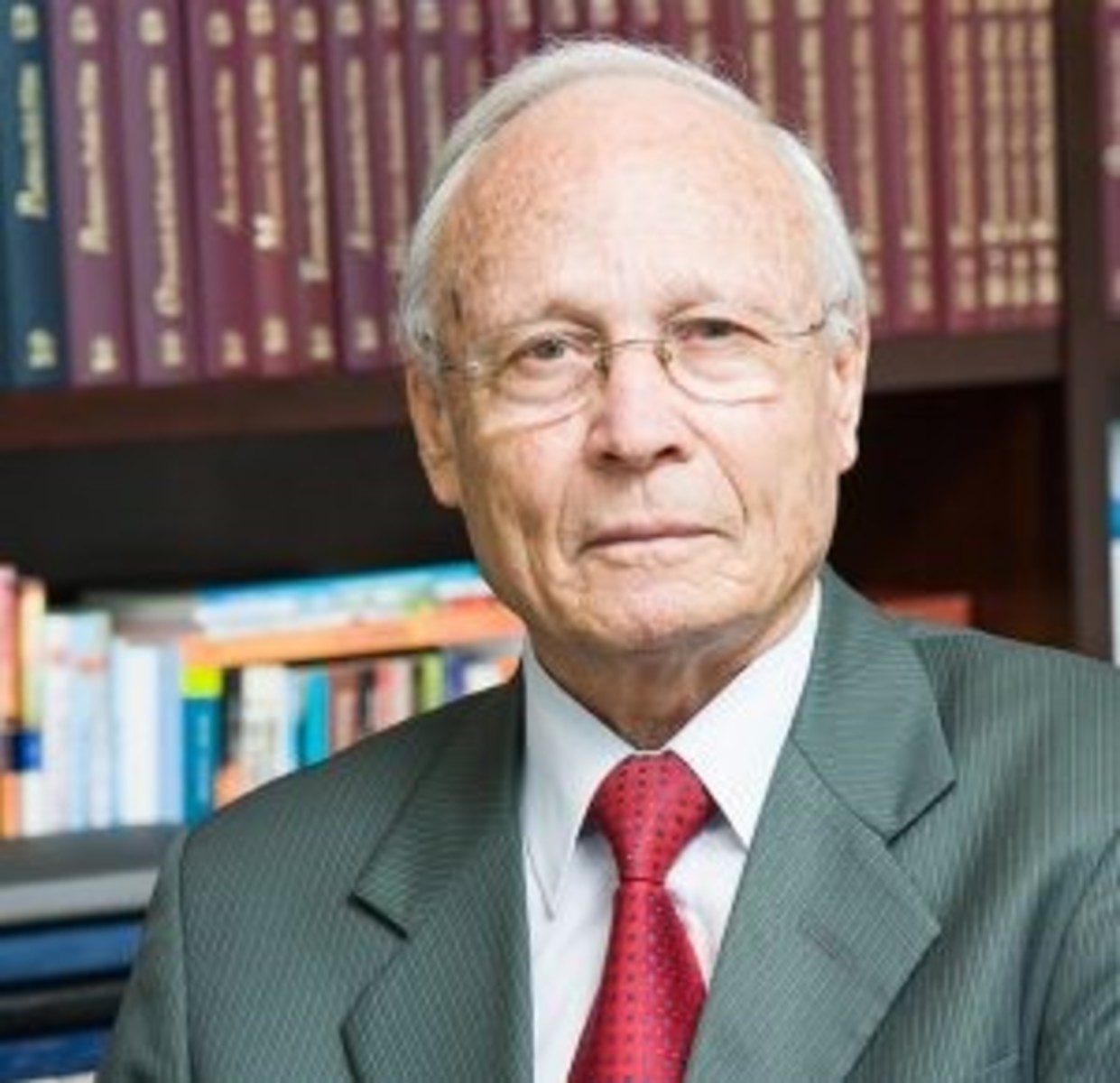
Rubens Lessa
Photo courtesy of Brazilian White Center - UNASP.
Lessa, Rubens da Silva (1937– 2019)
By The Brazilian White Center – UNASP
The Brazilian White Center – UNASP is a team of teachers and students at the Brazilian Ellen G. White Research Center – UNASP at the Brazilian Adventist University, Campus Engenheiro, Coelho, SP. The team was supervised by Drs. Adolfo Semo Suárez, Renato Stencel, and Carlos Flávio Teixeira. Bruno Sales Gomes Ferreira provided technical support. The following names are of team members: Adriane Ferrari Silva, Álan Gracioto Alexandre, Allen Jair Urcia Santa Cruz, Camila Chede Amaral Lucena, Camilla Rodrigues Seixas, Daniel Fernandes Teodoro, Danillo Alfredo Rios Junior, Danilo Fauster de Souza, Débora Arana Mayer, Elvis Eli Martins Filho, Felipe Cardoso do Nascimento, Fernanda Nascimento Oliveira, Gabriel Pilon Galvani, Giovana de Castro Vaz, Guilherme Cardoso Ricardo Martins, Gustavo Costa Vieira Novaes, Ingrid Sthéfane Santos Andrade, Isabela Pimenta Gravina, Ivo Ribeiro de Carvalho, Jhoseyr Davison Voos dos Santos, João Lucas Moraes Pereira, Kalline Meira Rocha Santos, Larissa Menegazzo Nunes, Letícia Miola Figueiredo, Luan Alves Cota Mól, Lucas Almeida dos Santos, Lucas Arteaga Aquino, Lucas Dias de Melo, Matheus Brabo Peres, Mayla Magaieski Graepp, Milena Guimarães Silva, Natália Padilha Corrêa, Rafaela Lima Gouvêa, Rogel Maio Nogueira Tavares Filho, Ryan Matheus do Ouro Medeiros, Samara Souza Santos, Sergio Henrique Micael Santos, Suelen Alves de Almeida, Talita Paim Veloso de Castro, Thais Cristina Benedetti, Thaís Caroline de Almeida Lima, Vanessa Stehling Belgd, Victor Alves Pereira, Vinicios Fernandes Alencar, Vinícius Pereira Nascimento, Vitória Regina Boita da Silva, William Edward Timm, Julio Cesar Ribeiro, Ellen Deó Bortolotte, Maria Júlia dos Santos Galvani, Giovana Souto Pereira, Victor Hugo Vaz Storch, and Dinely Luana Pereira.
First Published: June 25, 2021
Rubens da Silva Lessa was a missionary, pastor, journalist, writer, and editor-in-chief of the Brazil Publishing House.
First Years
Rubens da Silva Lessa was born on May 24, 1937,1 in the city of Anápolis, Goiás, Brazil, of José da Silva Lessa and Elvira Porto Lima. His parents were baptized and joined the Adventist faith in 1938, influenced by two books from the Brazil Publishing House sold by the canvassers José Toledo and Alceu Cândido Damas. Those books were entitled Doze Grandes Sinais da Volta de Cristo (Twelve Great Signs of Christ’s Return) and A Esperança do Mundo (The World’s Hope).2 At the time, Rubens was still a baby (about 10 or 11 months old), so he and his four siblings (Wilson, Marianita, Paulo and Juanita) were raised by Adventist principles.3
In 1939, one of the pioneer canvassers in Goiás, Longino Niz, invited Rubens’ father to enter the canvassing work. José sold literature and carried the Adventist message wherever he went, working in 111 cities throughout Goiás and Minas Gerais. Later he worked as the publishing director at the Central-Amazonas Mission and the Lower Amazon Mission and was district pastor in the state of Pará being ordained in 1963. He served the SDA church for almost 50 years, until November 1986.4 Rubens' childhood was marked by his father’s example and by much moving, due to his father's occupation.5
On October 23, 1953, at the age of 16, Rubens was baptized in the city of Uberaba, Minas Gerais, where the family was living at the time because of a canvassing campaign. He received Bible studies from pastor Lourival Ferreira, who also baptized him in the Uberaba River.6 In 1954, his father enrolled him at Brazil College (today Central Adventist University of Sao Paulo), where he attended the fifth grade in middle school while living at an uncle’s house.7 Later, however, he moved to Uberlândia where he graduated from middle school.8 The places where he studied in Uberaba and Uberlândia had much religious prejudice and refused to reschedule exam dates that fell on Saturdays. Faithful to his beliefs, Rubens didn’t take the tests on the Sabbath and, as a result, he lost a few years of study.9
At the end of 1959, he went to Northeast Brazil Junior College (today Educandário Adventista Nordestino - ENA) in Pernambuco, where he studied from 1960 to 1964, completing high school and two years of theology. In 1965, he returned to Brazil College, where he finished the third and fourth years of theology.10 In order to get resources for his studies, Rubens canvassed during 18 vacations through the cities of Manaus, Belém, Recife, João Pessoa, Campina Grande, Salvador, Feira de Santana, Ilhéus, Caxias do Sul, and others.11 In 1966, he met a young lady named Charlotte, who years later would become his wife. In August 1966, they started dating and, in October 1967, they were engaged. Then, on December 10, 1967, he received his undergraduate degree.12
Rubens and Charlotte were married on January 10, 1969, at the registry office and on the 12th in the Tucuruvi Church located in São Paulo City.13 From their union, three daughters were born: Cláudia, Márcia and Kathia. Charlotte Fermum was born in Bremen, Germany, on March 25, 1949. Her parents left Europe and moved to Brazil when she was three years old because they wanted to live in a more peaceful country. In 1956 at the age of 17, she became a student at Brazil College and some years later was baptized on November 19, 1965. There she completed the last two years of the secondary school and later, when she was already married, she studied pedagogy while living in Amapá and Belém, state of Pará. Also, she directed the program De Mulher para Mulher (From Woman to Woman) for two years at Rádio Notícias (News Radio) in Tatuí, state of São Paulo.14
Ministry
After finishing the theology course, Lessa received three invitations: one to serve as a missionary in Pará, another to be a pastor at the Arruda Church in Recife, and third, to work at the Brazil Publishing House.15 Lessa chose to enter ministerial service on January 6, 1968, as pastor of the Marambaia Church District in Belém, state of Pará. Since his youth, Lessa was an avid reader and while a boarding student he was involved in publishing newspapers for the colleges. In 1968, he had a column in the newspaper A Folha do Norte [The Northern Magazine] (now O Liberal [The Liberal]). His first articles talked about the work of Léo Halliwell with the local riparian, then little by little he began introducing religious subjects.
Seeing his talent for writing, the Brazil Publishing House also wanted Lessa to work with them as editor, since he already had some experience as a newspaper editor in the schools where he studied.16 However, because of the admiration he had for the work carried out by the Halliwells and other missionaries in the northern region of Brazil, he decided to work in Belém, Pará. There he made many trips by boat, bicycle, or seaplane to preach among the isolated people. Having also some musical talent, he led a choir Vozes da Amazônia, (Voices from the Amazon) composed of employees of the Adventist Hospital of Belém and members of churches in the region.17
Afterward, in 1969 and 1970, he was pastor of the Macapá Adventist Church, state of Amapá,18 where he built a school and held a series of public evangelistic meetings.19 In 1970, a series of meetings held together with Pastor Valdomiro Reis resulted in 68 baptisms.20 While working in that state, Lessa wrote for the newspaper O Novo Amapá (The New Amapá). Together with his wife, he also conducted, a local radio program called Rádio Novo Amapá (Radio New Amapá) for two years.21
In early 1971, he was called to return to Belém where he worked for two years at the Lower Amazon Mission in several departments: youth, education, stewardship, temperance, public relations, and religious freedom.22 That same year, a youth congress was held at the Amazonas Theater in the city of Manaus. Pastor Lessa was assigned to organize the program. He had as a mentor Pastor Homero dos Reis, Youth Director of the North Brazilian Union.23
In 1971 and 1972, while leading the Temperance Department, he developed a project of seminars with assistance for drug addicts in Belém. He gave speeches at government schools and had the opportunity to help young people who were involved with drugs.24 Lessa was ordained on July 22, 1972, during a youth congress held at the Amazonas Theater in the city of Manaus, Amazonas State. He had the pleasure of having his father present at the ceremony.25 After five years as a pastor and department director in Northern Brazil, he was called to work at the Brazil Publishing House.26
Rubens Lessa began his editorial work on January 6, 1973, in Santo André, São Paulo. His first responsibilities were to prepare news for the Revista Adventista (Adventist Review), translate the World Missions Newsletter, and carry out production demands for Nosso Amiguinho (Our Little Friend).27 From 1974 to 1976, he studied journalism at Cásper Líbero College in São Paulo.28 This helped make his writing clearer and more objective.29 Interestingly, in August 1956, sixteen years before being hired by the Brazil Publishing House, he had published his first article in the Revista Adventista, reporting a canvassing course in Uberlândia, Minas Gerais.30
When Rubens started working at the Brazil Publishing House, Pastor Bernardo Schünemann was the director and Lessa began his work on a team with six other editors: Arnaldo B. Christianini, Carlos Trezza, Naor Conrado, Otto S. Joas, Ivo Santos Cardoso, and Azenilto Britto.31 In January 1978, Lessa was appointed as editor-in-chief, a position he held for 36 years. In this office, he witnessed historical moments of the Brazil Publishing House such as the change of location from Santo André to Tatuí, financial instability because high inflation in the 1980s, the professionalization of human resources in the 1990s, and the modernization and expansion of the graphic department in the 2000s .32
In 1982, after nine years of work at the Brazil Publishing House, pastor Lessa received a scholarship to study at Newbold College in England. He stayed there for two years and three months, studying English and starting work on a master's of divinity degree. In 1983, he had the opportunity to visit Israel, giving him an interesting experience to better perform his work. Later, in 1985, he completed the master's of divinity degree at Andrews University, Michigan, United States.33
In 1995, Rubens Lessa served as president of the Brazilian Hinário Adventista committee (Seventh-day Adventist Hymnal), pre-launched on November 27 of the same year, at Central Adventist University of Sao Paul – Engenheiro Coelho Campus.34 When he was 77 years of age, Lessa decided to retire after serving the SDA Church for 46 years, of which 41 years were dedicated to the Brazilian Publishing House. With great respect, he was honored by the Church for his work and legacy,35 retiring in May, 2014.36 A year later, a commemoration of Central Brazil Academy’s (IABC) thirtieth anniversary was held in Planalmira, Goiás State with a lot of praise music, baptisms, friends reunions, and honors. Among the honors, on October 31, 2015, a new and modern library was dedicated at IABC with 12,500 volumes. The library was named Biblioteca Pastor Rubens Lessa37 in recognition of the work done by Pastor Lessa.
Throughout his life, Lessa wrote lots of articles and books for Revista Adventista; among them were Diagnóstico e Remédio (Diagnosis and Medicine; 1982), Livre para Viver (Free to Live; 1990), Alimento para o coração (Food for the Heart; 2007), Ele é a Saída, (He is the Way Out), and the famous daily devotional of the year 2000, A Esperança do Terceiro Milênio (The Third Millennium Hope; 2000).38 Despite being reserved, he agreed to receive the Sesquicentenary Medal of the 1842 Sorocabana Revolution in recognition for his work; he also received the title of Tatuí Citizen.39
Last Years
After his retirement, he edited and translated the book Uma Semente de Esperança (A seed of hope: history of the denominational structure) from Spanish into Portuguese and English. The book was published in 2015 and presented by Roberto Gullón Canedo as a commemoration for 100 years of operations of the South American Division. In 2016, he wrote Construtores de Esperança (Builders of Hope) with the purpose of celebrating the 80th Anniversary of North Brazil Union Mission. About 2000 copies were printed and donated to the leadership of the South American and other divisions. In 2017, he edited an annotated version of the New International Version of the Bible, with more than 4000 pages.40
In addition, although being 81 years of age, he was elder of the Inocoop Church in Tatuí, made many travels in order to preach in other churches, gave Bible studies, held baptisms, read many books, and memorized parts of the Bible and Ellen White writings.41 Rubens Lessa died of a heart attack in Tatuí, São Paulo on January 12, 2019, at the age of 81. The funeral ceremony took place in the auditorium of the Brazil Publishing House. He left his wife, Charlotte Fermum Lessa, to whom he was married for 50 years, three daughters, and two grandchildren.42
Contribution
Rubens da Silva Lessa left an important legacy of 46 years of service to the Seventh-day Adventist Church as a district pastor and department director in the North Brazil Region and as editor at the Brazil Publishing House where he contributed for more than 41 years of service. He was known for being very dedicated and hardworking, as well as very patient and efficient. His ministry was fruitful and very helpful for the growth of the publishing house.43
Sources
“30 anos do ABC.” Revista Adventista, December 2015.
“Elvira Porto Lessa.” Revista Adventista, February 2013.
“José da Silva Lessa.” Revista Adventista, November 1987.
“Mestre das letras.” Revista Adventista, July 2014.
de Benedicto, Marcos. “Texto Final.” Revista Adventista, February 2019.
dos Santos, Fábio. “Biografia do Pastor Rubens da Silva Lessa.” Monografia do Instituto Adventista de Ensino, 1997.
Eneas, Jael. "Hinário Adventista Completa 100 anos.” Revista Adventista, December 2014.
Köhler, Erton. "Boas notícias.” Revista Adventista, June 2014.
Lessa, Rubens. "Rios e regatos.” Revista Adventista, May 2014.
Tonetti, Márcio. “Nota de Falecimento.” Revista Adventista (Online), Februay 13, 2019.
Notes
-
Rubens Lessa, interviewed by Vanessa Stehling, Engenheiro Coelho, São Paulo, November 29, 2018.↩
-
Fábio dos Santos, “Biografia do Pastor Rubens da Silva Lessa” (Monography, Instituto Adventista de Ensino, 1997), 3; R. Lessa, interview; “José da Silva Lessa,” Revista Adventista, November 1987, 27.↩
-
“J. Lessa,” Revista Adventista, 27.↩
-
Ibid.; Rubens Lessa, interviewed by Vanessa Stehling, Engenheiro Coelho, São Paulo, November 29, 2018; Santos, 15.↩
-
Santos, 3; Rubens Lessa, interviewed by Vanessa Stehling, Engenheiro Coelho, São Paulo, November 29, 2018.↩
-
Rubens Lessa, interviewed by Vanessa Stehling, Engenheiro Coelho, São Paulo, November 29, 2018.↩
-
Ibid.↩
-
Ibid.↩
-
Santos, 11.↩
-
Rubens Lessa, interviewed by Vanessa Stehling, Engenheiro Coelho, São Paulo, November 29, 2018.↩
-
Ibid., 10.↩
-
Santos, 8.↩
-
Ibid., 5.↩
-
Ibid., 6, 7; Márcio, Tonetti, “Nota de Falecimento,” Revista Adventista, February 13, 2019.↩
-
Santos, 5, 12; Rubens Lessa, interviewed by Vanessa Stehling, Engenheiro Coelho, São Paulo, November 29, 2018.↩
-
Santos, 5, 12; Rubens Lessa, interviewed by Vanessa Stehling, Engenheiro Coelho, São Paulo, November 29, 2018.↩
-
Santos, 13; Rubens Lessa, interviewed by Vanessa Stehling, Engenheiro Coelho, São Paulo, November 29, 2018.↩
-
Ibid., 14.↩
-
Ibid., 15.↩
-
Ibid., 16.↩
-
Rubens Lessa, interviewed by Vanessa Stehling, Engenheiro Coelho, São Paulo, November 29, 2018.↩
-
Rubens Lessa, interviewed by Vanessa Stehling, Engenheiro Coelho, São Paulo, November 29, 2018; Santos, 15.↩
-
Ibid., 16.↩
-
Ibid., 16.↩
-
Ibid., 15.↩
-
Ibid., 18; Rubens Lessa, interviewed by Vanessa Stehling, Engenheiro Coelho, São Paulo, November 29, 2018.↩
-
Santos, 18.↩
-
Ibid., 18; Rubens Lessa, interviewed by Vanessa Stehling, Engenheiro Coelho, São Paulo, November 29, 2018.↩
-
Santos, 18.↩
-
“Mestre das letras,” Revista Adventista, July 2014, 6.↩
-
Rubens Lessa, "Rios e regatos,” Revista Adventista, May 2014, 2.↩
-
“Mestre das letras,” Revista Adventista, 6.↩
-
Santos, 10.↩
-
Eneas, Jael, “Hinário Adventista Completa 100 anos,” Revista Adventista, December 2014, 18.↩
-
Erton Köhler, “Boas notícias,” Revista Adventista, June 2014, 4.↩
-
R. Lessa, interview.↩
-
“30 anos do ABC,” Revista Adventista, December 2015, 11.↩
-
Marcos de Benedicto, “Texto Final,” Revista Adventista, February 2019, 14.↩
-
“Mestre das letras,” Revista Adventista, 7.↩
-
Rubens Lessa, interviewed by Vanessa Stehling, Engenheiro Coelho, São Paulo, November 29, 2018.↩
-
Rubens Lessa, interviewed by Vanessa Stehling, Engenheiro Coelho, São Paulo, November 29, 2018.↩
-
Márcio Tonetti, “Nota de Falecimento,” Revista Adventista, February 13, 2019.↩
-
“Mestre das letras,” Revista Adventista, 6; Tonetti.↩