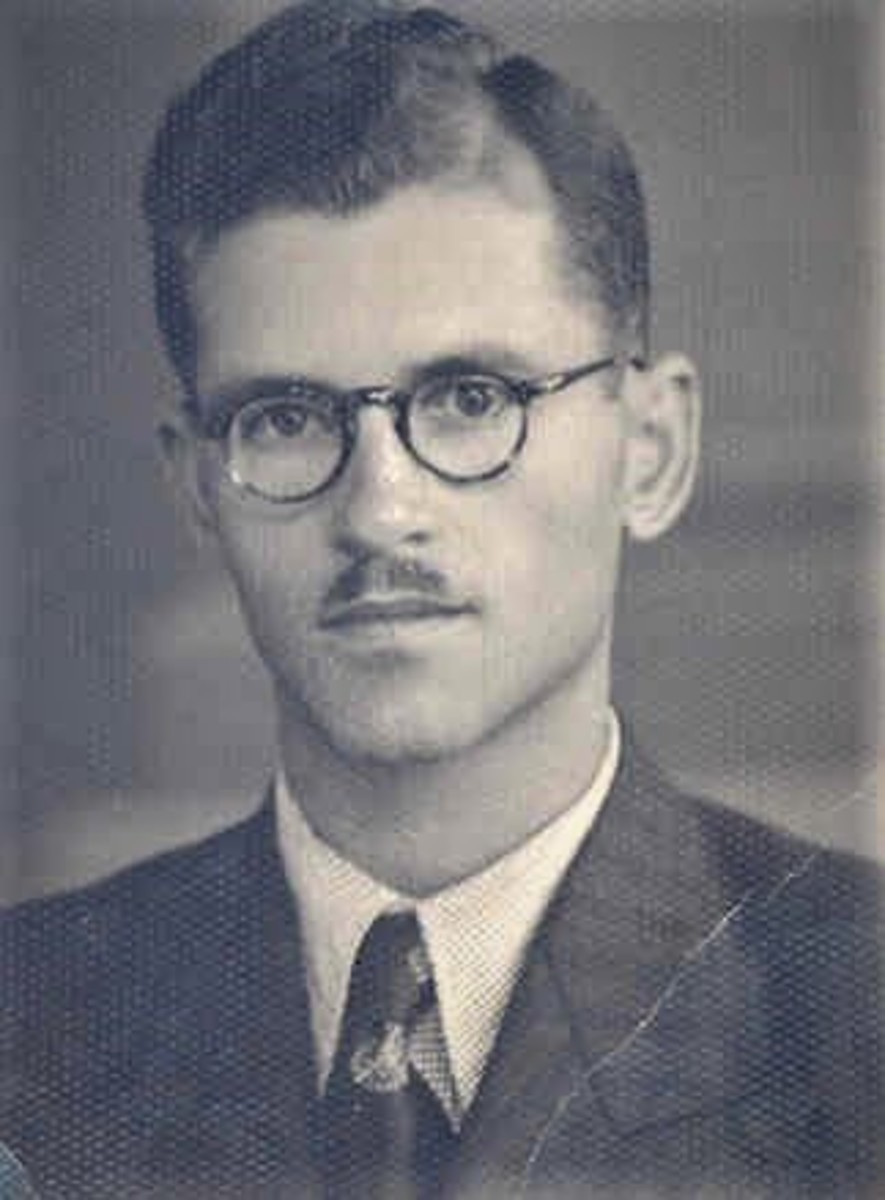
Durval Stockler de Lima
Photo courtesy of Brazilian White Center - UNASP.
Lima, Durval Stockler de (1909–1993)
By The Brazilian White Center – UNASP
The Brazilian White Center – UNASP is a team of teachers and students at the Brazilian Ellen G. White Research Center – UNASP at the Brazilian Adventist University, Campus Engenheiro, Coelho, SP. The team was supervised by Drs. Adolfo Semo Suárez, Renato Stencel, and Carlos Flávio Teixeira. Bruno Sales Gomes Ferreira provided technical support. The following names are of team members: Adriane Ferrari Silva, Álan Gracioto Alexandre, Allen Jair Urcia Santa Cruz, Camila Chede Amaral Lucena, Camilla Rodrigues Seixas, Daniel Fernandes Teodoro, Danillo Alfredo Rios Junior, Danilo Fauster de Souza, Débora Arana Mayer, Elvis Eli Martins Filho, Felipe Cardoso do Nascimento, Fernanda Nascimento Oliveira, Gabriel Pilon Galvani, Giovana de Castro Vaz, Guilherme Cardoso Ricardo Martins, Gustavo Costa Vieira Novaes, Ingrid Sthéfane Santos Andrade, Isabela Pimenta Gravina, Ivo Ribeiro de Carvalho, Jhoseyr Davison Voos dos Santos, João Lucas Moraes Pereira, Kalline Meira Rocha Santos, Larissa Menegazzo Nunes, Letícia Miola Figueiredo, Luan Alves Cota Mól, Lucas Almeida dos Santos, Lucas Arteaga Aquino, Lucas Dias de Melo, Matheus Brabo Peres, Mayla Magaieski Graepp, Milena Guimarães Silva, Natália Padilha Corrêa, Rafaela Lima Gouvêa, Rogel Maio Nogueira Tavares Filho, Ryan Matheus do Ouro Medeiros, Samara Souza Santos, Sergio Henrique Micael Santos, Suelen Alves de Almeida, Talita Paim Veloso de Castro, Thais Cristina Benedetti, Thaís Caroline de Almeida Lima, Vanessa Stehling Belgd, Victor Alves Pereira, Vinicios Fernandes Alencar, Vinícius Pereira Nascimento, Vitória Regina Boita da Silva, William Edward Timm, Julio Cesar Ribeiro, Ellen Deó Bortolotte, Maria Júlia dos Santos Galvani, Giovana Souto Pereira, Victor Hugo Vaz Storch, and Dinely Luana Pereira.
First Published: November 6, 2021
Durval Stockler de Lima, pastor, administrator, editor, translator, and writer, was born April 3, 1909, in the city of Santos, São Paulo, Brazil. His parents, Ernesto Maccario and Albina Bonander, were Swedish. Stockler de Lima had seven siblings: Osvaldo, Osminda, Dermeval, Mauro, Ernesto, Esther, and Lily.1
Due to his father’s health limitations, his mother devoted herself to peddling clothes in cities near the São Paulo capital; among those was the city of Santo André, where they went to live. In 1922 he had the first contact with the Adventist message when two canvassers came to his house. They were Rodolfo Belz and Luiz Waldvogel. At the time the Brazil Publishing House was in Santo André, which contributed to him learning of the Adventist message.2
At the age of 14, Durval started working in an Adventist lawyer’s house where he was in charge of running a small dairy factory. As part of his job, he had to distribute milk to the Brazil Publishing House families. On July 1, 1923, he accepted an invitation to work at the Brazil Publishing House in the typography and dispatch department. Months later, on May 3, 1924, he was baptized into the Seventh-day Adventist Church.3
Two years later he joined a canvassing campaign with the goal of paying for his studies at the Brazil College (current UNASP-SP), where on July 3, 1927, he began studying theology. In the second semester of 1930, he had to stop his studies and go back to working in the Brazil Publishing House as editor and translator.4 On June 30, 1931,5 he married Delila Stockler de Lima (1912-2013),6 with whom he had three children: Jurandyr Binajar S. de Lima (1935-2015),7 Ubiratan Roberto S. de Lima (1944-2008), and Ivan Moacyr.8
In 1932 Durval returned to the theology course, graduating in the same year.9 After his graduation he canvassed for another three months, until being called again by the Brazil Publishing House to return to his editor tasks.10 After two more years working at the Publishing House, he was diagnosed with intestinal tuberculosis. Because of this, he started searching for and learning many things about natural treatment methods, which later became a hallmark of his ministry. He worked at the Brazil Publishing House until 1936. Then he accepted a call to work in the city of Lages, state of Santa Catarina, where he taught for two years and led a local church. After fully recovering from the illness, he was transferred to Florianópolis district, where he contributed to the development of Adventism in that city.11
In addition, he worked as evangelist and held series of meetings. In 1939 he took over the education, Sabbath School, and youth departments in Paraná Mission, remaining in that position for five years. While living in the city of Curitiba, Paraná, he opened the local radio program Momento de Meditação (Meditation Time), which was a tool that brought many people to Jesus.12
On January 27, 1940, he was ordained to the pastoral ministry13 and in 1944 he was called to work as district pastor in the city of Santos, São Paulo coastline. In 1945 he was appointed as São Paulo Conference director of the education department, leaving the position in 1946 and then becoming a theology teacher at Brazil College. In 1948 he returned to the São Paulo Conference as missionary activities director, remaining in the position until being appointed as Mato Grosso Mission president in 1949.14
Durval tried to introduce the medical missionary work in the conference. He began his work with a social assistance launch, with special treatments for people affected by pemphigus. At the time, the number of people who contracted the disease was growing, and Pastor Stockler implemented the treatment with a recipe obtained from a resident of the region.15 When this new resource became available, the Adventist reputation for the pemphigus cure became known to the point that they were given land for the construction of a hospital for that specific disease.16
Since the South Brazil Union Conference donated resources, they built the Adventist Clinic, a sanitarium with natural treatments located in Campo Grande, now referred to as Mato Grosso do Sul territory. After resources were obtained through the clinic, 15 months later after its opening, the hospital’s first section was finished. In October 1952, Penfigo Adventist Hospital was inaugurated in Campo Grande.17 In 1953 Pastor Stockler worked as Brazil College dean for six months.18
In 1953 he had a heart problem which interrupted his activities, so he retired in 1954 due to his health condition.19 Durval particularly enjoyed studying about natural treatments and healthy lifestyles. Many times he lectured on these themes and he also wrote books.20 Two of his books were published by the Brazil Publishing House. The first one was Pontos Difíceis de Entender (Point of Difficult Understanding), in 1946; and Nutrição Orientada e os Remédios da Natureza (Guided Nutrition and Natural Medicines), in 1985.21
Due to his health, Pastor Stockler moved to the United States in order to seek treatment. By using Royal Jelly, he showed considerable improvement. He returned to Brazil in 1957. With the plan to disseminate the jelly in Brazil, in 1958 he founded the New Life company, based on the Seventh-day Adventist Church health principles. Stockler sold the company in 1974 to Superbom, (Brazil Food Factory) which continued with the line of products, generally honey, soy, peanut, and vegetable proteins.22
Durval Stockler passed away on June 22, 1993, in São Paulo Adventist Hospital.23 He served the Seventh-day Adventist Church in Brazil for more than 20 years, as district pastor and director of departments in the states of São Paulo, Mato Grosso, and Paraná. He was a great health message promoter throughout his life, contributing to the healing of many of those affected by pemphigus in Mato Grosso. He is also known for the construction of the Penfigo Adventist Hospital, in Campo Grande. Besides editing and translating for the Brazil Publishing House, he was the developer of the health food factory New Life.
Sources
Alcantara, Esmeraldo. “Pastor Durval Stockler de Lima.” National Center of Adventist History Archives/Ellen G. White Research Center: UNASP-EC, Engenheiro Coelho, SP.
“Delila Stockler de Lima.” Revista Adventista, April 2013.
Farias, Mauro. “Superbom compra a New Life.” Revista Adventista, March 1985.
“Jurandyr B. Stockler de Lima.” Revista Adventista, April 2016.
Lima, Durval. Nutrição Orientada e os Remédios Da Natureza. Tatuí, SP: Brazil Publishing House, 1985.
Lima, Durval. Pontos difíceis de Entender. Santo André, SP: Brazil Publishing House, 1946.
“New Life.” In National Center of Adventist History Archives/Ellen G. White Research Center: UNASP-EC, Engenheiro Coelho, SP. Shelf: 01. Rack: 11. Box: 28. Accessed June 10, 2019.
“Pastor Durval Stockler de Lima.” National Center of Adventist History Archives/Ellen G. White Research Center: UNASP-EC, Engenheiro Coelho, SP. Shelf 2, rack 6, folder “Lima, Durval Stockler de Lima.” Accessed June 10, 2019.
Quiles, Gerson Jorge and Eliseu Caputo. “New Life.” Monograph, Brazil College, 1987.
Reminiscências de um Empreendedor – Vida e Trabalho de Dermeval Stockler de Lima. National Center of Adventist History Archives/Ellen G. White Research Center: UNASP-EC, Engenheiro Coelho, SP.
Ritter, Germano G. “Assembleia Constituinte da Associação dos Adventistas do Sétimo Dia no Paraná e Santa Catarina.” Revista Adventista, March 1940.
Seventh-day Adventist Yearbook. Washington, D.C.: Review and Herald Publishing Association, 1950, 1954.
Notes
-
Gerson Jorge Quiles and Eliseu Caputo, “New Life,” (Monograph, Brazil College, 1987), 2; Reminiscências de um Empreendedor – Vida e Trabalho de Dermeval Stockler de Lima (National Center of Adventist History Archives/Ellen G. White Research Center: UNASP-EC, Engenheiro Coelho, SP), 19.↩
-
Quiles and Caputo, 4; and Reminiscências de um Empreendedor – Vida e Trabalho de Dermeval Stockler de Lima, 5-6.↩
-
Ibid., 5.↩
-
Esmeraldo Alcantara, “Pastor Durval Stockler de Lima,” (National Center of Adventist History Archives/Ellen G. White Research Center: UNASP-EC, Engenheiro Coelho, SP), 6.↩
-
Sônia Stockler, interviewed by Maria Júlia dos Santos Galvani, Ellen G. White Research Center, Engenheiro Coelho, São Paulo, March 17, 2020.↩
-
“Delila Stockler de Lima,” Revista Adventista, April 2013, 41.↩
-
“Jurandyr B. Stockler de Lima,” Revista Adventista, April 2016, 33.↩
-
Sônia Stockler, interviewed by Maria Júlia dos Santos Galvani, Ellen G. White Research Center, Engenheiro Coelho, São Paulo, March 17, 2020.↩
-
Alcantara, 6.↩
-
Ibid.↩
-
Ibid., 6-7↩
-
Alcantara, 7-8.↩
-
Germano G. Ritter, “Assembleia Constituinte da Associação dos Adventistas do Sétimo Dia no Paraná e Santa Catarina,” Revista Adventista, March 1940, 8.↩
-
Alcantara, 9; and “Mato Grosso Mission,” Seventh-day Adventist Yearbook (Washington, D.C.: Review and Herald Publishing Association, 1950), 168.↩
-
Alcantara, 10-11.↩
-
Ibid., 10-16.↩
-
Ibid., “Institutions in the South American Division,” Seventh-day Adventist Yearbook (Washington, D.C.: Review and Herald Publishing Association, 1954), 179.↩
-
Alcantara, 16.↩
-
Ibid.↩
-
Ibid., 17-18.↩
-
Durval Stockler Lima. Nutrição Orientada e os Remédios Da Natureza (Tatuí, SP: Brazil Publishing House, 1985); and Durval Stockler Lima, Pontos difíceis de Entender (Santo André, SP: Brazil Publishing House, 1946).↩
-
“A New Life” (National Center of Adventist History Archives/Ellen G. White Research Center: UNASP-EC, Engenheiro Coelho, SP) 1, 9-10; and Mauro Farias, “Superbom compra a NewLife,” Revista Adventista, March 1985, 32.↩
-
Sônia Stockler, interviewed by Maria Júlia dos Santos Galvani, Ellen G. White Research Center, Engenheiro Coelho, São Paulo, March 17, 2020.↩