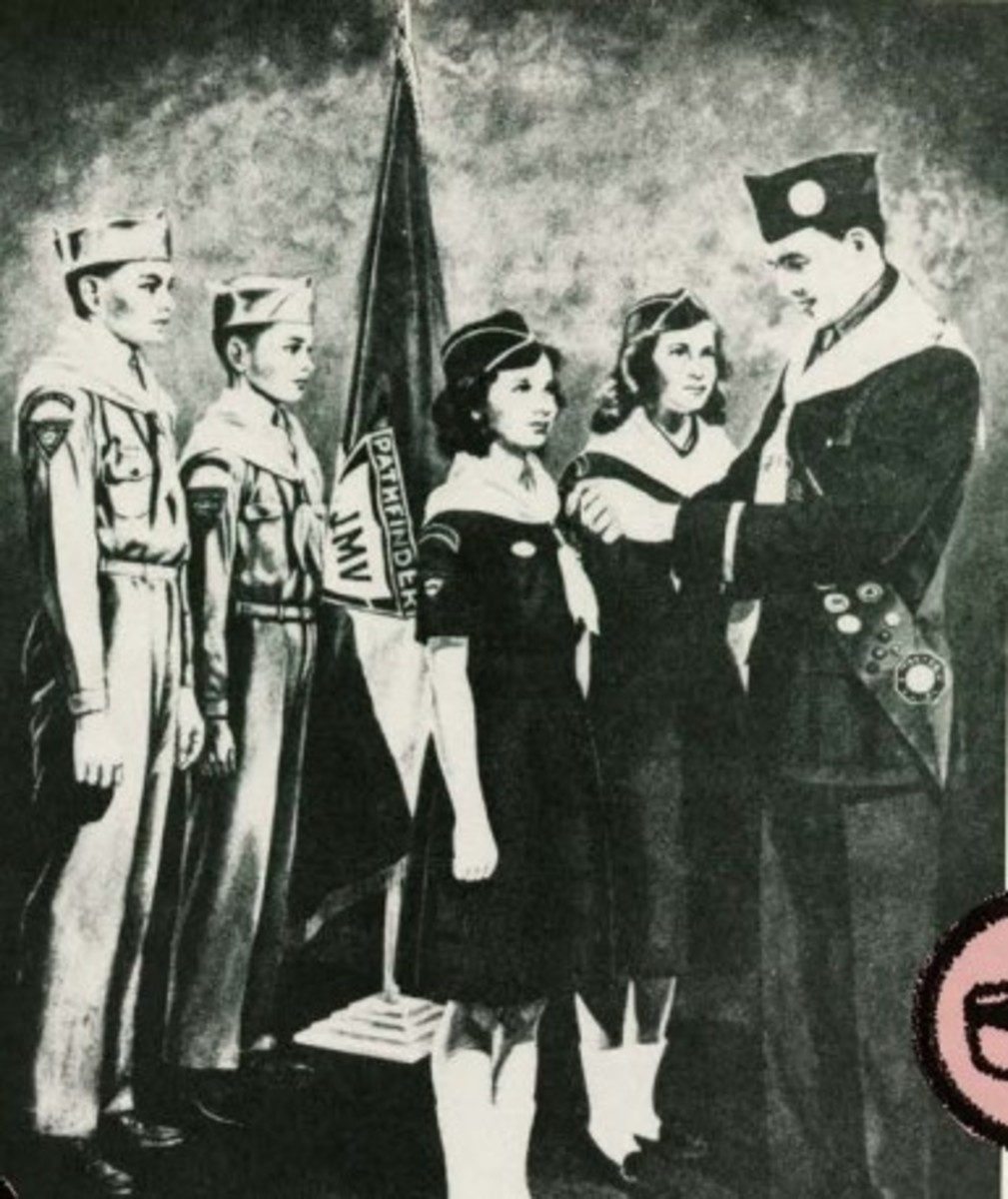
The Investiture Ceremony and awarding of class pins, certificates of achievement and M.V. Honors remains a highlight of the Pathfinder program.
From Adventist Heritage, Vol. 8, No. 2, Fall 1983 page 34.
Pathfinder Club Ministry
By Michael W. Campbell
Michael W. Campbell, Ph.D., is North American Division Archives, Statistics, and Research director. Previously, he was professor of church history and systematic theology at Southwestern Adventist University. An ordained minister, he pastored in Colorado and Kansas. He is assistant editor of The Ellen G. White Encyclopedia (Review and Herald, 2013) and currently is co-editor of the forthcoming Oxford Handbook of Seventh-day Adventism. He also taught at the Adventist International Institute for Advanced Studies (2013-18) and recently wrote the Pocket Dictionary for Understanding Adventism (Pacific Press, 2020).
First Published: December 16, 2025
A youth ministry of the Seventh-day Adventist Church focused on children from the age of ten through young adult.1 Officially adopted by the denomination in 1950, the purpose of Pathfinder Clubs is to train and mentor young people into leadership roles within the Seventh-day Adventist Church. Pathfinder Clubs provide opportunities for active and constructive roles for young people within both the community and denomination.2 While there is regional variation in implementation, the primary focus is on young people from middle school through high school. As of 2025 there are an estimated 40,000 clubs across the thirteen divisions of the world church involving two million Pathfinders. The organization features a uniform, a club flag, unit guidons, and ceremonies. The staff is composed of a director and deputy director elected by the local church; each club is comprised of units of six to eight young people led by an adult counselor, a captain, and a scribe.3
Missionary Volunteer Societies
Adventist ministry to youth began with the publication of The Youth’s Instructor (a magazine first published in 1852) with the guidance of Ellen White. The magazine featured stories and Bible lessons for children and teens. The next major phase of youth ministry centered on organizing young people together in small groups to promote mission work. The earliest “Young People’s Society” began in 1879 in Hazelton, Michigan, hosted by Luther Warren (1864-1940) and Harry Fenner (1862-1940) who prayed for God to help them reach their peers.4 The next major step was the development of missionary volunteer societies during the 1880s and 1890s, especially in conjunction with the wider Missionary Volunteer revival taking place among Protestant young people.5 These groups were intended to encourage and train young people for mission work.
The need to formalize youth ministry led to the organization of the Young People’s Societies at the 1901 re-organization of the denomination. Flora Plummer (1862-1945) was appointed secretary of the Sabbath School Department. Under this aegis she began to organize chapters of Young People’s Societies in local churches to encourage local and foreign missionary work. Over time these local chapters or societies developed into a more structured system for facilitating missionary work. The expansion of these societies contributed to the need for a separate department. At the 1907 Annual Council (held at Lake Geneva, Switzerland), the General Conference created the Young People’s Department.6 Two months later, at the very first Sabbath School and Young People’s Convention, held in Mount Vernon, Ohio, the name “Seventh-day Adventist Young People’s Society of Missionary Volunteers" was selected (often referred to as Missionary Volunteers or simply MV).7
The first MV departmental director was Milton Earl Kern (1875-1961) who served from 1907 to 1922. He was assisted by Anna Matilda Erickson (1880-1957) who served from 1907 to 1920. Under their leadership Young People’s Societies spread across the denomination. Erickson implemented a Junior Reading Course for Junior Youth in 1908.8 In 1908 the very first Morning Watch Calendar (daily devotional book) was published by the Central Union Conference, and the next year a similar calendar was published by the General Conference Missionary Volunteer Department.9 The 1908 calendar included three essentials for Christian growth: “Search the Scriptures”—FOOD; “Praying without Ceasing”—BREATH; “Go work to-day in my vineyard”—EXERCISE. The calendar contained a text for every day of the year with suggestions for subjects for special prayer and supplemental reading in Ellen White’s writings.10 The very first “Missionary Volunteer Reading Course” started with Ellen White’s book, Early Writings.11 In 1909 the Junior Missionary Volunteer Society (JMV) was organized for younger elementary students at Mount Vernon, Ohio.12 In 1913 the “Reading Course” was translated into Spanish, which expanded youth ministry resources to Hispanic church members. In 1918 The Junior Standard of Attainment curriculum was developed beginning with Friend and Companion levels.13 This was the forerunner of Progressive Classwork, (called Investiture Achievement in North America). By 1918, the first MV census results revealed there were 1,230 senior and junior societies with a total of 24,638 members.14
The Missionary Volunteer program’s initial emphasis was to reach young people as part of their education. They developed the 1917 Junior Methods, an 8-hour course given during the summer school for teachers which became in turn the precursor to the Pathfinder Staff Training Course.15 These tools for teachers encouraged the spread of the Junior Missionary Volunteer programs in Adventist schools. Also, that same year the “Junior Bible Year” was begun to encourage youth to consistently read the Bible (as chosen by Erickson).16 Another important resource was The Junior Standard of Attainment Manual (1918).17 A Junior Missionary Volunteer Manual: for Teachers and Leaders was also released that year, the first administrative manual for junior work, compiled by Ella A. Iden-Edwards (1890-1947), an MV Department associate at the General Conference.18 This manual was significantly revised and expanded in 1919.
Growth of MV Societies (1910s-1920s)
During the 1910s concern grew about the lack of social interaction and fellowship between Adventist youth, especially within the local church. Beyond their original purpose to train missionaries, MV Societies provided constructive social outlets. As early as 1911, boys clubs were started in Takoma Park, Maryland, and Lincoln, Nebraska, sought to expand activities for youth. By 1919 Arthur W. Spalding (1877-1953) had organized a group of boys in Tennessee, including his own children, into a club that they referred to as Mission Scouts.19 Although these clubs did not last, they demonstrated a felt need for Christian activities for youth, especially young men. It also coincided with shared concerns in society about masculinity and gender roles during the early twentieth century that contributed to the growth and expansion of Boy Scouts (founded in 1910) and Girls Scouts (founded in 1912).20
At the 1909 General Conference Fall Council an action was taken to add a “Junior” secretary to the MV Department. Harriet Maxson Holt (1891-1972) was the first Junior MV (JMV) secretary serving from 1920 to 1928.21 In 1921 Spalding also became an associate in the MV Department; he brought with him the pledge and law that he had written two years earlier, which in turn became the basis for the JMV Pledge and Law. The first time the new JMV Pledge and Law appeared in print was in 1923. It stated:
By the grace of God,—
I will be pure and kind and true,
I will keep the Junior Law,
I will be a servant of God and a friend to man.
The Junior Missionary Volunteer Law is for me to,—
Keep the Morning Watch.
Hold up my end. (Trustworthiness, courage, thrift.)
Care for my body.
Keep a level eye. (Purity, honesty, truth.)
Be courteous and obedient.
Walk softly in the sanctuary. (Reverence.)
Keep a song in my heart. (Cheerfulness.)
Go on God’s errands. (Service.)22
Working together in 1922, Holt and Spalding further defined and expanded the previously published Friend and Companion levels for the JMV progressive classes, which emphasized outdoor activities. Comrade and Master Comrade were introduced for senior youth. At the 1923 Colorado Springs Missionary Volunteer Convention, MV leaders approved The Junior Manual, authored by Harriet Maxson Holton, which contained additional direction to adult leaders. It was released the following year.23 By 1925 abridged editions of this Manual were published in Chinese, Korean, Japanese, and Malay.24
In 1927 John E. McKim25 (1890-1944) started a local club in his home in Anaheim, California. McKim was a Scoutmaster who wanted to offer Adventist youth Christian club activities as well as to be a witness to the youth of the community. Willa Simons Steen (1891-1964), from the Fullerton, California, Seventh-day Adventist Church (near Anaheim), worked with the girls, becoming the first deputy director. Dr. Claude Steen (1892-1966) and Bertha L. McKim (1892-1958) assisted their spouses in this work. Within a few weeks the group had grown sufficiently large that they needed to obtain more space. They were given permission to meet in the Lincoln school, where McKim was a janitor. While the group continued to utilize the school gym, the club grew to include many youth from the neighborhood. A third local club started in Santa Ana. Within a short time three churches in Orange County, California, had each organized clubs.26
The name Pathfinders emerged out of these early clubs. John McKim came up with the name “Pathfinder” during the first ten-day summer camp at Idyllwild, California, in June 1928 conducted by his wife, Harriet, along with Arthur Spalding. Spalding liked to tell stories about explorer John C. Frémont (1813-1890), nicknamed the “Pathfinder.” As McKim listened, it occurred to him that this would be a perfect name for their youth group.27 The idea soon caught on as the group afterward referred to themselves as a “Pathfinder Club,” the first to do so.28 Steen and McKim were assisted by the Southern California Conference youth director Guy Elmer Mann (1894-1978) who provided support for the fledgling ministry.
Spalding and Holt introduced the first sixteen vocational merits in 1928 and continued working on additional ones with the help of experts in various fields.29 Topics included automobile mechanics, birds, Christian storytelling, colportage, cooking, flowers, gardening, health and healing, laundering, needlecraft, photography, poultry raising, radio, shoe repair, and trees. The next Junior Missionary Volunteer secretaries were H. T. Elliott (1931-1933), Alfred W. Peterson (1934-1946), and C. Lester Bond (1888-1971). Bond served as the associate from 1928 to 1946 and was tasked with creating resources for the Junior Missionary Volunteer program. In 1929 “Vocational Merits” were renamed “Vocational Honors” with nineteen more honors: agriculture, beekeeping, campcraft, carpentry, Christian ethnic studies, dairying, drawing and painting, dress making, electricity, fruit growing, housekeeping, lifesaving, music, physical culture, preserving, printing, shorthand, swimming, and typewriting. Bond was a prolific writer and in 1929 introduced the first Junior Missionary Volunteer Handbook (subsequently revised, updated, and reprinted in 1933, 1936, 1938, 1944, 1945, 1950, 1951, 1957, 1963, and 1967).30 In this last edition it also included the new Master Guide Manual and was published collectively as the MV Handbook.31
Expansion and Standardizing Requirements (1930s)
As America entered the Great Depression, Pathfinders was viewed by some as a constructive outlet for discipleship. Another Pathfinder Club was started in 1930 by Charles Lester Martin (1896-1988) and Dr. Seward Theron Johnston (1892-1977) of Santa Ana, California.32 Charles Martin and his wife, Ione Ruth (1897-1958), felt a need to do something for the restless boys in the church, but there was no fellowship hall, so they asked the Johnstons if they would be interested in having a "Pathfinder" Club for boys in their basement workshop.33 The first honor they taught was Radio since Dr. Johnston was an enthusiast. The Johnston’s eldest daughter, Maurine (1919-2018), helped set up for the boys’ meetings but was not allowed to attend. She put up such a big fuss that her mother, Ethel Johnston (1891-1974), asked Ione Ruth Martin to help her start a girls club, which was held in an upstairs sewing room. The Santa Ann club met monthly with the Anaheim-Fullerton club to do classwork, hold choir practice, work on honors, and play games. The youth sang in the Orange County Junior Choir, directed by Willa Steen. Bertha McKim played the piano for the group, which went to nearby churches and evangelistic meetings to share their musical talent. Initially church leaders felt threatened by the new Pathfinder club initiative, and even the Johnstons were threatened with “church expulsion” if they did not stop what they were doing.34 A shift away from such opposition occurred as church leaders began to see the evangelistic and discipleship potential of Pathfinders. As interest in Pathfinders grew, especially in its spiritual potential, acceptance for such local clubs gained even wider support when the Southeastern California Conference dedicated its new summer camp for Pathfinders at Idyllwild in 1929.35 During the 1930s the number of clubs expanded significantly.
The early 1930s marked the development of an investiture service to honor all the MV and JMV work. One of the earliest documented investiture services took place at the Reno, Nevada, church on May 3, 1930.36 Laurence A. Skinner described in detail an early service, which included making several little fires arranged in the shape of a big “F” for completing the requirements and discussing “what it means to be a real J. M. V. Friend.” The person afterward received their Friend pin.37 The idea of having investiture services became a way to recognize the completion of requirements at the conclusion of the Pathfinder year. Completion of the Friend, Companion, or Comrade levels was recognized. Master Comrades could be awarded up to fifty-three additional kinds of pins. Although it is difficult to ascertain for certain the first investiture service, by the 1930s they had become standard practice within Adventist youth ministry. It is also important to note that as the MV/JMV program grew, more vocational honors were added with six in 1933, two more in 1935, ten in 1937, twenty-two in 1938, and one more each in 1939 and 1940. Another important area of growth included the adoption of the MV/JMV neckerchief first used at the 1936 General Conference session held in San Francisco, California. At the August 1937 Blue Ridge Educational Council, it was voted to standardize the neckerchief to 32 inches square. Different colored scarves were available for each class: blue for Friend, red for Companion, yellow for Comrade, and gold for Master Comrade. The original neckerchief was designed to be used as a first aid bandage. Suggested uses as a bandage included: (1) sprained foot or ankle; (2) tourniquet for bleeding or snake bite; (3) splint for broken leg; (4) sling for broken arm; (5) triangular bandage for head; (6) triangular bandage for hand; (7) and triangular bandage for foot. In addition, the neckerchief could be used as a smoke mask, cover for burns, wound dressing, sling for dislocated shoulder, pad to stop bleeding, bandage for a broken jaw, use as a “Fireman’s Carry,” hot and cold application, tied to pole as a stretcher, sunshade, or life line.
Another early Pathfinder Club (1937) started in Glendale, California, under the direction of Southern California Conference Youth Director Laurence Arthur Skinner (1905-2002). Skinner was instrumental in starting and supporting several new clubs, but he was most directly involved in mentoring young people in his club in Glendale. The next year a Pathfinder Club was organized at Loma Linda, California, in the fall of 1938.38 As news spread about these early clubs, other congregations wanted to provide similar opportunities for spiritual, physical, and mental activities for their young people, too. The growth of these clubs was in large part due to Bond who was a particularly effective evangelist for Pathfinders, traveling the world and writing books advocating for Pathfinders; his enthusiasm helped start Pathfinders in various countries around the world. He also wrote several important books: Ideals for Juniors (1938), Stamp Collecting (1938) coauthored with Merwin Ralph Thurber (1903-1991), and Recreational Plans for Missionary Volunteers (1941) coauthored with Nora M. Woolley. Henry T. Bergh (1918-2011) wrote the first curriculum material used for a group in Oregon that he called “Trailblazers” in 1938. Skinner encouraged new clubs across the Pacific Northwest although none of these lasted very long.39
Development of Pathfinder Clubs (1940s and 1950s)
New leadership and ideas percolated among youth leaders as Pathfinders continued to expand and as the requirements for having a club became even more standardized. This was particularly important during and after World War II (1939-1945) as the need to focus on families and childcare in America became especially important.
In 1946 the Pathfinder Club triangle emblem was designed by Southeastern California Conference youth director, John Henry Hancock (1917-2001), who also had earlier supported the first club in Riverside, California. This marked the first time a conference assisted a local congregation in organizing a Pathfinder Club. It was the fifth documented club in southern California. Hancock recruited a ministerial college student, Francis Hunt (1924-1993), who was elected by the Riverside congregation to direct its club with 35 participants. The club met in member homes and engaged in popular activities including campouts and classes in cooking, baking, leathercraft, and plastics.40
Back at church headquarters, in Takoma Park, Maryland, Skinner joined the team of E. W. Dunbar and T. E. Lucas at the General Conference MV Department. All three men worked closely together, searching for ways to enhance the Junior Youth (JMV) program and to make it more Christ-centered. They asked Joseph R. Nelson, Pacific Union youth director, to write a report describing how Pathfinder Clubs operated in the Pacific Union. Working with the local conference youth directors, Nelson formed the MV Council, which included Henry T. Bergh, Central California Conference; Clark Smith, Nevada-Utah Conference; Glenn Fillman, Northern California Conference; John H. Hancock, Southeastern California Conference; and Miller Brockett, Southern California Conference. The MV Council met several times to discuss what they were doing in their conferences.
In 1948, Henry T. Bergh, youth director for the Central California Conference, started twenty-three Pathfinder clubs within his conference. Bergh also appointed the first area Pathfinder coordinators to oversee these clubs and commissioned a Pathfinder flag which featured John H. Hancock’s triangle emblem. Helen Hobbs was asked to choose the colors for the flag and to sew it.
In 1949 a Junior Youth Congress was planned by John H. Hancock, at La Sierra College (now La Sierra University), California, Southeastern California Conference. In the Central California Conference, Henry T. Bergh held the first Pathfinder Leadership Training Camp at Camp Wawona, October 15- 17, 1949, wrote the Pathfinder Staff Training Course Certificate of completion. The word “kindness” was deleted in this early version without authorization but was reinstated in 1998. The first Pathfinder drill manual was also written by Clark Smith and Henry Garlick, with advice from Bergh, that they should “be sure and make them kinder and gentler than military manuals.”41 Soon the advanced level was added to the vocational honors.
Outside of the Pacific Union, the first Hispanic Pathfinder Club began in Puerto Rico led by nineteen- year-old schoolteacher Eliezer Melendez (1931-2012). Melendez learned about Pathfinder Clubs when he attended the Autumn Council of 1949 in San Francisco, California. The first Pathfinder Fair which was held at St Helena Sanitarium in St. Helena, California, on December 10, 1949, with several hundred in attendance.42
At the 1950 General Conference Session, JMV Pathfinder Clubs were officially authorized as a ministry of the world church. Later that year a Pathfinder Staff Training Course was published along with a How to Start a Pathfinder Club booklet. Soon more Pathfinder Fairs were held in California throughout 1950. The second one was held in Fresno on April 1, 1950,43 and then a third one was held that same year at Lynwood, California, with more than 1,000 Pathfinders in attendance on October 29.44 Also, in 1950 the terms Comrade and Master Comrade were changed to Guide and Master Guide, a reflection of concern about the growing Soviet Union and terms that could be associated with Communism (conferences were given one year to use up any old Comrade and Master Comrade materials).
As an official entity of the worldwide denomination, the Church published a Pathfinder Staff Manual in 1951. That year a third Pathfinder Fair was held at Dinuba, California, on September 23, directed by Henry T. Bergh. Dunbar came from the General Conference and while in southern California held another Pathfinder Fair on September 30, directed by Miller Brockett. A Pathfinder Congress was held at La Sierra College by John H. Hancock and a tenth edition of the JMV Handbook published. It is important to note that at this time the term “Vocational Honors” was changed to “Missionary Volunteer Honors” or simplified as “MV Honors.” One of the most memorable parts of Pathfinders was the 1949 song Bergh wrote for Pathfinders, which he composed while traveling. He stopped on the side of the road and jotted the lyrics on a piece of paper.45 He copyrighted the song in 1952 to reserve it for exclusive use by Pathfinder Clubs. A club in Minnesota, developed the idea of collecting food, clothing, and money for the less fortunate between Halloween and Thanksgiving. This tradition quickly spread as a fun way for Pathfinders to help those less fortunate in their communities.
The first conference-wide Pathfinder Camporee was held at Camp Winnekeag in Ashburnham, Massachusetts, from October 9-11, 1953.46 The term “camporee” was coined by John Hancock, Henry T. Bergh, Clark Smith, and Harry Garlick in the Pacific Union, who were already planning a camporee for the spring of the following year (this term was appropriated from the Scout term for such events, jamboree). However, the first group to put it into practice was the Southern New England Camporee. The second Pathfinder camporee was held at Camp Idyllwild in Idyllwild, California, from May 7-9, 1954, and another camporee was held at Middleton Lake in 1954 located in Fresno, California. These camporees were filled with fun activities, spiritual worships, and learning experiences for the youth, many whom had never been camping before.
The growth of Pathfinders helped church leaders recognize that there was the need for a new publication aimed at young people, specifically those who were in Pathfinders ages 10 to 15. The Junior Guide Magazine’s first issue was published October 7, 1953, with 16 pages and published by the Review and Herald. There were stories, an editorial by S. Lawrence Maxwell (1925-2009), an article about MV Honor Stars, instructions on making a crystal radio set and a tight-line telephone, news of Pathfinder activities, and the junior Sabbath school lesson. Within a year the periodical increased to 24 pages.
Pathfinder Clubs were promoted at the 1954 General Conference session, exposing international attendees to the concept. Pathfinder Clubs were introduced in the South Philippine Union in 1954 and the North Philippine Union in 1955.47 Pathfinder Clubs were also started in southern India by 1954.48 In the Malayan Union, a Pathfinder Leaders' Camp was held near Singapore during the weekend of February 11 to 14, 1956.49 By the end of 1958, Australia’s Victorian Conference had fifteen Pathfinder Clubs,50 and by the end of the decade clubs were also active in Africa and the Middle East.
One publication that helped expand the general philosophy of Pathfinders was The Happy Path written by Lawrence Maxwell, the editor of Guide, who expounded upon the meaning of the Pathfinder pledge and law. The proliferation of Pathfinder Clubs in the 1950s continued. During this time the Explorer class was added as a level for seventh graders, and in 1956, fifteen more MV honors became available. The additional MV honors meant that the Junior MV Handbook was revised and reprinted (1957). It also became standard practice to have a JMV Pathfinder Day or Sabbath as part of the annual church calendar. JMV Pathfinder Day, held usually as part of a church service, became a way for Pathfinders to share with the entire congregation what they were doing in their club.
Standards for physical fitness were adopted during the 1950s. Laurence A. Skinner developed a program of physical fitness, cultural improvement (through reading and journalism), and spiritual excellence for youth that became known as the Silver Award beginning in 1958. This program challenged youth to become physically active and to make sure that they consistently incorporated Bible study and prayer into their devotional lives. Also, that same year the Advanced JMV Classes were adopted: Frontier Friend, Campfire Companion, Range Explorer, and Trail Finder Guide were added. These names would be simplified to Trail Friend, Frontier Companion, Range Explorer and Wilderness Guide. In 1959 the General Conference presented the Gold Award developed by Skinner with advanced and challenging achievement standards for college-age young adults. Also, in 1959 the first union-wide camporee was held in the North Pacific Union at Snoqualmie National Forest in Washington from June 4-7, with 1,000 youth in attendance. The cost was fifty cents to participate which included a camporee pennant. Each club camped together and did their own cooking, though camp sites were segregated by gender. Together they enjoyed worship and other outdoor activities.51 The Pathfinder Drill Manual was written by Clark Smith,52 director of the Medical Cadet Corps (MCC), and Harry Garlick,53 associate MV director for the Pacific Union, who helped drill Pathfinders so that they would learn the discipline of marching without an association with the military. At that time many of the drill instructors were former World War II veterans so drilling became very popular across the United States. The influence of the MCC as well as Boy Scouts both contributed to the importance of marching and drilling in Pathfinder Clubs during and soon after World War II.
Pathfinder Clubs Reach Maturity (1960s)
As Pathfinders grew during the 1960s, new ideas, leaders, and the proliferation of camporees continued. The second union-wide camporee was held, April 11-14, 1960, by the Pacific Union at Lone Pine, California. A felt patch was awarded to each attendee. The Pathfinder Clubs enjoyed camping, cooking, activities, and worship although there was no electricity, flushing toilets, or running water. 54 The youth leaders continued to develop programs to invite young people to have a personal relationship with Christ.
In 1962 Norm Middag (1930-2021), a young associate youth director of the Northern California Conference, working with James Harris (1923-2007), youth director, developed the Junior Teens program to be used with Pathfinder Clubs. The program encouraged teens in grades seven through twelve to stay involved in the Pathfinder Ministry and the church. It included leadership training and many teen-related activities. This program was particularly popular in the Pacific Union Conference, and many church leaders were trained through it. The MV Field Guide (1962) was authored by Lawrence Maxwell with the Pathfinder pages written by Don Palmer (1915-1988), a lay Pathfinder outdoor and nature specialist. Also, that same year The Pathfinder Drill Manual was revised and reprinted and the JMV Advanced Manual was written to help leaders understand the requirements of the advanced classes Trail Friend, Frontier Companion, and Range Explorer.
During this time other unions were becoming active in Pathfinders, including the Central Union (now part of the Mid-America Union) which held a Pathfinder camporee June 3-6, 1962, at the Colorado Conference youth camp, Glacier View Ranch.55
An important addition for younger Pathfinders was the development of the Eager Beaver program first instituted in 1965 across the North American Division (NAD). This program would later become the Adventurer Club (for children ages 4 to 9), and in 1966 the Pioneer Class (for 8th grade) was added. In 1970 youth ministry leaders changed the name to Ranger. Also, in 1966 the first North American Division MV Camp Directory was published. This was intended to encourage Pathfinders to attend and participate in Adventist youth camps.
Additional refinements to Pathfinders included the Pathfinder Staff Training Course which was increased to six sections of ten hours each. Topics included history, mission, and purpose of the Pathfinder program, club leadership, club organization and programming, and Pathfinder curriculum, which included class levels, camping and outdoor education, and drill and ceremonies. John H. Hancock, who served as Pathfinder director for the world church from 1963 to 1970, encouraged the international expansion of Pathfinder Clubs.
International Growth of Pathfinders (1970s)
Leo Santos Ranzolin Sr. from Brazil (1970-1980) followed Hancock as world Pathfinder director. Pathfinders’ silver anniversary was celebrated between 1970 and 1975, to account for the different start dates of Pathfinders in various regions. Lowell Litten wrote a song “Smile, You’re a Pathfinder,” which was used to celebrate the first twenty-five years. The first Independence Day Parade by Pathfinders was held in Brazil at Ipiranga, Sao Paulo. Brazil was, at the time, under a military dictatorship and only a military parade could take place on their national holiday. Pastor Jose Silvestre, dubbed “Mr. Pathfinder” in Brazil, approached the military establishment to see if Pathfinders might be able to also participate. After some discussion, a group of Pathfinders were allowed to follow the lead float as an introduction to the parade. Heavy rain the night before canceled the parade, and the military did not show up, but still thousands came, including a large contingent of Pathfinders. After the sun came out, the parade, without the military, proceeded on schedule. Pathfinders received a grand applause along the parade route.56
In 1971 the first division-wide Pathfinder camporee was held in the Northern Europe-West Africa Division (now Trans-European Division) in Vasterang, Sweden.57 The camporee was the beginning of division camporees around the world. With the expansion of clubs around the world new and updated materials were published. The Missionary Volunteer Handbook was published in 1973, and the Pathfinder Staff Manual was revised and expanded in 1974.
As Pathfinders matured the opportunity to stop and reflect about the significance of the Pathfinder movement became increasingly important to Pathfinder leaders. The fiftieth anniversary of summer junior camps in North America was celebrated in 1976 as well as the thirtieth anniversary of Pathfinder Clubs in 1980, respectively. The Riverside, California, club, started in 1946, though not the first club, was the longest-running club (still active as of 2025). Over time the Pathfinder movement had developed its own traditions and stories that could be celebrated and retold. There was also an opportunity to revise some of the basic curriculum. In 1979 the Pathfinder Basic Unit, a basic manual, was revised highlighting the requirements for each class level. The most significant change in 1979 was the renaming of the Missionary Volunteer program. It became Adventist Youth (AY) and Junior Missionary Volunteers became Adventist Junior Youth (AJY). The pre-AJY program was changed to the Adventurers Club.58
Systematization and Division Wide Camporees (1980s)
The thirtieth anniversary of the General Conference’s adoption of Pathfinders was celebrated in 1980. At that time Master Awards, which was a collective honor for individuals who had completed a series of individual honors within a given genre, were added to the MV Honors: aquatic, artisan, conservation, farming, homemaking, naturalist, sportsman, technician, wilderness, and witnessing.
When Leo Santos Ranzolin was elected General Conference youth director in 1980, Michael Herbert Stevenson of South Africa became the fourth world Pathfinder director. Leslie Pitton became chair of the first NAD youth committee, which also included Norm Middag and the union conference youth directors. During this time the Youth Leader’s Handbook was revised and the name changed to Adventist Youth Honors or simply AY Honors. In 1981 a Pathfinder’s Sing songbook was compiled and the Pathfinder Drill Manual for the NAD revised once again. The Voyager class was added for ninth graders—those between Ranger and Guide levels in 1982—and the baseball-style cap was voted for use among North American Pathfinder Clubs.
A major development during the 1980s was division-wide camporees. The Inter-American Division held the first ever division-wide Pathfinder camporee outside North America at Oaxtepec, Mexico, from March 24-29, 1983, with World Director Leo Ranzolin and World Pathfinder Director Mike Stevenson attending. Israel Letio directed the camp.59 The South American Division (SAD) held its first camporee in its territory at Foz do Iguacu, Brazil, (December 28, 1983 to January 3, 1984) with Claudio Beltz who was the SAD youth director. In 1985 the NAD held its first division-wide Pathfinder camporee (July 31- August 6), at Camp Hale, in Leadville, Colorado, with Les Pitton directing. There were approximately 15,600 individuals present to enjoy the many activities, honors, and programs presented.60 Although formally there was a NAD administrative committee run by General Conference leaders, when the NAD became a functioning and autonomous level of church governance in 1985, Norman Middag was appointed the first NAD youth director responsible for Pathfinders, and later, Adventurers. Paul DeBooy, an associate in the General Conference Youth Department developed the Pathfinder Adventurer for Christ, Gold and Silver Awards. The North American Pathfinder uniform was also revised. The Camp Hale, Colorado (1985), camporee was the first official NAD event to take place after the creation of the division. This became the first place to showcase the new standardized and adapted uniform that replaced earlier MV uniforms.
Pathfinder leaders in the 1980s included Malcolm Allen of Australia, elected world Pathfinder director in 1986. He served until 1996. Also, in 1986 the AY Honors manual was revised with twenty-one new honors added. Norm Middag designed the NAD Pathfinder emblem using Hancock’s original emblem over the NAD map in 1987 and in 1988 the NAD Teaching the Pathfinder Curriculum Manual was published. In 1988 the first Chilean Union Camporee was held at Pacella, Chile, and in the Inter-American Division, the North Mexican Union held their first Master Guide Camporee at Montemorelos, Mexico, March 29-April 2, 1988.61
The Pathfinder Leadership Award curriculum (PLA) and the Pathfinder Instructors Award curriculum (PIA) were published in 1989. Also, the Friendship Camporee, the second North American Pathfinder camporee held at Mount Union, Pennsylvania, and sponsored by the Columbia Union was directed by Ron Stretter.62 The Pathfinder’s “Strong” video celebrating the official Pathfinder song was released by the General Conference Youth Ministries Department in English, French, and Spanish.
1990s to the Present
During Norman Middag’s term of service for the NAD, much work was done on updating, revising, and publishing materials to strengthen Pathfinder ministry. In 1991 the Pathfinder Leadership Awards Manual (PLA) and the Pathfinder Basic Staff Training Course were published. Jan S. Doward, associate in the Youth Department of the General Conference, wrote Finding the Right Path, illustrating the Pathfinder pledge and law. In 1991 the Pathfinder Staff Manual was revised and reprinted. To encourage more people to become professional youth ministry leaders, the denomination established the Center of Youth Evangelism in 1992 at the Seventh-day Adventist Theological Seminary at Andrews University.
The 1990s witnessed several creative initiatives, including the participation of Pathfinders in the Rose Bowl Parade. The 1991 float featured “Children Playing Together in Peace,” which received the Lathrop K. Leishman Award for most beautiful noncommercial entry; the 1992 float was themed “Discover the World of Service,” which won the National Trophy for “the best depiction of life in the United States”; and “Enjoying and Caring for Nature,” which was the last of these Pathfinder floats.63 The Pathfinder Instructors Award and the Pathfinder Leadership Award were revised and published for the NAD. The Dare to Care International Pathfinder Camporee, was held August 2-6, 1994, at Morrison, Colorado, sponsored by the Rocky Mountain Conference Youth Director Ron Whitehead. There were 12,600 Pathfinders and staff present.64 The Youth Ministries Department of the GC was re-organized, and Baraka Muganda, a native of Tanzania, became world youth director. Associates in the Youth Department included Richard Barron, David Wong, and Malcolm Allen. In 1995 the NAD established a Pathfinder web site.65
Robert Holbrook served as the GC Pathfinder Director from 1997 to 2005. During his leadership a new neckerchief slide made of cloth with the world emblem logo was introduced in 1997. This slide was washable and could be stored in the Pathfinder shirt pocket when not in use. Through the years there have been changes to adapt and revise the curriculum and events associated with Pathfinders. Pathfinder camporees have also grown in popularity. In August 1999 the “Discover the Power International Pathfinder Camporee” was held in Oshkosh, Wisconsin. This established a pattern of having a camporee every five years: “Faith on Fire International Camporee” (2004), “Courage to Stand” (2009), “Forever Faithful” (2014), “Chosen” (2019), and “Believe the Promise” (2024). The most recent camporee had an estimated 57,000 participants. Of special note was achieving two Guiness World Records during recent camporees: the largest Master Guide Scarf (2.204 m2) and the largest human image of a Cross (13,309 people).66 Most recently the Master Guide Club was recognized by the NAD as not just a curriculum but as an official church ministry with encouragement to appoint a club director at each local church. Pathfinder ministry in its many forms continues to evolve with new and revised honors and additional resources that are constantly added as resources to continue this mission of discipling young people to be citizens of this world, and the world to come.
Sources
Bautista, J. O. “North Philippine Union's Workers Retreat.” Far Eastern Division Outlook, May 1955.
Bergh, Henry T. How to Start a Pathfinder Club. Washington, D.C.: Review and Herald Publishing Association, 1965.
Bergh, Henry T. Upward Trails: A Junior Devotional. Washington, DC: Review and Herald Publishing Association, 1963.
Bond, C. Lester. Junior Missionary Volunteer Handbook. Washington, DC: Review and Herald Publishing Association, 1935.
Bond, C. Lester. The Master Comrade Manual; a Study and Service Guide for Master Comrades, and Superintendents of the Junior Society of Missionary Volunteers. Washington, D.C.: Review and Herald Publishing Association, 1938.
Bond, C. Lester. The Master Guide Manual; a Study and Service Guide for Master Guides, and Superintendents of the Junior Society of Missionary Volunteers. Washington, DC: Review and Herald Publishing Association, ca. 1950.
Bond, C. Lester. The Missionary Volunteer Handbook. Washington, DC: Review and Herald Publishing Association, 1933, 1936, 1938, 1944, 1945, 1950, 1951, 1957, 1963, and 1967.
Bond, C. Lester. Study Questions for Denominational History: For Use in Meeting the Requirements for Master Guide Work. N.p., ca. 1950.
Bond, C. Lester and Merwin R. Thurber. Stamp Collecting: A Study Guide for Vocational Honor in Philately Prepared and Compiled for the Young People’s Department of Missionary Volunteers of the General Conference of Seventh-day Adventists. Washington, DC: Review and Herald Publishing Association, 1938.
Brockett, Miller. “MV and Temperance Briefs Union-wide Pathfinder Camporee April 11 to 14.” Pacific Union Recorder, April 11, 1960.
Bunting, Elizabeth O. Live Wires. Washington, D.C.: Review and Herald Publishing Association, 1970.
Burns, W. E. “Pathfinder ‘Camporee.’” Atlantic Union Gleaner, October 26, 1953.
Campbell, Michael W. and Edward Martin Allen. A Global History of Seventh-day Adventists. Grand Rapids, MI: William B. Eerdmans, 2026.
Dodge, Terry. “Pathfinder Museum to Spotlight a Unique History.” ARH, August 27, 2009, 29.
Dzul, Jorge. “Pastors Moctezuma and Melendez Honored.” Inter-American News Flashes, July 1988.
“First Division-Wide Camporee.” Inter-American News Flashes, May 10, 1983.
Hancock, John H. “Camporee Attracts Over One Thousand.” North Pacific Union Gleaner, June 29, 1959.
Hancock, John. “Church Salutes SDA Youth During 1979.” ARH, March 1, 1979.
Hancock, John. The Pathfinder Story. Lincoln, NE: AdventSource, 1994.
Holbrook, Robert. The Pathfinder Story: Pathfindering Through Time Around the World. Collegedale, TN: The College Press, 2006.
Holt, Harriet Maxson. The Junior Manual for Missionary Volunteer Workers. Mountain View, CA: Pacific Press Publishing Association, 1924.
Iden, Ella A. Junior Missionary Volunteer Manual: for Teachers and Leaders. Mountain View, CA: Pacific Press Publishing Association, 1918.
Iden, Ella A. Junior Missionary Volunteer Manual: for Teachers and Leaders. 2nd rev. ed. Mountain View, CA: Pacific Press Publishing Association, 1919.
Jarnes, David and Jeanne Beck Jarnes. “Pathfinder City, U.S.A.” ARH, September 12, 1985.
Krum, Nathaniel. The MV Story. Washington, D.C.: Review and Herald Publishing Association, 1963.
MacGuire, Meade. Standard of Attainment Manual. N.p.: California, 1918.
Maran, Kimberly Luste. “The Hunt for History: The Pathfinder Club Owes Its Existence to Many,” ARH, August 27, 2009.
Matthews, O. S. “South India Holds Youth Convention.” Southern Asia Tidings, June 1, 1954.
Maxwell, Lawrence. MV Pathfinder Field Guide. Washington, D.C.: Review and Herald Publishing Association, 1962.
Melbourne, Cavel. “The MV Club in North America, 1911-1966.” Adventist Heritage 8, no. 2 (Fall 1983): 33-47.
Moreno, L. M. “Southern Mindanao Teachers' Institute.” Far Eastern Division Outlook, August 1954.
MV Handbook, with MV Class Revisions; a Study and Service Guide for Developing Skilled Youth Leaders [and] Training Junior Missionary Volunteers. A compilation, revision and enlargement of Materials Originally Prepared by C. Lester Bond Which Appeared in Two Books, Master Guide Manual and Junior Missionary Volunteer Handbook. Washington, D.C.: General Conference of Seventh-day Adventists, 1968.
Nelson, J. R. “Quarter Century of Camping.” Pacific Union Recorder, July 2, 1951.
“New from Here & There.” Far Eastern Division Outlook, February 1956.
Nix, James R. “35 Years of Pathfindering.” ARH, November 14, 1985.
“Pathfinder Clubs.” Australasian Record, September 29, 1958.
Pathfinders Sing: Favorite Songs of Pathfinders, Camp Ministries, and Classrooms. Washington, D.C.: Review and Herald Publishing Association, 1981.
Pearce, Anna May. “Wyoming Youth Enjoyed Camporee.” Central Union Reaper, June 26, 1962.
Pierson, Robbi and Kermit Netteburg. “A Special Time, a Special Place.” ARH, August 31, 1989.
Peterson, Alfred W. “The Story of the Missionary Volunteer Department.” ARH, December 29, 1938.
Plata, Dixie. “Obituary of Laurence A. Skinner.” Accessed December 9, 2025. https://aymmuseum.org/newsletters/laurence-a-skinner-by-dixie-plata/.
Plata, Dixie. Witness Through Roses. Lincoln, NE: AdventSource, 2025.
Ranzolin, Leo. “Pathfinder Camporees Held Across U.S.A. and World.” ARH, November 25, 1971.
Wynn, Becky. “Hendersonville Welcomes Pathfinder Composer.” Southern Tidings, April 2006.
Youth Leaders Handbook Prepared by the Youth Department of Missionary Volunteers. Washington, D.C.: General Conference of Seventh-day Adventists, 1976.
Notes
-
This article began as a draft from Dixie L. Plata and various members of the NAD Pathfinder Historians group, and significantly revised and expanded, with additional documentation from primary sources. Special thanks to Dixie L. Plata, Donny Gore, Leo Ranzolin, Les Pitton, Tracy Wood, and Armando Miranda, Jr. along with many others who have provided valuable input to this article.↩
-
Seventh-day Adventist Encyclopedia, s.v. “Pathfinder Clubs,” [1996] 10:307-308.↩
-
Ibid.↩
-
Michael W. Campbell and Edward Martin Allen, A Global History of Seventh-day Adventists (Grand Rapids, MI: William B. Eerdmans Publishing Company, 2026), 107-110, 172-173.↩
-
Bonita J. Shields and Michael W. Campbell, eds., Faith on the Move: The History of the North American Division of Seventh-day Adventists, 1985-2025 (Columbia, MD: North American Division of Seventh-day Adventists, 2025), 51-54.↩
-
W. A. Spicer, “The General Conference Committee Council at Gland, Switzerland: Third Report,” ARH, June 20, 1907, 4.↩
-
G. B. Thompson, “The Sabbath-School and Young People’s Convention,” ARH, August 8, 1907, 6.↩
-
M. E. Kern, “A Junior Reading Course,” ARH, December 17, 1908, 24.↩
-
M. E. K[ern], “The Morning Watch Calendar,” ARH, December 12, 1907, 30.↩
-
Ibid.↩
-
“Missionary Volunteer Reading Course,” The Youth’s Instructor, December 24, 1907, 4.↩
-
“All were agreed that every church-school should have a Junior Missionary Volunteer Society, setting apart some hour during the week for the meeting, when reports would be rendered, etc.” See “Plans for Progress—No. 7,” The Youth’s Instructor, September 21, 1909, 12-13.↩
-
Mrs. R. D. Quinn, “New Helps for the Missionary Volunteers,” Atlantic Union Gleaner, January 30, 1918, 3.↩
-
For statistics see “Summary of the Missionary Volunteer Work of the General Conference for Quarter Ending March 31, 1919,” ARH, November 13, 1919, 21.↩
-
M. E. Kern, “Missionary Volunteer Department Meeting,” ARH, September 20, 1917, 20-21.↩
-
See announcement for the 1917 year in M. E. Kern, “The Senior Bible Year,” ARH, December 28, 1916, 18.↩
-
“Juniors, Attention!” Youth’s Instructor, January 8, 1918, 13. The description states: “This little manual contains two lists of study questions, with references—one list on Bible doctrines and one on denominational history. On these questions the Junior Standard of Attainment examinations will be based.”↩
-
M. E. Kern, “A New Book on Junior Work,” ARH, August 8, 1918, 20.↩
-
A. W. Spalding, Christ’s Last Legion: Second Volume of a History of Seventh-day Adventists Covering the Years 1901-1948 (Washington, DC: Review and Herald Publishing Association, 1949), 202.↩
-
Wyatt Blassingame, Story of the Boy Scouts (Champaign, IL: Garrard Pub. Co., 1968); Chuck Wills, Boy Scouts of America: A Centennial History (New York: DK Publishing, 2009); Betty Christiansen, Girl Scouts: A Celebration of 100 Trailblazing Years (New York: Stewart, Tabori, & Chang: 2011).↩
-
She began her role writing to church youth. E.g. Harriet M. Holt, “Summer Volunteers,” Youth’s Instructor, May 25, 1920, 11.↩
-
H[arriet] H[olt], “Junior Notes,” The Church Officers’ Gazette, September 1923, 12.↩
-
See under the “Missionary Volunteer Department,” ARH, November 22, 1923, 13.↩
-
See “Missionary Volunteer Literature,” ARH, September 3, 1925, 21.↩
-
G. E. Mann, “About the Juniors,” Pacific Union Recorder, May 16, 1929, 4-5.↩
-
J. R. Nelson, “Quarter Century of Camping,” Pacific Union Recorder, July 2, 1951, 2.↩
-
John Hancock, The Pathfinder Story.↩
-
Terry Dodge, “Pathfinder Museum to Spotlight a Unique History,” ARH, August 27, 2009, 29.↩
-
The editions are based upon a search of the WorldCat catalogue.↩
-
MV Handbook, with MV Class Revisions; a Study and Service Guide for Developing Skilled Youth Leaders [and] Training Junior Missionary Volunteers. A compilation, revision and enlargement of Materials Originally Prepared by C. Lester Bond Which Appeared in Two Books, Master Guide Manual and Junior Missionary Volunteer Handbook (Washington, DC: General Conference of Seventh-day Adventists, 1968).↩
-
https://www.findagrave.com/memorial/58983875/seward-theron-johnston↩
-
Leo Ranzolin, “Pathfinder Silver Anniversary: From Trailblazers to Conquistadors,” Southwestern Union Record, January 26, 1974, 2-3.↩
-
Ibid.↩
-
H. A. Rentfro, “Summer Camp at Idyllwild,” Pacific Union Recorder, July 4, 1929, 5.↩
-
Mrs. J. H. McEachern, “Initial Investiture Service in Nevada,” PUR, May 15, 1930, 5.↩
-
Laurence A. Skinner, “Pathfinders of the Sky,” Youth’s Instructor, April 21, 1931, 11-12.↩
-
J. C. Nixon, “Loma Linda Pathfinders’ Club,” Pacific Union Recorder, May 29, 1940, 10.↩
-
Kimberly Luste Maran, “The Hunt of History: Following the Trail of the First Pathfinders,” Adventist Review, June 26, 2020, https://adventistreview.org/my-church/the-hunt-of-history/↩
-
Leo Ranzolin, “Pathfinder Silver Anniversary from Trailblazers to Conquistadores,” Trans-Africa Division Outlook, February 15, 1974, 10.↩
-
John Hancock, The Pathfinder Story, 17.↩
-
“M.V. Newsettes,” Pacific Union Recorder, December 26, 1949, 2-3.↩
-
“Region Six Newsettes,” Pacific Union Recorder, February 27, 1950, 7.↩
-
See under “Pathfinder Fair,” Pacific Union Recorder, September 25, 1950, 9.↩
-
Becky Wynn, “Hendersonville Welcomes Pathfinder Composer,” Southern Tidings, April 2006, 9.↩
-
W. E. Burns, “Pathfinder ‘Camporee,’” Atlantic Union Gleaner, October 26, 1953, 8.↩
-
L. M. Moreno, “Southern Mindanao Teachers' Institute,” Far Eastern Division Outlook, August 1954, 6; J. O. Bautista, “North Philippine Union's Workers Retreat,” Far Eastern Division Outlook, May 1955, 4.↩
-
O. S. Matthews, “South India Holds Youth Convention,” Southern Asia Tidings, June 1, 1954, 8.↩
-
“News from Here & There,” Far Eastern Division Outlook, February 1956, 20.↩
-
“Pathfinder Clubs,” Australasian Record, September 29, 1958, 5.↩
-
John H. Hancock, “Camporee Attracts Over One Thousand,” North Pacific Union Gleaner, June 29, 1959, 3-5.↩
-
See “Clark Smith obituary,” ARH, August 28, 1997, 28.↩
-
https://aymmuseum.org/newsletters/harry-garlick-story-by-dixie-and-harry-garlick/↩
-
Miller Brockett, “MV and Temperance Briefs Union-wide Pathfinder Camporee April 11 to 14,” Pacific Union Recorder, April 11, 1960, 5.↩
-
Anna May Pearce, “Wyoming Youth Enjoyed Camporee,” Central Union Reaper, June 26, 1962, 7. See also “Who Was at the Union Camporee!” Central Union Reaper, June 26, 1962, 4-5.↩
-
Leo S. Ranzolin, interview by the author.↩
-
Leo Ranzolin, “Pathfinder Camporees Held Across U.S.A. and World,” ARH, November 25, 1971, 24.↩
-
John Hancock, “Church Salutes SDA Youth During 1979,” ARH, March 1, 1979, 2.↩
-
“First Division-Wide Camporee,” Inter-American News Flashes, May 10, 1983, 1.↩
-
David and Jeanne Beck Jarnes, “Pathfinder City, U.S.A.,” ARH, September 12, 1985, 5-8.↩
-
Jorge Dzul, “Pastors Moctezuma and Melendez Honored,” Inter-American News Flashes, July 1988, 2.↩
-
Robbi Pierson and Kermit Netteburg, “A Special Time, a Special Place,” ARH, August 31, 1989, 6-7.↩
-
C. Elwyn Platner, “North American Earns Second Rose Parade Trophy,” ARH, February 6, 1992, 6.↩
-
“1994 – Dare to Care,” 2024 International Pathfinder Camporee, accessed December 9, 2025, https://2024.camporee.org/about/our-history/1994-dare-to-care/.↩
-
For more information about these camporees, see “Our History,” 2024 International Pathfinder Camporee, accessed December 9, 2025, https://2024.camporee.org/about/our-history/.↩