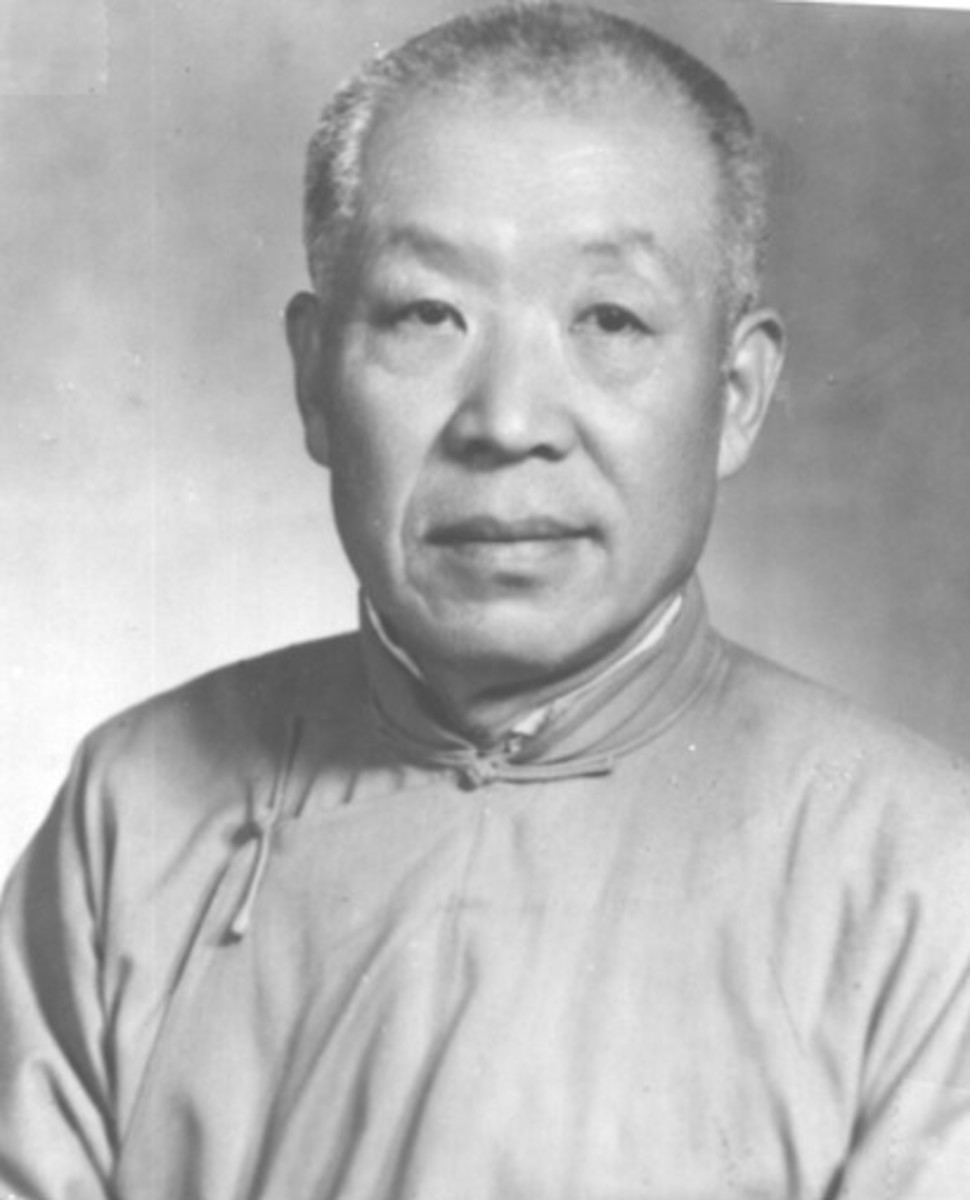
Jiang Zongguang
Credit: Chinese Seventh-day Adventist History.
Jiang Zongguang (姜從光)
By Jiang Yingwen (姜瑩文)
Jiang Yingwen, Chinese Seventh-day Adventist History.
First Published: November 4, 2026
Editors’s Note: This article is taken from Chinese Seventh-day Adventist History, originally written in Chinese and published by the China Union Mission of Seventh-day Adventists (CHUM) and now published in the ESDA with permission from CHUM. The English version has been reviewed and edited by Christie Chui-Shan Chow (Ph.D., Princeton Theological Seminary). Most of these materials were not previously available in English and are presented here to broaden access to this important historical record.
My father, Pastor Jiang Zongguang, served the Lord for a full forty years, from his graduation in 1912 from the China Training Mission School (Daoyi Guanhua Xuexiao, the forerunner of the China Training Institute) until his death in 1953.
Father was a devout, zealous, and faithful messenger of the gospel. He carried the gospel across the length and breadth of China: from the Shanghai–Nanjing region to the Southwest, and from the Northeast to Hong Kong and Kowloon. The breadth of his field of service and the length of his years of labor were rare among his Chinese fellow workers of that era. He served as the director of three local missions under different union missions. Most memorable of all was his service as a Bible teacher at the China Training Institute. Father truly made an outstanding contribution to the sacred work in China.
My late father was born on September 26, 1885, in Jiangkouji, Yingshang County, Anhui Province. When the China Union Training School, our denomination’s school for training evangelists in China, was established at Chowkiakow (Zhoujiakou) in Henan, Father was among the first class of ministerial students to enroll. The Bible teacher, Miss Xi Baolin (Pauline Schilbarg), had a profound influence on him. She set extremely high standards for her students. Those who completed her classes could recite fluently the outlines of our denomination’s doctrines and the related Bible passages, and many students could even recite entire chapters and books of the Bible from memory. Father was one of them.
After graduating in 1912, Father began preaching the gospel. Later, when the Signs of the Times Publishing House was established in Shanghai, he went to there to assist with editorial work and remained there for several years. During this period, the publishing house issued such books as Jiaohui zuzhi (Church Organization,) Jiaohui guicheng (Church Manual), Yaodao jinwang (Essentials of Doctrine), Shengdao zhiyin (Guide to the Holy Way), and Danyili qishilu jujie (Verse-by-Verse Commentary on Daniel and Revelation). These publications played a major role in building up the church in China.
In 1920, after receiving his missionary license, Father served in the newly organized Anhwei (Anhui) Mission as an evangelist in Yingshang County. At that time, the Yingshang church served as a base for the sacred work throughout northern Anhui, northern Jiangsu, eastern Henan, and western Shandong. The person responsible for the work across this vast Huai River region was Pastor Li Baogui (Frederick Lee), the father of Pastor Li Sigui (Milton Lee). Yingshang County nurtured many workers for our denomination. Many of the staff members of the Signs of the Times Publishing House at that time, as well as faculty, students, and workers of our missionary college after its relocation to Shanghai, were originally from Yingshang.
In 1925, the Asiatic Division, which included China and the territory now under the Far Eastern Division, held its annual meeting in Shanghai. At that meeting, Father was ordained to the gospel ministry. Following his ordination, he was invited to serve as a Bible teacher at Shanghai Missionary College. The following year, the college’s new campus at Qiaotou Town (Chiao Tou Tseng), on the Nanking–Shanghai railway line, was completed. The school moved to the new campus and was renamed the “China Theological Seminary” (Sanyu shenxue yuan). Father moved his family to the new campus. Pastor Lin Sihan (Sidney H. Lindt) headed the ministerial department, and Father and Pastor Lin were authorized by the board to prepare textbooks for the ministerial course. The first Bible textbook they completed was Shengdao gangyao (Outlines of Bible Doctrines.)
Two years after the Mukden Incident, in 1933, the Manchurian Union Missionary Training Institute called Father to serve as its principal. Although the northeast had already fallen under Japanese control, Father put the gospel commission first and resolutely took his family by steamer from Shanghai to Dalian. Traveling on the same ship was the family of evangelist Chen Min.
In 1935, Father became director of the Kirin (Jilin) Mission, and the following year he returned to the Manchurian Union Missionary Training Institute. When the China Training Institute was forced to evacuate Qiaotou Town as the area was about to fall, it reopened at Chen Lou in Shatin, in the New Territories of Kowloon, Hong Kong, operating jointly with the South China Training Institute. The board once again called Father back. Thus, in 1938, our family of six traveled south from Shenyang. In 1939, after the new campus at Clear Water Bay was completed, the two institutes moved to the new site.
During our first months in Hong Kong, malaria was rampant. Father lost, one after another, his beloved thirteen-year-old son, Zhewen, and his companion, Madam Guo Shuwan, a devoted fellow worker who had shared with him the hardships and dangers of the gospel ministry, travelling north and south, crossing mountains and rivers, and facing life and death together with him. More than twenty years earlier, amid the civil wars and epidemic that plagued the central plains, he had lost his first wife, an exceptional woman. Now, in an epidemic brought on by international war, he once again endured the anguish of losing a loved one to death. Father had a craftsman engrave on her tombstone the hope they had shared: “Awaiting the Lord’s Return.”
Father dried his tears of grief, restrained his sorrow, and pressed forward with head held high to meet the urgent demands of the gospel work that awaited him. In those days, while he was both father and mother to his children and carrying an overwhelming burden of work, fellow workers in the church repeatedly encouraged and urged him to marry again. Experience indeed confirms that a single evangelist falls far short of that of husband and wife working together, united in heart, for the Lord. Thus, in the summer of 1940, Father married my mother, Madam Tan Zhenhua.
A year after my parents’ marriage, the militarists of Japan launched the Pacific War, and Hong Kong was among their targets. In April of the following year, the board decided to relocate both schools inland: the China Training Institute to Chungking (Chongqing), and the South China Training Institute to Laolong in Guangdong. Carrying me, still in swaddling clothes, and leading my ten-year-old third brother Lewen, my parents joined more than 120 faculty members, students, staff, and family members in walking from Clear Water Bay to Huizhou in Guangdong. During the journey, Father and Pastor Meng Zhaoyi were responsible for leading the daily devotional activities. Beyond Huizhou, the school did everything it could to find whatever means of transportation were available. Climbing mountains, crossing ridges, and enduring tremendous hardship, the group finally reached Chongqing in August of the same year. A journey that today would take only two or three hours by modern jet aircraft took more than four months in the war-torn 1940s—almost unbelievable to imagine now.
When Pastor Gai Naide (C. B. Guild) returned to his home country, the China Division asked Father to serve as director of the West Szechwan (Sichuan) Mission. Without taking time to rest, my parents hurried to Chengdu, the ancient cultural city of western Sichuan, fragrant with rapeseed blossoms in spring and glowing golden with ripened rice in autumn. The West Szechwan Mission already had a very good foundation. The treasurer, Lü Shoudao, and the secretaries Wang Anxi, Li Jin’an, and others, were all highly capable, and they worked together seamlessly. In addition to overseeing the mission’s affairs in Chengdu, Father frequently traveled to churches in various places to conduct evangelistic meetings, training classes, and baptisms. The annual Ingathering campaign was carried out with great enthusiasm and archieved remarkable success. Mother, too, demonstrated a special gift for literature evangelism and made many contributions in this work.
A year after the victory in the War of Resistance—in 1946—the work of postwar resettlement reached its height. The Kiangsi (Jiangxi) Mission, whose sacred work had long been carried forward by Chinese workers, needed a director, and the Central China Union Mission called Father to serve in that capacity. He immediately set out eastward with the whole family. We traveled by long-distance bus from Chengdu to Chongqing, where we wait for boat tickets downriver. The millions who had fled years earlier to the upper Yangtze hinterland were now making the same journey, and obtaining boat tickets was harder than ascending to the heavens! We stayed at the Bao’an Road church for more than a month before finally securing a few tickets on a Minsheng Company steamer. There were no cabin berths, so we had to sleep on the open deck, exposed to sun and rain. When the boat stopped at Wan County, the whole family went ashore to bathe. When it docked at Yichang, we again went ashore and spent the night in the home of a foreign missionary.
The postwar Kiangsi Mission, with everything awaiting reconstruction, was a busy field. Many buildings that had gone unrepaired through eight years of war needed restoration while churches that had not seen an evangelist for years were in need of revival. Working alongside the treasurer, Leng Yusong and the secretaries Qiu Qixiu, Xu Liangji, and other fellow workers, Father first set about repairing the buildings. They then opened the San Yu Primary School on Chaisang Road in Jiujiang and the San Yu Junior Middle School in Nanchang. They held evangelistic meetings in Jiujiang and many other churches, conducted Bible classes for baptismal candidates, and traveled extensively to visit local congregations. On every journey Father carried little more than one small bundle and an umbrella. Meanwhile, case upon case was packed with Bibles and books—heavy and cumbersome, but these were the spiritual provisions needed to nourish the churches! Whenever Father was away, Mother prayed together with us for his safety and for the success of the sacred work.
After a little more than a year, Pastor Lin Sihan, the newly appointed president of the China Training Institute, came to Jiujiang to invite Father to return to the institute. I remember that they talked for a long time, and before they parted, they knelt together in the sitting room and prayer at length. Soon afterward, we boarded a river steamer and traveled eastward, first to Shanghai and then to Qiaotou Town.
We reached Qiaotou Town in August 1948. Before long, Pastor Lin resigned the presidency, and Pastor Ge Lide (Thomas S. Geraty) succeeded him. In the hours outside their classes, Pastor Lin and Father continued writing specialized books for the ministerial course: “Studies in Daniel,” “Studies in Revelation,” and Shengdao chanwei (Bible Doctrines), a volume not yet titled at that time. In November the board voted to move the college department and the twelfth-grade students and teachers to Clear Water Bay, Kowloon, Hong Kong. Just after the new year, on Sabbath morning, all the teachers and students who had not been laid low by seasickness gathered on the deck, and Father preached a sermon on the theme of Jesus on the Sea of Galilee.
After arriving at Clear Water Bay on January 6, 1949, Father plunged once again into writing and teaching: first draft, revision, proofreading, printing. The manuscripts went first sent to the Signs of the Times Publishing House in Shanghai and later to the Commercial Press in Hong Kong. Within a year, the stereotype plates for the volumes on Daniel and Revelation were essentially completed and sent to press, while Shengdao chanwei remained in first draft.
By this time, Father had worked for the church nearly forty years and had reached the age when he could apply for retirement. Our family, too, was at last supremely happy and complete. Especially gratifying was the restoration of contact with his eldest son, Xuanwen, who had gone abroad to study in 1928 and lost contact with the family during the Second World War. With the help of the General Conference, correspondence between him and Father was restored after the war. By then, he had become a distinguished chemist who frequently published papers and delivered lectures. His eldest daughter, Liwen, was an outstanding nurse who had served as head nurse for many years. In the winter of 1947, she was reunited with our parents in Shanghai, where she suddenly received an invitation from the Northwest Union Mission to serve as head nurse at the Northwest Sanitarium in Lanzhou, Gansu. She flew to her new post on New Year’s Day 1948—and forty-six years later, she remains in Lanzhou. His second daughter, Caiwen, worked in the editorial department of the Signs of the Times Publishing House. After the war, the translator who signed her work in the Shizhao yuebao (Signs of the Times monthly magazine) as “Hailun” (Helen) was her. Our second brother, Zhaowen, served as a middle school principal in the Central China Union Mission. His third son, Lewen, had just graduated from the China Training Institute and was engaged by the China Division to work in its Education and Youth departments.
But the board decided to move the China Training Institute back to Qiaotou Town in June 1950, and Father was appointed head of the ministerial department. Once again, the responsibility of training the future evangelists who would carry forward China’s sacred work fell upon Father’s shoulders. Without hesitation, he abandoned all thought of retirement. While the other workers packed their belongings for the move back to Qiaotou Town, Father worked day and night to complete the manuscript of Shengdao chanwei. The China Division assigned our third brother to assist him by copying out the manuscript. On June 25, war broke out on the Korean peninsula. Telegram after telegram from the China Division, the institute’s board, and the institute’s administration urged Father to set out. At the end of September, he completed the final chapter of Shengdao chanwei and delivered the manuscript to the Commercial Press for typesetting. A few days later, my parents, taking with them our third brother Lewen, me, my elder younger sister Rongwen, my second younger sister Xunwen, and my little brother Yawen, boarded the Kowloon-Canton Railway train northward from the terminus at Tsim Sha Tsui.
In the first half of 1951, the three books—on Daniel, on Revelation, and Shengdao chanwei —were published one after another. Unexpectedly, at the end of the spring term that year, the China Training Institute was disbanded. Two years later, Father passed away.
Father has been gone from us for nearly half a century, but his voice, his smile, and his towering image live on forever in our hearts. We brothers and sisters are proud to have had such a devout and great father. He remains our model, and through his writings he continues to teach us how to walk in the footsteps of Christ.